
[array] leetcode - 42. Trapping Rain Water - Hard
leetcode - 42. Trapping Rain Water - Hard
descrition
Given n non-negative integers representing an elevation map where the width of each bar is 1, compute how much water it is able to trap after raining.
For example,
Given [0,1,0,2,1,0,1,3,2,1,2,1], return 6.
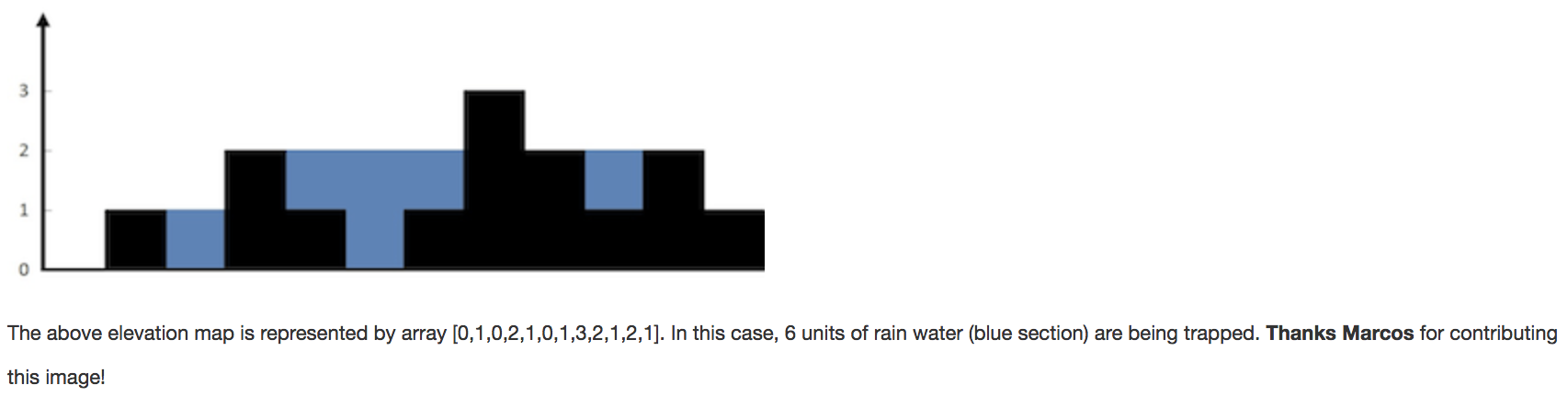
解析
关键是要想到暴力的解法,然后逐步优化。理解的过程中建议作图。
height[],每个槽的宽度为 1。
方法-1-Brute force
对于任意两个点 i,j,height[i] 和 height[j],并且 i != j,那么 [i,j] 区间将形成一个储水槽,储水量取决于两则高度偏小的一方。对于任意 k=(i,j) && height[k] < min(height[i], height[j]),那么位置 k 储水量应该为 water_k = min(height[i], height[j]) - height[k], 将所有满足要求的 k 检查一遍并将储水量相加,则可得到 [i,j] 区间水槽的储水量。
根据上面的基本思路,稍微换个角度,对于任意 k = [0,n-1],计算其储水量并累加即可得到总的储水量。对于任意位置 k 有,water_k = min(max_left, max_right) - height[k],其中 max_left 是指 [0,..,k-1] 中最大的高度,max_right 指 [k+1,...,n-1] 中最大的高度。
其实很容易理解,对于任意位置 k,我们希望计算其储水量,需要找到包含它的水槽即可,假设水槽的高度为 height_x,那么 k 在水槽中贡献的储水量为 water_k = height_x - k,此时,若 height_x 越大,那么 water_k 将越大,也就是说 water_k 取决于最大的 height_x,因此我们要找的是包含 k 的最大的水槽,那就是其左边最大的高度 left_max 和右边最大的高度 right_max 形成的水槽。
具体实现见代码。两重循环时间复杂度为 O(n^2),空间复杂度 O(1)。下面的 3 种方法实际上是在此基础上的改进,主要是通过某种技巧来获取 left_max, right_max 的信息,以达到降低时间复杂度的目的,最优时间复杂度可达到 O(n)
方法-2-Dynamic Programming
方法 1 中,我们计算任意位置 i 的储水量,需要知道 left_max 和 right_max。如果我们可以事先将这些信息存储起来,那么时间复杂度将可以进一步降低。
以空间换时间。假设 left_max[i] 表示 height[0,...,i] 的最大值,right_max[i] 表示height[i,...,n-1] 的最大值。我们实用动态规划的思想可以在 O(n) 时间复杂度内计算得到两个数组的信息,left_max[i] = max(height[i], left_max[i-1]), right_max[i] = max(height[i], right_max[i+1])。在此基础上我们只需要一层循环即可将储水量统计出来,对于任意位置 i,water_i = min(left_max[i], right_max[i]) - height[i]。
因此总的复杂度为 O(n),空间复杂度为 O(n)。
方法-3-Using Stacks
我们以上计算是从 i 往两边发散,这里的着眼点是否可以是一个方向呢?
我们借助一个栈 stack 来存储当前访问过的下标,stack 所存储下标对应的高度从栈底到栈顶是呈递减有序的(可以参考代码,按照入栈和出栈的规则很容易得到此结论,可以用反证法进行证明)。
算法参考代码。逻辑解释:
假设 icurrent=[0,...n-1],从前往后遍历,每次循环中我们都检查 stack 栈顶元素,
- 如果 stack.top > height[icurrent],那么弹出栈顶到 itop,此时如果 stack 为空那么表明 itop 位置左边已经没有比它高的元素不能形成蓄水池,跳出内层循环;否则,由 stack 的性质可以得知,新的栈顶 stack.top 和 icurrent 可以构成蓄水池,蓄水池的宽度由 stack.top 和 icurrent 的距离决定,而高度由 itop 和 icurrent 中较小者决定。
- 当上面的循环解释后,将当前位置入栈。
此处比较核心的点在于时间复杂度的分析。不要看有两重 while 就误认为时间复杂度是 O(n^2)。从 stack 的角度分析,两重 while 循环中,每个元素只能被访问两次,一次是入栈,一次是出栈,总共有 n 个元素,因此循环执行 2n 次,时间复杂度为 O(n)。
另一个值得注意的是,蓄水量的计算方式有所不同
方法-4-Using 2 pointers
方法 2 中,注意到,对于任意位置 i
- (1)当 right_max[i] > left_max[i] 时,储水量取决于 left_max[i],其中 left_max[i] 存储 [0,...,i] 的最大值;
- (2)当 right_max[i] < left_max[i] 时,储水量取决于 right_max[i],其中 right_max[i] 存储 [i,...,n-1] 的最大值;
我们可以使用两个指针 left 和 right,分别从左往右,从右往左遍历数组,同时使用两个变量 left_max 和 right_max 记录左边和右边的最大值。在任意时刻,left 或 right 就相当于上面的 i,当 height[left] < height[right] 时,等价于上面的情况 (1),储水量只取决于 left_max,并且继续从左往右遍历,left++;反方向的情况类似。
可以参考官网的 solution,有配图:
leetcode-solution
code
#include <iostream>

#include <vector>

#include <algorithm>

#include <stack>

using namespace std;

class Solution{

public:

	int trap(vector<int>& height){

		//return trap_brute_force(height);

		//return trap_dynamic_programming(height);

		//return trap_stack(height);

		return trap_two_pointer(height);

	}

	// time-O(n^2), space-O(1)

	int trap_brute_force(vector<int>& height){

		int ans = 0;

		for(int i=0; i<height.size(); ++i){

			int left_max = 0, right_max = 0;

			for(int j=i; j>=0; --j)

				left_max = max(left_max, height[j]);

			for(int j=i; j<height.size(); ++j)

				right_max = max(right_max, height[j]);

			ans += min(left_max, right_max) - height[i];

		}

		return ans;

	}

	// time-O(n), space-O(n)

	int trap_dynamic_programming(vector<int>& height){

		if(height.empty())

			return 0;

		int n = height.size();

		vector<int> left_max(n, 0);

		vector<int> right_max(n, 0);

		int ans = 0;

		// calcualte left and right max with dynamic programming

		left_max[0] = height[0]; // Note: height can not be empty!

		for(int i=1; i<n; ++i)

			left_max[i] = max(height[i], left_max[i-1]);

		right_max[n-1] = height[n-1];

		for(int i=n-2; i>=0; --i)

			right_max[i] = max(height[i], right_max[i+1]);

		// calculate trapped water

		for(int i=0; i<n; i++){

			ans += min(left_max[i], right_max[i]) - height[i];

		}

		return ans;

	}

	// time-O(n), for each element in height[], they are just visited twice,

	// push into stack and pop from the stack.

	// space-O(n)

	int trap_stack(vector<int>& height){

		stack<int> st;

		int ans = 0;

		int icur = 0;

		// st is in descending from bottom to top if it work with the following rule

		while(icur < height.size()){

			while(!st.empty() && height[st.top()] < height[icur]){

				int itop = st.top();

				st.pop();

				if(st.empty())

					break;

				int width = icur - st.top() - 1;

				int bounded_height = min(height[icur], height[st.top()]) - height[itop];

				ans += width * bounded_height;

			}

			st.push(icur);

			icur++;

		}

		return ans;

	}

	// time-O(n), space-O(1)

	int trap_two_pointer(vector<int>& height){

		int left = 0;

		int right = height.size() - 1;

		int left_max = 0; // the max hight in range [0, ..., left-1]

		int right_max = 0; // the max hight in range [right+1, ..., n-1]

		int ans = 0;

		while(left < right){

			if(height[left] < height[right]){

				// the water trapped would be dependant on height of bar in current

				// direction (from left to right)

				height[left] >= left_max ? (left_max = height[left])

				                         : ans += (left_max - height[left]);

				left++;

			}else{

				//height[left] >= height[right]

				// the water trapped would be dependant on height of bar in current

				// direction (from right to left)

				height[right] >= right_max ? (right_max = height[right])

				                            : ans += (right_max - height[right]);

				right--;

			}

		}

		return ans;

	}

};

int main()

{

	return 0;

}
[array] leetcode - 42. Trapping Rain Water - Hard的更多相关文章
- leetcode#42 Trapping rain water的五种解法详解
leetcode#42 Trapping rain water 这道题十分有意思,可以用很多方法做出来,每种方法的思想都值得让人细细体会. 42. Trapping Rain WaterGiven n ...
- LeetCode 42. Trapping Rain Water 【两种解法】(python排序遍历,C++ STL map存索引,时间复杂度O(nlogn))
LeetCode 42. Trapping Rain Water Python解法 解题思路: 本思路需找到最高点左右遍历,时间复杂度O(nlogn),以下为向左遍历的过程. 将每一个点的高度和索引存 ...
- LeetCode - 42. Trapping Rain Water
42. Trapping Rain Water Problem's Link ------------------------------------------------------------- ...
- [LeetCode] 42. Trapping Rain Water 收集雨水
Given n non-negative integers representing an elevation map where the width of each bar is 1, comput ...
- leetCode 42.Trapping Rain Water(凹槽的雨水) 解题思路和方法
Trapping Rain Water Given n non-negative integers representing an elevation map where the width of e ...
- [LeetCode] 42. Trapping Rain Water 解题思路
Given n non-negative integers representing an elevation map where the width of each bar is 1, comput ...
- [leetcode]42. Trapping Rain Water雨水积水问题
Given n non-negative integers representing an elevation map where the width of each bar is 1, comput ...
- LeetCode 42 Trapping Rain Water(积水体积)
题目链接: https://leetcode.com/problems/trapping-rain-water/?tab=Description Problem: 根据所给数组的值,按照上图的示意 ...
- Java [Leetcode 42]Trapping Rain Water
题目描述: Given n non-negative integers representing an elevation map where the width of each bar is 1, ...
随机推荐
- border-radio属性
boreder-radio属性是css3的新增属性,可以设置圆角的边框. <head> <style type="text/css"> *{ margin ...
- OC面向对象的三大特性
一.面向对象的三大特性:封装(成员变量).继承和多态 1. set方法和get方法 1. set方法和get方法的使用场合 @public的成员可以被随意赋值,应该使用set方法和get方法来管理成员 ...
- Java项目之员工收录系统
在Java SE中,对IO流与集合的操作在应用中比较重要.接下来,我以一个小型项目的形式,演示IO流.集合等知识点在实践中的运用. 该项目名称为"员工收录系统",在Eclipse的 ...
- 理论篇:关注点分离(Separation of concerns, SoC)
概念 关注点分离(Separation of concerns,SOC)是对只与"特定概念.目标"(关注点)相关联的软件组成部分进行"标识.封装和操纵"的能力, ...
- 生成ssl秘钥的方法(纯粹本人记录用的,勿踩)
openssl genrsa -des3 -out server.key 1024 openssl req -new -key server.key -out server.csr cp server ...
- 如何扩展或者添加硬盘给VMware的Linux操作系统
我们在使用Linux系统一段时间以后,可能添加的东西原来越多导致原来开辟的硬盘不够,当硬盘剩余空间过小时Ubuntu系统也会给出提示或者可以通过df -hl命令查看你硬盘使用情况如下图所示:我已经用 ...
- 适合Linux新手的发行版有哪些?
一个很古老的问题,找到适合的 Linux 发行版比简单的指出哪种 Linux 版本受欢迎更重要.为什么这么说?让我们设置一个情景:你有一位用户,很有可能,他过去大多数时候都是在 Windows 或者 ...
- JAVA中静态修饰符static的学习(初学)
静态修饰符static,用于修饰类中的成员变量和成员函数. 用static修饰的成员变量也可叫做类变量. 什么时候使用静态 什么时候定义静态成员变量? 当对象中出现共享数据时,将该数据定义为静 ...
- Codeforces 438D The Child and Sequence
题意:给定一个n个数的序列,完成以下3个操作: 1.给定区间求和 2.给定区间对x取模 3.单点修改 对一个数取模,这个数至少折半.于是我们记一个最大值max,如果x>max则不做处理. #in ...
- c++对象在lua层的生命周期与内容扩展
前言 上一篇博客记录了 tolua++ 将 c++类型,变量,函数,以及对象导出到 lua 的过程,这篇博客就接着记录一下 c++对象的内存回收以及c++对象数据和方法在lua中的扩展. 首先 tol ...