
Android学习笔记- Fragment实例 底部导航栏的实现
1.要实现的效果图以及工程目录结构:
先看看效果图吧:

接着看看我们的工程的目录结构:
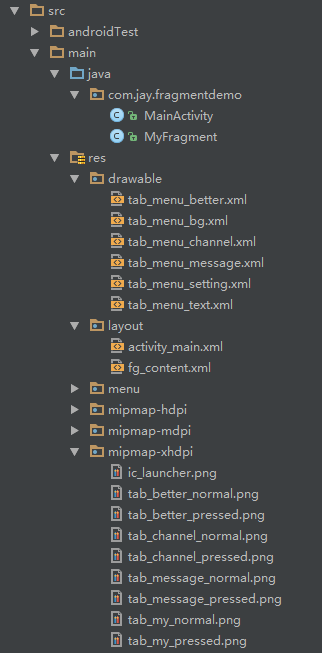
2.实现流程:
Step 1:写下底部选项的一些资源文件
我们从图上可以看到,我们底部的每一项点击的时候都有不同的效果是吧! 我们是通过是否selected来判定的!我们要写的资源文件有:首先是图片,然后是文字,接着是背景!
图片Drawable资源:tab_menu_channel.xml
<?xml version="1.0" encoding="utf-8"?>

<selector xmlns:android="http://schemas.android.com/apk/res/android">

    <item android:drawable="@mipmap/tab_channel_pressed" android:state_selected="true" />

    <item android:drawable="@mipmap/tab_channel_normal" />

</selector>
其他三个照葫芦画瓢!
文字资源:tab_menu_text.xml
<?xml version="1.0" encoding="utf-8"?>

<selector xmlns:android="http://schemas.android.com/apk/res/android">

    <item android:color="@color/text_yellow" android:state_selected="true" />

    <item android:color="@color/text_gray" />

</selector>
背景资源:tab_menu_bg.xml
<?xml version="1.0" encoding="utf-8"?>

<selector xmlns:android="http://schemas.android.com/apk/res/android">

    <item android:state_selected="true">

        <shape>

            <solid android:color="#FFC4C4C4" />

        </shape>

    </item>

    <item>

        <shape>

            <solid android:color="@color/transparent" />

        </shape>

    </item>

</selector>
Step 2:编写我们的Activity布局
activity_main.xml:
<RelativeLayout xmlns:android="http://schemas.android.com/apk/res/android"

    xmlns:tools="http://schemas.android.com/tools"

    android:layout_width="match_parent"

    android:layout_height="match_parent"

    tools:context=".MainActivity">

    <RelativeLayout

        android:id="@+id/ly_top_bar"

        android:layout_width="match_parent"

        android:layout_height="48dp"

        android:background="@color/bg_topbar">

        <TextView

            android:id="@+id/txt_topbar"

            android:layout_width="match_parent"

            android:layout_height="match_parent"

            android:layout_centerInParent="true"

            android:gravity="center"

            android:textSize="18sp"

            android:textColor="@color/text_topbar"

            android:text="信息"/>

        <View

            android:layout_width="match_parent"

            android:layout_height="2px"

            android:background="@color/div_white"

            android:layout_alignParentBottom="true"/>

    </RelativeLayout>

    <LinearLayout

        android:id="@+id/ly_tab_bar"

        android:layout_width="match_parent"

        android:layout_height="56dp"

        android:layout_alignParentBottom="true"

        android:background="@color/bg_white"

        android:orientation="horizontal">

        <TextView

            android:id="@+id/txt_channel"

            android:layout_width="0dp"

            android:layout_height="match_parent"

            android:layout_weight="1"

            android:background="@drawable/tab_menu_bg"

            android:drawablePadding="3dp"

            android:drawableTop="@drawable/tab_menu_channel"

            android:gravity="center"

            android:padding="5dp"

            android:text="@string/tab_menu_alert"

            android:textColor="@drawable/tab_menu_text"

            android:textSize="16sp" />

        <TextView

            android:id="@+id/txt_message"

            android:layout_width="0dp"

            android:layout_height="match_parent"

            android:layout_weight="1"

            android:background="@drawable/tab_menu_bg"

            android:drawablePadding="3dp"

            android:drawableTop="@drawable/tab_menu_message"

            android:gravity="center"

            android:padding="5dp"

            android:text="@string/tab_menu_profile"

            android:textColor="@drawable/tab_menu_text"

            android:textSize="16sp" />

        <TextView

            android:id="@+id/txt_better"

            android:layout_width="0dp"

            android:layout_height="match_parent"

            android:layout_weight="1"

            android:background="@drawable/tab_menu_bg"

            android:drawablePadding="3dp"

            android:drawableTop="@drawable/tab_menu_better"

            android:gravity="center"

            android:padding="5dp"

            android:text="@string/tab_menu_pay"

            android:textColor="@drawable/tab_menu_text"

            android:textSize="16sp" />

        <TextView

            android:id="@+id/txt_setting"

            android:layout_width="0dp"

            android:layout_height="match_parent"

            android:layout_weight="1"

            android:background="@drawable/tab_menu_bg"

            android:drawablePadding="3dp"

            android:drawableTop="@drawable/tab_menu_setting"

            android:gravity="center"

            android:padding="5dp"

            android:text="@string/tab_menu_setting"

            android:textColor="@drawable/tab_menu_text"

            android:textSize="16sp"/>

    </LinearLayout>

    <View

        android:id="@+id/div_tab_bar"

        android:layout_width="match_parent"

        android:layout_height="2px"

        android:background="@color/div_white"

        android:layout_above="@id/ly_tab_bar"/>

    <FrameLayout

        android:layout_width="match_parent"

        android:layout_height="match_parent"

        android:layout_below="@id/ly_top_bar"

        android:layout_above="@id/div_tab_bar"

        android:id="@+id/ly_content">

    </FrameLayout>

</RelativeLayout>
代码解析:
首先定义顶部标题栏的样式,48dp的LinearLayout中间加上一个TextView作为标题!
接着定义一个大小为56dp的LinerLayout对其底部,在这个里面加入四个TextView,比例1:1:1:1, 并且设置相关属性,接着在这个LinearLayout上加一条线段!
最后以标题栏和底部导航栏为边界,写一个FrameLayout,宽高match_parent,用做Fragment的容器!
PS:这里四个TextView属性是重复的,你也可以自行抽取出来,编写一个style,设置下~
Step 3:隐藏顶部导航栏
意外发现以前的在Activity中调用requestWindowFeature(Window.FEATURE_NO_TITLE);可以隐藏手机 自带顶部导航栏,但是写demo时候发现会报错,即使这句话写在了setContentView()之前!可能是因为 继承的是AppCompatActivity而非Activity类!
当然以前的getSupportActionbar().hide()隐藏掉Actionbar,但是他还是会在界面上! 最后还有一种方法就是自己编写一个style,然后在AndroidManifest.xml中为Application设置这个Theme:
注: 把 requestWindowFeature(Window.FEATURE_NO_TITLE);放在super.onCreate(savedInstanceState);前面就可以隐藏ActionBar而不报错。
接着AndroidManifest.xml设置下theme属性:
android:theme="@style/Theme.AppCompat.NoActionBar"
Step 4:创建一个Fragment的简单布局与类:
fg_content.xml:
<?xml version="1.0" encoding="utf-8"?>

<LinearLayout xmlns:android="http://schemas.android.com/apk/res/android"

    android:orientation="vertical" android:layout_width="match_parent"

    android:layout_height="match_parent"

    android:background="@color/bg_white">

    <TextView

        android:id="@+id/txt_content"

        android:layout_width="match_parent"

        android:layout_height="match_parent"

        android:gravity="center"

        android:text="呵呵"

        android:textColor="@color/text_yellow"

        android:textSize="20sp"/>

</LinearLayout>
MyFragment.java:
public class MyFragment extends Fragment {

    private String content;

    public MyFragment(String content) {

        this.content = content;

    }

    @Override

    public View onCreateView(LayoutInflater inflater, ViewGroup container, Bundle savedInstanceState) {

        View view = inflater.inflate(R.layout.fg_content,container,false);

        TextView txt_content = (TextView) view.findViewById(R.id.txt_content);

        txt_content.setText(content);

        return view;

    }

}
代码解析:
就是简单的重写了一个onCreateView()方法,其他方法可以按需重写!
Step 5:编写MainActivity.java
先说说我们要考虑的一些关键问题:
- Fragment什么时候初始化和add到容器中?什么时候hide和show?
- 如何让TextView被选中?选中一个TextView后,要做一些什么操作?
- 刚进入MainActivity怎么样让一个TextView处于Selected的状态?
嗯,接下来一一解答上面这些问题:
- 我们选中TextView后对对应的Fragment进行判空,如果为空,初始化,并添加到容器中; 而hide的话,我们定义一个方法hide所有的Fragment,每次触发点击事件就先调用这个hideAll方法, 讲所有Fragment隐藏起来,然后如果TextView对应的Fragment不为空,我们就将这个Fragment显示出来;
- 这个我们通过点击事件来实现,点击TextView后先重置所有TextView的选中状态为false,然后设置点击的 TextView的选中状态为true;
- 这个更简单,我们是通过点击事件来设置选中的,那么在onCreate()方法里加个触发点击事件的 方法不就可以了嘛~txt_channel.performClick();
逻辑都弄懂了,直接上代码咯:
MainActivity.java:
public class MainActivity extends AppCompatActivity implements View.OnClickListener{

    //UI Object

    private TextView txt_topbar;

    private TextView txt_channel;

    private TextView txt_message;

    private TextView txt_better;

    private TextView txt_setting;

    private FrameLayout ly_content;

    //Fragment Object

    private MyFragment fg1,fg2,fg3,fg4;

    private FragmentManager fManager;

    @Override

    protected void onCreate(Bundle savedInstanceState) {

        super.onCreate(savedInstanceState);

        requestWindowFeature(Window.FEATURE_NO_TITLE);

        setContentView(R.layout.activity_main);

        fManager = getFragmentManager();

        bindViews();

        txt_channel.performClick();   //模拟一次点击,既进去后选择第一项

    }

    //UI组件初始化与事件绑定

    private void bindViews() {

        txt_topbar = (TextView) findViewById(R.id.txt_topbar);

        txt_channel = (TextView) findViewById(R.id.txt_channel);

        txt_message = (TextView) findViewById(R.id.txt_message);

        txt_better = (TextView) findViewById(R.id.txt_better);

        txt_setting = (TextView) findViewById(R.id.txt_setting);

        ly_content = (FrameLayout) findViewById(R.id.ly_content);

        txt_channel.setOnClickListener(this);

        txt_message.setOnClickListener(this);

        txt_better.setOnClickListener(this);

        txt_setting.setOnClickListener(this);

    }

    //重置所有文本的选中状态

    private void setSelected(){

        txt_channel.setSelected(false);

        txt_message.setSelected(false);

        txt_better.setSelected(false);

        txt_setting.setSelected(false);

    }

    //隐藏所有Fragment

    private void hideAllFragment(FragmentTransaction fragmentTransaction){

        if(fg1 != null)fragmentTransaction.hide(fg1);

        if(fg2 != null)fragmentTransaction.hide(fg2);

        if(fg3 != null)fragmentTransaction.hide(fg3);

        if(fg4 != null)fragmentTransaction.hide(fg4);

    }

    @Override

    public void onClick(View v) {

        FragmentTransaction fTransaction = fManager.beginTransaction();

        hideAllFragment(fTransaction);

        switch (v.getId()){

            case R.id.txt_channel:

                setSelected();

                txt_channel.setSelected(true);

                if(fg1 == null){

                    fg1 = new MyFragment("第一个Fragment");

                    fTransaction.add(R.id.ly_content,fg1);

                }else{

                    fTransaction.show(fg1);

                }

                break;

            case R.id.txt_message:

                setSelected();

                txt_message.setSelected(true);

                if(fg2 == null){

                    fg2 = new MyFragment("第二个Fragment");

                    fTransaction.add(R.id.ly_content,fg2);

                }else{

                    fTransaction.show(fg2);

                }

                break;

            case R.id.txt_better:

                setSelected();

                txt_better.setSelected(true);

                if(fg3 == null){

                    fg3 = new MyFragment("第三个Fragment");

                    fTransaction.add(R.id.ly_content,fg3);

                }else{

                    fTransaction.show(fg3);

                }

                break;

            case R.id.txt_setting:

                setSelected();

                txt_setting.setSelected(true);

                if(fg4 == null){

                    fg4 = new MyFragment("第四个Fragment");

                    fTransaction.add(R.id.ly_content,fg4);

                }else{

                    fTransaction.show(fg4);

                }

                break;

        }

        fTransaction.commit();

    }

}
Android学习笔记- Fragment实例 底部导航栏的实现的更多相关文章
- [置顶]
xamarin android Fragment实现底部导航栏
前段时间写了篇关于Fragment的文章,介绍了基础的概念,用静态和动态的方式加载Fragment Xamarin Android Fragment的两种加载方式.下面的这个例子介绍xamarin ...
- TextView+Fragment实现底部导航栏
前言:项目第二版刚上线没多久,产品又对需求进行了大改动,以前用的是左滑菜单,现在又要换成底部导航栏,于是今天又苦逼加班了.花了几个小时实现了一个底部导航栏的demo,然后总结一下.写一篇博客.供自己以 ...
- [Android学习笔记]Fragment使用
一.android.app.Fragment 与 android.support.v4.app.Fragment 区别 support.v4.app.Fragment是为了给低版本Android使用的 ...
- android学习笔记Fragment的使用
Fragment的内容感觉好多啊,主要需要掌握Fragment静态加载,Fragment动态加载,Fragment的生命周期,Fragment与Activity的交互 1,Fragment的静态加载 ...
- 微信小程序开发笔记2,底部导航栏tablebar
底部导航(要在app.js里面配置,也就是把导航的代码写到app.js) 官方文档说最少2个导航最多5个 , "tabBar": { "color": &quo ...
- 使用BottomNavigationView+ViewPager+Fragment的底部导航栏
2019独角兽企业重金招聘Python工程师标准>>> 使用BottomNavigationView做底部工具栏,使用ViewPager做页面切换,使用Fragment完成每个页面的 ...
- 使用fragment添加底部导航栏
切记:fragment一定要放在framlayout中,不然不会被替换完全(就是切换之后原来的fagment可能还会存在) main.xml <LinearLayout xmlns:androi ...
- Bootstrap学习笔记(4)--导航栏
相关类: nav, nav-pills, nav-tags, nav-stacked ul里使用,导航格胶囊,方片外观,堆叠外观 navbar, navbar-header, navbar-brand ...
- Android应用底部导航栏(选项卡)实例
现在很多android的应用都采用底部导航栏的功能,这样可以使得用户在使用过程中随意切换不同的页面,现在我采用TabHost组件来自定义一个底部的导航栏的功能. 我们先看下该demo实例的框架图: 其 ...
随机推荐
- js移动端/H5同时选择多张图片上传并使用canvas压缩图片
最近在做一个H5的项目,里边涉及到拍照上传图片的功能以及识别图片的功能,这里对识别图片的功能不做赘述,不属本文范畴.我在做完并上线项目后,同事跟我提了一个要求是可不可以同时选择多张图片上传,我做的时候 ...
- ubuntu16.04-x64系统中Jexus web server部署.NetCore和端口分析引发的猜想!
您有这样的牢骚么? 有一周没更新博客了,简单说下在干什么吧:主要是公司安排对接某旅游大公司的接口,接口数量倒也就10个左右,对接完后还需要加入到业务系统中和App端,因此还是需要花点时间的:时间上来说 ...
- windbg工具安装配置及dump抓取
安装与配置windbg 安装与配置windbg的symbol(符号) 第一步 下载WinDBG, 第二步 双击下载的文件安装windbg.安装时注意记住安装到那里了. 第三步 windbg访问符号需要 ...
- jrebel配置热部署参数
jrebel配置热部署参数: -noverify -agentpath:D:/jrebel/lib/jrebel64.dll -Drebel.dirs=E:/workspace/item/src/ma ...
- object覆盖的div解决办法
最近做个web项目,因为里面有个<object>的插件,弹出<div>对话框会被其遮盖,我做了个<iframe>标签,在弹框时,把<object>覆盖掉 ...
- Window文件目录挂载(mount)到linux系统目录下
1.先在windows下面共享需要挂载的目录. 2.确保linux与windows是在同一个局域网当中. 3.在linux下面创建一个需要挂载到的目录. 4.然后点击"添加",建立 ...
- Unity 游戏框架搭建 (二) 单例的模板
上一篇文章中说到的manager of managers,其中每个manager都是单例的实现,当然也可以使用静态类实现,但是相比于静态类的实现,单例的实现更为通用,可以适用大多数情况. 如何设计 ...
- axis1.4开发webservice客户端(快速入门)-基于jdk1.4
写在前面: 对于客户端,服务端开发好了以后,客户端只需要调用就可以了.这里我们讲的是,根据服务的访问地址,来生成客户端所需要用到的代码(听说有几种调用方式,但是用到最常见的就是stub方式,貌似我说的 ...
- 读书共享 Primer Plus C-part 7
第十章 数组和指针 1.关于二维数组跟指针 #include<stdio.h> int main() { ][]={{,,,},{,,,},{,,,}}; ; ;i< ;i++) ...
- Apollo框架试玩
2017年7月5日,百度举行了AI开发者大会,在会上发布了Apollo项目,并进行了演示,该项目在Github上已经能够被访问.出于一个程序员的好奇,昨天试玩了一把,确实不错. http://apol ...