
TensorFlowSharp入门使用C#编写TensorFlow人工智能应用
TensorFlowSharp入门使用C#编写TensorFlow人工智能应用学习。
TensorFlow简单介绍
TensorFlow 是谷歌的第二代机器学习系统,按照谷歌所说,在某些基准测试中,TensorFlow的表现比第一代的DistBelief快了2倍。
TensorFlow 内建深度学习的扩展支持,任何能够用计算流图形来表达的计算,都可以使用TensorFlow。任何基于梯度的机器学习算法都能够受益于TensorFlow的自动分化(auto-differentiation)。通过灵活的Python接口,要在TensorFlow中表达想法也会很容易。
TensorFlow 对于实际的产品也是很有意义的。将思路从桌面GPU训练无缝搬迁到手机中运行。
示例Python代码:
import tensorflow as tf

import numpy as np

# Create 100 phony x, y data points in NumPy, y = x * 0.1 + 0.3

x_data = np.random.rand(100).astype(np.float32)

y_data = x_data * 0.1 + 0.3

# Try to find values for W and b that compute y_data = W * x_data + b

# (We know that W should be 0.1 and b 0.3, but TensorFlow will

# figure that out for us.)

W = tf.Variable(tf.random_uniform([1], -1.0, 1.0))

b = tf.Variable(tf.zeros([1]))

y = W * x_data + b

# Minimize the mean squared errors.

loss = tf.reduce_mean(tf.square(y - y_data))

optimizer = tf.train.GradientDescentOptimizer(0.5)

train = optimizer.minimize(loss)

# Before starting, initialize the variables.  We will 'run' this first.

init = tf.global_variables_initializer()

# Launch the graph.

sess = tf.Session()

sess.run(init)

# Fit the line.

for step in range(201):

    sess.run(train)

    if step % 20 == 0:

        print(step, sess.run(W), sess.run(b))

# Learns best fit is W: [0.1], b: [0.3]
使用TensorFlowSharp
GitHub:https://github.com/migueldeicaza/TensorFlowSharp
官方源码库,该项目支持跨平台,使用Mono。
可以使用NuGet 安装TensorFlowSharp,如下:
Install-Package TensorFlowSharp
编写简单应用
使用VS2017新建一个.NET Framework 控制台应用 tensorflowdemo,接着添加TensorFlowSharp 引用。
TensorFlowSharp 包比较大,需要耐心等待。
然后在项目属性中生成->平台目标 改为 x64。
打开Program.cs 写入如下代码:
        static void Main(string[] args)

        {

            using (var session = new TFSession())

            {

                var graph = session.Graph;

                Console.WriteLine(TFCore.Version);

                var a = graph.Const();

                var b = graph.Const();

                Console.WriteLine("a=2 b=3");

                // 两常量加

                var addingResults = session.GetRunner().Run(graph.Add(a, b));

                var addingResultValue = addingResults[].GetValue();

                Console.WriteLine("a+b={0}", addingResultValue);

                // 两常量乘

                var multiplyResults = session.GetRunner().Run(graph.Mul(a, b));

                var multiplyResultValue = multiplyResults[].GetValue();

                Console.WriteLine("a*b={0}", multiplyResultValue);

                var tft = new TFTensor(Encoding.UTF8.GetBytes($"Hello TensorFlow Version {TFCore.Version}! LineZero"));

                var hello = graph.Const(tft);

                var helloResults = session.GetRunner().Run(hello);

                Console.WriteLine(Encoding.UTF8.GetString((byte[])helloResults[].GetValue()));

            }

            Console.ReadKey();

        }
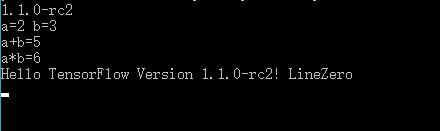
运行程序结果如下:
TensorFlow C# image recognition
图像识别示例体验
https://github.com/migueldeicaza/TensorFlowSharp/tree/master/Examples/ExampleInceptionInference
下面学习一个实际的人工智能应用,是非常简单的一个示例,图像识别。
新建一个 imagerecognition .NET Framework 控制台应用项目,接着添加TensorFlowSharp 引用。
然后在项目属性中生成->平台目标 改为 x64。
接着编写如下代码:
    class Program

    {

        static string dir, modelFile, labelsFile;

        public static void Main(string[] args)

        {

            dir = "tmp";

            List<string> files = Directory.GetFiles("img").ToList();

            ModelFiles(dir);

            var graph = new TFGraph();

            // 从文件加载序列化的GraphDef

            var model = File.ReadAllBytes(modelFile);

            //导入GraphDef

            graph.Import(model, "");

            using (var session = new TFSession(graph))

            {

                var labels = File.ReadAllLines(labelsFile);

                Console.WriteLine("TensorFlow图像识别 LineZero");

                foreach (var file in files)

                {

                    // Run inference on the image files

                    // For multiple images, session.Run() can be called in a loop (and

                    // concurrently). Alternatively, images can be batched since the model

                    // accepts batches of image data as input.

                    var tensor = CreateTensorFromImageFile(file);

                    var runner = session.GetRunner();

                    runner.AddInput(graph["input"][], tensor).Fetch(graph["output"][]);

                    var output = runner.Run();

                    // output[0].Value() is a vector containing probabilities of

                    // labels for each image in the "batch". The batch size was 1.

                    // Find the most probably label index.

                    var result = output[];

                    var rshape = result.Shape;

                    if (result.NumDims !=  || rshape[] != )

                    {

                        var shape = "";

                        foreach (var d in rshape)

                        {

                            shape += $"{d} ";

                        }

                        shape = shape.Trim();

                        Console.WriteLine($"Error: expected to produce a [1 N] shaped tensor where N is the number of labels, instead it produced one with shape [{shape}]");

                        Environment.Exit();

                    }

                    // You can get the data in two ways, as a multi-dimensional array, or arrays of arrays,

                    // code can be nicer to read with one or the other, pick it based on how you want to process

                    // it

                    bool jagged = true;

                    var bestIdx = ;

                    float p = , best = ;

                    if (jagged)

                    {

                        var probabilities = ((float[][])result.GetValue(jagged: true))[];

                        for (int i = ; i < probabilities.Length; i++)

                        {

                            if (probabilities[i] > best)

                            {

                                bestIdx = i;

                                best = probabilities[i];

                            }

                        }

                    }

                    else

                    {

                        var val = (float[,])result.GetValue(jagged: false);

                        // Result is [1,N], flatten array

                        for (int i = ; i < val.GetLength(); i++)

                        {

                            if (val[, i] > best)

                            {

                                bestIdx = i;

                                best = val[, i];

                            }

                        }

                    }

                    Console.WriteLine($"{Path.GetFileName(file)} 最佳匹配: [{bestIdx}] {best * 100.0}% 标识为:{labels[bestIdx]}");

                }

            }

            Console.ReadKey();

        }

        // Convert the image in filename to a Tensor suitable as input to the Inception model.

        static TFTensor CreateTensorFromImageFile(string file)

        {

            var contents = File.ReadAllBytes(file);

            // DecodeJpeg uses a scalar String-valued tensor as input.

            var tensor = TFTensor.CreateString(contents);

            TFGraph graph;

            TFOutput input, output;

            // Construct a graph to normalize the image

            ConstructGraphToNormalizeImage(out graph, out input, out output);

            // Execute that graph to normalize this one image

            using (var session = new TFSession(graph))

            {

                var normalized = session.Run(

                         inputs: new[] { input },

                         inputValues: new[] { tensor },

                         outputs: new[] { output });

                return normalized[];

            }

        }

        // The inception model takes as input the image described by a Tensor in a very

        // specific normalized format (a particular image size, shape of the input tensor,

        // normalized pixel values etc.).

        //

        // This function constructs a graph of TensorFlow operations which takes as

        // input a JPEG-encoded string and returns a tensor suitable as input to the

        // inception model.

        static void ConstructGraphToNormalizeImage(out TFGraph graph, out TFOutput input, out TFOutput output)

        {

            // Some constants specific to the pre-trained model at:

            // https://storage.googleapis.com/download.tensorflow.org/models/inception5h.zip

            //

            // - The model was trained after with images scaled to 224x224 pixels.

            // - The colors, represented as R, G, B in 1-byte each were converted to

            //   float using (value - Mean)/Scale.

            const int W = ;

            const int H = ;

            const float Mean = ;

            const float Scale = ;

            graph = new TFGraph();

            input = graph.Placeholder(TFDataType.String);

            output = graph.Div(

                x: graph.Sub(

                    x: graph.ResizeBilinear(

                        images: graph.ExpandDims(

                            input: graph.Cast(

                                graph.DecodeJpeg(contents: input, channels: ), DstT: TFDataType.Float),

                            dim: graph.Const(, "make_batch")),

                        size: graph.Const(new int[] { W, H }, "size")),

                    y: graph.Const(Mean, "mean")),

                y: graph.Const(Scale, "scale"));

        }

        /// <summary>

        /// 下载初始Graph和标签

        /// </summary>

        /// <param name="dir"></param>

        static void ModelFiles(string dir)

        {

            string url = "https://storage.googleapis.com/download.tensorflow.org/models/inception5h.zip";

            modelFile = Path.Combine(dir, "tensorflow_inception_graph.pb");

            labelsFile = Path.Combine(dir, "imagenet_comp_graph_label_strings.txt");

            var zipfile = Path.Combine(dir, "inception5h.zip");

            if (File.Exists(modelFile) && File.Exists(labelsFile))

                return;

            Directory.CreateDirectory(dir);

            var wc = new WebClient();

            wc.DownloadFile(url, zipfile);

            ZipFile.ExtractToDirectory(zipfile, dir);

            File.Delete(zipfile);

        }

    }
这里需要注意的是由于需要下载初始Graph和标签,而且是google的站点,所以得使用一些特殊手段。
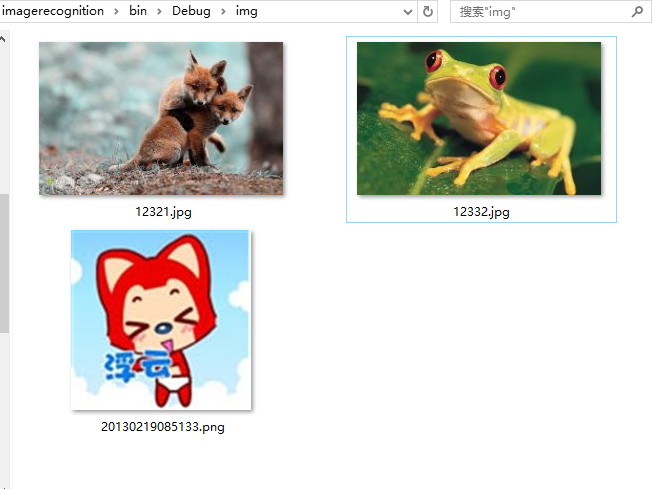
最终我随便下载了几张图放到bin\Debug\img
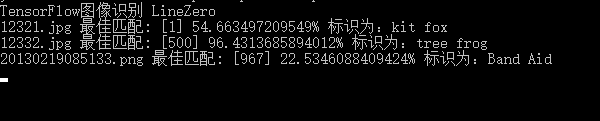
然后运行程序,首先确保bin\Debug\tmp文件夹下有tensorflow_inception_graph.pb及imagenet_comp_graph_label_strings.txt。
人工智能的魅力非常大,本文只是一个入门,复制上面的代码,你没法训练模型等等操作。所以道路还是很远,需一步一步来。
更多可以查看 https://github.com/migueldeicaza/TensorFlowSharp 及 https://github.com/tensorflow/models
参考文档:
TensorFlow 官网:https://www.tensorflow.org/get_started/
TensorFlow 中文社区:http://www.tensorfly.cn/
TensorFlow 官方文档中文版:http://wiki.jikexueyuan.com/project/tensorflow-zh/
如果你觉得本文对你有帮助,请点击“推荐”,谢谢。
TensorFlowSharp入门使用C#编写TensorFlow人工智能应用的更多相关文章
- C# 编写 TensorFlow 人工智能应用
TensorFlowSharp入门使用C#编写TensorFlow人工智能应用学习. TensorFlow简单介绍 TensorFlow 是谷歌的第二代机器学习系统,按照谷歌所说,在某些基准测试中,T ...
- C#编写TensorFlow人工智能应用
C#编写TensorFlow人工智能应用 TensorFlowSharp入门使用C#编写TensorFlow人工智能应用学习. TensorFlow简单介绍 TensorFlow 是谷歌的第二代机器学 ...
- JAVA WEB快速入门之从编写一个基于SpringBoot+Mybatis快速创建的REST API项目了解SpringBoot、SpringMVC REST API、Mybatis等相关知识
JAVA WEB快速入门系列之前的相关文章如下:(文章全部本人[梦在旅途原创],文中内容可能部份图片.代码参照网上资源) 第一篇:JAVA WEB快速入门之环境搭建 第二篇:JAVA WEB快速入门之 ...
- Hadoop基础-MapReduce入门篇之编写简单的Wordcount测试代码
Hadoop基础-MapReduce入门篇之编写简单的Wordcount测试代码 作者:尹正杰 版权声明:原创作品,谢绝转载!否则将追究法律责任. 本文主要是记录一写我在学习MapReduce时的一些 ...
- Tensorflow人工智能入门(一)
前言: 作为一个程序员,已经离开开发岗好多年,最近突然迷茫了,不知道自己何去何从.互联网技术发展的速度已快得难以想象,许久不码代码的手也越来越僵直,需求沟通中的套话和空话却越发的熟练,这和当年入行时的 ...
- SLAM+语音机器人DIY系列:(二)ROS入门——4.如何编写ROS的第一个程序hello_world
摘要 ROS机器人操作系统在机器人应用领域很流行,依托代码开源和模块间协作等特性,给机器人开发者带来了很大的方便.我们的机器人“miiboo”中的大部分程序也采用ROS进行开发,所以本文就重点对ROS ...
- JAVA WEB快速入门之从编写一个基于SpringMVC框架的网站了解Maven、SpringMVC、SpringJDBC
接上篇<JAVA WEB快速入门之通过一个简单的Spring项目了解Spring的核心(AOP.IOC)>,了解了Spring的核心(AOP.IOC)后,我们再来学习与实践Maven.Sp ...
- JAVA WEB快速入门之从编写一个JSP WEB网站了解JSP WEB网站的基本结构、调试、部署
接上篇<JAVA WEB快速入门之环境搭建>,在完成了环境搭建后(JDK.Tomcat.IDE),现在是万事具备,就差写代码了,今天就来从编写一个JSP WEB网站了解JSP WEB网站的 ...
- 02基于python玩转人工智能最火框架之TensorFlow人工智能&深度学习介绍
人工智能之父麦卡锡给出的定义 构建智能机器,特别是智能计算机程序的科学和工程. 人工智能是一种让计算机程序能够"智能地"思考的方式 思考的模式类似于人类. 什么是智能? 智能的英语 ...
随机推荐
- Android多渠道打包
项目需要,简单2步实现(由于简单,所以对大量渠道打包不是最优的),比如1000个渠道同时打包的话可能花费的时间会过长.不过目前该方法能满足绝大需求了...根据截图一步一步走: 第一步 设置配置清单文件 ...
- WebService基础学习(三)—CXF
一.什么是CXF? Apache CXF = Celtix + Xfire,开始叫 Apache CeltiXfire,后来更名为 Apache CXF 了,以下简称为 CXF.Apache ...
- JavaScript中的6种运算符总结
JavaScript 运算符主要包括: 算术运算符 赋值运算符 比较运算符 三元运算符 逻辑运算符 字符串连接运算符 运算符 说明 例子 运算结果 + 加 y = 2+1 y = 3 - 减 y = ...
- require.js入门
小颖目前所在的公司在用require.js,小颖一只说要写个小demo,今天抽空把自己写的小demo分享出来,希望对初学者有一些帮助,嘻嘻 学习资料: CSDN上的一篇文章:使用RequireJS优化 ...
- 给我的cnblogs主页做一个响应式布局模板
在cnblogs,一直都是使用官方自带的那些模板,而且感觉也一直很良好!不过最近用手机搜索一些相关的技术资料,很多都来自cnblogs,有些博主的页面在和机端显得很好,有些则展示得不那么友好了……忽然 ...
- 转账示例(二):service层面实现(本例采用QueryRunner来执行sql语句,数据源为C3P0)
缺点:Service层面把Dao层面的开启事务操作完成了1.自行创建C3P0Uti,account数据库,导入Jar包 2.Dao层面 接口: package com.learning.dao; im ...
- MySQL索引统计信息更新相关的参数
MySQL统计信息相关的参数: 1. innodb_stats_on_metadata(是否自动更新统计信息),MySQL 5.7中默认为关闭状态 仅在统计信息配置为非持久化的时候生效. 也就是说在i ...
- Unity C# const与static readonly的区别与联系
using System; namespace Test { class MainClass { //懒人写法的单例 class Weapon { public static readonly Wea ...
- CF #356 div1 A. Bear and Prime 100
题目链接:http://codeforces.com/contest/679/problem/A CF有史以来第一次出现交互式的题目,大致意思为选择2到100中某一个数字作为隐藏数,你可以询问最多20 ...
- [Day03] 循环语句、list相关练习题
用户输入两个数,求平均值. 让用户一直输入数字,如果输入的是'0',终止程序打印所有数字之和. 让用户一直输入数字(只输入数字),如果没输入任何值,终止程序打印所有输入数字的平均值. 求出这个list ...