
CTR学习笔记&代码实现4-深度ctr模型 NFM/AFM
这一节我们总结FM另外两个远亲NFM,AFM。NFM和AFM都是针对Wide&Deep 中Deep部分的改造。上一章PNN用到了向量内积外积来提取特征交互信息,总共向量乘积就这几种,这不NFM就带着element-wise(hadamard) product来了。AFM则是引入了注意力机制把NFM的等权求和变成了加权求和。
以下代码针对Dense输入感觉更容易理解模型结构,针对spare输入的代码和完整代码
https://github.com/DSXiangLi/CTR
NFM
NFM的创新点是在wide&Deep的Deep部分,在Embedding层和全联接层之间加入了BI-Pooling层,也就是Embedding两两做element-wise乘积得到 \(N*(N-1)/2\)个 \(1*K\)的矩阵然后做sum_pooling得到最终\(1*k\)的矩阵。
Deep部分的模型结构如下

和其他模型的联系
NFM不接全连接层,直接weight=1输出就是FM,所以NFM可以在FM上学到更高阶的特征交互。
有看到一种说法是DeepFM是FM和Deep并联,NFM是把FM和Deep串联,也是可以这么理解,但感觉本质是在学习不同的信息,把FM放在wide侧是帮助学习二阶‘记忆特征’,把FM放在Deep侧是帮助学习高阶‘泛化特征’。
NFM和PNN都是用向量相乘的方式来帮助全联接层提炼特征交互信息。虽然一个是element-wise product一个是inner product,但区别其实只是做sum_pooling时axis的差异。 IPNN是在k的axis上求和得到\(N^2\)个scaler拼接成输入, 而NFM是在\(N^2\)的axis上求和得到\(1*K\)的输入。
下面这个例子可以比较直观的比较一下FM,NFM,IPNN对Embedding的处理(为了简单理解给了Embedding简单数值)
NFM几个想吐槽的点
- 和FNN,PNN一样对低阶特征的提炼比较有限
- 这个sum_pooling同样会存在信息损失,不同的特征交互对Target的影响不同,等权加和一定不是最好的方法,但也算是为特征交互提供了一种新方法
代码实现
@tf_estimator_model

def model_fn_dense(features, labels, mode, params):

    dense_feature, sparse_feature = build_features()

    dense = tf.feature_column.input_layer(features, dense_feature)

    sparse = tf.feature_column.input_layer(features, sparse_feature)

    field_size = len( dense_feature )

    embedding_size = dense_feature[0].variable_shape.as_list()[-1]

    embedding_matrix = tf.reshape( dense, [-1, field_size, embedding_size] )  # batch * field_size *emb_size

    with tf.variable_scope('Linear_output'):

        linear_output = tf.layers.dense( sparse, units=1 )

        add_layer_summary( 'linear_output', linear_output )

    with tf.variable_scope('BI_Pooling'):

        sum_square = tf.pow(tf.reduce_sum(embedding_matrix, axis=1), 2)

        square_sum = tf.reduce_sum(tf.pow(embedding_matrix, 2), axis=1)

        dense = tf.subtract(sum_square, square_sum)

        add_layer_summary( dense.name, dense )

    dense = stack_dense_layer(dense, params['hidden_units'],

                              dropout_rate = params['dropout_rate'], batch_norm = params['batch_norm'],

                              mode = mode, add_summary = True)

    with tf.variable_scope('output'):

        y = linear_output + dense

        add_layer_summary( 'output', y )

    return y
AFM
AFM和NFM同样使用element-wise product来提取特征交互信息,和NFM直接等权重做pooling不同的是,AFM增加了一层Attention Layer来学习pooling的权重。
Deep部分的模型结构如下
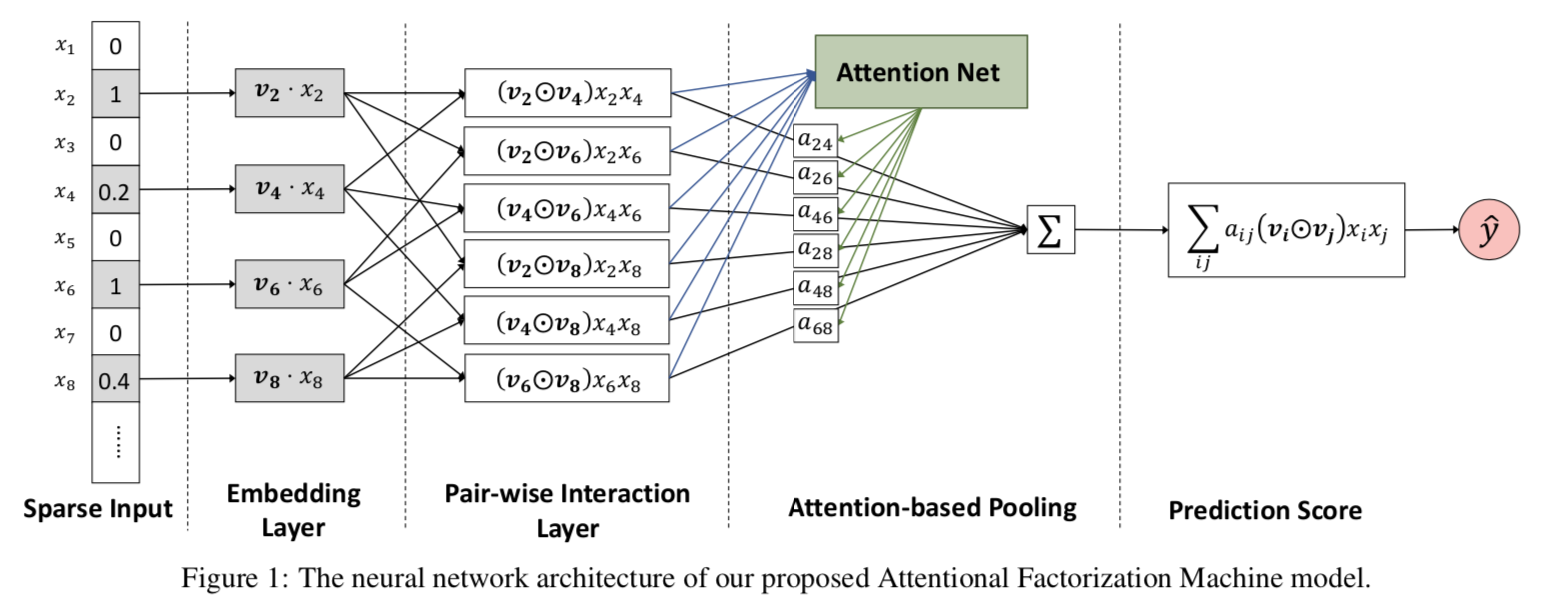
注意力部分是一个简单的全联接层,输出的是\(N(N-1)/2\)的矩阵,作为sum_pooling的权重向量,对element-wise特征交互向量进行加权求和。加权求和的向量直接连接output,不再经过全联接层。如果权重为1,那AFM和不带全联接层的NFM是一样滴。
AFM几个想吐槽的点
- 不带全联接层会导致高级特征表达有限,不过这个不重要啦,AFM更多还是为特征交互提供了Attention的新思路
代码实现
@tf_estimator_model

def model_fn_dense(features, labels, mode, params):

    dense_feature, sparse_feature = build_features()

    dense = tf.feature_column.input_layer(features, dense_feature) # lz linear concat of embedding

    sparse = tf.feature_column.input_layer(features, sparse_feature)

    field_size = len( dense_feature )

    embedding_size = dense_feature[0].variable_shape.as_list()[-1]

    embedding_matrix = tf.reshape( dense, [-1, field_size, embedding_size] )  # batch * field_size *emb_size

    with tf.variable_scope('Linear_part'):

        linear_output = tf.layers.dense(sparse, units=1)

        add_layer_summary( 'linear_output', linear_output )

    with tf.variable_scope('Elementwise_Interaction'):

        elementwise_list = []

        for i in range(field_size):

            for j in range(i+1, field_size):

                vi = tf.gather(embedding_matrix, indices=i, axis=1, batch_dims=0,name = 'vi') # batch * emb_size

                vj = tf.gather(embedding_matrix, indices=j, axis=1, batch_dims=0,name = 'vj')

                elementwise_list.append(tf.multiply(vi,vj)) # batch * emb_size

        elementwise_matrix = tf.stack(elementwise_list) # (N*(N-1)/2) * batch * emb_size

        elementwise_matrix = tf.transpose(elementwise_matrix, [1,0,2]) # batch * (N*(N-1)/2) * emb_size

    with tf.variable_scope('Attention_Net'):

        # 2 fully connected layer

        dense = tf.layers.dense(elementwise_matrix, units = params['attention_factor'], activation = 'relu') # batch * (N*(N-1)/2) * t

        add_layer_summary( dense.name, dense )

        attention_weight = tf.layers.dense(dense, units=1, activation = 'softmax') # batch *(N*(N-1)/2) * 1

        add_layer_summary( attention_weight.name, attention_weight)

    with tf.variable_scope('Attention_pooling'):

        interaction_output = tf.reduce_sum(tf.multiply(elementwise_matrix, attention_weight), axis=1) # batch * emb_size

        interaction_output = tf.layers.dense(interaction_output, units=1) # batch * 1

    with tf.variable_scope('output'):

        y = interaction_output + linear_output

        add_layer_summary( 'output', y )

    return y
CTR学习笔记&代码实现系列
https://github.com/DSXiangLi/CTR
CTR学习笔记&代码实现1-深度学习的前奏LR->FFM
CTR学习笔记&代码实现2-深度ctr模型 MLP->Wide&Deep
CTR学习笔记&代码实现3-深度ctr模型 FNN->PNN->DeepFM
资料
- Jun Xiao, Hao Ye ,2017, Attentional Factorization Machines - Learning the Weight of Feature Interactions via Attention Networks
- Xiangnan He, Tat-Seng Chua,2017, Neural Factorization Machines for Sparse Predictive Analytics
- https://zhuanlan.zhihu.com/p/86181485
CTR学习笔记&代码实现4-深度ctr模型 NFM/AFM的更多相关文章
- CTR学习笔记&代码实现3-深度ctr模型 FNN->PNN->DeepFM
这一节我们总结FM三兄弟FNN/PNN/DeepFM,由远及近,从最初把FM得到的隐向量和权重作为神经网络输入的FNN,到把向量内/外积从预训练直接迁移到神经网络中的PNN,再到参考wide& ...
- CTR学习笔记&代码实现5-深度ctr模型 DeepCrossing -> DCN
之前总结了PNN,NFM,AFM这类两两向量乘积的方式,这一节我们换新的思路来看特征交互.DeepCrossing是最早在CTR模型中使用ResNet的前辈,DCN在ResNet上进一步创新,为高阶特 ...
- CTR学习笔记&代码实现6-深度ctr模型 后浪 xDeepFM/FiBiNET
xDeepFM用改良的DCN替代了DeepFM的FM部分来学习组合特征信息,而FiBiNET则是应用SENET加入了特征权重比NFM,AFM更进了一步.在看两个model前建议对DeepFM, Dee ...
- CTR学习笔记&代码实现2-深度ctr模型 MLP->Wide&Deep
背景 这一篇我们从基础的深度ctr模型谈起.我很喜欢Wide&Deep的框架感觉之后很多改进都可以纳入这个框架中.Wide负责样本中出现的频繁项挖掘,Deep负责样本中未出现的特征泛化.而后续 ...
- CTR学习笔记&代码实现1-深度学习的前奏LR->FFM
CTR学习笔记系列的第一篇,总结在深度模型称王之前经典LR,FM, FFM模型,这些经典模型后续也作为组件用于各个深度模型.模型分别用自定义Keras Layer和estimator来实现,哈哈一个是 ...
- GIS案例学习笔记-明暗等高线提取地理模型构建
GIS案例学习笔记-明暗等高线提取地理模型构建 联系方式:谢老师,135-4855-4328,xiexiaokui#qq.com 目的:针对数字高程模型,通过地形分析,建立明暗等高线提取模型,生成具有 ...
- 【PyTorch深度学习】学习笔记之PyTorch与深度学习
第1章 PyTorch与深度学习 深度学习的应用 接近人类水平的图像分类 接近人类水平的语音识别 机器翻译 自动驾驶汽车 Siri.Google语音和Alexa在最近几年更加准确 日本农民的黄瓜智能分 ...
- [原创]java WEB学习笔记44:Filter 简介,模型,创建,工作原理,相关API,过滤器的部署及映射的方式,Demo
本博客为原创:综合 尚硅谷(http://www.atguigu.com)的系统教程(深表感谢)和 网络上的现有资源(博客,文档,图书等),资源的出处我会标明 本博客的目的:①总结自己的学习过程,相当 ...
- cips2016+学习笔记︱简述常见的语言表示模型(词嵌入、句表示、篇章表示)
在cips2016出来之前,笔者也总结过种类繁多,类似词向量的内容,自然语言处理︱简述四大类文本分析中的"词向量"(文本词特征提取)事实证明,笔者当时所写的基本跟CIPS2016一 ...
随机推荐
- echarts图表x,y轴的设置
https://www.cnblogs.com/cjh-strive/p/11065005.html xAxis属性代表echarts图表的x轴设置代码如下 xAxis : [ { type : 'c ...
- 简单记录下RestTemplate 中postForObject调用例子
学无止境! 今天无意中做了下RestTemplate调用demo,简单的尝试了下一个项目调用另一个项目接口示例 在A项目中创建可访问controller 然后在B项目中进行调用 调用成功
- reuire代码优化之:r.js
r.js是requireJS的优化(Optimizer)工具,可以实现前端文件的压缩与合并,在requireJS异步按需加载的基础上进一步提供前端优化,减小前端文件大小.减少对服务器的文件请求.要使用 ...
- Java8 学习笔记--函数式接口
通过之前的函数式接口与lambda表达式的关系那篇文章,大家应该对函数式接口有了一定的了解了,在Java中它是lambda表达式的基础,没有函数式接口就没有办法使用lambda表达式. 函数式接口如此 ...
- 关于Cookie的相关知识点以及使用方法
首先介绍cookie的一些方法 response.addCookie(Cookie cookie)是将一个cookie对象传入客户端. Cookie cookie=new Cookie(String ...
- 【Web】阿里icon图标webpack插件(webpack-qc-iconfont-plugin)详解
webpack-qc-iconfont-plugin webpack-qc-iconfont-plugin是一个webpack插件,可以轻松地帮你将阿里icon的图标项目下载至本地 开发初衷 之前已经 ...
- Linq下有一个非常实用的SelectMany方法,很多人却不会用
在平时开发中经常会看到有些朋友或者同事在写代码时会充斥着各种for,foreach,这种程式代码太多的话阅读性特别差,而且还显得特别累赘,其实在FCL中有很多帮助我们提高阅读感的方法,而现实中很多人不 ...
- 【Selenium01篇】python+selenium实现Web自动化:搭建环境,Selenium原理,定位元素以及浏览器常规操作!
一.前言 最近问我自动化的人确实有点多,个人突发奇想:想从0开始讲解python+selenium实现Web自动化测试,请关注博客持续更新! 二.话不多说,直接开干,开始搭建自动化测试环境 这里以前在 ...
- Array(数组)对象-->indexOf() 方法
1.定义和用法 indexOf() 方法可返回某个指定的字符串值在字符串中首次出现的位置,即下标. 如果没有找到匹配的字符串则返回 -1. 语法: string.indexOf(searchvalue ...
- 11-Json提取器使用
1.使用json提取关键信息 有时候接口返回数据为json数据或者直接为一个列表,可使用这个更简单快捷 json数据: 这样的,数据有在result里面以列表形式存在,也有在列表外的,可在json提取 ...