
hdu1298 T9(手机输入法,每按一个数字,找出出现频率最高的字串,字典树+DFS)
entered by pressing one key several times. For example, if you wanted to type "hello" you had to press key 4 twice, key 3 twice, key 5 three times, again key 5 three times, and finally key 6 three times. This procedure is very tedious and keeps many people
from using the Short Message Service.
This led manufacturers of mobile phones to try and find an easier way to enter text on a mobile phone. The solution they developed is called T9 text input. The "9" in the name means that you can enter almost arbitrary words with just nine keys and without pressing
them more than once per character. The idea of the solution is that you simply start typing the keys without repetition, and the software uses a built-in dictionary to look for the "most probable" word matching the input. For example, to enter "hello" you
simply press keys 4, 3, 5, 5, and 6 once. Of course, this could also be the input for the word "gdjjm", but since this is no sensible English word, it can safely be ignored. By ruling out all other "improbable" solutions and only taking proper English words
into account, this method can speed up writing of short messages considerably. Of course, if the word is not in the dictionary (like a name) then it has to be typed in manually using key repetition again.
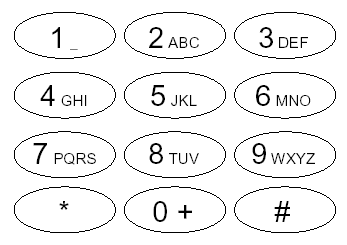
Figure 8: The Number-keys of a mobile phone.
More precisely, with every character typed, the phone will show the most probable combination of characters it has found up to that point. Let us assume that the phone knows about the words "idea" and "hello", with "idea" occurring more often. Pressing the
keys 4, 3, 5, 5, and 6, one after the other, the phone offers you "i", "id", then switches to "hel", "hell", and finally shows "hello".
Write an implementation of the T9 text input which offers the most probable character combination after every keystroke. The probability of a character combination is defined to be the sum of the probabilities of all words in the dictionary that begin with
this character combination. For example, if the dictionary contains three words "hell", "hello", and "hellfire", the probability of the character combination "hell" is the sum of the probabilities of these words. If some combinations have the same probability,
your program is to select the first one in alphabetic order. The user should also be able to type the beginning of words. For example, if the word "hello" is in the dictionary, the user can also enter the word "he" by pressing the keys 4 and 3 even if this
word is not listed in the dictionary.
Each scenario begins with a line containing the number w of distinct words in the dictionary (0<=w<=1000). These words are given in the next w lines. (They are not guaranteed in ascending alphabetic order, although it's a dictionary.) Every line starts with
the word which is a sequence of lowercase letters from the alphabet without whitespace, followed by a space and an integer p, 1<=p<=100, representing the probability of that word. No word will contain more than 100 letters.
Following the dictionary, there is a line containing a single integer m. Next follow m lines, each consisting of a sequence of at most 100 decimal digits 2-9, followed by a single 1 meaning "next word".
For every number sequence s of the scenario, print one line for every keystroke stored in s, except for the 1 at the end. In this line, print the most probable word prefix defined by the probabilities in the dictionary and the T9 selection rules explained above.
Whenever none of the words in the dictionary match the given number sequence, print "MANUALLY" instead of a prefix.
Terminate the output for every number sequence with a blank line, and print an additional blank line at the end of every scenario.
2

5

hell 3

hello 4

idea 8

next 8

super 3

2

435561

43321

7

another 5

contest 6

follow 3

give 13

integer 6

new 14

program 4

5

77647261

6391

4681

26684371

77771
Scenario #1:
i
id
hel
hell
hello i
id
ide
idea Scenario #2:
p
pr
pro
prog
progr
progra
program n
ne
new g
in
int c
co
con
cont
anoth
anothe
another p
pr
MANUALLY
MANUALLY题意:首先给定n组字符串s和数字a,表示该字符串s输入过a次,接下来q次输入,每次输入表示按键顺序(使用手机输入发那种),问每次按键可能出现的字符串,按使用频率高的输出,若没有则输出MANUALLY注意:每一个数字代表一个字母,假设要找出两个长度的答案,那么在两个长度的全部可能中找出出现频率最高的。#include<stdio.h>
#include<string.h>
//#include<malloc.h> typedef struct nn
{
int prio;
struct nn *next[26];
}node;
typedef struct nnn
{
int maxprio;
char str[105];
}ansseme; node *builde()
{
int i;
node *p=new node;//node *p=(node*)malloc(sizeof(node));
p->prio=0;
for(i=0;i<26;i++)
p->next[i]=NULL;
return p;
}
node *root;
void insert(char str[],int prio)
{
node *p=root;
int i;
for(i=0;str[i]!='\0';i++)
{
if(p->next[str[i]-'a']==NULL)
p->next[str[i]-'a']=builde();
p=p->next[str[i]-'a'];
p->prio+=prio;
}
}
int l;
char num[105];
ansseme prin[105];
char ch[10][5]={"abc","def","ghi","jkl","mno","pqrs","tuv","wxyz"};
void dfs(int i,node *p,char pre[])
{
int len=strlen(ch[num[i]-'2']),ti=0,cc[4],pri[4],j;
for( j=0;j<len;j++)
if(p->next[ch[num[i]-'2'][j]-'a']!=NULL)
{
pri[ti]=p->next[ch[num[i]-'2'][j]-'a']->prio;
cc[ti++]=ch[num[i]-'2'][j]-'a';
}
for( j=0;j<ti;j++)
{
pre[i]=cc[j]+'a'; pre[i+1]='\0';
if(prin[i].maxprio<pri[j])
{
prin[i].maxprio=pri[j]; strcpy(prin[i].str,pre);
}
if(l>i+1) dfs(i+1,p->next[cc[j]],pre);
}
}
int main()
{
int t,cas=0,n,prio,i;
char str[105];
scanf("%d",&t);
while(t--)
{
scanf("%d",&n);
printf("Scenario #%d:\n",++cas);
root=builde();
while(n--)
{
scanf("%s %d",str,&prio);
insert(str,prio);
}
scanf("%d",&n);
while(n--)
{
scanf("%s",num);
l=strlen(num)-1;
for( i=0;i<=l;i++)
prin[i].maxprio=0;
str[0]='\0'; if(l) dfs(0,root,str);
for( i=0;i<l;i++)
if(prin[i].maxprio)
printf("%s\n",prin[i].str);
else
printf("MANUALLY\n");
printf("\n");
}
printf("\n");
}
}
hdu1298 T9(手机输入法,每按一个数字,找出出现频率最高的字串,字典树+DFS)的更多相关文章
- HDU1298 字典树+dfs
T9 Time Limit: 2000/1000 MS (Java/Others) Memory Limit: 65536/32768 K (Java/Others)Total Submissi ...
- HDU 1298 T9(字典树+dfs)
http://acm.hdu.edu.cn/showproblem.php?pid=1298 题意:模拟手机9键,给出每个单词的使用频率.现在给出按键的顺序,问每次按键后首字是什么(也就是要概率最大的 ...
- HDU 1298 T9 字典树+DFS
必须要批评下自己了,首先就是这个题目的迟疑不定,去年做字典树的时候就碰到这个题目了,当时没什么好的想法,就暂时搁置了,其实想法应该有很多,只是居然没想到. 同样都是对单词进行建树,并插入可能值,但是拨 ...
- hdu 1298 字典树 + DFS (模拟T9文本输入)
题意: 给你一些按键顺序,让你输出每一步中概率最大的那个单词,这里的概率计算方 法好好看看别弄错了,一开始就是因为弄错了,各种wa,比如 abc 1 ,ab 1,那么 ab 的概率就是2 ...
- 给一个非常长的字符串str 另一个字符集比方{a,b,c} 找出str 里包括{a,b,c}的最短子串。要求O(n)
给一个非常长的字符串str 另一个字符集比方{a,b,c} 找出str 里包括{a,b,c}的最短子串.要求O(n). 比方,字符集是a,b,c,字符串是abdcaabcx,则最短子串为abc. 设置 ...
- 移动前端手机输入法自带emoji表情字符处理
今天,测试给我提了一个BUG,说移动端输入emoji表情无法提交.很早以前就有思考过,手机输入法里自带的emoji表情,应该是某些特殊字符.既然是字符,那应该都能提交才对,可是为啥会被卡住呢?搜了一下 ...
- paip.android 手机输入法制造大法
paip.android 手机输入法制造大法 作者Attilax , EMAIL:1466519819@qq.com 来源:attilax的专栏 地址:http://blog.csdn.net/at ...
- 【转】移动前端手机输入法自带emoji表情字符处理
http://blog.csdn.net/binjly/article/details/47321043 今天,测试给我提了一个BUG,说移动端输入emoji表情无法提交.很早以前就有思考过,手机输入 ...
- baidu手机输入法:邂逅"吹神"的声场漫游
"十年,好久不见,兄妹,所有还好?年月如歌,你的背包.却仍然没有筛选.装满红玫瑰.人来人往,爱情搬运,纵使我成了K歌之王.也谢谢你.依然让我的全世界失眠. 孤单患者.不如不见,不要说 ...
随机推荐
- DataTable的属性与使用方式
一.DataTable简介 (1)构造函数 DataTable() 不带参数初始化DataTable 类的新实例. DataTable(string t ...
- iOS中 视频直播功能-流媒体的使用
简单介绍: HLS 协议 : >5M会被AppStore拒绝 服务器要求低 延迟高 多平台 RTMP 协议: 电视直播 PC端使用 配合flash插件 及时性好 ...
- [Swust OJ 1091]--土豪我们做朋友吧(并查集,最值维护)
题目链接:http://acm.swust.edu.cn/problem/1091/ Time limit(ms): 1000 Memory limit(kb): 32768 人都有缺钱的时候,缺 ...
- [转]CentO下限制SSH登录次数
应公司内部网站等级测评的需求,正逐渐加强系统安全防护. 设备默认 3 次验证失败自动退出,并且结束会话:网络登录连接超时自动退出时间 5 分钟: 第一种方法:已验证. 1.ssh超时时间设置 # cd ...
- WinXP系统服务详细列表
windows XP 系统服务“关闭”详细列表,释放N多内存,128也够用了! 在xp系统中,有近90个服务,默认开启了 30多个服务,而事实上我们只需要其中几个就够用了.禁止所有不必要的服务可以为您 ...
- php利用iframe实现无刷新文件上传功能
上传原理很简单就是利用表单的打开方式为iframe的name名,这样就可以在当前页面的iframe打来了,实现文件上传,再利用js返回上传结果. form target .在 action 属性中规定 ...
- Java--日期的使用
Date 类: 最基础的日期时间类,返回一个相对日期的毫秒数.精确到毫秒,但不支持日期的国际化和分时区显示. Calender类: 相对于Date更加强大的时间类,是抽象类,提供了常规的日期修改功能和 ...
- zzuli Camellia的难题(暴力)
1784: Camellia的难题 Time Limit: 2 Sec Memory Limit: 128 MB Submit: 67 Solved: 14SubmitStatusWeb Boar ...
- python groupby
groupby() 将key函数作用于原循环器的各个元素.根据key函数结果,将拥有相同函数结果的元素分到一个新的循环器.每个新的循环器以函数返回结果为标签. 这就好像一群人的身高作为循环器.我们可以 ...
- Android 播放声音
public static void PlayAlarmRing(Context mContext) { Uri alert = RingtoneManager.getDefaultUri(Ringt ...