
HashMap(1.8)源码学习
一.HashMap介绍
1.哈希表(hash table)
在哈希表中进行添加,删除,查找等操作,时间复杂度为O(1)
存储位置 = f(关键字)
其中,这个函数f一般称为
哈希函数,这个函数的设计好坏会直接影响到哈希表的优劣将key通过哈希算法计算出
哈希值,把哈希值作为数组下标通过该方法建立的数组就叫做
哈希表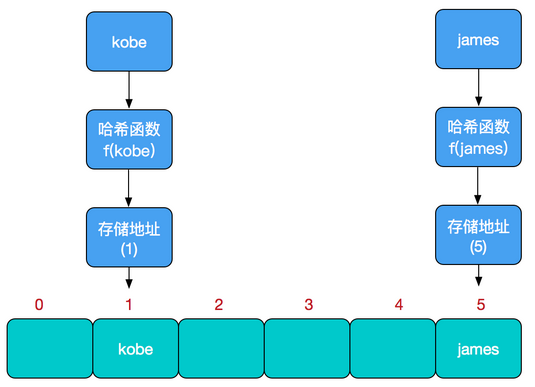
哈希冲突
当我们对某个元素进行哈希运算,得到一个存储地址,然后要进行插入的时候,发现已经被其他元素占用了,其实这就是所谓的哈希冲突,也叫哈希碰撞。
解决方案:
开放定址法
开放地执法有一个公式:Hi=(H(key)+di) MOD m i=1,2,…,k(k<=m-1)
其中,m为哈希表的表长。di 是产生冲突的时候的增量序列。如果di值可能为1,2,3,…m-1,称线性探测再散列。再散列函数法
当发生冲突时,使用第二个、第三个、哈希函数计算地址,直到无冲突时。缺点:计算时间增加。
链地址法(拉链法)
将所有关键字为同义词的记录存储在同一线性链表中
2.HashMap实现原理
2.1 Map
- HashMap是
Map的主要实现类,线程不安全的,效率高;可以存储null的key和value Map就是用于存储键值对(<key,value>)的集合类,也可以说是一组键值对的映射(数学概念),在java中map是一个接口,是和collection接口同一等级的集合根接口。- Map特点:
- key键值不可以重复
- 每个key只能对应一个value,多个key可以对应一个value
- key,value 都可以是任何引用类型(包括 null)的数据(只能是引用类型)
2.2 HashMap
HashMap是用
数组+单链表+红黑树实现的map类。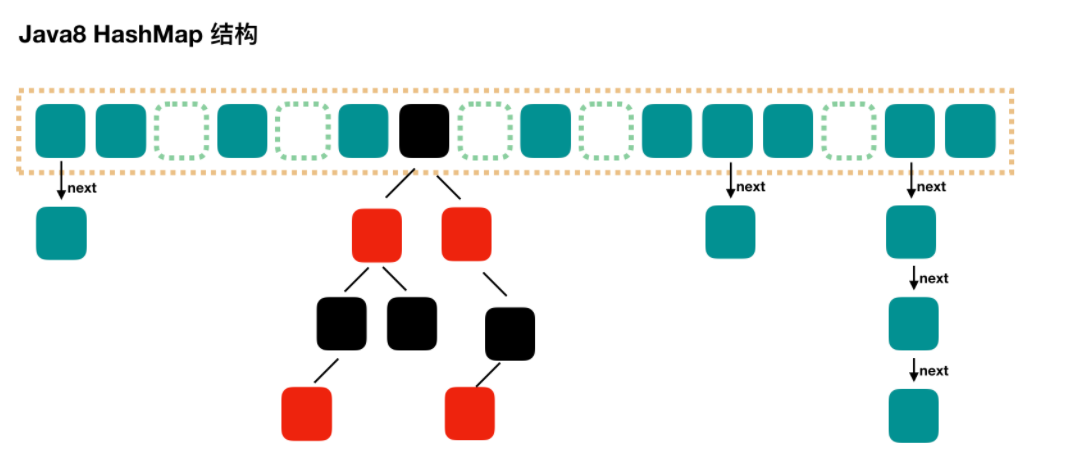
HashMap 的实现不是同步的,这意味着它不是线程安全的。
扩容机制和哈希函数越合理,空间成本越小,哈希函数计算结果越分散均匀。越分散发生哈希冲突的几率就越小
3.红黑树
、、、、、、、、
二.源码部分
1.基本属性
AbstractMap<K, V>:AbstractMap 提供了 Map 的基本实现,使得我们以后要实现一个 Map 不用从头开始,只需要继承 AbstractMap, 然后按需求实现/重写对应方法即可。
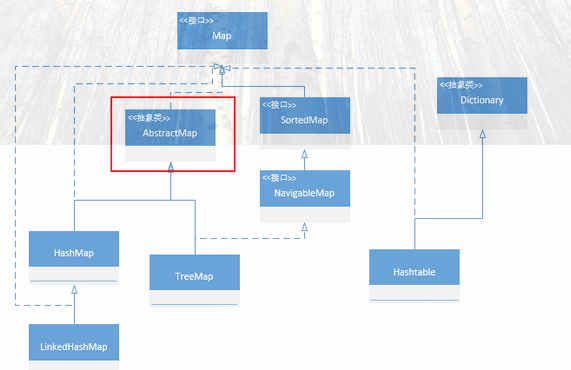
Map是Java集合框架的根接口,另一个是Collection接口
Cloneable接口是一个标记接口,也就是没有任何内容
Serializable接口之所以定义为空,是因为它只起到了一个标识的作用,告诉程序实现了它的对象是可以被序列化的,但真正序列化和反序列化的操作并不需要它来完成。
public class HashMap<K,V> extends AbstractMap<K,V>

    implements Map<K,V>, Cloneable, Serializable {

    private static final long serialVersionUID = 362498820763181265L;

/**

 * The default initial capacity - MUST be a power of two.

 * 默认的初始容量--必须是2的幂

 */

static final int DEFAULT_INITIAL_CAPACITY = 1 << 4; // aka 16

/**

 * The maximum capacity, used if a higher value is implicitly specified

 * by either of the constructors with arguments.

 * MUST be a power of two <= 1<<30.

 * 哈希表的最大容量为2^30

 */

static final int MAXIMUM_CAPACITY = 1 << 30;

/**

 * The load factor used when none specified in constructor.

 * 在构造函数中未指定时使用的负载系数,负载因子默认为0.75f

 * 当元素的总个数>当前数组的长度 * 负载因子。数组会进行扩容,扩容为原来的两倍

 */

static final float DEFAULT_LOAD_FACTOR = 0.75f;

/**

 * The bin count threshold for using a tree rather than list for a

 * bin.  Bins are converted to trees when adding an element to a

 * bin with at least this many nodes. The value must be greater

 * than 2 and should be at least 8 to mesh with assumptions in

 * tree removal about conversion back to plain bins upon

 * shrinkage.

 * 当链表结点到达8时转换为红黑树

 */

static final int TREEIFY_THRESHOLD = 8;

/**

 * The bin count threshold for untreeifying a (split) bin during a

 * resize operation. Should be less than TREEIFY_THRESHOLD, and at

 * most 6 to mesh with shrinkage detection under removal.

 * 当红黑树结点小于6时重新转化为链表

 */

static final int UNTREEIFY_THRESHOLD = 6;

/**

 * The smallest table capacity for which bins may be treeified.

 * 可以树形化容器的最小表容量。

 * (Otherwise the table is resized if too many nodes in a bin.)

 * 否则,如果容器中的节点太多,则会调整表的大小

 * Should be at least 4 * TREEIFY_THRESHOLD to avoid conflicts

 * between resizing and treeification thresholds.

 * 当Table所有元素超过该值,才会进行树化(为了防止前期阶段频繁扩容和树化过程冲突)

 */

static final int MIN_TREEIFY_CAPACITY = 64;
/* ---------------- Fields -------------- */

/**

 * The table, initialized on first use, and resized as

 * necessary. When allocated, length is always a power of two.

 * (We also tolerate length zero in some operations to allow

 * bootstrapping mechanics that are currently not needed.)

 * node数组

 */

transient Node<K,V>[] table;

/**

 * Holds cached entrySet(). Note that AbstractMap fields are used

 * for keySet() and values().

 * 存放键值对的集合

 */

transient Set<Map.Entry<K,V>> entrySet;

/**

 * The number of key-value mappings contained in this map.

 *键-值映射的数量

 */

transient int size;

/**

 * The number of times this HashMap has been structurally modified

 * 这个HashMap被结构修改的次数

 * Structural modifications are those that change the number of mappings in

 * the HashMap or otherwise modify its internal structure

 * 结构修改是HashMap中那些改变映射数量的修改或修改其内部结构

 * (e.g.,

 * rehash).  This field is used to make iterators on Collection-views of

 * the HashMap fail-fast.  (See ConcurrentModificationException).

 */

transient int modCount;

/**

 * The next size value at which to resize (capacity * load factor).

 *要调整大小的下一个大小值,边界值

 * @serial

 */

// (The javadoc description is true upon serialization.

// Additionally, if the table array has not been allocated, this

// field holds the initial array capacity, or zero signifying

// DEFAULT_INITIAL_CAPACITY.)

int threshold;

/**

 * The load factor for the hash table.

 *哈希表的加载因子

 * @serial

 */

final float loadFactor;
2.结构
- 如2.2中的图,顶层为动态数组,每个元素为一个node
而每个node又是一个链表的头节点
node的next指向下个hash值相同的结点
    /**

     * Basic hash bin node, used for most entries.  (See below for

     * TreeNode subclass, and in LinkedHashMap for its Entry subclass.)

     * node内部类,node

     */

    static class Node<K,V> implements Map.Entry<K,V> {

        //当前的hash值

        final int hash;

        //键值

        final K key;

        //数据值

        V value;

        //指向node

        Node<K,V> next;

//有参构造

        Node(int hash, K key, V value, Node<K,V> next) {

            this.hash = hash;

            this.key = key;

            this.value = value;

            this.next = next;

        }

        //返回node键值的get方法

        public final K getKey()        { return key; }

        //返回node数据的get方法

        public final V getValue()      { return value; }

        public final String toString() { return key + "=" + value; }

        public final int hashCode() {

            return Objects.hashCode(key) ^ Objects.hashCode(value);

        }

        //value的set方法

        public final V setValue(V newValue) {

            V oldValue = value;

            value = newValue;

            return oldValue;

        }

        public final boolean equals(Object o) {

            if (o == this)

                return true;

            if (o instanceof Map.Entry) {

                Map.Entry<?,?> e = (Map.Entry<?,?>)o;

                if (Objects.equals(key, e.getKey()) &&

                    Objects.equals(value, e.getValue()))

                    return true;

            }

            return false;

        }

    }
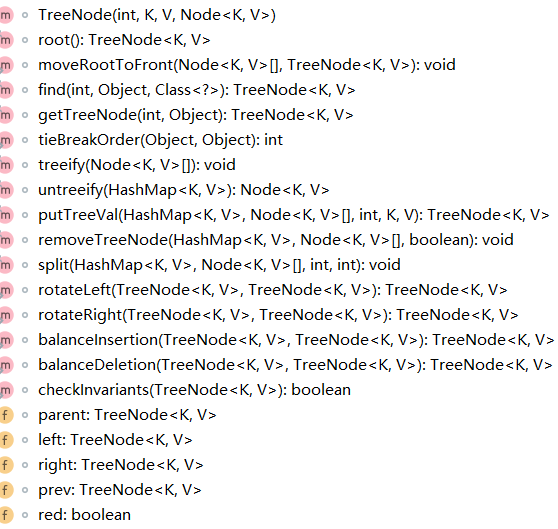
static final class TreeNode<K,V> extends LinkedHashMap.Entry<K,V> {

    TreeNode<K,V> parent;  // red-black tree links

    TreeNode<K,V> left;

    TreeNode<K,V> right;

    TreeNode<K,V> prev;    // needed to unlink next upon deletion

    boolean red;

    TreeNode(int hash, K key, V val, Node<K,V> next) {

        super(hash, key, val, next);

    }
3.构造函数
/**

 * Constructs an empty <tt>HashMap</tt> with the specified initial

 * capacity and load factor.

 *构造一个手动设置初始容量和负载因子的空hashmap

 * @param  initialCapacity the initial capacity

 * @param  loadFactor      the load factor

 * @throws IllegalArgumentException if the initial capacity is negative

 *         or the load factor is nonpositive

 */

public HashMap(int initialCapacity, float loadFactor) {

    //如果设置的初始容量小于0,抛出异常

    if (initialCapacity < 0)

        throw new IllegalArgumentException("Illegal initial capacity: " +

                                           initialCapacity);

    //如果手动设置的初始容量大于最大容量,则设置为最大容量,即2^30 = 1,073,741,824

    if (initialCapacity > MAXIMUM_CAPACITY)

        initialCapacity = MAXIMUM_CAPACITY;

    //如若设置的负载因子<=0 或者

    //NaN全称是Not a Number,意思是“不是一个数字”,代表一种不合法,即float值和double值不合法。

    if (loadFactor <= 0 || Float.isNaN(loadFactor))

        throw new IllegalArgumentException("Illegal load factor: " +

                                           loadFactor);

    //将负载因子赋值

    this.loadFactor = loadFactor;

    //将初始容量的2次幂值赋给边界值

    this.threshold = tableSizeFor(initialCapacity);

}
/**

 * Constructs an empty <tt>HashMap</tt> with the specified initial

 * capacity and the default load factor (0.75).

 *使用指定的初始容量构造一个空的HashMap

 * 负载因子为默认的0.75

 * @param  initialCapacity the initial capacity.

 * @throws IllegalArgumentException if the initial capacity is negative.

 */

public HashMap(int initialCapacity) {

    this(initialCapacity, DEFAULT_LOAD_FACTOR);

}
/**

 * Constructs an empty <tt>HashMap</tt> with the default initial capacity

 * (16) and the default load factor (0.75).

 * 无参构造

 * 初始容量为默认值 16

 * 默认负载因子也为0.75

 */

public HashMap() {

    this.loadFactor = DEFAULT_LOAD_FACTOR; // all other fields defaulted

}
/**

 * Constructs a new <tt>HashMap</tt> with the same mappings as the

 * specified <tt>Map</tt>.  The <tt>HashMap</tt> is created with

 * default load factor (0.75) and an initial capacity sufficient to

 * hold the mappings in the specified <tt>Map</tt>.

 *根据传入的map,使用相同的映射构造一个新的HashMap

 * 负载因子为0.75

 * @param   m the map whose mappings are to be placed in this map

 * @throws  NullPointerException if the specified map is null

 */

public HashMap(Map<? extends K, ? extends V> m) {

    this.loadFactor = DEFAULT_LOAD_FACTOR;

    putMapEntries(m, false);

}
/**

 * Returns a power of two size for the given target capacity.

 * 返回给定目标容量的2次幂大小

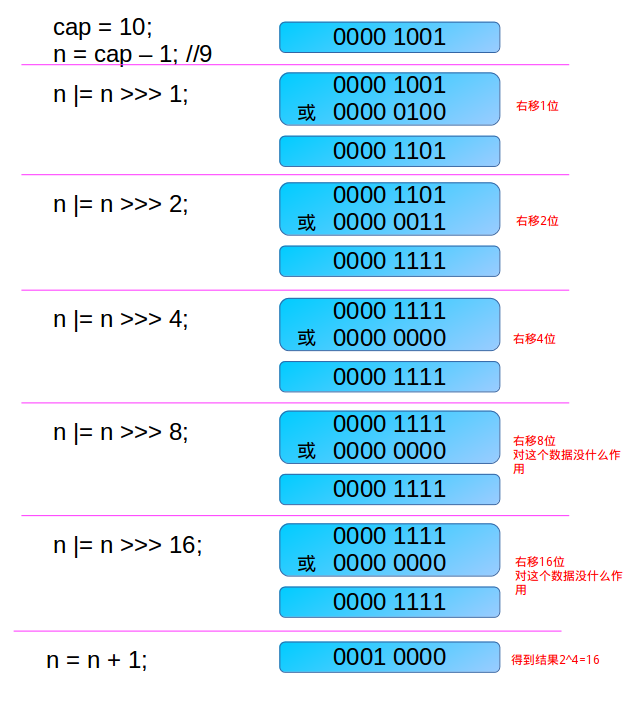
 * 由于HashMap的capacity都是2的幂,因此这个方法用于找到大于等于initialCapacity的最小的2的幂(initialCapacity如果就是2的幂,则返回的还是这个数)。

 */

static final int tableSizeFor(int cap) {

    //cap-1是当进入的数本身为二次幂数而进行转换

    //让最高位的1后面的位全变为1,最后加1,就得到了2次幂大小

    //当32为都为1的时候,容量为MAXIMUM_CAPACITY

    int n = cap - 1;

    n |= n >>> 1;

    n |= n >>> 2;

    n |= n >>> 4;

    n |= n >>> 8;

    n |= n >>> 16;

    return (n < 0) ? 1 : (n >= MAXIMUM_CAPACITY) ? MAXIMUM_CAPACITY : n + 1;

}
4.hashcode

Java中的hashCode方法就是根据一定的规则将与对象相关的信息(比如对象的存储地址,对象的字段等)映射成一个数值,这个数值称作为散列值。
由于和(length-1)运算,length 绝大多数情况小于2的16次方。所以始终是hashcode 的低16位(甚至更低)参与运算。要是高16位也参与运算,会让得到的下标更加散列。
  static final int hash(Object key) {

      int h;

      //h >>> 16是用来取出h的高16,(>>>是无符号右移)

      return (key == null) ? 0 : (h = key.hashCode()) ^ (h >>> 16);

  }
5.get方法
public V get(Object key) {

    Node<K,V> e;

    //找不到键映射的值,返回null,否则返回value

    return (e = getNode(hash(key), key)) == null ? null : e.value;

}
/**

 * Implements Map.get and related methods

 *get操作是通过调用getNode方法

 * @param hash hash for key

 * @param key the key

 * @return the node, or null if none

 */

final Node<K,V> getNode(int hash, Object key) {

    //

    Node<K,V>[] tab; Node<K,V> first, e; int n; K k;

    //在table不为空的情况下

    if ((tab = table) != null && (n = tab.length) > 0 &&

        (first = tab[(n - 1) & hash]) != null) {

        //哈希碰撞几率小,为了效率考虑,总是检查第一个节点是不是我们想要的

        if (first.hash == hash && // **always check first node**

            ((k = first.key) == key || (key != null && key.equals(k))))

            return first;

        //以下为first node不是目标结点的情况

        if ((e = first.next) != null) {

            //判断是否为红黑树对象

            //instanceof是Java中的二元运算符,左边是对象,右边是类;当对象是右边类或子类所创建对象时,返回true;否则,返回false。

            if (first instanceof TreeNode)

                return ((TreeNode<K,V>)first).getTreeNode(hash, key);

            //不是红黑树的话,链表向下查询即可

            do {

                if (e.hash == hash &&

                    ((k = e.key) == key || (key != null && key.equals(k))))

                    return e;

            } while ((e = e.next) != null);

        }

    }

    //没找到,返回null

    return null;

}
instanceof是Java中的二元运算符,左边是对象,右边是类;当对象是右边类或子类所创建对象时,返回true;否则,返回false。
6.put方法
/**

 * Associates the specified value with the specified key in this map.

 * If the map previously contained a mapping for the key, the old

 * value is replaced.

 * 将键/值对添加到 hashMap 中

 * 如果先前的映射包含一个键的映射,则旧的value被替换。

 * @param key key with which the specified value is to be associated

 * @param value value to be associated with the specified key

 * @return the previous value associated with <tt>key</tt>, or

 *         <tt>null</tt> if there was no mapping for <tt>key</tt>.

 *         (A <tt>null</tt> return can also indicate that the map

 *         previously associated <tt>null</tt> with <tt>key</tt>.)

 */

public V put(K key, V value) {

    //false: onlyIfAbsent,表示改变现有值

    //true: 不处于创建模式

    return putVal(hash(key), key, value, false, true);

}
/**

 * Implements Map.put and related methods

 *实现了地图Map.put及相关方法

 * @param hash hash for key

 * @param key the key

 * @param value the value to put

 * @param onlyIfAbsent if true, don't change existing value

 *        如果为true,则不更改现有值

 * @param evict if false, the table is in creation mode.

 *        如果为false,则表示表处于创建模式

 * @return previous value, or null if none

 */

final V putVal(int hash, K key, V value, boolean onlyIfAbsent,

               boolean evict) {

    Node<K,V>[] tab; Node<K,V> p; int n, i;

    //如果table为空,则进行扩容操作

    if ((tab = table) == null || (n = tab.length) == 0)

        //n 为扩容后的长度

        n = (tab = resize()).length;

    //如果 tab[i]为空,则新建结点

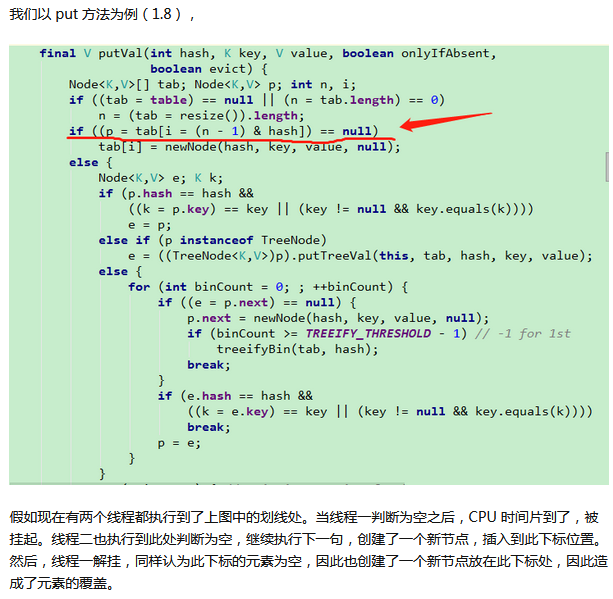
    if ((p = tab[i = (n - 1) & hash]) == null)

        tab[i] = newNode(hash, key, value, null);

    else {

        Node<K,V> e; K k;

        //n = (tab = resize()).length

        //p目前指向tab[i = (n - 1) & hash],也就是数组的最后一个元素

        //如果p的hash有相同的,且key != null,说明键值已经存在了

        if (p.hash == hash &&

            ((k = p.key) == key || (key != null && key.equals(k))))

            //把p存储在e中

            e = p;

        //如果p结点为红黑树结点

        else if (p instanceof TreeNode)

            e = ((TreeNode<K,V>)p).putTreeVal(this, tab, hash, key, value);

        else {

            //遍历链表

            for (int binCount = 0; ; ++binCount) {

                //如果p结点没有后继结点,则新建链表节点

                if ((e = p.next) == null) {

                    p.next = newNode(hash, key, value, null);

                    //插入结点后判断边界值,检查是否需要把链表转化为红黑树

                    if (binCount >= TREEIFY_THRESHOLD - 1) // -1 for 1st

                        treeifyBin(tab, hash);

                    break;

                }

                //判断链表中的结点是否有相同键值

                if (e.hash == hash &&

                    ((k = e.key) == key || (key != null && key.equals(k))))

                    break;

                //p = p.next;

                p = e;

            }

        }

        //如果e不为空说明hashmap本来就存储了键值

        if (e != null) { // existing mapping for key

            //把原来的vlue保存起来

            V oldValue = e.value;

            //当相同可以修改的时候,进行重新赋值操作

            if (!onlyIfAbsent || oldValue == null)

                e.value = value;

            //继承HashMap的LinkedHashMap类服务的

            afterNodeAccess(e);

            return oldValue;

        }

    }

    ++modCount;

    //在进行一次扩容判断

    if (++size > threshold)

        resize();

    //继承HashMap的LinkedHashMap类服务的

    afterNodeInsertion(evict);

    return null;

}

7.resize()方法
/**

 * Initializes or doubles table size.  If null, allocates in

 * accord with initial capacity target held in field threshold.

 * Otherwise, because we are using power-of-two expansion, the

 * elements from each bin must either stay at same index, or move

 * with a power of two offset in the new table.

 * 初始化或加倍表大小

 * @return the table

 */

final Node<K,V>[] resize() {

    Node<K,V>[] oldTab = table;

    //旧容量

    int oldCap = (oldTab == null) ? 0 : oldTab.length;

    //旧阈值

    int oldThr = threshold;

    int newCap, newThr = 0;

    //如果旧的容量大于0,则以2的幂次加倍table的容量

    if (oldCap > 0) {

        //如果容量已经为最大值时,将边界值也赋值成最大值,返回原来的table

        if (oldCap >= MAXIMUM_CAPACITY) {

            threshold = Integer.MAX_VALUE;

            return oldTab;

        }

        //newCap * 2 小于最大容量,且oldCap大于等于默认容量(已经初始化过的table),阈值 * 2

        else if ((newCap = oldCap << 1) < MAXIMUM_CAPACITY &&

                 oldCap >= DEFAULT_INITIAL_CAPACITY)

            newThr = oldThr << 1; // double threshold

    }

    //oldCap <= 0,但是oldThr > 0,说明构造hashtable对象时,手动设置了容量

    else if (oldThr > 0) // initial capacity was placed in threshold 初始容量设置为threshold

        newCap = oldThr;

    else {               // zero initial threshold signifies using defaults 零初始阈值表示使用默认值,16

        newCap = DEFAULT_INITIAL_CAPACITY;

        newThr = (int)(DEFAULT_LOAD_FACTOR * DEFAULT_INITIAL_CAPACITY);

    }

    //??

    if (newThr == 0) {

        float ft = (float)newCap * loadFactor;

        newThr = (newCap < MAXIMUM_CAPACITY && ft < (float)MAXIMUM_CAPACITY ?

                  (int)ft : Integer.MAX_VALUE);

    }

    //边界值更改

    threshold = newThr;

    //告诉编译器忽略指定的警告,不用在编译完成后出现警告信息。

    @SuppressWarnings({"rawtypes","unchecked"})

            //扩容后,新建数组保存旧数组

        Node<K,V>[] newTab = (Node<K,V>[])new Node[newCap];

    table = newTab;

    //如果原数组不为空,则需要将新的数组都逐个拷贝到新的数组中

    if (oldTab != null) {

        for (int j = 0; j < oldCap; ++j) {

            Node<K,V> e;

            //如果 j 结点不为空,则将其先保存在e中,并将原结点设置为null

            if ((e = oldTab[j]) != null) {

                oldTab[j] = null;

                //如果该结点没有后继结点(树,链表),直接把这个结点放在新的数组中

                //根据当前节点的hash值与新数组容量减1做&运算,得到新数组的插入位置

                if (e.next == null)

                    newTab[e.hash & (newCap - 1)] = e;

                //不只有一个结点,首先判断是否为树节点

                else if (e instanceof TreeNode)

                    ((TreeNode<K,V>)e).split(this, newTab, j, oldCap);

                else { // preserve order 维护秩序

                    Node<K,V> loHead = null, loTail = null;

                    Node<K,V> hiHead = null, hiTail = null;

                    Node<K,V> next;

                    do {

                        next = e.next;

                        //新的位置在原位置

                        if ((e.hash & oldCap) == 0) {

                            //目前数组为空

                            if (loTail == null)

                                loHead = e;

                            else

                                //尾插法

                                loTail.next = e;

                            loTail = e;

                        }

                        else {

                            //新的位置在原长度+原位置的位置

                            if (hiTail == null)

                                hiHead = e;

                            else

                                hiTail.next = e;

                            hiTail = e;

                        }

                    } while ((e = next) != null);

                    if (loTail != null) {

                        //再将最后的结点赋值为null

                        loTail.next = null;

                        //再将数组头节点赋给数组

                        newTab[j] = loHead;

                    }

                    //高位同样操作

                    if (hiTail != null) {

                        hiTail.next = null;

                        newTab[j + oldCap] = hiHead;

                    }

                }

            }

        }

    }

    //返回新的数组

    return newTab;

}

8.遍历方法
先遍历key,再取出value
/**

 * Returns a {@link Set} view of the keys contained in this map.

 * The set is backed by the map, so changes to the map are

 * reflected in the set, and vice-versa.  If the map is modified

 * while an iteration over the set is in progress (except through

 * the iterator's own <tt>remove</tt> operation), the results of

 * the iteration are undefined.  The set supports element removal,

 * which removes the corresponding mapping from the map, via the

 * <tt>Iterator.remove</tt>, <tt>Set.remove</tt>,

 * <tt>removeAll</tt>, <tt>retainAll</tt>, and <tt>clear</tt>

 * operations.  It does not support the <tt>add</tt> or <tt>addAll</tt>

 * operations.

 *     返回 hashMap 中所有 key 组成的集合视图

 * @return a set view of the keys contained in this map

 */

public Set<K> keySet() {

    Set<K> ks = keySet;

    if (ks == null) {

        ks = new KeySet();

        keySet = ks;

    }

    return ks;

}
然后通过get方法都得到value
直接遍历value
/**

 * Returns a {@link Collection} view of the values contained in this map.

 * The collection is backed by the map, so changes to the map are

 * reflected in the collection, and vice-versa.  If the map is

 * modified while an iteration over the collection is in progress

 * (except through the iterator's own <tt>remove</tt> operation),

 * the results of the iteration are undefined.  The collection

 * supports element removal, which removes the corresponding

 * mapping from the map, via the <tt>Iterator.remove</tt>,

 * <tt>Collection.remove</tt>, <tt>removeAll</tt>,

 * <tt>retainAll</tt> and <tt>clear</tt> operations.  It does not

 * support the <tt>add</tt> or <tt>addAll</tt> operations.

 * 返回 hashMap 中存在的所有 value 值。

 * @return a view of the values contained in this map

 */

public Collection<V> values() {

    Collection<V> vs = values;

    if (vs == null) {

        vs = new Values();

        values = vs;

    }

    return vs;

}
通过遍历entry来取key和value
/**

 * Returns a {@link Set} view of the mappings contained in this map.

 * The set is backed by the map, so changes to the map are

 * reflected in the set, and vice-versa.  If the map is modified

 * while an iteration over the set is in progress (except through

 * the iterator's own <tt>remove</tt> operation, or through the

 * <tt>setValue</tt> operation on a map entry returned by the

 * iterator) the results of the iteration are undefined.  The set

 * supports element removal, which removes the corresponding

 * mapping from the map, via the <tt>Iterator.remove</tt>,

 * <tt>Set.remove</tt>, <tt>removeAll</tt>, <tt>retainAll</tt> and

 * <tt>clear</tt> operations.  It does not support the

 * <tt>add</tt> or <tt>addAll</tt> operations.

 * 返回键值对

 * @return a set view of the mappings contained in this map

 */

public Set<Map.Entry<K,V>> entrySet() {

    Set<Map.Entry<K,V>> es;

    return (es = entrySet) == null ? (entrySet = new EntrySet()) : es;

}
通过foreach方法直接遍历key和value
//对 hashMap 中的每个映射执行指定的操作。

    @Override

    // BiConsumer是一个功能接口。 它接受两个参数,但不返回任何内容

    public void forEach(BiConsumer<? super K, ? super V> action) {

        Node<K,V>[] tab;

        //如果action为0,则抛出异常

        if (action == null)

            throw new NullPointerException();

        //如果size大于0, 并且将table 赋给tab

        if (size > 0 && (tab = table) != null) {

            int mc = modCount;

            //遍历哈希表

            for (int i = 0; i < tab.length; ++i) {

                //遍历表上的链表节点或者树节点

                for (Node<K,V> e = tab[i]; e != null; e = e.next)

                    action.accept(e.key, e.value);

            }

            if (modCount != mc)

                throw new ConcurrentModificationException();

        }

    }
9.remove方法
/**

 * Removes the mapping for the specified key from this map if present.

 * 删除 hashMap 中指定键 key 的映射关系

 * @param  key key whose mapping is to be removed from the map

 * @return the previous value associated with <tt>key</tt>, or

 *         <tt>null</tt> if there was no mapping for <tt>key</tt>.

 *         (A <tt>null</tt> return can also indicate that the map

 *         previously associated <tt>null</tt> with <tt>key</tt>.)

 */

public V remove(Object key) {

    Node<K,V> e;

    //调用removeNode方法,若无则返回null,否则返回value

    return (e = removeNode(hash(key), key, null, false, true)) == null ?

        null : e.value;

}
/**

 * Implements Map.remove and related methods

 * 实现了MAP移除及相关方法

 * @param hash hash for key

 * @param key the key

 * @param value the value to match if matchValue, else ignored

 * @param matchValue if true only remove if value is equal

 *                   如果为true,只在value相等时移除

 * @param movable if false do not move other nodes while removing

 *                如果为false,则在移除时不要移动其他节点

 * @return the node, or null if none

 */

final Node<K,V> removeNode(int hash, Object key, Object value,

                           boolean matchValue, boolean movable) {

    Node<K,V>[] tab; Node<K,V> p; int n, index;

    //同样的在复制的同时,做一个合法性检查

    if ((tab = table) != null && (n = tab.length) > 0 &&

        (p = tab[index = (n - 1) & hash]) != null) {

        Node<K,V> node = null, e; K k; V v;

        //如果头节点就是目标结点,就将这个节点保存起来

        if (p.hash == hash &&

            ((k = p.key) == key || (key != null && key.equals(k))))

            node = p;

        //如果不是,就遍历链表或者红黑树

        else if ((e = p.next) != null) {

            if (p instanceof TreeNode)

                node = ((TreeNode<K,V>)p).getTreeNode(hash, key);

            else {

                do {

                    //判断key值相等,则为目标节点

                    if (e.hash == hash &&

                        ((k = e.key) == key ||

                         (key != null && key.equals(k)))) {

                        node = e;

                        break;

                    }

                    p = e;

                    //直到结点遍历完

                } while ((e = e.next) != null);

            }

        }

        //在结点找到,且matchValue为false 或者 两个value相等的时候,则删除结点

        if (node != null && (!matchValue || (v = node.value) == value ||

                             (value != null && value.equals(v)))) {

            //当该结点为红黑树的时候

            if (node instanceof TreeNode)

                ((TreeNode<K,V>)node).removeTreeNode(this, tab, movable);

            //如果node为头节点,则将其next变成头节点

            else if (node == p)

                tab[index] = node.next;

            else

                //这时p为e的前驱结点,就将node删除

                p.next = node.next;

            ++modCount;

            --size;

            afterNodeRemoval(node);

            //返回结点

            return node;

        }

    }

    return null;

}
三.总结
HashMap的初始长度为什么是16?每次自动扩展或是手动初始化时,长度为什么是2的幂?
- HashMap的默认长度为16,15的二进制为1111,做与运算的时候,降低了hash碰撞的几率
- 容量为2的整数幂是为了让(2^n)-1的二进制是全1 的,符合hash均匀分布的原则
为什么要引入红黑树?
为了提高查询效率,故在JDK1.8中引入了改进方法红黑树。此数据结构的平均查询效率为O(log n) 。
什么是加载因子、负载因子、边界值?
加载因子:用于表示哈希表中元素填满的程度。
加载因子越大,填满的元素越多,好处是,空间利用率高了,但,冲突的机会加大了.反之,亦同。
冲突的机会越大,则查找的成本越高.反之,查找的成本越小.因而,查找时间就越小.
默认的加载因子: static final float DEFAULT_LOAD_FACTOR = 0.75f;
负载因子:等同于加载因子,也叫扩容因子
边界值: threshold
threshold=capacity*loadFactory
怎么计算key值的存储位置?
hash & (cap - 1)
扩容时:e.hash & oldCap
HashMap(1.8)源码学习的更多相关文章
- Java集合专题总结(1):HashMap 和 HashTable 源码学习和面试总结
2017年的秋招彻底结束了,感觉Java上面的最常见的集合相关的问题就是hash--系列和一些常用并发集合和队列,堆等结合算法一起考察,不完全统计,本人经历:先后百度.唯品会.58同城.新浪微博.趣分 ...
- HashMap与HashTable源码学习及效率比较分析
一.个人学习后的见解: 首先表明学习源码后的个人见解,后续一次依次进行分析: 1.线程安全:HashMap是非线程安全的,HashTable是线程安全的(HashTable中使用了synchroniz ...
- HashMap(1.7)源码学习
一. 1.7 和1.8区别 数据结构: 1.7: 数组 + 链表 1.8 : 数组 + 链表 + 红黑树 put: 1.7: 头插法 1.8: 尾插法 hash计算: 1.7 : Objects.ha ...
- hashMap源码学习记录
hashMap作为java开发面试最常考的一个题目之一,有必要花时间去阅读源码,了解底层实现原理. 首先,让我们看看hashMap这个类有哪些属性 // hashMap初始数组容量 static fi ...
- 基于jdk1.8的HashMap源码学习笔记
作为一种最为常用的容器,同时也是效率比较高的容器,HashMap当之无愧.所以自己这次jdk源码学习,就从HashMap开始吧,当然水平有限,有不正确的地方,欢迎指正,促进共同学习进步,就是喜欢程序员 ...
- HashSet源码学习,基于HashMap实现
HashSet源码学习 一).Set集合的主要使用类 1). HashSet 基于对HashMap的封装 2). LinkedHashSet 基于对LinkedHashSet的封装 3). TreeS ...
- HashMap的源码学习以及性能分析
HashMap的源码学习以及性能分析 一).Map接口的实现类 HashTable.HashMap.LinkedHashMap.TreeMap 二).HashMap和HashTable的区别 1).H ...
- 【JDK1.8】 Java小白的源码学习系列:HashMap
目录 Java小白的源码学习系列:HashMap 官方文档解读 基本数据结构 基本源码解读 基本成员变量 构造器 巧妙的tableSizeFor put方法 巧妙的hash方法 JDK1.8的putV ...
- JDK1.8源码学习-HashMap
JDK1.8源码学习-HashMap 目录 一.HashMap简介 HashMap 主要用来存放键值对,它是基于哈希表的Map接口实现的,是常用的Java集合之一. 我们都知道在JDK1.8 之前 的 ...
随机推荐
- vue js格式化数字为金额格式
/** * @description 格式化金额 * @param number:要格式化的数字 * @param decimals:保留几位小数 默认0位 * @param decPoint:小数点 ...
- 图形验证插件,百度编辑器拓展功能,NodeJs消息机制以及聊天室
图形验证插件 网上找了很多图形验证插件,比较推荐verify.js <link rel="stylesheet" type="text/css" href ...
- HIVE理论学习笔记
概述 参加了新的公司新的工作新的环境之后,本人必须学习更多的知识,所以稳固之前的知识和学习新的知识是重中之重,新的公司把hadoop大部分的组件都进行了架构源码深度改造,所以使用过程确实遇到一些麻烦, ...
- MongoDB-基础知识学习(一)
概述 最近mongodb在互联网的活跃度直线上升,并且我们公司也使用了mongoDB 3.6 作为生产重要的数据库,我们项目组要监控mongodb的op.log日志,在此整理以前学习的知识,为以后备份 ...
- 介绍一下主流的浏览器的开发者工具(js调试和查看网络请求)
1.打开开发者工具:右键-->检查 (快捷键 f12) 2.开发者工具介绍: (1): 选择页面的dom进行查看 (2):设备适配 (3)元素: ① 可以查找到界面对应的dom: ② 通过计算样 ...
- Docsify部署IIS
什么是Docsify? 一个神奇的文档网站生成器.docsify 可以快速帮你生成文档网站.不同于 GitBook.Hexo 的地方是它不会生成静态的 .html 文件,所有转换工作都是在运行时.如果 ...
- python 使用sqlite,ConfigParser实例
此实例是本人公司真实场景,使用了VNC,ngrok 技术实现内网穿透,本例是对内网穿透的使用: 此例的最终效果是对于处于各地内网终端实现远程桌面监控及操作: 目前世面上也有一些软件实现了内网穿透(向日 ...
- Python解释器下载安装教程
简介: 自从20世纪90年代初Python语言诞生至今,它已被逐渐广泛应用于系统管理任务的处理和Web编程.2021年10月,语言流行指数的编译器Tiobe将Python加冕为最受欢迎的编程语言,20 ...
- NextCloud + python API
NextCloud库地址:https://github.com/matejak/nextcloud-API 安装库依赖: 安装库: 建议在虚拟环境下使用 使用示例: # -*- coding: utf ...
- Vue 面试题
1.Vue父组件向子组件传递数据? 答:props传参 父组件 <child :list="list"></child> //在这里绑定list对象 子组件 ...