
STL——容器(List)List 的数据元素插入和删除操作
push_back(elem);
//在容器尾部加入一个元素
 1 #include <iostream>

 2 #include <list>

 3

 4 using namespace std;

 5

 6 int main()

 7 {

 8     int num[] = { 111,222,333 };

 9     list<int> listInt(num, num + size(num));

10     cout << "初始遍历 listInt:";

11     for (list<int>::iterator it = listInt.begin(); it != listInt.end(); it++)

12     {

13         cout << *it << " ";

14     }

15     cout << endl;

16

17     listInt.push_back(444);

18     cout << "push_back后遍历 listInt:";

19     for (list<int>::iterator it = listInt.begin(); it != listInt.end(); it++)

20     {

21         cout << *it << " ";

22     }

23     cout << endl;

24

25     return 0;

26 }
打印结果:

pop_back();
//删除容器中最后一个元素
 1 #include <iostream>

 2 #include <list>

 3

 4 using namespace std;

 5

 6 int main()

 7 {

 8     int num[] = { 111,222,333 };

 9     list<int> listInt(num, num + size(num));

10     cout << "初始遍历 listInt:";

11     for (list<int>::iterator it = listInt.begin(); it != listInt.end(); it++)

12     {

13         cout << *it << " ";

14     }

15     cout << endl;

16

17     listInt.pop_back();

18     cout << "pop_back 后遍历 listInt:";

19     for (list<int>::iterator it = listInt.begin(); it != listInt.end(); it++)

20     {

21         cout << *it << " ";

22     }

23     cout << endl;

24

25     return 0;

26 }
打印结果:

push_front(elem);
//在容器开头插入一个元素
 1 #include <iostream>

 2 #include <list>

 3

 4 using namespace std;

 5

 6 int main()

 7 {

 8     int num[] = { 111,222,333 };

 9     list<int> listInt(num, num + size(num));

10     cout << "初始遍历 listInt:";

11     for (list<int>::iterator it = listInt.begin(); it != listInt.end(); it++)

12     {

13         cout << *it << " ";

14     }

15     cout << endl;

16

17     listInt.push_front(0);

18     cout << "push_front 后遍历 listInt:";

19     for (list<int>::iterator it = listInt.begin(); it != listInt.end(); it++)

20     {

21         cout << *it << " ";

22     }

23     cout << endl;

24

25     return 0;

26 }
打印结果:

pop_front();
//从容器开头移除第一个元素
 1 #include <iostream>

 2 #include <list>

 3

 4 using namespace std;

 5

 6 int main()

 7 {

 8     int num[] = { 111,222,333 };

 9     list<int> listInt(num, num + size(num));

10     cout << "初始遍历 listInt:";

11     for (list<int>::iterator it = listInt.begin(); it != listInt.end(); it++)

12     {

13         cout << *it << " ";

14     }

15     cout << endl;

16

17     listInt.pop_front();

18     cout << "pop_front 后遍历 listInt:";

19     for (list<int>::iterator it = listInt.begin(); it != listInt.end(); it++)

20     {

21         cout << *it << " ";

22     }

23     cout << endl;

24

25     return 0;

26 }
打印结果:

insert(pos, elem);
//在pos位置插elem元素的拷贝,返回新数据的位置
这里需要注意一点,list 不可以随机存取元素,所以不支持 at.(position)函数与[]操作符。可以对其迭代器执行++和--,但是不能这样操作迭代器:it + 3
 1 #include <iostream>

 2 #include <list>

 3

 4 using namespace std;

 5

 6 int main()

 7 {

 8     int num[] = { 111,222,333 };

 9     list<int> listInt(num, num + size(num));

10     cout << "初始遍历 listInt:";

11     for (list<int>::iterator it = listInt.begin(); it != listInt.end(); it++)

12     {

13         cout << *it << " ";

14     }

15     cout << endl;

16

17

18     cout << "insert 后,用 insert 的返回值遍历 listInt:";

19     for (list<int>::iterator it = listInt.insert(++listInt.begin(), 888); it != listInt.end(); it++)

20     {

21         cout << *it << " ";

22     }

23     cout << endl;

24     cout << "最终遍历 listInt:";

25     for (list<int>::iterator it = listInt.begin(); it != listInt.end(); it++)

26     {

27         cout << *it << " ";

28     }

29

30     return 0;

31 }
打印结果:

insert(pos, n, elem);
//在pos位置插入n个elem数据,返回新数据的第一个数据的位置(这个有没有返回值是编译器版本决定,早起版本的编译器没有返回值)
这里需要注意一点,list 不可以随机存取元素,所以不支持 at.(position)函数与[]操作符。可以对其迭代器执行++和--,但是不能这样操作迭代器:it + 3
 1 #include <iostream>

 2 #include <list>

 3

 4 using namespace std;

 5

 6 int main()

 7 {

 8     int num[] = { 111,222,333 };

 9     list<int> listInt(num, num + size(num));

10     cout << "初始遍历 listInt:";

11     for (list<int>::iterator it = listInt.begin(); it != listInt.end(); it++)

12     {

13         cout << *it << " ";

14     }

15     cout << endl;

16

17

18     cout << "insert 后,用 insert 的返回值遍历 listInt:";

19     for (list<int>::iterator it = listInt.insert(++listInt.begin(), 2, 888); it != listInt.end(); it++)

20     {

21         cout << *it << " ";

22     }

23     cout << endl;

24     cout << "最终遍历 listInt:";

25     for (list<int>::iterator it = listInt.begin(); it != listInt.end(); it++)

26     {

27         cout << *it << " ";

28     }

29

30     return 0;

31 }
打印结果:

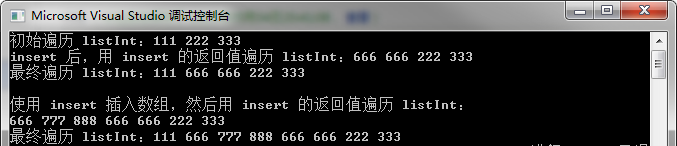
insert(pos, beg, end);
//在pos位置插入[beg,end)区间的数据,下面代码我举两种使用方法,一种是使用迭代器插入,另一种是插入数组
这里需要注意一点,list 不可以随机存取元素,所以不支持 at.(position)函数与[]操作符。可以对其迭代器执行++和--,但是不能这样操作迭代器:it + 3
 1 #include <iostream>

 2 #include <list>

 3

 4 using namespace std;

 5

 6 int main()

 7 {

 8     int num[] = { 111,222,333 };

 9     int num_1[] = { 666,777,888 };

10     list<int> listInt(num, num + size(num));

11     list<int> listInt_A(2, 666);

12     cout << "初始遍历 listInt:";

13     for (list<int>::iterator it = listInt.begin(); it != listInt.end(); it++)

14     {

15         cout << *it << " ";

16     }

17     cout << endl;

18

19

20     cout << "insert 后,用 insert 的返回值遍历 listInt:";

21     for (list<int>::iterator it = listInt.insert(++listInt.begin(), listInt_A.begin(), listInt_A.end()); it != listInt.end(); it++)

22     {

23         cout << *it << " ";

24     }

25

26     cout << endl;

27     cout << "最终遍历 listInt:";

28     for (list<int>::iterator it = listInt.begin(); it != listInt.end(); it++)

29     {

30         cout << *it << " ";

31     }

32     cout << endl << endl;

33

34

35     //当然这里也可以插入数组

36     cout << "使用 insert 插入数组,然后用 insert 的返回值遍历 listInt:" << endl;

37     for (list<int>::iterator it = listInt.insert(++listInt.begin(), num_1, num_1 + size(num_1)); it != listInt.end(); it++)

38     {

39         cout << *it << " ";

40     }

41

42     cout << endl;

43     cout << "最终遍历 listInt:";

44     for (list<int>::iterator it = listInt.begin(); it != listInt.end(); it++)

45     {

46         cout << *it << " ";

47     }

48

49     return 0;

50 }
打印结果:
clear();
//移除容器的所有数据
 1 #include <iostream>

 2 #include <list>

 3

 4 using namespace std;

 5

 6 int main()

 7 {

 8     int num[] = { 111,222,333 };

 9     list<int> listInt(num, num + size(num));

10     cout << "clear 前遍历 listInt:";

11     for (list<int>::iterator it = listInt.begin(); it != listInt.end(); it++)

12     {

13         cout << *it << " ";

14     }

15     cout << endl;

16     cout << "clear 前 listInt.size() = " << listInt.size() << endl;

17

18

19     listInt.clear();

20     cout << "clear 后遍历 listInt:";

21     for (list<int>::iterator it = listInt.begin(); it != listInt.end(); it++)

22     {

23         cout << *it << " ";

24     }

25     cout << endl;

26     cout << "clear 后 listInt.size() = " << listInt.size() << endl;

27

28     return 0;

29 }
打印结果:

erase(beg, end);
//删除[beg,end)区间的数据,返回下一个数据的位置
 1 #include <iostream>

 2 #include <list>

 3

 4 using namespace std;

 5

 6 int main()

 7 {

 8     int num[] = { 111,222,333,444,555,666 };

 9     list<int> listInt(num, num + size(num));

10     cout << "erase 前遍历 listInt:";

11     for (list<int>::iterator it = listInt.begin(); it != listInt.end(); it++)

12     {

13         cout << *it << " ";

14     }

15     cout << endl;

16

17

18     cout << "erase 后,用其返回值遍历 listInt:";

19     for (list<int>::iterator it = listInt.erase(++listInt.begin(), --listInt.end()); it != listInt.end(); it++)

20     {

21         cout << *it << " ";

22     }

23

24     cout << endl;

25     cout << "erase 后遍历 listInt:";

26     for (list<int>::iterator it = listInt.begin(); it != listInt.end(); it++)

27     {

28         cout << *it << " ";

29     }

30

31     return 0;

32 }
打印结果:

erase(pos);
//删除pos位置的数据,返回下一个数据的位置
 1 #include <iostream>

 2 #include <list>

 3

 4 using namespace std;

 5

 6 int main()

 7 {

 8     int num[] = { 111,222,333,444,555,666 };

 9     list<int> listInt(num, num + size(num));

10     cout << "erase 前遍历 listInt:";

11     for (list<int>::iterator it = listInt.begin(); it != listInt.end(); it++)

12     {

13         cout << *it << " ";

14     }

15     cout << endl;

16

17

18     cout << "erase 后,用其返回值遍历 listInt:";

19     for (list<int>::iterator it = listInt.erase(++listInt.begin()); it != listInt.end(); it++)

20     {

21         cout << *it << " ";

22     }

23

24     cout << endl;

25     cout << "erase 后遍历 listInt:";

26     for (list<int>::iterator it = listInt.begin(); it != listInt.end(); it++)

27     {

28         cout << *it << " ";

29     }

30

31     return 0;

32 }
打印结果:

remove(elem);
//删除容器中所有与elem值匹配的元素
 1 #include <iostream>

 2 #include <list>

 3

 4 using namespace std;

 5

 6 int main()

 7 {

 8     int num[] = { 111,222,111,333,111,444 };

 9     list<int> listInt(num, num + size(num));

10     cout << "erase 前遍历 listInt:";

11     for (list<int>::iterator it = listInt.begin(); it != listInt.end(); it++)

12     {

13         cout << *it << " ";

14     }

15     cout << endl;

16

17     listInt.remove(111);

18     cout << "remove 后遍历 listInt:";

19     for (list<int>::iterator it = listInt.begin(); it != listInt.end(); it++)

20     {

21         cout << *it << " ";

22     }

23

24     return 0;

25 }
打印结果:

还有一种遍历删除法:
 1 #include <iostream>

 2 #include <list>

 3

 4 using namespace std;

 5

 6 int main()

 7 {

 8     int num[] = { 111,222,111,333,111,444 };

 9     list<int> listInt(num, num + size(num));

10     cout << "erase 前遍历 listInt:";

11     for (list<int>::iterator it = listInt.begin(); it != listInt.end(); it++)

12     {

13         cout << *it << " ";

14     }

15     cout << endl;

16

17     for (list<int>::iterator it = listInt.begin(); it != listInt.end();)

18     {

19         if (*it == 111)

20         {

21             it = listInt.erase(it);

22         }

23         else

24         {

25             it++;

26         }

27     }

28

29     cout << "erase 后遍历 listInt:";

30     for (list<int>::iterator it = listInt.begin(); it != listInt.end(); it++)

31     {

32         cout << *it << " ";

33     }

34

35     return 0;

36 }
打印结果:

======================================================================================================================
STL——容器(List)List 的数据元素插入和删除操作的更多相关文章
- [剑指offer]09用两个栈实现队列插入和删除操作,C++实现
原创博文,转载请注明出处! # 本文为牛客网<剑指offer>刷题笔记 1.题目 # 用两个栈实现队列的插入和删除操作 2.思路 栈服从先入后出的原则处理数据,队列服从先入先出的原则处理数 ...
- Java创建二叉搜索树,实现搜索,插入,删除操作
Java实现的二叉搜索树,并实现对该树的搜索,插入,删除操作(合并删除,复制删除) 首先我们要有一个编码的思路,大致如下: 1.查找:根据二叉搜索树的数据特点,我们可以根据节点的值得比较来实现查找,查 ...
- STL——容器(Map & multimap)的插入与迭代器
1. 容器(Map & multimap)的插入 map.insert(...); //往容器插入元素,返回pair<iterator,bool> map中插入元素的四种方式 ...
- jquery元素插入、删除、清空
1)jquery元素插入 <!--位置1--> <div id='test'> <!--位置2--> <div>测试</div> <! ...
- jquery元素插入、删除、清空、找父子级元素
1)jquery元素插入 <!--位置1--> <div id='test'> <!--位置2--> <div>测试</div> <! ...
- STL—— 容器(vector)数据插入insert()方法 的返回值
vector 容器下的 insert() 方法拥有返回值,由于insert() 方法拥有4种重载函数,他的返回值不尽相同. 第一种,插入单个元素后的返回值: 1 #include <iostre ...
- STL——容器(deque)deque 的插入 insert()
deque.insert(pos,elem); //在pos位置插入一个elem元素的拷贝,返回新数据的位置. 1 #include <iostream> 2 #include <d ...
- Java BLOB 数据的插入与读取 操作
package com.lw.database; import java.io.FileInputStream; import java.io.FileOutputStream; import jav ...
- Thinkphp 数据的修改及删除操作
一.数据修改操作 save() 实现数据修改,返回受影响的记录条数 具体有两种方式实现数据修改,与添加类似(数组.AR方式) 1.数组方式: a) $goods = D(“Goods ...
随机推荐
- Python网络编程_抓取百度首页代码(注释详细)
1 #coding=utf-8 2 #网络编程 3 4 #客户端建立socket套接字 5 #引入socket模块 6 import socket 7 #实例化一个套接字,2个参数分别是: IPV4. ...
- Docker学习第四天(Dockerfile)
dockerfile Dockerfile是用来构建Docker镜像的构建文件,是由一系列命令和参数构成的脚本 Dockerfile是由一系列命令和参数构成的脚本,这些命令应用于基础镜像并最终创建一个 ...
- 设置cmd默认管理员模式启动
打开cmd文件位置
- RSA(攻防世界)Rsa256 -- cr4-poor-rsa
RSA256 [攻防世界] 题目链接 [RSA256] 下载附件得到两个文件. 猜测第一个 txt 文件 可能为RSA加密密文 ,第二个估计就是密钥.依次打开看看: 果然如此. 目标: 寻找 n.e. ...
- 理解Volatile关键字,其实看这一篇就够了,写的非常细致
前言 volatile是Java虚拟机提供的轻量级的同步机制. volatile关键字作用是什么? 两个作用: 1.保证被volatile修饰的共享变量对所有线程总数可见的,也就是当一个线程修改了一个 ...
- 面试阿里,首先要掌握的 Java 泛型,帮你一次性搞懂!
引言 泛型是Java中一个非常重要的知识点,在Java集合类框架中泛型被广泛应用.本文我们将从零开始来看一下Java泛型的设计,将会涉及到通配符处理,以及让人苦恼的类型擦除. 泛型基础 泛型类 我们首 ...
- 了解 MySQL的数据行、行溢出机制吗?
目录 一.行 有哪些格式? 二.紧凑的行格式长啥样? 三.MySQL单行能存多大体量的数据? 四.Compact格式是如何做到紧凑的? 五.什么是行溢出? 六.行 如何溢出? 七.思考一个问题 关注送 ...
- 巧妙利用Camtasia制作网课
随着互联网的快速发展,网络学习变得非常流行.这种躺在床上就可以获取知识的方法让大家渐渐地都喜欢上了学习,那么我们是否想要了解一下网课的幕后制作呢. 今天我给大家带来的便是巧妙利用Camtasia进行网 ...
- 推荐一款比迅雷下载速度快的mac下载器
Folx和迅雷是2款支持在Mac系统上进行文件资源下载的工具,两者都支持BT种子资源的下载和直链下载,但Folx还另外支持了下载计划的自定义和智能限速功能.本文主要是为了比较Folx和迅雷在下载同一资 ...
- jQuery 第九章 工具方法之插件扩展 $.extend() 和 $.fn.extend()
$.extend() $.fn.extend() -------------------------------------------------- $.extend() 插件扩展(工具方法) jq ...