
Struts2(三)
以下内容是基于导入struts2-2.3.32.jar包来讲的
1.全局视图配置
xml标签:
<global-results>

    <result name="error">/error.jsp</result>

</global-results>
 package com.ronng.web.action;

 public class TwoAction {

     public String show(){

         return "error";

     }

     public String look(){

         return "error";

     }

 }
<?xml version="1.0" encoding="UTF-8" ?>

<!DOCTYPE struts PUBLIC

    "-//Apache Software Foundation//DTD Struts Configuration 2.3//EN"

    "http://struts.apache.org/dtds/struts-2.3.dtd">

<struts>

    <package name="com.rong.web.action" namespace="/" extends="struts-default">

        <!-- 全局视图。当action标签里面不包含result标签时,就会寻找全局的global-results结果视图 -->

        <global-results>

            <result name="error">/error.jsp</result>

        </global-results>

        <action name="error1" class="com.ronng.web.action.TwoAction" method="show">

        </action>

        <action name="error2" class="com.ronng.web.action.TwoAction" method="look">

        </action>

    </package>

</struts>
访问路径:
http://localhost:8080/struts/error1
http://localhost:8080/struts/error2
返回的都是同一个error.jsp页面
2.全局的异常配置
 package com.ronng.web.action;

 public class TwoAction {

     public String show() throws Exception{

         //抛出异常,无法返回"error"字符串

         int number=1/0;

         return "error";

     }

     public String look()throws Exception{

         return "error";

     }

 }
struts.xml配置是有顺序的:全局结果视图需要放在全局异常的前面

<?xml version="1.0" encoding="UTF-8" ?>

<!DOCTYPE struts PUBLIC

    "-//Apache Software Foundation//DTD Struts Configuration 2.3//EN"

    "http://struts.apache.org/dtds/struts-2.3.dtd">

<struts>

    <package name="com.rong.web.action" namespace="/" extends="struts-default">

        <!-- 全局视图。当action标签里面不包含result标签时,就会寻找全局的global-results结果视图 -->

        <global-results>

            <result name="error">/error.jsp</result>

            <result name="exception">/exception.jsp</result>

        </global-results>

        <!-- 全局异常配置 。result对应全局视图的result的name-->

        <global-exception-mappings>

            <exception-mapping result="exception" exception="java.lang.Exception"></exception-mapping>

        </global-exception-mappings>

        <action name="error1" class="com.ronng.web.action.TwoAction" method="show">

        </action>

        <action name="error2" class="com.ronng.web.action.TwoAction" method="look">

        </action>

    </package>

</struts>
以上的方法不能处理类似404的错误,若要处理404错误,则只需要修改web.xml配置文件
<error-page>标签配置
<?xml version="1.0" encoding="UTF-8"?>

<web-app xmlns:xsi="http://www.w3.org/2001/XMLSchema-instance" xmlns="http://java.sun.com/xml/ns/javaee" xsi:schemaLocation="http://java.sun.com/xml/ns/javaee http://java.sun.com/xml/ns/javaee/web-app_3_0.xsd" id="WebApp_ID" version="3.0">

  <display-name>struts</display-name>

  <welcome-file-list>

    <welcome-file>index.html</welcome-file>

    <welcome-file>index.htm</welcome-file>

    <welcome-file>index.jsp</welcome-file>

    <welcome-file>default.html</welcome-file>

    <welcome-file>default.htm</welcome-file>

    <welcome-file>default.jsp</welcome-file>

  </welcome-file-list>

  <filter>

      <filter-name>struts2</filter-name>

      <filter-class>org.apache.struts2.dispatcher.ng.filter.StrutsPrepareAndExecuteFilter</filter-class>

  </filter>

  <filter-mapping>

      <filter-name>struts2</filter-name>

      <url-pattern>/*</url-pattern>

  </filter-mapping>

  <error-page>

      <error-code>404</error-code>

      <location>/404.jsp</location>

  </error-page>

</web-app>
3.最简单的action配置
<?xml version="1.0" encoding="UTF-8" ?>

<!DOCTYPE struts PUBLIC

    "-//Apache Software Foundation//DTD Struts Configuration 2.3//EN"

    "http://struts.apache.org/dtds/struts-2.3.dtd">

<struts>

    <package name="com.rong.web.action" namespace="/" extends="struts-default">

        <!-- 最简单的action

            class 默认是struts-default.xml的

                <default-class-ref class="com.opensymphony.xwork2.ActionSupport" />

            默认执行的method 是 execute

            方法默认的返回值是什么 "success"

         -->

        <!-- 对于最简单的action也就是

        没有配置class的action要执行的哪个action,

        可以不使用默认的,重新配置 ,但是依然会使用默认的 execute方法-->

        <default-class-ref class="com.ronng.web.action.OneAction"></default-class-ref>

        <action name="simple">

            <result>/index.jsp</result>

        </action>

    </package>

</struts>
4.路径访问搜索顺序
<?xml version="1.0" encoding="UTF-8" ?>

<!DOCTYPE struts PUBLIC

    "-//Apache Software Foundation//DTD Struts Configuration 2.3//EN"

    "http://struts.apache.org/dtds/struts-2.3.dtd">

<struts>

    <!--

        资源路径

        http://localhost:8080/struts/search

        http://localhost:8080/struts/aa/bb/cc/search

        以上两种方式均可访问到同一页面

        其中http://localhost:8080/struts是服务器以及项目信息

            主要看这段:/aa/bb/cc/search

            搜索顺序:没找到时继续往前找,由于search是action里面的name路径,所以最后才判断

            先判断package,最后才判断action

                namespace是/aa/bb/cc

                namespace是/aa/bb

                namespace是/aa

                namespace是/

                有这个/的命名空间了

                    那就在这个命名空间的action里找search

     -->

    <!-- namespace命名空间不写时,默认是斜杠"/" -->

    <package name="com.rong.web.action" namespace="/" extends="struts-default">

        <action name="search" class="com.ronng.web.action.OneAction">

            <result>/index.jsp</result>

        </action>

    </package>

</struts>
5.获取域对象以及ActionContext上下文
A.第一种方式(通过ServletActionContext获取)
 package com.ronng.web.action;

 import javax.servlet.ServletContext;

 import javax.servlet.http.HttpServletRequest;

 import javax.servlet.http.HttpSession;

 import javax.servlet.jsp.PageContext;

 import org.apache.struts2.ServletActionContext;

 /**

  * 普通类获取域对象

  * 通过ServletActionContext获取

  * @author Rong

  *

  */

 public class TwoAction {

     public String show() throws Exception{

         //使用原生API,耦合度高,很少使用

         PageContext pageContext = ServletActionContext.getPageContext();

         //可通过pageContext获取其余域对象

 //        ServletRequest request = pageContext.getRequest();

 //        HttpSession session = pageContext.getSession();

 //        ServletContext application = pageContext.getServletContext();

         HttpServletRequest request = ServletActionContext.getRequest();

         //获取前台传过来的值

         String parameter = request.getParameter("name");

         System.out.println(parameter);

         HttpSession session = request.getSession();

         ServletContext application = ServletActionContext.getServletContext();

         request.setAttribute("name", "rong");

         session.setAttribute("name", "jie");

         application.setAttribute("name", "long");

         return "success";

     }

 }
<body>

    通用的域: ${name }<br/>

    request域:${requestScope.name }<br/>

    session域:${sessionScope.name }<br/>

    application域:${applicationScope.name }<br/>

</body>
<?xml version="1.0" encoding="UTF-8" ?>

<!DOCTYPE struts PUBLIC

    "-//Apache Software Foundation//DTD Struts Configuration 2.3//EN"

    "http://struts.apache.org/dtds/struts-2.3.dtd">

<struts>

    <package name="com.rong.web.action" namespace="/" extends="struts-default">

        <action name="search" class="com.ronng.web.action.TwoAction" method="show">

            <result>/two.jsp</result>

        </action>

    </package>

</struts>
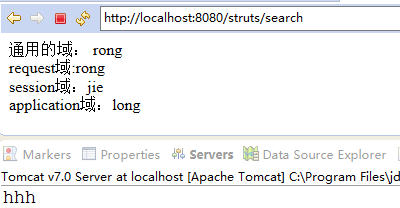
B.第二种方式(ActionContext上下文的get方式)
 package com.ronng.web.action;

 import org.apache.struts2.dispatcher.ApplicationMap;

 import org.apache.struts2.dispatcher.RequestMap;

 import org.apache.struts2.dispatcher.SessionMap;

 import com.opensymphony.xwork2.ActionContext;

 /**

  * 普通类获取域对象

  * 通过ActionContext上下文get方式获取

  * 松耦合

  * @author Rong

  */

 public class TwoAction {

     public String show() throws Exception{

         //获取ActionContext上下文。ActionContext在请求最开始的时候封装了所有数据。

         ActionContext actionContext = ActionContext.getContext();

         //通过get方法获取域对象。其中get里面的字符串是唯一指定的。

         RequestMap requestMap = (RequestMap) actionContext.get("request");

         SessionMap<String, Object> sessionMap = (SessionMap<String, Object>) actionContext.get("session");

         ApplicationMap applicationMap = (ApplicationMap) actionContext.get("application");

         requestMap.put("name", "rong");

         sessionMap.put("name", "jie");

         applicationMap.put("name", "long");

         return "success";

     }

 }
C.第三种方式(ActionContext上下文的getXxx方式)
 package com.ronng.web.action;

 import java.util.Map;

 import com.opensymphony.xwork2.ActionContext;

 /**

  * 普通类获取域对象

  * 通过ActionContext上下文getXxx方式获取

  * 松耦合

  * @author Rong

  */

 public class TwoAction {

     public String show() throws Exception{

         //获取ActionContext上下文。ActionContext在请求最开始的时候封装了所有数据。

         ActionContext actionContext = ActionContext.getContext();

         Map<String, Object> request = actionContext.getContextMap();

         Map<String, Object> session = actionContext.getSession();

         Map<String, Object> application = actionContext.getApplication();

         request.put("name", "rong");

         session.put("name", "jie");

         application.put("name", "long");

         return "success";

     }

 }
D.第四种方式(实现XxxAware接口)
根据需要实现不同域的接口
 package com.ronng.web.action;

 import java.util.Map;

 import org.apache.struts2.interceptor.ApplicationAware;

 import org.apache.struts2.interceptor.RequestAware;

 import org.apache.struts2.interceptor.SessionAware;

 /**

  * 实现接口方式获取域对象

  * 松耦合

  * @author Rong

  * 这里列举了实现多种域接口,实际根据自己需要实现接口

  */

 public class TwoAction implements RequestAware,SessionAware,ApplicationAware{

     //需要自己去声明成员变量(域对象)

     private Map<String, Object> request;

     private Map<String, Object> session;

     private Map<String, Object> applicaton;

     public String show() throws Exception{

         request.put("name", "r");

         session.put("name", "j");

         applicaton.put("name", "l");

         return "success";

     }

     //域对象赋值

     @Override

     public void setApplication(Map<String, Object> arg0) {

         this.applicaton=arg0;

     }

     @Override

     public void setSession(Map<String, Object> arg0) {

         this.session=arg0;

     }

     @Override

     public void setRequest(Map<String, Object> arg0) {

         this.request=arg0;

     }

 }
Struts2(三)的更多相关文章
- Struts2(三)——数据在框架中的数据流转问题
一款软件,无在乎对数据的处理.而B/S软件,一般都是用户通过浏览器客户端输入数据,传递到服务器,服务器进行相关处理,然后返回到指定的页面,进行相关显示,完成相关功能.这篇博客重点简述一下Struts2 ...
- Struts2 (三)
1 Struts2的拦截器 Struts2拦截器在访问某个Action方法之前或之后实施拦截,拦截器是可插拔的,拦截器是AOP的一种实现. Struts2拦截器栈:将拦截器按一定顺序联结成一条链,在访 ...
- 框架学习之Struts2(三)---OGNL和值栈
一.OGNL概述 1.1OGNL是对象图导航语言(Object-Graph Navigation Languaged)的缩写,他是一种功能强大的表达式语言,通过简单一致的表达式语法,可以存取Java对 ...
- struts2(三) 输入校验和拦截器
前面知道了struts2的架构图和struts2的自动封装表单参数和数据类型自动转换,今天来学struts2的第三第四个东西,输入校验和拦截器, --WH 一.输入校验 在以前我们写一个登录页面时,并 ...
- Struts2(三)配置详解
一.概述 Struts2提供了多种可选的配置文件形式. 其中,struts-default.xml和default.properties是框架级别的配置文件,这两个文件在Struts的核心JAR包中, ...
- Struts2 (三) — OGNL与值栈
一.OGNL表达式 1.概述 1.1什么是OGNL OGNL是Object-Graph Navigation Language的缩写,俗称对象图导航语言. 它是一种功能强大的表达式语言,通过它简单 ...
- Struts2(三):新建Struts2工程
下载的struts2xx-all.zip包对搭建项目的作用 一般情况下,我们下载一个Struts2的full包时,并不知道新建过程中需要哪些包,那么这时我们可以从下载的包中解压出的目录\apps\st ...
- Struts2 三、指定Struts2处理的请求后缀
Action的请求通常情况下默认为以.action结尾,例如:http://localhost:9000/Struts2/hello/helloAction_sayHello.action .a ...
- 浅谈Struts2(三)
一.Struts2收集client的参数 核心思路: <form method="post" action="XXXX"> <input ty ...
- 深入struts2(三)---工作机制和运行流程图
1 工作原理 1.1 体系架构 图2.1 struts2.0体系架构图 1.2 工作机制 针对上节体系架构图,以下分步说明运行流程 Ø client初始化一个指向Servle ...
随机推荐
- python列表的通用操作
#'+'和'*'#+可以将两个列表拼接为一个列表my_list = [1,2,3]+[4,5,6]#*可以将列表重复指定的次数my_list = [1,2,3]*5 print(my_list) #创 ...
- Linux--ps及top、ls命令
day8 ps系统管理命令 ps是强大的后台进程检测命令 格式:ps [options] [--help] 选项参数: 1.-a :显示所有进程,包括PID等,包括其他用户运行的程序 2.-ef:显 ...
- Python学习:17.Python面向对象(四、属性(特性),成员修饰符,类的特殊成员)
一.属性(特性) 普通方法去执行的时候,后面需要加括号,特性方法执行的时候和静态字段一样不需要不需要加括号. 特性方法不和字段同名. 特性方法不能传参数. 在我们定义数据库字段类的时候,往往需要对其中 ...
- Testing for diversifying selection for two clades with a background clade
在利用branch-site检测趋同进化的时候 .可以将各个趋同进化枝分别进行检测,分析的时候不去除某一趋同枝系 .在分析的时候,需要去除其他趋同枝系的影响 I have sequences of a ...
- 脱离matlab运行可执行程序的步骤
MCR是由matlab的运行环境,占用不到600M的对于用不同matlab版本生成的exe文件,MCR版本也会有不同,因此,在程序打包时,最好将相应版本的MCR一起打包.MCR环境的设置文件存放目录如 ...
- Linux入门第四天——shell基础
一.shell概述 1.概述 命令行解释器(壳,也就是我们的操作界面),计算机只认识0101的二进制,我们需要通过ASCII表来进行翻译 较为官方的解释是: Shell 是一个用 C 语言编写的程序, ...
- 推荐一个学习Flex chart的好网站
推荐一个学习Flex chart的好网站 2013-03-04 14:16:56| 分类: Flex | 标签: |字号大中小 订阅 推荐一个学习Flex chart的好网站 最近在做一个 ...
- 一个servlet如何处理多个请求
页面1:表单的action=login?method=login 页面2:表单的action=login?method=insert ..... 然后通过method的值采用不同方法进行处理. 如下 ...
- 考研编程练习----Kruskal
#include <stdio.h> #include <stdlib.h> #define MAX 100 /* 定义边(x,y),权为w */ typedef st ...
- Matplotlib API汉化
Pyplot API 示例汇总:https://matplotlib.org/gallery/index.html#api-examples 该matplotlib.pyplot模块包含的功能允许您快 ...