
Spring的IOC/DI使用到的技术
一、了解Spring IOC/DI
1:Spring有两大核心技术,控制反转(Inversion of Control, IOC)/依赖注入(Dependency Injection,DI)和面向切面编程(Aspect Oriented Programming,AOP)
2. IOC/DI: 它用来管理所有的java类,类对象的创建和依赖关系都由IOC/DI进行控制。控制反转(IOC)和依赖注入(DI)在spring中表示同一种意思,只是看问题的角度不同,例如
当在A类中new一个B类时,控制权由A掌握,可以理解为控制正转,当A类使用的B类实例有spring创建时,控制权由spring掌握,就是控制反转;
依赖注入可以理解为A类依赖于spring,由spring注入B类。控制反转是抽象的概念,只是提出了一种“控制”的方式,而依赖注入是spring框架实现“控制反转”的具体方法。
3. IOC/DI工作原理:spring IOC/DI的更为直观的叫法是容器,这是因为spring可以管理很多类,当需要某一类对象的实例时,spring就会提供相应的实例,就像是一个容器里面
可以放入很多东西,需要什么就取什么。那么在spring容器中都有什么类可以使用呢?这需要预先定义在spring的配置文件中,默认的配置文件名称是applicationContext.xml
例如在配置文件中定义了A类和B类,而A类中使用到了B类,那么配置文件中再定义好这种依赖关系,即可由Spring自动地把B类实例注入到A类中,但是,这种注入是有条件的,
类需要符合Javabean的定义规范,在A类中需要定义对B类赋值的setter方法。这是Spring对管理的类唯一的要求,不需要像EJB那样实现框架本身的任何接口,也是spring被称
为轻量级框架的原因。
二、IOC/DI使用到的技术
1. JDOM:JDOM是对xml文件进行解析的技术,Spring的配置文件applicationContext.xml就是由JDOM进行解析的,它可以提取出xml文件中定义的标签和属性值。
1.1 环境的搭建:

1.2 StudentAction.java
public class StudentAction {

    private StudentService studentService;

    public void setStudentService(StudentService studentService) {

        this.studentService = studentService;

    }

    public void printName() {

        System.out.println(studentService.getName());

    }

}
1.3 StudentServiceImpl.java
public class StudentServiceImpl implements StudentService{

    private StudentDao studentDao;

    public void setStudentDao(StudentDao studentDao) {

        this.studentDao = studentDao;

    }

    public String getName() {

        return studentDao.getName();

    }

}
1.4 StudentService.java
public interface StudentService {

    public String getName();

}
1.5 StudentDao.java
public interface StudentDao {

    public String getName();

}
1.6 StudentDaoImpl.java
public class StudentDaoImpl implements StudentDao{

    public String getName() {

        return "Jike Wang";

    }

}
1.7 测试
public class TestAction {

public static void main(String[] args) {

    //使用ApplicationContext接口的实现类ClassPathXmlApplicationContext加载spring配置文件

    ApplicationContext applicationContext = new ClassPathXmlApplicationContext("/applicationContext.xml");

    //通过ApplicationContext接口的getBean方法获取id或name为studentAction的Bean实例

    StudentAction studentAction = (StudentAction) applicationContext.getBean("studentAction");

    //调用方法

    studentAction.printName();

}

}
1.8 使用jdom模拟spring解析xml文件,读取关键信息
自定义XML代码:
<?xml version="1.0" encoding="UTF-8"?>

<beans>

    <!-- 定义StudentDaoImpl对象并指定id为studentDao -->

    <bean id="studentDao" class="com.IOC.dao.impl.StudentDaoImpl"></bean>

    <!-- 定义StudentServiceImpl对象并指定id为studentService-->

    <bean id="studentService" class="com.IOC.service.impl.StudentServiceImpl">

        <property name="studentDao" ref="studentDao"></property>

    </bean>

    <!-- 定义StudentAction对象并指定id为studentAction -->

    <bean id="studentAction" class="com.IOC.action.StudentAction">

        <property name="studentService" ref="studentService"></property>

    </bean>

</beans>
public class TestJDOM {

public static void main(String[] args) {

    String path = "src/main/resources/applicationContext.xml";//xml文件目录

    //用于创建文档对象

    SAXBuilder sb = new SAXBuilder();

    //构造的XML文档对象

    Document doc;

    try {

        //创建文档对象

        doc = sb.build(path);

        //得到文档的根元素<beans>

        Element rootElement = doc.getRootElement();

        //得到文档的所有<bean>

        List<Element> list = rootElement.getChildren("bean");

        for (Element element : list) {

            //得到<bean>的id属性值

            String id = element.getAttributeValue("id");

            //得到<bean>的class属性值

            String classValue = element.getAttributeValue("class");

            //得到<bean>的子元素<property>

            Element propertyElement = element.getChild("property");

            String propertyName = null;

            String propertyRef = null;

            if (propertyElement != null) {

                //得到<property>的name属性值

                propertyName = propertyElement.getAttributeValue("name");

                //得到property的内容

                propertyRef = propertyElement.getAttributeValue("ref");

            }

            System.out.println("========================");

            System.out.println("id="+id);

            System.out.println("class="+classValue);

            System.out.println("propertyName="+propertyName);

            System.out.println("propertyRef="+propertyRef);

            System.out.println("========================");

        }

    } catch (Exception e) {

        e.printStackTrace();

    }

}

}
测试结果:
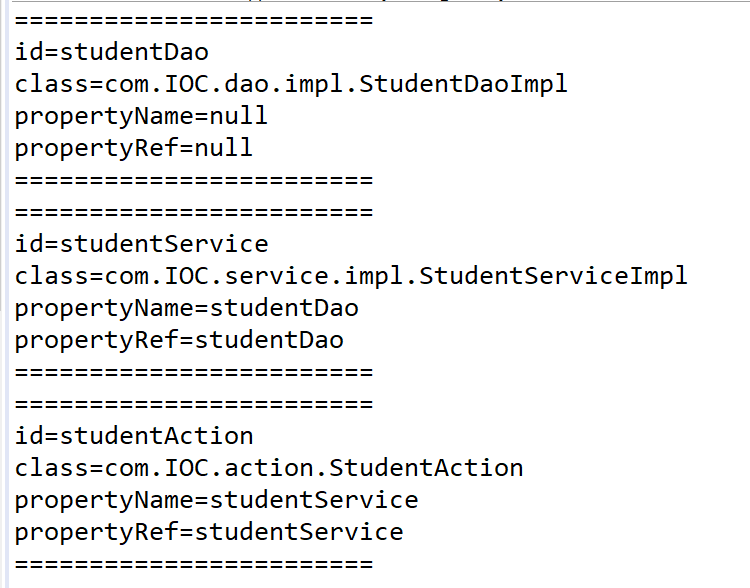
2. 反射机制:对配置文件中的类名使用反射机制可以实现类加载初始化等工作,也可以调用类的方法进行属性注入,java.lang.reflect提供了反射相关的工具
public class TestReflect {

    public static void main(String[] args) {

        //表示StudentDao接口全路径

        String studentDao = "com.IOC.dao.StudentDao";

        //表示StudentService接口全路径

        String studentService = "com.IOC.service.StudentService";

        //表示StudentDaoImpl类全路径

        String studentDaoImpl = "com.IOC.dao.impl.StudentDaoImpl";

        //表示StudentServiceImpl

        String studentServiceImpl = "com.IOC.service.impl.StudentServiceImpl";

        //表示StudentAction类全路径

        String studentAction = "com.IOC.action.StudentAction";

        //表示setStudentService方法的字符串

        String setStudentService = "setStudentService";

        //表示setStudentDao方法的字符串

        String setStudentDao = "setStudentDao";

        try {

            //使用全路径字符串加载StudentDao类别

            Class studentDaoClass = Class.forName(studentDao);

            //使用全路径字符串加载StudentService类别

            Class studentServiceClass = Class.forName(studentService);

            //使用全路径字符串加载StudentDaoImpl类别

            Class studentDaoImplClass = Class.forName(studentDaoImpl);

            //使用全路径字符串加载StudentServiceImpl类别

            Class studentServiceImplClass = Class.forName(studentServiceImpl);

            //使用全路径字符串加载StudentAction类别

            Class studentActionClass = Class.forName(studentAction);

            //setStudentDao方法签名,相当于获取次此方法,使用类别获取setStudentDao方法

            Method setDaoMethod = studentServiceImplClass.getMethod(setStudentDao, studentDaoClass);

            //setStudentService方法签名,使用类别获取setStudentService方法

            Method setServiceMethod = studentActionClass.getMethod(setStudentService, studentServiceClass);

            //创建StudentDaoImpl对象,相当于new StudentDaoImpl(),但返回的是Object对象

            Object studentDaoImplnstance = studentDaoImplClass.newInstance();

            //创建StudentServiceImpl对象,相当于new StudentServiceImpl(),但返回的是Object对象

            Object studentServiceImplInstance = studentServiceImplClass.newInstance();

            //创建StudentAction对象,相当于new StudentAction(),但返回的是Object对象

            Object studentActionInstance = studentActionClass.newInstance();

            //使用反射机制调用StudentServiceImpl的setStudentDao方法,参数是StudentDaoImpl对象,

            //第一个参数是执行方法的类实例,第二个参数是方法参数

            setDaoMethod.invoke(studentServiceImplInstance, studentDaoImplnstance);

            setServiceMethod.invoke(studentActionInstance, studentServiceImplInstance);

            //调用StudentAction的printName方法

            ((StudentAction)studentActionInstance).printName();

        } catch (Exception e) {

            e.printStackTrace();

        }

    }

}
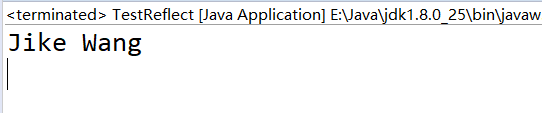
测试结果:
Spring的IOC/DI使用到的技术的更多相关文章
- Spring框架-IOC/DI详细学习
一.IOC/DI概念 参考博客:https://www.cnblogs.com/xdp-gacl/p/4249939.html IOC(inversion of control, 控制反转)是一种设计 ...
- Spring框架——IOC&DI
Spring Spring 目标 内容 Spring与web整合的原理 Spring 中包含的关键特性 Spring架构图 企业级框架 企业级系统 IOCDI IOC DI IOC和DI 为什么使用依 ...
- spring的IOC/DI功能实践
一.写在前面: 做这个Demo主要是为了能够更好的理解Spring的原理,看再多的文章,听再多的讲解最终都最好自己去实现一遍,可以将Spring的功能分块实现,最终自然比较容易将各个功能组合起来. 这 ...
- Spring之IOC/DI(反转控制/依赖注入)_入门Demo
在平时的java应用开发中,我们要实现某一个功能或者说是完成某个业务逻辑时至少需要两个或以上的对象来协作完成,在没有使用Spring的时候,每个对象在需要使用他的合作对象时,自己均要使用像new ob ...
- 个人对spring的IOC+DI的封装
暂时支持8种基本数据类型,String类型,引用类型,List的注入. 核心代码 package day01; import java.lang.reflect.Field;import java.l ...
- Spring基础[IOC/DI、AOP]
一.Spring作用:管理项目中各种业务Bean(service类.Dao类.Action类),实例化类,属性赋值 二.Spring IOC(Inversion of Control )控制反转,也被 ...
- Spring理解IOC,DI,AOP作用,概念,理解。
IOC控制反转:创建实例对象的控制权从代码转换到Spring容器.实际就是在xml中配置.配置对象 实例化对象时,进行强转为自定义类型.默认返回类型是Object强类型. ApplicationCon ...
- Spring注解IOC/DI(4)
2019-03-08/11:10:17 演示:使用注解的方式完成注入对象中的效果 注解参考链接:https://www.cnblogs.com/szlbm/p/5512931.html Spring中 ...
- 解释Spring中IOC, DI, AOP
oc就是控制翻转或是依赖注入.通俗的讲就是如果在什么地方需要一个对象,你自己不用去通过new 生成你需要的对象,而是通过spring的bean工厂为你长生这样一个对象.aop就是面向切面的编程.比如说 ...
随机推荐
- datatable实例教程
网站的后台,多数是需要使用datatable来展示数据的,因为datatable的功能比较强大,可以更好的使用. 引用css <link href="../../static/asse ...
- QT在Linux下的安装
QT是一个跨平台的C++开发库,设计思想是同样的,C++无需修改就可以在windows.linux.macOS等平台上使用,他使开发更专注于构建软件的核心价值,而不是维护API.作为面向对象的框架,它 ...
- 3 week work—Position
源代码部分: (1)httm部分: <!DOCTYPE html> <html lang="en"> <head> <meta chars ...
- 使用CGlib出现java.lang.NoClassDefFoundError: org/objectweb/asm/Type异常
在学习使用CGlib生成动态代理对象,项目的源代码也很简单: package proxy; import java.lang.reflect.Method; import net.sf.cglib.p ...
- 宽字符wchar_t和窄字符char——putwchar、wprintf
宽字符wchar_t 与 窄字符char 先说下窄字符char,这个大部分读者应该很清楚,char类型的变量占一个字节(byte)(也就是8个bit(比特)),能表示256个字符,那char的范围有两 ...
- 解决C#调用执行js报检索 COM 类工厂中 CLSID 为 {0E59F1D5-1FBE-11D0-8FF2-00A0D10038BC} 组件失败
最近做了一个模拟请求的网站简化原网站的繁琐数据,提出有用的数据简单展示并完成post.由于原网站数据有js加密,所以我抓出原网站的js解密方法,由C#调用js得到解密后的数据. 整个抓包的框架是用的苏 ...
- XXE(XML External Entity attack)XML外部实体注入攻击
导语 XXE:XML External Entity 即外部实体,从安全角度理解成XML External Entity attack 外部实体注入攻击.由于程序在解析输入的XML数据时,解析了攻击者 ...
- JDK 安装目录中 native2ascii.exe 命令详解
native2ascii 简介 native2ascii 是 sun java sdk提供的一个工具.用来将别的文本类文件(比如*.txt,*.ini,*.properties,*.java等等)编码 ...
- openresty + lua 1、openresty 连接 mysql,实现 crud
最近开发一个项目,公司使用的是 openresty + lua,所以就研究了 openresty + lua.介绍的话,我就不多说了,网上太多了. 写这个博客主要是记录一下,在学习的过程中遇到的一些坑 ...
- LeetCode--No.012 Integer to Roman
12. Integer to Roman Total Accepted: 71315 Total Submissions: 176625 Difficulty: Medium Given an int ...