
Spring Security(三十):9.5 Access-Control (Authorization) in Spring Security
The main interface responsible for making access-control decisions in Spring Security is the AccessDecisionManager. It has a decide method which takes an Authentication object representing the principal requesting access, a "secure object" (see below) and a list of security metadata attributes which apply for the object (such as a list of roles which are required for access to be granted).
9.5.1 Security and AOP Advice
If you’re familiar with AOP, you’d be aware there are different types of advice available: before, after, throws and around. An around advice is very useful, because an advisor can elect whether or not to proceed with a method invocation, whether or not to modify the response, and whether or not to throw an exception. Spring Security provides an around advice for method invocations as well as web requests. We achieve an around advice for method invocations using Spring’s standard AOP support and we achieve an around advice for web requests using a standard Filter.
9.5.2 Secure Objects and the AbstractSecurityInterceptor
So what is a "secure object" anyway? Spring Security uses the term to refer to any object that can have security (such as an authorization decision) applied to it. The most common examples are method invocations and web requests.
Each supported secure object type has its own interceptor class, which is a subclass of AbstractSecurityInterceptor. Importantly, by the time the AbstractSecurityInterceptor is called, the SecurityContextHolder will contain a valid Authentication if the principal has been authenticated.
AbstractSecurityInterceptor provides a consistent workflow for handling secure object requests, typically:
- Look up the "configuration attributes" associated with the present request
查找与当前请求关联的“配置属性”
- Submitting the secure object, current
Authenticationand configuration attributes to theAccessDecisionManagerfor an authorization decision将安全对象,当前身份验证和配置属性提交给AccessDecisionManager以进行授权决策 - Optionally change the
Authenticationunder which the invocation takes place(可选)更改进行调用的身份验证 - Allow the secure object invocation to proceed (assuming access was granted)
允许安全对象调用继续(假设已授予访问权限)
- Call the
AfterInvocationManagerif configured, once the invocation has returned. If the invocation raised an exception, theAfterInvocationManagerwill not be invoked.调用返回后,调用AfterInvocationManager(如果已配置)。如果调用引发异常,则不会调用AfterInvocationManager。
What are Configuration Attributes?
A "configuration attribute" can be thought of as a String that has special meaning to the classes used by AbstractSecurityInterceptor. They are represented by the interface ConfigAttribute within the framework. They may be simple role names or have more complex meaning, depending on the how sophisticated the AccessDecisionManager implementation is. The AbstractSecurityInterceptor is configured with a SecurityMetadataSource which it uses to look up the attributes for a secure object. Usually this configuration will be hidden from the user.
<intercept-url pattern='/secure/**' access='ROLE_A,ROLE_B'/> in the namespace introduction, this is saying that the configuration attributes ROLE_A and ROLE_B apply to web requests matching the given pattern. In practice, with the default AccessDecisionManager configuration, this means that anyone who has a GrantedAuthority matching either of these two attributes will be allowed access. Strictly speaking though, they are just attributes and the interpretation is dependent on the AccessDecisionManager implementation. The use of the prefix ROLE_ is a marker to indicate that these attributes are roles and should be consumed by Spring Security’s RoleVoter. This is only relevant when a voter-based AccessDecisionManager is in use. We’ll see how the AccessDecisionManager is implemented in the authorization chapter.RunAsManager
Assuming AccessDecisionManager decides to allow the request, the AbstractSecurityInterceptor will normally just proceed with the request. Having said that, on rare occasions users may want to replace the Authentication inside the SecurityContext with a different Authentication, which is handled by the AccessDecisionManager calling a RunAsManager. This might be useful in reasonably unusual situations, such as if a services layer method needs to call a remote system and present a different identity. Because Spring Security automatically propagates security identity from one server to another (assuming you’re using a properly-configured RMI or HttpInvoker remoting protocol client), this may be useful.
AfterInvocationManager
Following the secure object invocation proceeding and then returning - which may mean a method invocation completing or a filter chain proceeding - the AbstractSecurityInterceptor gets one final chance to handle the invocation. At this stage the AbstractSecurityInterceptor is interested in possibly modifying the return object. We might want this to happen because an authorization decision couldn’t be made "on the way in" to a secure object invocation. Being highly pluggable, AbstractSecurityInterceptor will pass control to an AfterInvocationManager to actually modify the object if needed. This class can even entirely replace the object, or throw an exception, or not change it in any way as it chooses. The after-invocation checks will only be executed if the invocation is successful. If an exception occurs, the additional checks will be skipped.
AbstractSecurityInterceptor and its related objects are shown in Figure 9.1, “Security interceptors and the "secure object" model”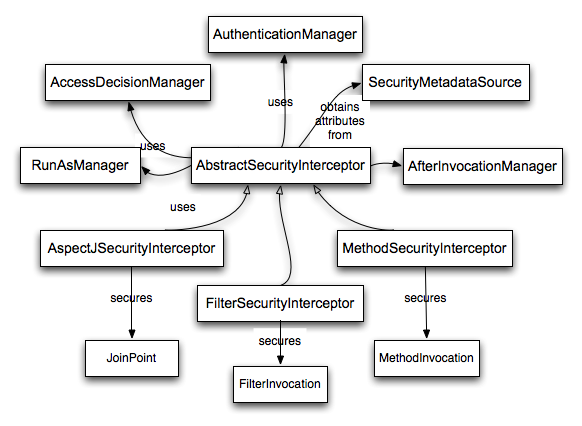
Extending the Secure Object Model
Only developers contemplating an entirely new way of intercepting and authorizing requests would need to use secure objects directly. For example, it would be possible to build a new secure object to secure calls to a messaging system. Anything that requires security and also provides a way of intercepting a call (like the AOP around advice semantics) is capable of being made into a secure object. Having said that, most Spring applications will simply use the three currently supported secure object types (AOP Alliance MethodInvocation, AspectJ JoinPoint and web request FilterInvocation) with complete transparency.
Spring Security(三十):9.5 Access-Control (Authorization) in Spring Security的更多相关文章
- 精选Spring Boot三十五道必知必会知识点
Spring Boot 是微服务中最好的 Java 框架. 我们建议你能够成为一名 Spring Boot 的专家.本文精选了三十五个常见的Spring Boot知识点,祝你一臂之力! 问题一 Spr ...
- Browser security standards via access control
A computing system is operable to contain a security module within an operating system. This securit ...
- SpringBoot:三十五道SpringBoot面试题及答案
SpringBoot面试前言今天博主将为大家分享三十五道SpringBoot面试题及答案,不喜勿喷,如有异议欢迎讨论! Spring Boot 是微服务中最好的 Java 框架. 我们建议你能够成为一 ...
- Oracle Applications Multiple Organizations Access Control for Custom Code
档 ID 420787.1 White Paper Oracle Applications Multiple Organizations Access Control for Custom Code ...
- spring boot / cloud (十五) 分布式调度中心进阶
spring boot / cloud (十五) 分布式调度中心进阶 在<spring boot / cloud (十) 使用quartz搭建调度中心>这篇文章中介绍了如何在spring ...
- Spring Security(三十五):Part III. Testing
This section describes the testing support provided by Spring Security. 本节介绍Spring Security提供的测试支持. ...
- Spring Security(三十六):12. Spring MVC Test Integration
Spring Security provides comprehensive integration with Spring MVC Test Spring Security提供与Spring MVC ...
- spring boot 常见三十四问
Spring Boot 是微服务中最好的 Java 框架. 我们建议你能够成为一名 Spring Boot 的专家. 问题一 Spring Boot.Spring MVC 和 Spring 有什么区别 ...
- SELINUX、Security Access Control Strategy && Method And Technology Research - 安全访问控制策略及其方法技术研究
catalog . 引言 . 访问控制策略 . 访问控制方法.实现技术 . SELINUX 0. 引言 访问控制是网络安全防范和客户端安全防御的主要策略,它的主要任务是保证资源不被非法使用.保证网络/ ...
- Spring Security(十九):6. Security Namespace Configuration
6.1 Introduction Namespace configuration has been available since version 2.0 of the Spring Framewor ...
随机推荐
- SpringBoot完美配置阿里云的文件上传
新建一个config类 AliyunOSS.java @Configuration @Data public class AliyunOSS { private OSSClient ossClient ...
- 剖析HBase负载均衡和性能指标
1.概述 在分布式系统中,负载均衡是一个非常重要的功能,在HBase中通过Region的数量来实现负载均衡,HBase中可以通过hbase.master.loadbalancer.class来实现自定 ...
- spring cloud 配置zuul实用
在线演示 演示地址:http://139.196.87.48:9002/kitty 用户名:admin 密码:admin 技术背景 前面我们通过Ribbon或Feign实现了微服务之间的调用和负载均衡 ...
- Session执行机制与原理
Session执行机制与原理 作者:Stanley 罗昊 [转载请注明出处和署名,谢谢!] 什么是Session 首先了解一下Session的中文意思:一次会话,什么是一次会话呢?我举个例子:就我们现 ...
- kubernetes的安装方法
背景 自己学习k8s集群,无奈屌丝一枚,没钱配置vpn服务,安装k8s花费的时间太久了.为了小伙伴们可以快速安装k8s,我花了点时间整理了这篇博客,提供一个不用FQ就可以愉快安装k8s集群的方法. 主 ...
- 在数据采集器中用TensorFlow进行实时机器学习
最新DataOps平台的真正价值,只有在业务用户和应用程序能够从各种数据源来访问原始数据和聚合数据,并且及时地产生数据驱动的认识时,才能够实现.利用机器学习(Machine Learning),分析师 ...
- Azkaban学习之路 (三)Azkaban的使用
界面介绍 首页有四个菜单 projects:最重要的部分,创建一个工程,所有flows将在工程中运行. scheduling:显示定时任务 executing:显示当前运行的任务 history:显示 ...
- Python并发编程之谈谈线程中的“锁机制”(三)
大家好,并发编程 进入第三篇. 今天我们来讲讲,线程里的锁机制. 本文目录 何为Lock( 锁 )?如何使用Lock( 锁 )?为何要使用锁?可重入锁(RLock)防止死锁的加锁机制饱受争议的GIL( ...
- webpack4.0各个击破(8)—— tapable篇
webpack作为前端最火的构建工具,是前端自动化工具链最重要的部分,使用门槛较高.本系列是笔者自己的学习记录,比较基础,希望通过问题 + 解决方式的模式,以前端构建中遇到的具体需求为出发点,学习we ...
- php ip2long负数的问题
大家可能都知道php提供了ip2long与long2ip方法对ip地址处理.抛砖引玉,说点概念性滴: 1.ip2long — 将一个IPV4的字符串互联网协议转换成数字格式 int ip2long ( ...