
C语言实现面向对象(转)
1、引言
面向对象编程(OOP)并不是一种特定的语言或者工具,它只是一种设计方法、设计思想。
它表现出来的三个最基本的特性就是封装、继承与多态。
很多面向对象的编程语言已经包含这三个特性了,例如 Smalltalk、C++、Java。
但是你也可以用几乎所有的编程语言来实现面向对象编程,例如 ANSI-C。要记住,面向对象是一种思想,一种方法,不要太拘泥于编程语言。
2、封装
封装就是把数据和方法打包到一个类里面。其实C语言编程者应该都已经接触过了,C 标准库 中的 fopen(), fclose(), fread(), fwrite()等函数的操作对象就是 FILE。
数据内容就是 FILE,数据的读写操作就是 fread()、fwrite(),fopen() 类比于构造函数,fclose() 就是析构函数。
这个看起来似乎很好理解,那下面我们实现一下基本的封装特性。
#ifndef SHAPE_H

#define SHAPE_H

#include <stdint.h>

// Shape 的属性

typedef struct {

    int16_t x;

    int16_t y;

} Shape;

// Shape 的操作函数,接口函数

void Shape_ctor(Shape * const me, int16_t x, int16_t y);

void Shape_moveBy(Shape * const me, int16_t dx, int16_t dy);

int16_t Shape_getX(Shape const * const me);

int16_t Shape_getY(Shape const * const me);

#endif /* SHAPE_H */
这是 Shape 类的声明,非常简单,很好理解。一般会把声明放到头文件里面 “Shape.h”。
来看下 Shape 类相关的定义,当然是在 “Shape.c” 里面。
#include "shape.h"

// 构造函数

void Shape_ctor(Shape * const me, int16_t x, int16_t y)

{

    me->x = x;

    me->y = y;

}

void Shape_moveBy(Shape * const me, int16_t dx, int16_t dy)

{

    me->x += dx;

    me->y += dy;

}

// 获取属性值函数

int16_t Shape_getX(Shape const * const me)

{

    return me->x;

}

int16_t Shape_getY(Shape const * const me)

{

    return me->y;

}
再看下 main.c
#include "shape.h"  /* Shape class interface */

#include <stdio.h>  /* for printf() */

int main()

{

    Shape s1, s2; /* multiple instances of Shape */

    Shape_ctor(&s1, , );

    Shape_ctor(&s2, -, );

    printf("Shape s1(x=%d,y=%d)\n", Shape_getX(&s1), Shape_getY(&s1));

    printf("Shape s2(x=%d,y=%d)\n", Shape_getX(&s2), Shape_getY(&s2));

    Shape_moveBy(&s1, , -);

    Shape_moveBy(&s2, , -);

    printf("Shape s1(x=%d,y=%d)\n", Shape_getX(&s1), Shape_getY(&s1));

    printf("Shape s2(x=%d,y=%d)\n", Shape_getX(&s2), Shape_getY(&s2));

    return ;

}
编译之后,看看执行结果:
Shape s1(x=,y=)

Shape s2(x=-,y=)

Shape s1(x=,y=-)

Shape s2(x=,y=)
3、继承
继承就是基于现有的一个类去定义一个新类,这样有助于重用代码,更好的组织代码。
在 C 语言里面,去实现单继承也非常简单,只要把基类放到继承类的第一个数据成员的位置就行了。
例如,我们现在要创建一个 Rectangle 类,我们只要继承 Shape 类已经存在的属性和操作,再添加不同于 Shape 的属性和操作到 Rectangle 中。
下面是 Rectangle 的声明与定义:
#ifndef RECT_H

#define RECT_H

#include "shape.h" // 基类接口

// 矩形的属性

typedef struct {

    Shape super; // 继承 Shape

    // 自己的属性

    uint16_t width;

    uint16_t height;

} Rectangle;

// 构造函数

void Rectangle_ctor(Rectangle * const me, int16_t x, int16_t y,

                    uint16_t width, uint16_t height);

#endif /* RECT_H */
#include "rect.h"

// 构造函数

void Rectangle_ctor(Rectangle * const me, int16_t x, int16_t y,

                    uint16_t width, uint16_t height)

{

    /* first call superclass’ ctor */

    Shape_ctor(&me->super, x, y);

    /* next, you initialize the attributes added by this subclass... */

    me->width = width;

    me->height = height;

}
我们来看一下 Rectangle 的继承关系和内存布局
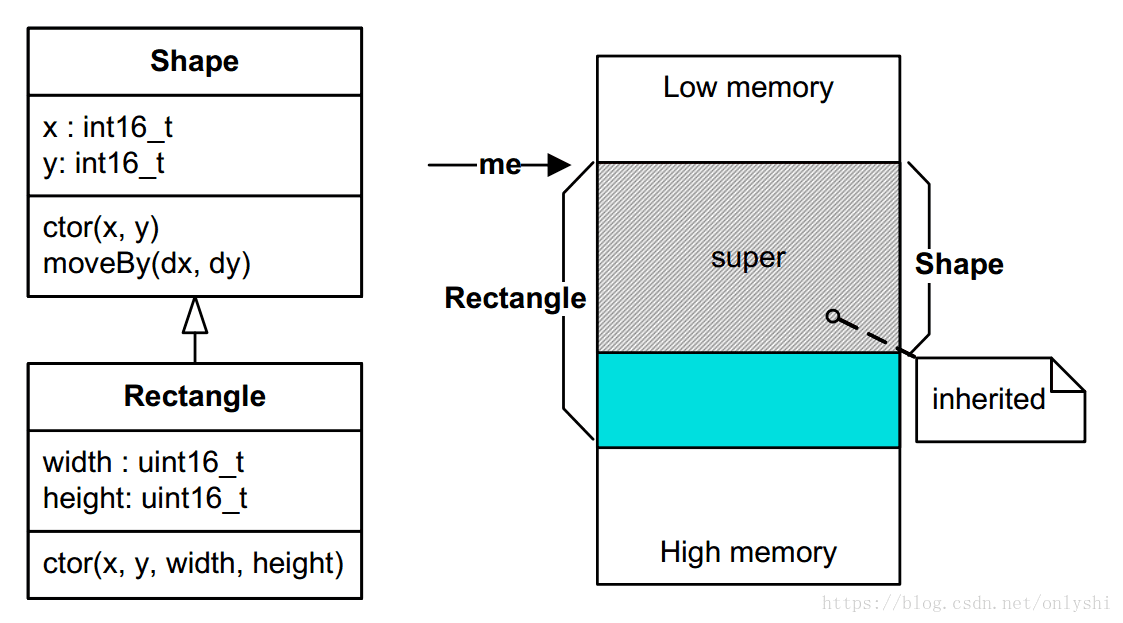
因为有这样的内存布局,所以可以很安全的传一个指向 Rectangle 对象的指针到一个期望传入 Shape 对象的指针的函数中,就是一个函数的参数是 “Shape *”,你可以传入 “Rectangle *”,并且这是非常安全的。
这样的话,基类的所有属性和方法都可以被继承类继承!
#include "rect.h"

#include <stdio.h>

int main()

{

    Rectangle r1, r2;

    // 实例化对象

    Rectangle_ctor(&r1, , , , );

    Rectangle_ctor(&r2, -, , , );

    printf("Rect r1(x=%d,y=%d,width=%d,height=%d)\n",

           Shape_getX(&r1.super), Shape_getY(&r1.super),

           r1.width, r1.height);

    printf("Rect r2(x=%d,y=%d,width=%d,height=%d)\n",

           Shape_getX(&r2.super), Shape_getY(&r2.super),

           r2.width, r2.height);

    // 注意,这里有两种方式,一是强转类型,二是直接使用成员地址

    Shape_moveBy((Shape *)&r1, -, );

    Shape_moveBy(&r2.super, , -);

    printf("Rect r1(x=%d,y=%d,width=%d,height=%d)\n",

           Shape_getX(&r1.super), Shape_getY(&r1.super),

           r1.width, r1.height);

    printf("Rect r2(x=%d,y=%d,width=%d,height=%d)\n",

           Shape_getX(&r2.super), Shape_getY(&r2.super),

           r2.width, r2.height);

    return ;

}
输出结果:
Rect r1(x=,y=,width=,height=)

Rect r2(x=-,y=,width=,height=)

Rect r1(x=-,y=,width=,height=)

Rect r2(x=,y=,width=,height=)
4、多态 C++
语言实现多态就是使用虚函数。在 C 语言里面,也可以实现多态。 现在,我们又要增加一个圆形,并且在 Shape 要扩展功能,我们要增加 area() 和 draw() 函数。但是 Shape 相当于抽象类,不知道怎么去计算自己的面积,更不知道怎么去画出来自己。而且,矩形和圆形的面积计算方式和几何图像也是不一样的。
下面让我们重新声明一下 Shape 类
#ifndef SHAPE_H

#define SHAPE_H

#include <stdint.h>

struct ShapeVtbl;

// Shape 的属性

typedef struct {

    struct ShapeVtbl const *vptr;

    int16_t x;

    int16_t y;

} Shape;

// Shape 的虚表

struct ShapeVtbl {

    uint32_t (*area)(Shape const * const me);

    void (*draw)(Shape const * const me);

};

// Shape 的操作函数,接口函数

void Shape_ctor(Shape * const me, int16_t x, int16_t y);

void Shape_moveBy(Shape * const me, int16_t dx, int16_t dy);

int16_t Shape_getX(Shape const * const me);

int16_t Shape_getY(Shape const * const me);

static inline uint32_t Shape_area(Shape const * const me) //用于虚函数调用

{

    return (*me->vptr->area)(me);

}

static inline void Shape_draw(Shape const * const me)//用于虚函数调用

{

    (*me->vptr->draw)(me);

}

Shape const *largestShape(Shape const *shapes[], uint32_t nShapes);

void drawAllShapes(Shape const *shapes[], uint32_t nShapes);

#endif /* SHAPE_H */
看下加上虚函数之后的类关系图
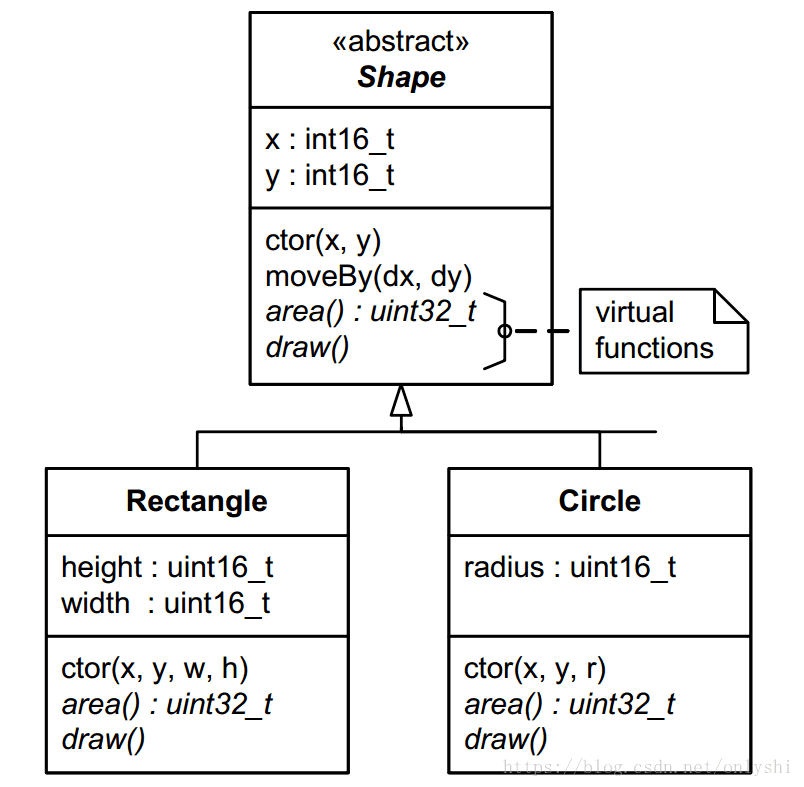
4.1 虚表和虚指针
虚表(Virtual Table)是这个类所有虚函数的函数指针的集合。
虚指针(Virtual Pointer)是一个指向虚表的指针。这个虚指针必须存在于每个对象实例中,会被所有子类继承。
在《Inside The C++ Object Model》的第一章内容中,有这些介绍。
4.2 在构造函数中设置vptr
在每一个对象实例中,vptr 必须被初始化指向其 vtbl。
最好的初始化位置就是在类的构造函数中。
事实上,在构造函数中,C++ 编译器隐式的创建了一个初始化的vptr。
在 C 语言里面, 我们必须显示的初始化vptr。
下面就展示一下,在 Shape 的构造函数里面,如何去初始化这个 vptr。
#include "shape.h"

#include <assert.h>

// Shape 的虚函数

static uint32_t Shape_area_(Shape const * const me);

static void Shape_draw_(Shape const * const me);

// 构造函数

void Shape_ctor(Shape * const me, int16_t x, int16_t y)

{

    // Shape 类的虚表

    static struct ShapeVtbl const vtbl =

    {

       &Shape_area_,

       &Shape_draw_

    };

    me->vptr = &vtbl;

    me->x = x;

    me->y = y;

}

void Shape_moveBy(Shape * const me, int16_t dx, int16_t dy)

{

    me->x += dx;

    me->y += dy;

}

int16_t Shape_getX(Shape const * const me)

{

    return me->x;

}

int16_t Shape_getY(Shape const * const me)

{

    return me->y;

}

// Shape 类的虚函数实现

static uint32_t Shape_area_(Shape const * const me)

{

    assert(); // 类似纯虚函数

    return 0U; // 避免警告

}

static void Shape_draw_(Shape const * const me)

{

    assert(); // 纯虚函数不能被调用

}

Shape const *largestShape(Shape const *shapes[], uint32_t nShapes)

{

    Shape const *s = (Shape *);

    uint32_t max = 0U;

    uint32_t i;

    for (i = 0U; i < nShapes; ++i)

    {

        uint32_t area = Shape_area(shapes[i]);// 虚函数调用

        if (area > max)

        {

            max = area;

            s = shapes[i];

        }

    }

    return s;

}

void drawAllShapes(Shape const *shapes[], uint32_t nShapes)

{

    uint32_t i;

    for (i = 0U; i < nShapes; ++i)

    {

        Shape_draw(shapes[i]); // 虚函数调用

    }

}
4.3 继承 vtbl 和 重载 vptr
上面已经提到过,基类包含 vptr,子类会自动继承。但是,vptr 需要被子类的虚表重新赋值。并且,这也必须发生在子类的构造函数中。下面是 Rectangle 的构造函数。
#include "rect.h"

#include <stdio.h>

// Rectangle 虚函数

static uint32_t Rectangle_area_(Shape const * const me);

static void Rectangle_draw_(Shape const * const me);

// 构造函数

void Rectangle_ctor(Rectangle * const me, int16_t x, int16_t y,

                    uint16_t width, uint16_t height)

{

    static struct ShapeVtbl const vtbl =

    {

        &Rectangle_area_,

        &Rectangle_draw_

    };

    Shape_ctor(&me->super, x, y); // 调用基类的构造函数

    me->super.vptr = &vtbl;           // 重载 vptr

    me->width = width;

    me->height = height;

}

// Rectangle's 虚函数实现

static uint32_t Rectangle_area_(Shape const * const me)

{

    Rectangle const * const me_ = (Rectangle const *)me; //显示的转换

    return (uint32_t)me_->width * (uint32_t)me_->height;

}

static void Rectangle_draw_(Shape const * const me)

{

    Rectangle const * const me_ = (Rectangle const *)me; //显示的转换

    printf("Rectangle_draw_(x=%d,y=%d,width=%d,height=%d)\n",

           Shape_getX(me), Shape_getY(me), me_->width, me_->height);

}
4.4 虚函数调用
有了前面虚表(Virtual Tables)和虚指针(Virtual Pointers)的基础实现,虚拟调用(后期绑定)就可以用下面代码实现了。
uint32_t Shape_area(Shape const * const me)

{

    return (*me->vptr->area)(me);

}
这个函数可以放到.c文件里面,但是会带来一个缺点就是每个虚拟调用都有额外的调用开销。为了避免这个缺点,如果编译器支持内联函数(C99)。
我们可以把定义放到头文件里面,类似下面:
static inline uint32_t Shape_area(Shape const * const me)

{

    return (*me->vptr->area)(me);

}
如果是老一点的编译器(C89),我们可以用宏函数来实现,类似下面这样:
#define Shape_area(me_) ((*(me_)->vptr->area)((me_)))
看一下例子中的调用机制:
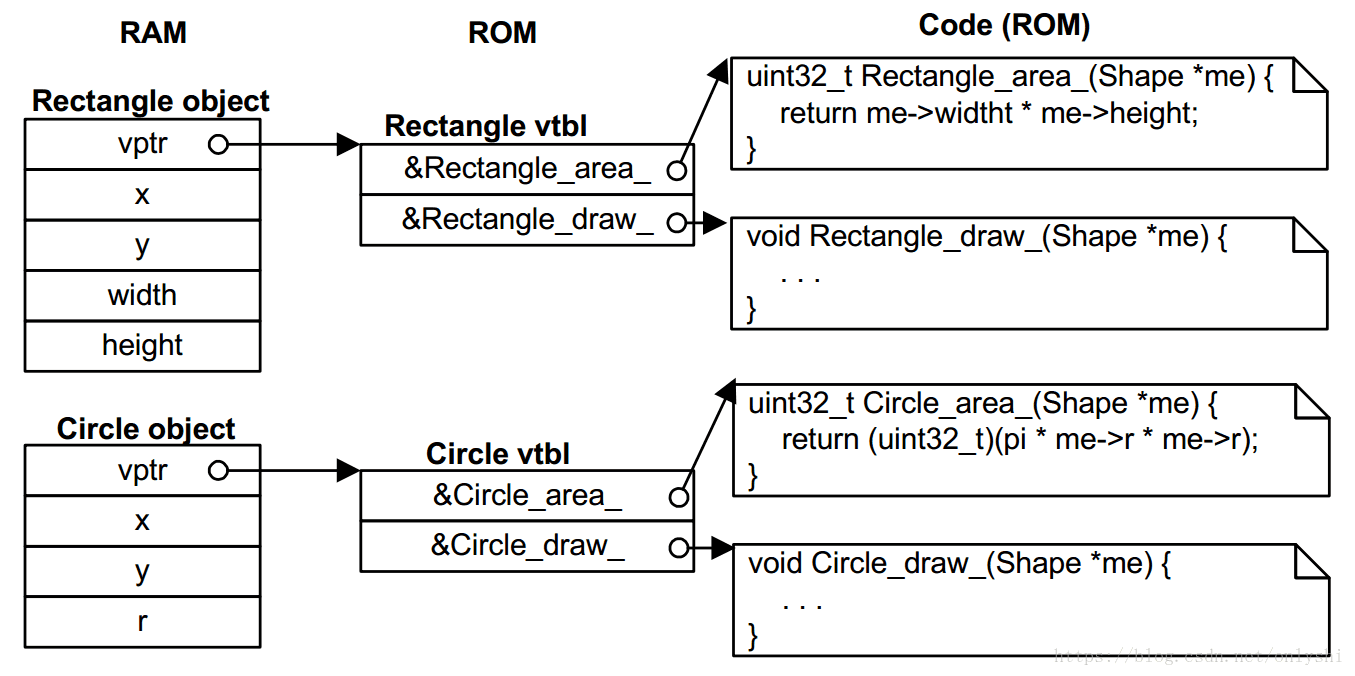
4.5 main.c
#include "rect.h"

#include "circle.h"

#include <stdio.h>

int main()

{

    Rectangle r1, r2;

    Circle    c1, c2;

    Shape const *shapes[] =

    {

        &c1.super,

        &r2.super,

        &c2.super,

        &r1.super

    };

    Shape const *s;

    // 实例化矩形对象

    Rectangle_ctor(&r1, , , , );

    Rectangle_ctor(&r2, -, , , );

    // 实例化圆形对象

    Circle_ctor(&c1, , -, );

    Circle_ctor(&c2, , -, );

    s = largestShape(shapes, sizeof(shapes)/sizeof(shapes[]));

    printf("largetsShape s(x=%d,y=%d)\n", Shape_getX(s), Shape_getY(s));

    drawAllShapes(shapes, sizeof(shapes)/sizeof(shapes[]));

    return ;

}
输出结果:
largetsShape s(x=,y=-)

Circle_draw_(x=,y=-,rad=)

Rectangle_draw_(x=-,y=,width=,height=)

Circle_draw_(x=,y=-,rad=)

Rectangle_draw_(x=,y=,width=,height=)
5、总结
还是那句话,面向对象编程是一种方法,并不局限于某一种编程语言。
用 C 语言实现封装、单继承,理解和实现起来比较简单,多态反而会稍微复杂一点,如果打算广泛的使用多态,还是推荐转到 C++ 语言上,毕竟这层复杂性被这个语言给封装了,你只需要简单的使用就行了。
但并不代表,C 语言实现不了多态这个特性。
转自:
https://blog.csdn.net/onlyshi/article/details/81672279
C语言实现面向对象(转)的更多相关文章
- [java学习笔记]java语言核心----面向对象之this关键字
一.this关键字 体现:当成员变量和函数的局部变量重名时,可以使用this关键字来区别:在构造函数中调用其它构造函数 原理: 代表的是当前对象. this就是所在函数 ...
- 第二十五节:Java语言基础-面向对象基础
面向对象 面向过程的代表主要是C语言,面向对象是相对面向过程而言,Java是面向对象的编程语言,面向过程是通过函数体现,面向过程主要是功能行为. 而对于面向对象而言,将功能封装到对象,所以面向对象是基 ...
- 如何使用C语言的面向对象
我们都知道,C++才是面向对象的语言,但是C语言是否能使用面向对象的功能? (1)继承性 typedef struct _parent { int data_parent; }Parent; type ...
- 比较分析C++、Java、Python、R语言的面向对象特征,这些特征如何实现的?有什么相同点?
一门课的课后题答案,在这里备份一下: 面向对象程序设计语言 – 比较分析C++.Java.Python.R语言的面向对象特征,这些特征如何实现的?有什么相同点? C++ 语言的面向对象特征: 对象模 ...
- 用C语言实现面向对象的开发
C语言的对象化模型 面向对象的特征主要包括: .封装,隐藏内部实现 .继承,复用现有代码 .多态,改写对象行为 采用C语言实现的关键是如何运用C语言本身的特性来实现上述面向对象的特征. 1.1 封装 ...
- 基于C语言的面向对象编程
嵌入式软件开发中,虽然很多的开发工具已经支持C++的开发,但是因为有时考虑运行效率和编程习惯,还是有很多人喜欢用C来开发嵌入式软件.Miro Samek说:"我在开发现场发现,很多嵌入式软件 ...
- 已看1.熟练的使用Java语言进行面向对象程序设计,有良好的编程习惯,熟悉常用的Java API,包括集合框架、多线程(并发编程)、I/O(NIO)、Socket、JDBC、XML、反射等。[泛型]\
1.熟练的使用Java语言进行面向对象程序设计,有良好的编程习惯,熟悉常用的Java API,包括集合框架.多线程(并发编程).I/O(NIO).Socket.JDBC.XML.反射等.[泛型]\1* ...
- luajit利用ffi结合C语言实现面向对象的封装库
luajit中.利用ffi能够嵌入C.眼下luajit的最新版是2.0.4,在这之前的版本号我还不清楚这个扩展库详细怎么样,只是在2.04中,真的非常爽. 既然是嵌入C代码.那么要说让lua支持 ...
- go语言之面向对象
Go 语言结构体 Go 语言中数组可以存储同一类型的数据,但在结构体中我们可以为不同项定义不同的数据类型. 结构体是由一系列具有相同类型或不同类型的数据构成的数据集合. 结构体表示一项记录,比如保存图 ...
- C 语言实现面向对象编程
转载 https://blog.csdn.net/onlyshi/article/details/81672279 C 语言实现面向对象编程1.引言面向对象编程(OOP)并不是一种特定的语言或者工具, ...
随机推荐
- struts配置之namespace
- Strtus配置Tomcat出现问题2
启动myeclipse的tomcat6.0有如下提示:The APR based Apache Tomcat Native library which allows optimal performan ...
- Bootstrap警告
警告(Alerts)向用户提供了一种定义消息样式的方式.它们为典型的用户操作提供了上下文信息反馈. 警告(Alerts) 步骤: 1.创建一个 <div> 2.并向其加入一个 .alert ...
- SOA概念具体解释
1.概述 1.1基本定义 SOA(Service-Oriented Architecture)既面向服务的体系结构,是一个组件模型.它将应用程序猿的不同功能可是(称为服务)通过定义良好的接口联系起来. ...
- 项目部署在windows下的tomcat里
打包放在webapps 目录下,web的改成ROOT ok!!!
- 0x18 总结与练习
这一章不太满意啊.. 还是有点痛苦,但就是做的挺慢啊... 1.就是例题 2.括号画家 感觉这种提高组类型的细节题都没什么信心啊,fail了几次才A #include<cstdio> #i ...
- 避免ANR异常
避免ANR异常 不要在主线程中执行耗时的代码,不然很容易出现anr错误. 原因: 解决方法:
- Python 下的 return 关键字
def make_sum(a, b): return ('+', a, b) >> make_sum(1, 2) ('+', 1, 2) 显示地返回一个元组(tuple),当然 retur ...
- 杂项-Java:Shiro(Java安全架构)
ylbtech-杂项-Java:Shiro(Java安全架构) Apache Shiro是一个强大且易用的Java安全框架,执行身份验证.授权.密码和会话管理.使用Shiro的易于理解的API,您可以 ...
- init&initWithFrame&initWithCoder
//当我们所写的程序里没用用Nib文件(XIB)时,用代码控制视图内容,需要调用initWithFrame去初始化 - (id)initWithFrame:(CGRect)frame { if (se ...