
(3)一起来看下使用mybatis框架的select语句的源码执行流程吧
本文是作者原创,版权归作者所有.若要转载,请注明出处.本文以简单的select语句为例,只贴我觉得比较重要的源码,其他不重要非关键的就不贴了
主流程和insert语句差不多,这里主要讲不同的流程,前面配置解析就不看了
SqlSession sqlSession = sqlSessionFactory.openSession();

    //通过动态代理实现接口 ,用动态代理对象去帮我们执行SQL

    //这里生成mapper实际类型是org.apache.ibatis.binding.MapperProxy

    DemoMapper mapper = sqlSession.getMapper(DemoMapper.class);

    //这里用生成的动态代理对象执行

    String projId="0124569b738e405fb20b68bfef37f487";

    String sectionName="标段";

    List<ProjInfo> projInfos = mapper.selectAll(projId, sectionName);

    System.out.println(projInfos);

    //sqlSession.commit();

    sqlSession.close();
点进去,看下方法sqlSession.getMapper(DemoMapper.class),这个调到下面这个方法
public <T> T getMapper(Class<T> type, SqlSession sqlSession) {

    //这里就是动态代理生成的代理对象

    final MapperProxyFactory<T> mapperProxyFactory = (MapperProxyFactory<T>) knownMappers.get(type);

    if (mapperProxyFactory == null) {

      throw new BindingException("Type " + type + " is not known to the MapperRegistry.");

    }

    try {

      return mapperProxyFactory.newInstance(sqlSession);

    } catch (Exception e) {

      throw new BindingException("Error getting mapper instance. Cause: " + e, e);

    }

  }
我们看下mapperProxyFactory.newInstance(sqlSession)这个方法
public T newInstance(SqlSession sqlSession) {

    final MapperProxy<T> mapperProxy = new MapperProxy<>(sqlSession, mapperInterface, methodCache);

    return newInstance(mapperProxy);

  }
继续点进去看
protected T newInstance(MapperProxy<T> mapperProxy) {

    return (T) Proxy.newProxyInstance(mapperInterface.getClassLoader(), new Class[] { mapperInterface }, mapperProxy);

  }
好,很明显了,这里用的jdk的动态代理,关于动态代理,这里就不赘述了,下次有机会在设计模式里专门讲一下.所以这里返回的是代理对象
继续往下看,我们看mapper.selectAll(projId, sectionName)这个方法debug进去,调的是jdk动态代理的invoke方法,里面就是具体的查询逻辑了
//这里method是接口DemoMapper的selectAll方法

  @Override

  public Object invoke(Object proxy, Method method, Object[] args) throws Throwable {

    try {

      // 如果目标方法是Object类继承来的,直接调用目标方法

      //method.getDeclaringClass()是接口DemoMapper的类对象,这里结果为false,跳过这一步

      if (Object.class.equals(method.getDeclaringClass())) {

        return method.invoke(this, args);

        //这里method是接口DemoMapper的selectAll方法,所以结果也为false,跳过这一步

      } else if (method.isDefault()) {

        if (privateLookupInMethod == null) {

          return invokeDefaultMethodJava8(proxy, method, args);

        } else {

          return invokeDefaultMethodJava9(proxy, method, args);

        }

      }

    } catch (Throwable t) {

      throw ExceptionUtil.unwrapThrowable(t);

    }

    //这里将method放入缓存

    // 从缓存中获取MapperMethod 对象,如果没有就创建新的并添加

    final MapperMethod mapperMethod = cachedMapperMethod(method);

    //这是真正的执行方法

    return mapperMethod.execute(sqlSession, args);

  }
缓存的东西,我们下次再说,我们继续点进去看
//就是这个执行方法

  public Object execute(SqlSession sqlSession, Object[] args) {

    Object result;

    //command.getType()此时是select

    switch (command.getType()) {

      case INSERT: {

        Object param = method.convertArgsToSqlCommandParam(args);

        result = rowCountResult(sqlSession.insert(command.getName(), param));

        break;

      }

      case UPDATE: {

        Object param = method.convertArgsToSqlCommandParam(args);

        result = rowCountResult(sqlSession.update(command.getName(), param));

        break;

      }

      case DELETE: {

        Object param = method.convertArgsToSqlCommandParam(args);

        result = rowCountResult(sqlSession.delete(command.getName(), param));

        break;

      }

      //进入这个分支

      case SELECT:

        //这里结果为false,不进这里

        if (method.returnsVoid() && method.hasResultHandler()) {

          executeWithResultHandler(sqlSession, args);

          result = null;

          //这里结果为真,进这里

        } else if (method.returnsMany()) {

          result = executeForMany(sqlSession, args);

          //这里结果为false,不进这里

        } else if (method.returnsMap()) {

          result = executeForMap(sqlSession, args);

          //这里结果为false,不进这里

        } else if (method.returnsCursor()) {

          result = executeForCursor(sqlSession, args);

        } else {

          //

          Object param = method.convertArgsToSqlCommandParam(args);

          //处理参数完成后后param是hashmap类型,key有两种,一种是#{}里面的参数名,

          // 另一种是(param1, param2, ...),value只有一种,就是我们的实际参数

          //这里执行sql得到查询结果result,跟进去看下

          result = sqlSession.selectOne(command.getName(), param);

          if (method.returnsOptional()

              && (result == null || !method.getReturnType().equals(result.getClass()))) {

            result = Optional.ofNullable(result);

          }

        }

        break;

      case FLUSH:

        result = sqlSession.flushStatements();

        break;

      default:

        throw new BindingException("Unknown execution method for: " + command.getName());

    }

    if (result == null && method.getReturnType().isPrimitive() && !method.returnsVoid()) {

      throw new BindingException("Mapper method '" + command.getName()

          + " attempted to return null from a method with a primitive return type (" + method.getReturnType() + ").");

    }

    return result;

  }
继续往下看
private <E> Object executeForMany(SqlSession sqlSession, Object[] args) {
  List<E> result;
  Object param = method.convertArgsToSqlCommandParam(args);
  if (method.hasRowBounds()) {
    RowBounds rowBounds = method.extractRowBounds(args);
    result = sqlSession.selectList(command.getName(), param, rowBounds);
  } else {
    //进这里,点进去看
    result = sqlSession.selectList(command.getName(), param);
  }
  // issue #510 Collections & arrays support
  if (!method.getReturnType().isAssignableFrom(result.getClass())) {
    if (method.getReturnType().isArray()) {
      return convertToArray(result);
    } else {
      return convertToDeclaredCollection(sqlSession.getConfiguration(), result);
    }
  }
  return result;
}
继续
//这个是真正的sql执行方法了,statement是具体的方法名com.lusaisai.dao.DemoMapper.selectOne

  //parameter是参数名和真是的参数

  @Override

  public <E> List<E> selectList(String statement, Object parameter, RowBounds rowBounds) {

    try {

      //configuration对象根据statement,得到关于sql语句的相关信息

      //这里得到的ms包含sql语句

      MappedStatement ms = configuration.getMappedStatement(statement);

      //这里就是执行sql语句

      return executor.query(ms, wrapCollection(parameter), rowBounds, Executor.NO_RESULT_HANDLER);

    } catch (Exception e) {

      throw ExceptionFactory.wrapException("Error querying database.  Cause: " + e, e);

    } finally {

      ErrorContext.instance().reset();

    }

  }
继续跟
//执行语句这个方法,跟进去看下

  @Override

  public <E> List<E> query(MappedStatement ms, Object parameterObject, RowBounds rowBounds, ResultHandler resultHandler) throws SQLException {

    //

    BoundSql boundSql = ms.getBoundSql(parameterObject);

    CacheKey key = createCacheKey(ms, parameterObject, rowBounds, boundSql);

    //这个跟进去看戏,应该是真正的jdbc操作了

    return query(ms, parameterObject, rowBounds, resultHandler, key, boundSql);

  }
继续
@Override

  public <E> List<E> query(MappedStatement ms, Object parameterObject, RowBounds rowBounds, ResultHandler resultHandler, CacheKey key, BoundSql boundSql)

      throws SQLException {

    Cache cache = ms.getCache();

    if (cache != null) {

      flushCacheIfRequired(ms);

      if (ms.isUseCache() && resultHandler == null) {

        ensureNoOutParams(ms, boundSql);

        @SuppressWarnings("unchecked")

        List<E> list = (List<E>) tcm.getObject(cache, key);

        if (list == null) {

          list = delegate.query(ms, parameterObject, rowBounds, resultHandler, key, boundSql);

          tcm.putObject(cache, key, list); // issue #578 and #116

        }

        return list;

      }

    }

    //前面是缓存处理跟进去

    return delegate.query(ms, parameterObject, rowBounds, resultHandler, key, boundSql);

  }
这里继续
@Override

  public <E> List<E> query(MappedStatement ms, Object parameter, RowBounds rowBounds, ResultHandler resultHandler, CacheKey key, BoundSql boundSql) throws SQLException {

    ErrorContext.instance().resource(ms.getResource()).activity("executing a query").object(ms.getId());

    if (closed) {

      throw new ExecutorException("Executor was closed.");

    }

    if (queryStack == 0 && ms.isFlushCacheRequired()) {

      clearLocalCache();

    }

    List<E> list;

    try {

      queryStack++;

      list = resultHandler == null ? (List<E>) localCache.getObject(key) : null;

      if (list != null) {

        handleLocallyCachedOutputParameters(ms, key, parameter, boundSql);

      } else {

        //进这里,继续跟

        list = queryFromDatabase(ms, parameter, rowBounds, resultHandler, key, boundSql);

      }

    } finally {

      queryStack--;

    }

    if (queryStack == 0) {

      for (DeferredLoad deferredLoad : deferredLoads) {

        deferredLoad.load();

      }

      // issue #601

      deferredLoads.clear();

      if (configuration.getLocalCacheScope() == LocalCacheScope.STATEMENT) {

        // issue #482

        clearLocalCache();

      }

    }

    return list;

  }
继续
private <E> List<E> queryFromDatabase(MappedStatement ms, Object parameter, RowBounds rowBounds, ResultHandler resultHandler, CacheKey key, BoundSql boundSql) throws SQLException {

    List<E> list;

    //key值就是待执行的sql

    localCache.putObject(key, EXECUTION_PLACEHOLDER);

    try {

      //跟进去

      list = doQuery(ms, parameter, rowBounds, resultHandler, boundSql);

    } finally {

      localCache.removeObject(key);

    }

    localCache.putObject(key, list);

    if (ms.getStatementType() == StatementType.CALLABLE) {

      localOutputParameterCache.putObject(key, parameter);

    }

    return list;

  }
继续
@Override

  public <E> List<E> doQuery(MappedStatement ms, Object parameter, RowBounds rowBounds, ResultHandler resultHandler, BoundSql boundSql) throws SQLException {

    Statement stmt = null;

    try {

      Configuration configuration = ms.getConfiguration();

      StatementHandler handler = configuration.newStatementHandler(wrapper, ms, parameter, rowBounds, resultHandler, boundSql);

      stmt = prepareStatement(handler, ms.getStatementLog());

      return handler.query(stmt, resultHandler);

    } finally {

      closeStatement(stmt);

    }

  }
跟一下return那行
@Override

  public <E> List<E> query(Statement statement, ResultHandler resultHandler) throws SQLException {

    //这里强转成预编译对象PreparedStatement

    PreparedStatement ps = (PreparedStatement) statement;

    ps.execute();

    return resultSetHandler.handleResultSets(ps);

  }
好,我们看到PreparedStatement对象了,继续
public List<Object> handleResultSets(Statement stmt) throws SQLException {

    ErrorContext.instance().activity("handling results").object(mappedStatement.getId());

    final List<Object> multipleResults = new ArrayList<>();

    int resultSetCount = 0;

    ResultSetWrapper rsw = getFirstResultSet(stmt);

    List<ResultMap> resultMaps = mappedStatement.getResultMaps();

    int resultMapCount = resultMaps.size();

    validateResultMapsCount(rsw, resultMapCount);

    while (rsw != null && resultMapCount > resultSetCount) {

      ResultMap resultMap = resultMaps.get(resultSetCount);

      handleResultSet(rsw, resultMap, multipleResults, null);

      //这里已经执行完sql,生成结果集了

      rsw = getNextResultSet(stmt);

      cleanUpAfterHandlingResultSet();

      resultSetCount++;

    }

    String[] resultSets = mappedStatement.getResultSets();

    if (resultSets != null) {

      while (rsw != null && resultSetCount < resultSets.length) {

        ResultMapping parentMapping = nextResultMaps.get(resultSets[resultSetCount]);

        if (parentMapping != null) {

          String nestedResultMapId = parentMapping.getNestedResultMapId();

          ResultMap resultMap = configuration.getResultMap(nestedResultMapId);

          handleResultSet(rsw, resultMap, null, parentMapping);

        }

        rsw = getNextResultSet(stmt);

        cleanUpAfterHandlingResultSet();

        resultSetCount++;

      }

    }

    return collapseSingleResultList(multipleResults);

  }
继续跟我注释的那行
private ResultSetWrapper getNextResultSet(Statement stmt) {

    // Making this method tolerant of bad JDBC drivers

    try {

      if (stmt.getConnection().getMetaData().supportsMultipleResultSets()) {

        // Crazy Standard JDBC way of determining if there are more results

        //这里的stmt已经包含可执行的sql了

        if (!(!stmt.getMoreResults() && stmt.getUpdateCount() == -1)) {

          ResultSet rs = stmt.getResultSet();

          if (rs == null) {

            return getNextResultSet(stmt);

          } else {

            return new ResultSetWrapper(rs, configuration);

          }

        }

      }

    } catch (Exception e) {

      // Intentionally ignored.

    }

    return null;

  }
最后再贴张网上找的图
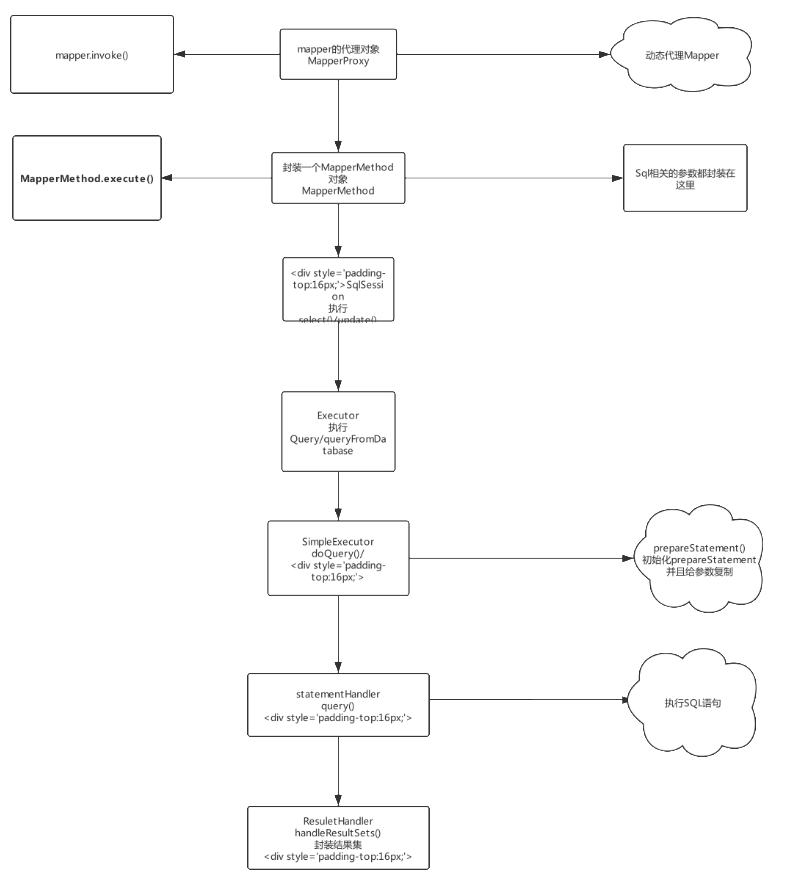
好,到这里我们已经看完执行流程,其实封装了很多层,并没有全都要搞懂的必要,这里的重点是用了动态代理,底层肯定是jdbc操作,当然它还加了很多缓存和各种验证的代码.关于缓存的源码,有机会下次再看吧.
(3)一起来看下使用mybatis框架的select语句的源码执行流程吧的更多相关文章
- mybatis源码专题(2)--------一起来看下使用mybatis框架的insert语句的源码执行流程吧
本文是作者原创,版权归作者所有.若要转载,请注明出处.本文以简单的insert语句为例 1.mybatis的底层是jdbc操作,我们先来回顾一下insert语句的执行流程,如下 执行完后,我们看下数据 ...
- 深入Mybatis源码——执行流程
前言 上一篇分析Mybatis是如何加载解析XML文件的,本篇紧接上文,分析Mybatis的剩余两个阶段:代理封装和SQL执行. 正文 代理封装 Mybatis有两种方式调用Mapper接口: pri ...
- Mybatis底层源码执行流程
1.通过类加载器,加载了config.xml文件 2.通过SqlSessionFactoryBuilder.build(resource)这个方法进行了config.xml的解析,解析为Configu ...
- 详解Java的MyBatis框架中SQL语句映射部分的编写
这篇文章主要介绍了Java的MyBatis框架中SQL语句映射部分的编写,文中分为resultMap和增删查改实现两个部分来讲解,需要的朋友可以参考下 1.resultMap SQL 映射XML 文件 ...
- MVC系列——MVC源码学习:打造自己的MVC框架(二:附源码)
前言:上篇介绍了下 MVC5 的核心原理,整篇文章比较偏理论,所以相对比较枯燥.今天就来根据上篇的理论一步一步进行实践,通过自己写的一个简易MVC框架逐步理解,相信通过这一篇的实践,你会对MVC有一个 ...
- 详解Mybatis拦截器(从使用到源码)
详解Mybatis拦截器(从使用到源码) MyBatis提供了一种插件(plugin)的功能,虽然叫做插件,但其实这是拦截器功能. 本文从配置到源码进行分析. 一.拦截器介绍 MyBatis 允许你在 ...
- Ext.NET 4.1 系统框架的搭建(后台) 附源码
Ext.NET 4.1 系统框架的搭建(后台) 附源码 代码运行环境:.net 4.5 VS2013 (代码可直接编译运行) 预览图: 分析图: 上面系统的构建包括三块区域:North.West和C ...
- Java并发包源码学习之AQS框架(四)AbstractQueuedSynchronizer源码分析
经过前面几篇文章的铺垫,今天我们终于要看看AQS的庐山真面目了,建议第一次看AbstractQueuedSynchronizer 类源码的朋友可以先看下我前面几篇文章: <Java并发包源码学习 ...
- 从零开始手写 spring ioc 框架,深入学习 spring 源码
IoC Ioc 是一款 spring ioc 核心功能简化实现版本,便于学习和理解原理. 创作目的 使用 spring 很长时间,对于 spring 使用非常频繁,实际上对于源码一直没有静下心来学习过 ...
随机推荐
- CSS自定义默认样式
html, body, div, span, applet, object, iframe, h1, h2, h3, h4, h5, h6, p, blockquote, pre, a, abbr, ...
- mac office软件的安装与破解
1.mac office 软件的安装及破解 http://10176523.cn/archives/29/ 下载后安装 切记不要登录 然后用这个文件 破解
- js练习- 给你一个对象,求有几层
// 比如这个a中,就有四层.如何算出这四层 const a = { b: 1, c() {}, d: { e: 2, f: { g: 3, h: { i: 4, }, }, j: { k: 5, } ...
- [TimLinux] Python IDE工具
1. 首推IDE工具PyCharm JetBrains公司推出的系列IDE工具中支持Python编译语言的开发工具,基本上可以认为是行业第一IDE工具了,分为社区版和专业版,可以创建纯Python单文 ...
- nbuoj2786 玻璃球
题目:http://www.nbuoj.com/v8.83/Problems/Problem.php?pid=2786 用2个玻璃球找到从一100层的大楼的某一层落下刚好会摔碎,如何制定最优策略? 别 ...
- hdu2199,double二分
题目链接:http://acm.hdu.edu.cn/showproblem.php?pid=2199 题意:给一个Y,求满足8*x^4 + 7*x^3 + 2*x^2 + 3*x + 6 == Y的 ...
- LightOJ 1344 Aladdin and the Game of Bracelets
It's said that Aladdin had to solve seven mysteries before getting the Magical Lamp which summons a ...
- CoderForces999B- Reversing Encryption
time limit per test 1 second memory limit per test 256 megabytes input standard input output standar ...
- Python学习心得体会总结,不要采坑
前言 本文的文字及图片来源于网络,仅供学习.交流使用,不具有任何商业用途,版权归原作者所有,如有问题请及时联系我们以作处理. 作者:樱桃小丸子0093 大家要持续关注哦,不定时更新Python知识 ...
- Python3 网络编程和并发编程总结
目录 网络编程 开发架构 OSI七层模型 socket subprocess 粘包问题 socketserver TCP UDP 并发编程 多道技术 并发和并行 进程 僵尸进程和孤儿进程 守护进程 互 ...