
html5 Websockets development guidance
1. WebSockets -- full-duplex communication
The main HTML5 pillars include Markup, CSS3, and JavaScript APIs
For whole set of HTML5, visit html5rocks.com (google product)
The URL
The following image shows the WebSocket URL example in tokens:
schema host port server
ws://example.com:/chat.php
wss is supported as well and is the WebSocket equivalent to https for secure connections (SSL).
Who's using WebSockets
Name Website Description
Gamooga http://www.gamooga.com/ Real-time backend for apps and games
GitLive http://gitlive.com/ Notifications on GitHub projects
Superfeedr http://superfeedr.com/ Real-time data pushing
Pusher http://pusher.com/ Scalable real-time functionality API for web and mobile apps
Smarkets https://smarkets.com/ Real-time betting
IRC Cloud https://www.irccloud.com/ Chatting
Two great resources containing a large variety of WebSocket demos are as follows:
• http://www.websocket.org/demos.html
• http://www.html5rocks.com/en/features/connectivity
2. The WebSocket API web client
WebSocket communication and data transmission is bidirectional, so we need two parties to establish it: a server and a client.
HTML5 basics:
- Markup HTML (.html)
For more information about the HTML5 markup, consider visiting http://html5doctor.com/. There is a complete reference for the supported HTML5 tags at http://html5doctor.com/element-index/.
- Styling CSS (.css)
http://www.css3.info/ is a great resource for CSS3 and further reading.
- Logic JavaScript (.js)
The markup defines the structure and the CSS rules apply the styling. What about event handling and user actions? Well, here comes JavaScript! The WebSocket API is pure JavaScript, too!
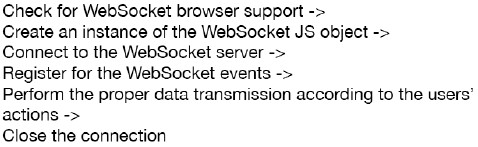
WebSocket API allows you to connect to a local or remote server, listen for messages, send data, and close the connection. Typical WebSocket workflow shows below:
JavaScript provides an easy way to find out whether a browser can execute WebSocket-specific code:
if (window.WebSocket) {   // validation check

  console.log("WebSockets supported.");

  // Continue with the rest of the WebSockets-specific functionality…

}

else {

  console.log("WebSockets not supported.");

  alert("Consider updating your browser for a richer experience.");

}
Want to see which browsers do support the WebSocket protocol? There is an up-to-date resource available at http://caniuse.com/#feat=websockets.
- The WebSocket object :var socket = new WebSocket("ws://echo.websocket.org");
- Events: Open, Message, Close, and Error.
You can handle them either by implementing the onopen, onmessage, onclose, and onerror functions respectively, or by using the addEventListener method.
- Actions: The WebSocket protocol supports two main actions: send() and close().
- Properties:
Properties Description
url Returns the URL of the WebSocket protocol Returns the protocol used by the server
readyState Reports the state of the connection and can take one of the following selfexplanatory values:
WebSocket.OPEN
WebSocket.CLOSED
WebSocket.CONNECTING
WebSocket.CLOSING
bufferedAmount Returns the total number of bytes that were queued when the send() method was called
binaryType Returns the binary data format we
received when the onmessage event was raised
The complete client example:
index.html:
<!DOCTYPE html>

<html>

<head>

<title>HTML5 WebSockets</title>

<link rel="stylesheet" href="style.css" />

<script src="chat.js"></script>

</head>

<body>

<h1> HTML5 WebSocket chat. </h1>

<input type="text" id="text-view" />

<input type="button" id="send-button" value="Send!" />

<input type="button" id="stop-button" value="Stop" />

</br>

<label id="status-label">Status</label>

</body>

</html>
Chat.js:
 window.onload = function() {

 var textView = document.getElementById("text-view");

 var buttonSend = document.getElementById("send-button");

 var buttonStop = document.getElementById("stop-button");

 var label = document.getElementById("status-label");

 var socket = new WebSocket("ws://echo.websocket.org");

 socket.onopen = function(event) {

 label.innerHTML = "Connection open";

 }

 socket.onmessage = function(event) {

 if (typeof event.data === "string") {

 label.innerHTML = label.innerHTML + "<br />" + event.data;

 }

 }

 socket.onclose = function(event) {

 var code = event.code;

 var reason = event.reason;

 var wasClean = event.wasClean;

 if (wasClean) {

 label.innerHTML = "Connection closed normally.";

 }

 else {

 label.innerHTML = "Connection closed with message: " +

 reason + " (Code: " + code + ")";

 }

 }

 socket.onerror = function(event) {

 label.innerHTML = "Error: " + event;

 }

 buttonSend.onclick = function() {

 if (socket.readyState == WebSocket.OPEN) {

 socket.send(textView.value);

 }

 }

 buttonStop.onclick = function() {

 if (socket.readyState == WebSocket.OPEN) {

 socket.close();

 }

 }

 }
Server side:
Server Client
Create a server on localhost:8181
Start running
Initial handshake: establish connection <----------- Request connection
Handle the incoming message --------------------> Send message
refer to book (p. 31):http://www.amazon.com/Getting-Started-HTML5-WebSocket-Programming/dp/1782166963
create dll file in c#

html5 Websockets development guidance的更多相关文章
- HTML5分析实战WebSockets基本介绍
HTML5 WebSockets规范定义了API,同意web使用页面WebSockets与远程主机协议的双向交流. 介绍WebSocket接口,并限定了全双工通信信道,通过套接字网络.HTML5 We ...
- HTML5分析实战WebSockets一个简短的引论
HTML5 WebSockets规范定义了API,同意web页面使用WebSockets与远程主机协议的双向通信. 介绍WebSocket接口,并限定了全双工通信信道,通过套接字网络. HTML5 W ...
- 《HTML5编程之旅》系列三:WebSockets 技术解析
本文主要研究HTML5 WebSockets的使用方法,它是HTML5中最强大的通信功能,定义了一个全双工的通信信道,只需Web上的一个Socket即可进行通信,能减少不必要的网络流量并降低网络延迟. ...
- HTML5 postMessage 和 onmessage API 具体应用
HTML5 postMessage 和 onmessage API 具体应用 随着 HTML5 的发展.了解并熟悉 HTML5 的 API 接口是很重要的.postMessage(send) 和 on ...
- 现在就使用HTML5的十大原因
你难道还没有考虑使用HTML5? 当然我猜想你可能有自己的原因: 它现在还没有被广泛的支持,在IE中不好使,或者你就是喜欢写比较严格的XHTML代码. HTML5是Web开发世界的一次重大的改变,事实 ...
- HTML5实现屏幕手势解锁(转载)
来源:https://github.com/lvming6816077/H5lockhttp://threejs.org/examples/http://www.inf.usi.ch/phd/wett ...
- [转]人人网首页拖拽上传详解(HTML5 Drag&Drop、FileReader API、formdata)
人人网首页拖拽上传详解(HTML5 Drag&Drop.FileReader API.formdata) 2011年12月11日 | 彬Go 上一篇:给力的 Google HTML5 训练营( ...
- 使用HTML5的十大原因
你难道还没有考虑使用HTML5? 当然我猜想你可能有自己的原因:它现在还没有被广泛的支持,在IE中不好使,或者你就是喜欢写比较严格的XHTML代码.HTML5是web开发世界的一次重大的改变,事实上不 ...
- Bone.io是一个轻量级的框架构建高性能实时单页HTML5应用程序
Bone.io允许你使用HTML5 WebSockets构建实时应用程序,提供“热”数据到浏览器.这使您可以轻松地构建丰富的,高度响应的用户界面. 项目主页:http://www.open-open. ...
随机推荐
- [django]手动数据库备份
基本原理是按钮点击后,系统查询出数据表中信息,然后在网页中导出相关表格! 若有自动数据库备份的兄弟,指点一下! 模板代码: <a href="{% url 'work_backup' ...
- After the exam
离散数学考完啦!!!自我感觉还行,或许得不到高分,但是过的话是没问题了.(但愿成绩出来后不打脸) 持续了两周的复习,告一段落了.那么,今天就休息休息吧. 今天阴有雨,走过的地儿都是湿漉漉.滑溜溜的.这 ...
- 实例:对2个Makefile的备注
实例1:Makefile编译链接简单.c函数 example.c Makefile exe: example.c gcc example.c -o exe clean: rm exe 执行效果: 实例 ...
- Resharper 检测所有NullReferenceExceptions(空指针)
需求分析 "null exception"很见的一种异常,但在某些情况下却会引起严重的bug! 本文目的就是对代码进行null 的检查,避免不应该出现的Error. 本文借助res ...
- HDU 1856 Brave Game(巴什博奕)
十年前读大学的时候,中国每年都要从国外引进一些电影大片,其中有一部电影就叫<勇敢者的游戏>(英文名称:Zathura),一直到现在,我依然对于电影中的部分电脑特技印象深刻. 今天,大家选择 ...
- 我要成为前端工程师!给 JavaScript 新手的建议与学习资源整理
来源于:http://blog.miniasp.com/post/2016/02/02/JavaScript-novice-advice-and-learning-resources.aspx 今年有 ...
- Spring Boot
Spring Boot是由Pivotal团队提供的全新框架,其设计目的是用来简化新Spring应用的初始搭建以及开发过程.该框架使用了特定的方式来进行配置,从而使开发人员不再需要定义样板化的配置.通过 ...
- YYKit学习系列 ---- 开篇
准备花半年时间系统学习YYKit, 学习过程会放入"YYKit学习系列"这个分类, 喜欢YYKit的可以随时留意我的文章, 一起学习!!!
- MySQL基础
数据库操作 ---终端使用数据库 mysql -u root -p 之后回车键 输入密码 ---显示所有数据库: show databases; ---默认数据库: mysql - 用户权限相关数据 ...
- python3使用pyinstaller打包apscheduler出的错
本来只是想用Python做一个定时任务小工具在服务器上运行,可是服务器在隔离区,各种禁止上外网,使用pip导出列表那种下载库的方法不管用,导致Python的各种库都下不到,官网离线下载又各种缺依赖,好 ...