
python学习day3
目录:
1.集合set
2.计数器
3.有序字典
4.默认字典
5.可命名元组
6.队列
7.深浅拷贝
8.函数
9.lambda表达式
10.内置函数
一、集合set
set是一个无序且不重复的元素集合
 class set(object):

     """

     set() -> new empty set object

     set(iterable) -> new set object

     Build an unordered collection of unique elements.

     """

     def add(self, *args, **kwargs): # real signature unknown

         """ 添加 """

         """

         Add an element to a set.

         This has no effect if the element is already present.

         """

         pass

     def clear(self, *args, **kwargs): # real signature unknown

         """ Remove all elements from this set. """

         pass

     def copy(self, *args, **kwargs): # real signature unknown

         """ Return a shallow copy of a set. """

         pass

     def difference(self, *args, **kwargs): # real signature unknown

         """

         Return the difference of two or more sets as a new set.

         (i.e. all elements that are in this set but not the others.)

         """

         pass

     def difference_update(self, *args, **kwargs): # real signature unknown

         """ 删除当前set中的所有包含在 new set 里的元素 """

         """ Remove all elements of another set from this set. """

         pass

     def discard(self, *args, **kwargs): # real signature unknown

         """ 移除元素 """

         """

         Remove an element from a set if it is a member.

         If the element is not a member, do nothing.

         """

         pass

     def intersection(self, *args, **kwargs): # real signature unknown

         """ 取交集,新创建一个set """

         """

         Return the intersection of two or more sets as a new set.

         (i.e. elements that are common to all of the sets.)

         """

         pass

     def intersection_update(self, *args, **kwargs): # real signature unknown

         """ 取交集,修改原来set """

         """ Update a set with the intersection of itself and another. """

         pass

     def isdisjoint(self, *args, **kwargs): # real signature unknown

         """ 如果没有交集,返回true  """

         """ Return True if two sets have a null intersection. """

         pass

     def issubset(self, *args, **kwargs): # real signature unknown

         """ 是否是子集 """

         """ Report whether another set contains this set. """

         pass

     def issuperset(self, *args, **kwargs): # real signature unknown

         """ 是否是父集 """

         """ Report whether this set contains another set. """

         pass

     def pop(self, *args, **kwargs): # real signature unknown

         """ 移除 """

         """

         Remove and return an arbitrary set element.

         Raises KeyError if the set is empty.

         """

         pass

     def remove(self, *args, **kwargs): # real signature unknown

         """ 移除 """

         """

         Remove an element from a set; it must be a member.

         If the element is not a member, raise a KeyError.

         """

         pass

     def symmetric_difference(self, *args, **kwargs): # real signature unknown

         """ 差集,创建新对象"""

         """

         Return the symmetric difference of two sets as a new set.

         (i.e. all elements that are in exactly one of the sets.)

         """

         pass

     def symmetric_difference_update(self, *args, **kwargs): # real signature unknown

         """ 差集,改变原来 """

         """ Update a set with the symmetric difference of itself and another. """

         pass

     def union(self, *args, **kwargs): # real signature unknown

         """ 并集 """

         """

         Return the union of sets as a new set.

         (i.e. all elements that are in either set.)

         """

         pass

     def update(self, *args, **kwargs): # real signature unknown

         """ 更新 """

         """ Update a set with the union of itself and others. """

         pass

     def __and__(self, y): # real signature unknown; restored from __doc__

         """ x.__and__(y) <==> x&y """

         pass

     def __cmp__(self, y): # real signature unknown; restored from __doc__

         """ x.__cmp__(y) <==> cmp(x,y) """

         pass

     def __contains__(self, y): # real signature unknown; restored from __doc__

         """ x.__contains__(y) <==> y in x. """

         pass

     def __eq__(self, y): # real signature unknown; restored from __doc__

         """ x.__eq__(y) <==> x==y """

         pass

     def __getattribute__(self, name): # real signature unknown; restored from __doc__

         """ x.__getattribute__('name') <==> x.name """

         pass

     def __ge__(self, y): # real signature unknown; restored from __doc__

         """ x.__ge__(y) <==> x>=y """

         pass

     def __gt__(self, y): # real signature unknown; restored from __doc__

         """ x.__gt__(y) <==> x>y """

         pass

     def __iand__(self, y): # real signature unknown; restored from __doc__

         """ x.__iand__(y) <==> x&=y """

         pass

     def __init__(self, seq=()): # known special case of set.__init__

         """

         set() -> new empty set object

         set(iterable) -> new set object

         Build an unordered collection of unique elements.

         # (copied from class doc)

         """

         pass

     def __ior__(self, y): # real signature unknown; restored from __doc__

         """ x.__ior__(y) <==> x|=y """

         pass

     def __isub__(self, y): # real signature unknown; restored from __doc__

         """ x.__isub__(y) <==> x-=y """

         pass

     def __iter__(self): # real signature unknown; restored from __doc__

         """ x.__iter__() <==> iter(x) """

         pass

     def __ixor__(self, y): # real signature unknown; restored from __doc__

         """ x.__ixor__(y) <==> x^=y """

         pass

     def __len__(self): # real signature unknown; restored from __doc__

         """ x.__len__() <==> len(x) """

         pass

     def __le__(self, y): # real signature unknown; restored from __doc__

         """ x.__le__(y) <==> x<=y """

         pass

     def __lt__(self, y): # real signature unknown; restored from __doc__

         """ x.__lt__(y) <==> x<y """

         pass

     @staticmethod # known case of __new__

     def __new__(S, *more): # real signature unknown; restored from __doc__

         """ T.__new__(S, ...) -> a new object with type S, a subtype of T """

         pass

     def __ne__(self, y): # real signature unknown; restored from __doc__

         """ x.__ne__(y) <==> x!=y """

         pass

     def __or__(self, y): # real signature unknown; restored from __doc__

         """ x.__or__(y) <==> x|y """

         pass

     def __rand__(self, y): # real signature unknown; restored from __doc__

         """ x.__rand__(y) <==> y&x """

         pass

     def __reduce__(self, *args, **kwargs): # real signature unknown

         """ Return state information for pickling. """

         pass

     def __repr__(self): # real signature unknown; restored from __doc__

         """ x.__repr__() <==> repr(x) """

         pass

     def __ror__(self, y): # real signature unknown; restored from __doc__

         """ x.__ror__(y) <==> y|x """

         pass

     def __rsub__(self, y): # real signature unknown; restored from __doc__

         """ x.__rsub__(y) <==> y-x """

         pass

     def __rxor__(self, y): # real signature unknown; restored from __doc__

         """ x.__rxor__(y) <==> y^x """

         pass

     def __sizeof__(self): # real signature unknown; restored from __doc__

         """ S.__sizeof__() -> size of S in memory, in bytes """

         pass

     def __sub__(self, y): # real signature unknown; restored from __doc__

         """ x.__sub__(y) <==> x-y """

         pass

     def __xor__(self, y): # real signature unknown; restored from __doc__

         """ x.__xor__(y) <==> x^y """

         pass

     __hash__ = None

 set
set源码
二、计数器(counter)
Counter是对字典类型的补充,用于追踪值出现的次数
ps:具备字典的所有功能+自己的功能
c = Counter('abcdeabcdabcaba')

print c

输出:Counter({'a': 5, 'b': 4, 'c': 3, 'd': 2, 'e': 1})
 ########################################################################

 ###  Counter

 ########################################################################

 class Counter(dict):

     '''Dict subclass for counting hashable items.  Sometimes called a bag

     or multiset.  Elements are stored as dictionary keys and their counts

     are stored as dictionary values.

     >>> c = Counter('abcdeabcdabcaba')  # count elements from a string

     >>> c.most_common(3)                # three most common elements

     [('a', 5), ('b', 4), ('c', 3)]

     >>> sorted(c)                       # list all unique elements

     ['a', 'b', 'c', 'd', 'e']

     >>> ''.join(sorted(c.elements()))   # list elements with repetitions

     'aaaaabbbbcccdde'

     >>> sum(c.values())                 # total of all counts

     >>> c['a']                          # count of letter 'a'

     >>> for elem in 'shazam':           # update counts from an iterable

     ...     c[elem] += 1                # by adding 1 to each element's count

     >>> c['a']                          # now there are seven 'a'

     >>> del c['b']                      # remove all 'b'

     >>> c['b']                          # now there are zero 'b'

     >>> d = Counter('simsalabim')       # make another counter

     >>> c.update(d)                     # add in the second counter

     >>> c['a']                          # now there are nine 'a'

     >>> c.clear()                       # empty the counter

     >>> c

     Counter()

     Note:  If a count is set to zero or reduced to zero, it will remain

     in the counter until the entry is deleted or the counter is cleared:

     >>> c = Counter('aaabbc')

     >>> c['b'] -= 2                     # reduce the count of 'b' by two

     >>> c.most_common()                 # 'b' is still in, but its count is zero

     [('a', 3), ('c', 1), ('b', 0)]

     '''

     # References:

     #   http://en.wikipedia.org/wiki/Multiset

     #   http://www.gnu.org/software/smalltalk/manual-base/html_node/Bag.html

     #   http://www.demo2s.com/Tutorial/Cpp/0380__set-multiset/Catalog0380__set-multiset.htm

     #   http://code.activestate.com/recipes/259174/

     #   Knuth, TAOCP Vol. II section 4.6.3

     def __init__(self, iterable=None, **kwds):

         '''Create a new, empty Counter object.  And if given, count elements

         from an input iterable.  Or, initialize the count from another mapping

         of elements to their counts.

         >>> c = Counter()                           # a new, empty counter

         >>> c = Counter('gallahad')                 # a new counter from an iterable

         >>> c = Counter({'a': 4, 'b': 2})           # a new counter from a mapping

         >>> c = Counter(a=4, b=2)                   # a new counter from keyword args

         '''

         super(Counter, self).__init__()

         self.update(iterable, **kwds)

     def __missing__(self, key):

         """ 对于不存在的元素,返回计数器为0 """

         'The count of elements not in the Counter is zero.'

         # Needed so that self[missing_item] does not raise KeyError

         return 0

     def most_common(self, n=None):

         """ 数量大于等n的所有元素和计数器 """

         '''List the n most common elements and their counts from the most

         common to the least.  If n is None, then list all element counts.

         >>> Counter('abcdeabcdabcaba').most_common(3)

         [('a', 5), ('b', 4), ('c', 3)]

         '''

         # Emulate Bag.sortedByCount from Smalltalk

         if n is None:

             return sorted(self.iteritems(), key=_itemgetter(1), reverse=True)

         return _heapq.nlargest(n, self.iteritems(), key=_itemgetter(1))

     def elements(self):

         """ 计数器中的所有元素,注:此处非所有元素集合,而是包含所有元素集合的迭代器 """

         '''Iterator over elements repeating each as many times as its count.

         >>> c = Counter('ABCABC')

         >>> sorted(c.elements())

         ['A', 'A', 'B', 'B', 'C', 'C']

         # Knuth's example for prime factors of 1836:  2**2 * 3**3 * 17**1

         >>> prime_factors = Counter({2: 2, 3: 3, 17: 1})

         >>> product = 1

         >>> for factor in prime_factors.elements():     # loop over factors

         ...     product *= factor                       # and multiply them

         >>> product

         Note, if an element's count has been set to zero or is a negative

         number, elements() will ignore it.

         '''

         # Emulate Bag.do from Smalltalk and Multiset.begin from C++.

         return _chain.from_iterable(_starmap(_repeat, self.iteritems()))

     # Override dict methods where necessary

     @classmethod

     def fromkeys(cls, iterable, v=None):

         # There is no equivalent method for counters because setting v=1

         # means that no element can have a count greater than one.

         raise NotImplementedError(

             'Counter.fromkeys() is undefined.  Use Counter(iterable) instead.')

     def update(self, iterable=None, **kwds):

         """ 更新计数器,其实就是增加;如果原来没有,则新建,如果有则加一 """

         '''Like dict.update() but add counts instead of replacing them.

         Source can be an iterable, a dictionary, or another Counter instance.

         >>> c = Counter('which')

         >>> c.update('witch')           # add elements from another iterable

         >>> d = Counter('watch')

         >>> c.update(d)                 # add elements from another counter

         >>> c['h']                      # four 'h' in which, witch, and watch

         '''

         # The regular dict.update() operation makes no sense here because the

         # replace behavior results in the some of original untouched counts

         # being mixed-in with all of the other counts for a mismash that

         # doesn't have a straight-forward interpretation in most counting

         # contexts.  Instead, we implement straight-addition.  Both the inputs

         # and outputs are allowed to contain zero and negative counts.

         if iterable is not None:

             if isinstance(iterable, Mapping):

                 if self:

                     self_get = self.get

                     for elem, count in iterable.iteritems():

                         self[elem] = self_get(elem, 0) + count

                 else:

                     super(Counter, self).update(iterable) # fast path when counter is empty

             else:

                 self_get = self.get

                 for elem in iterable:

                     self[elem] = self_get(elem, 0) + 1

         if kwds:

             self.update(kwds)

     def subtract(self, iterable=None, **kwds):

         """ 相减,原来的计数器中的每一个元素的数量减去后添加的元素的数量 """

         '''Like dict.update() but subtracts counts instead of replacing them.

         Counts can be reduced below zero.  Both the inputs and outputs are

         allowed to contain zero and negative counts.

         Source can be an iterable, a dictionary, or another Counter instance.

         >>> c = Counter('which')

         >>> c.subtract('witch')             # subtract elements from another iterable

         >>> c.subtract(Counter('watch'))    # subtract elements from another counter

         >>> c['h']                          # 2 in which, minus 1 in witch, minus 1 in watch

         >>> c['w']                          # 1 in which, minus 1 in witch, minus 1 in watch

         -1

         '''

         if iterable is not None:

             self_get = self.get

             if isinstance(iterable, Mapping):

                 for elem, count in iterable.items():

                     self[elem] = self_get(elem, 0) - count

             else:

                 for elem in iterable:

                     self[elem] = self_get(elem, 0) - 1

         if kwds:

             self.subtract(kwds)

     def copy(self):

         """ 拷贝 """

         'Return a shallow copy.'

         return self.__class__(self)

     def __reduce__(self):

         """ 返回一个元组(类型,元组) """

         return self.__class__, (dict(self),)

     def __delitem__(self, elem):

         """ 删除元素 """

         'Like dict.__delitem__() but does not raise KeyError for missing values.'

         if elem in self:

             super(Counter, self).__delitem__(elem)

     def __repr__(self):

         if not self:

             return '%s()' % self.__class__.__name__

         items = ', '.join(map('%r: %r'.__mod__, self.most_common()))

         return '%s({%s})' % (self.__class__.__name__, items)

     # Multiset-style mathematical operations discussed in:

     #       Knuth TAOCP Volume II section 4.6.3 exercise 19

     #       and at http://en.wikipedia.org/wiki/Multiset

     #

     # Outputs guaranteed to only include positive counts.

     #

     # To strip negative and zero counts, add-in an empty counter:

     #       c += Counter()

     def __add__(self, other):

         '''Add counts from two counters.

         >>> Counter('abbb') + Counter('bcc')

         Counter({'b': 4, 'c': 2, 'a': 1})

         '''

         if not isinstance(other, Counter):

             return NotImplemented

         result = Counter()

         for elem, count in self.items():

             newcount = count + other[elem]

             if newcount > 0:

                 result[elem] = newcount

         for elem, count in other.items():

             if elem not in self and count > 0:

                 result[elem] = count

         return result

     def __sub__(self, other):

         ''' Subtract count, but keep only results with positive counts.

         >>> Counter('abbbc') - Counter('bccd')

         Counter({'b': 2, 'a': 1})

         '''

         if not isinstance(other, Counter):

             return NotImplemented

         result = Counter()

         for elem, count in self.items():

             newcount = count - other[elem]

             if newcount > 0:

                 result[elem] = newcount

         for elem, count in other.items():

             if elem not in self and count < 0:

                 result[elem] = 0 - count

         return result

     def __or__(self, other):

         '''Union is the maximum of value in either of the input counters.

         >>> Counter('abbb') | Counter('bcc')

         Counter({'b': 3, 'c': 2, 'a': 1})

         '''

         if not isinstance(other, Counter):

             return NotImplemented

         result = Counter()

         for elem, count in self.items():

             other_count = other[elem]

             newcount = other_count if count < other_count else count

             if newcount > 0:

                 result[elem] = newcount

         for elem, count in other.items():

             if elem not in self and count > 0:

                 result[elem] = count

         return result

     def __and__(self, other):

         ''' Intersection is the minimum of corresponding counts.

         >>> Counter('abbb') & Counter('bcc')

         Counter({'b': 1})

         '''

         if not isinstance(other, Counter):

             return NotImplemented

         result = Counter()

         for elem, count in self.items():

             other_count = other[elem]

             newcount = count if count < other_count else other_count

             if newcount > 0:

                 result[elem] = newcount

         return result

 Counter

 Counter
counter源码
三、有序字典
orderdDict是对字典类型的补充,他记住了字典元素添加的顺序
例:
dic = collections.OrderedDict()

dic['k1']='v1'

dic['k2']='v2'

dic['k3']='v3'

print(dic)
操作方法与字典操作方法相同
四、默认字典
dic=collections.defaultdict(list)

dic['k1'].append('cat')

print(dic)
操作方法与字典操作方法相同
五、可命名元组(namedtuple)
根据nametuple可以创建一个包含tuple所有功能以及其他功能的类型。
import collections

Mytuple = collections.namedtuple('Mytuple',['x', 'y', 'z'])
六、队列
双向队列(deque):
d = collections.deque()

d.append('')    #添加数据到队列

d.appendleft('')    #添加数据到队列左边

d.appendleft('')

print(d)

r = d.count('')    #查看1在队列里的个数

print(r)

d.extend(['yy','uu','ii'])    #添加多个元素到列表

d.extendleft(['y1y','u1u','i1i'])    #添加多个元素到列表左边

print(d)

d.rotate(5)    #将右边的值按顺序放到左边,括号里的值为要取值的个数

print(d)
单向队列(queue):
import queue

q = queue.Queue()

q.put('')

q.put('')    #将数据添加到队列

print(q.qsize())    #获取队列中数据的个数

print(q.get())    #拿取队列中的数据(先进先出原则)
七、深浅拷贝
对于 数字 和 字符串 而言,赋值、浅拷贝和深拷贝无意义,因为其永远指向同一个内存地址。
import copy

# ######### 数字、字符串 #########

n1 = 123

# n1 = "i am alex age 10"

print(id(n1))

# ## 赋值 ##

n2 = n1

print(id(n2))

# ## 浅拷贝 ##

n2 = copy.copy(n1)

print(id(n2))

# ## 深拷贝 ##

n3 = copy.deepcopy(n1)

print(id(n3))
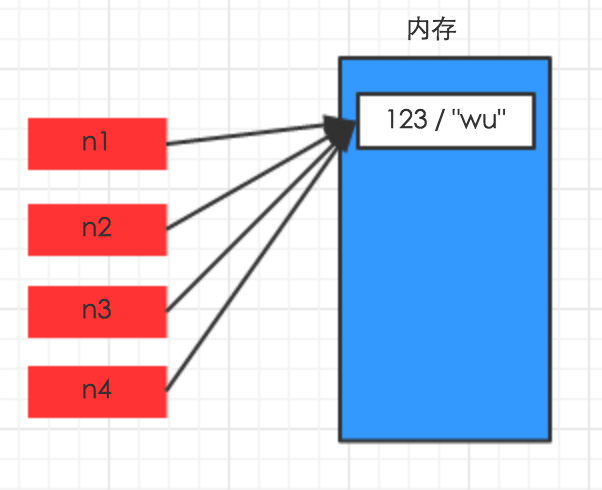
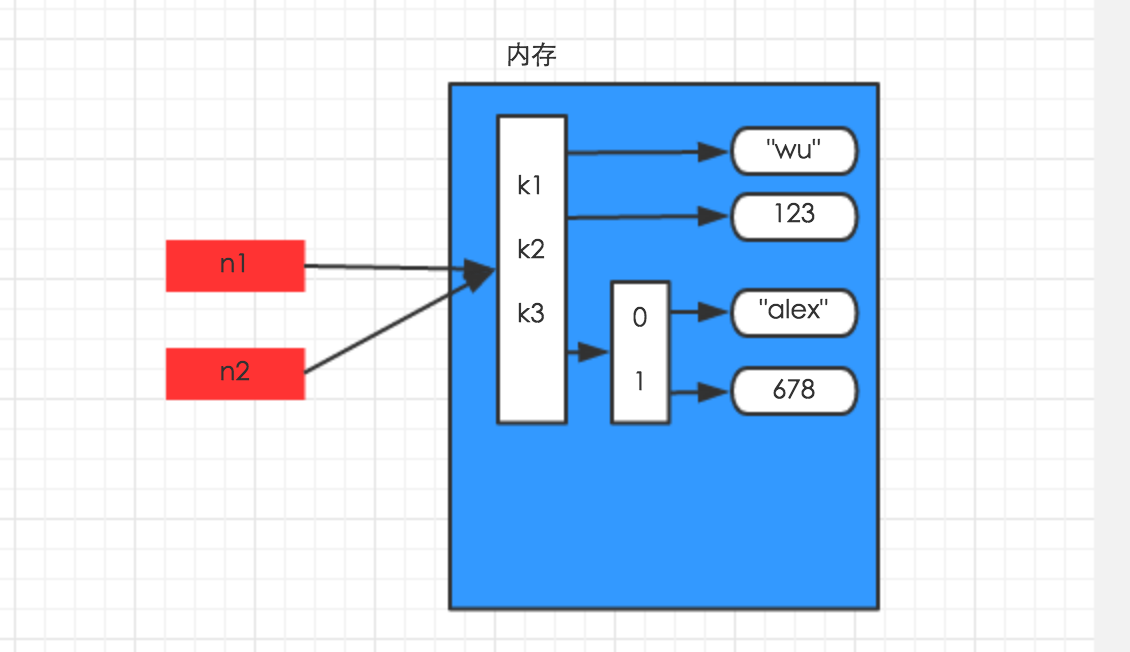
对于字典、元祖、列表 而言,进行赋值、浅拷贝和深拷贝时,其内存地址的变化是不同的。
赋值,只是创建一个变量,该变量指向原来内存地址,如:
n1 = {"k1": "wu", "k2": 123, "k3": ["alex", 456]}

n2 = n1
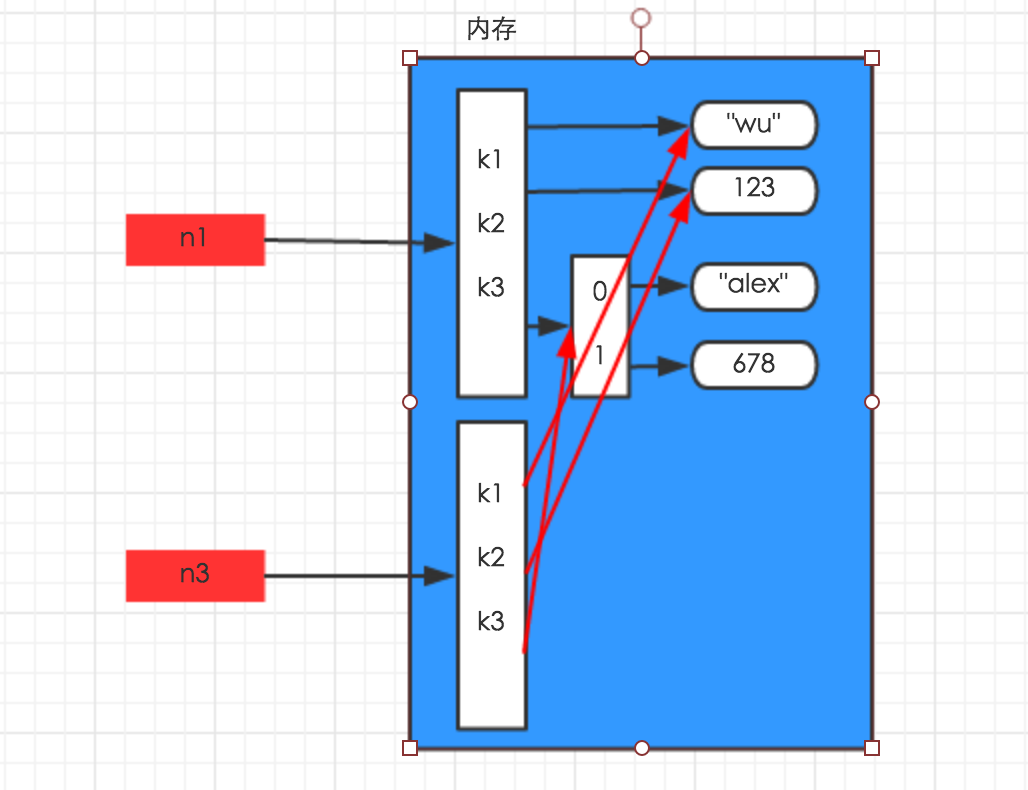
浅拷贝,在内存中只额外创建第一层数据
import copy

n1 = {"k1": "wu", "k2": 123, "k3": ["alex", 456]}

n3 = copy.copy(n1)
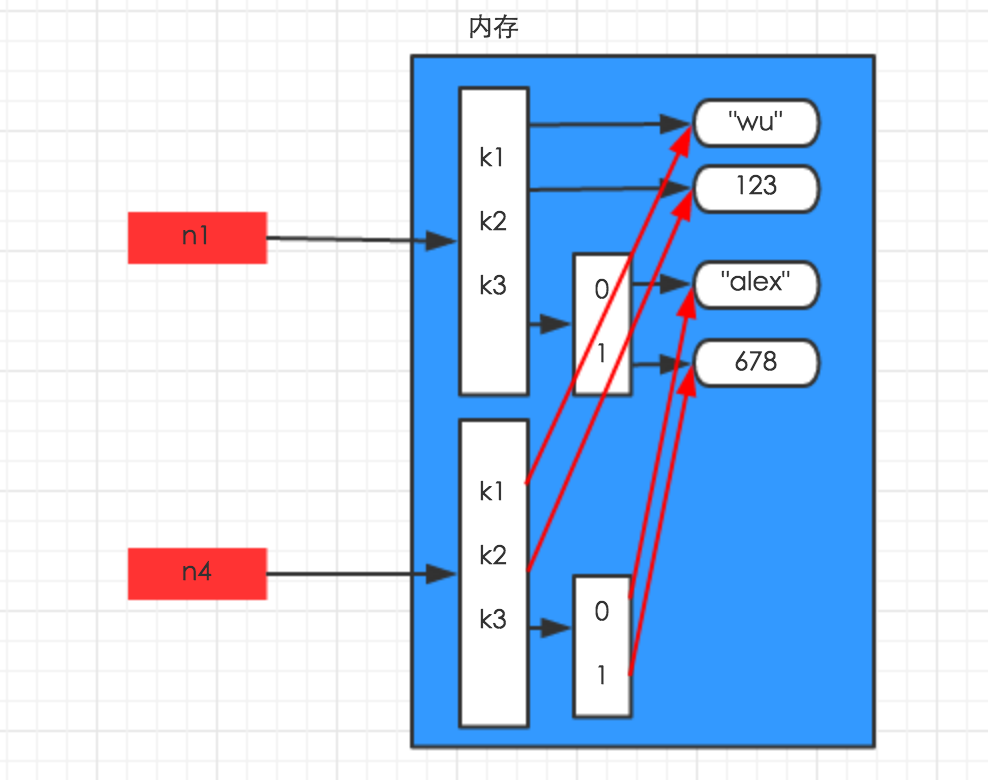
深拷贝,在内存中将所有的数据重新创建一份(排除最后一层,即:python内部对字符串和数字的优化)
import copy

n1 = {"k1": "wu", "k2": 123, "k3": ["alex", 456]}

n4 = copy.deepcopy(n1)
八、函数
一、背景
在学习函数之前,一直遵循:面向过程编程,即:根据业务逻辑从上到下实现功能,其往往用一长段代码来实现指定功能,开发过程中最常见的操作就是粘贴复制,也就是将之前实现的代码块复制到现需功能处,如下:
while True:

    if cpu利用率 > 90%:

        #发送邮件提醒

        连接邮箱服务器

        发送邮件

        关闭连接

    if 硬盘使用空间 > 90%:

        #发送邮件提醒

        连接邮箱服务器

        发送邮件

        关闭连接

    if 内存占用 > 80%:

        #发送邮件提醒

        连接邮箱服务器

        发送邮件

        关闭连接
仔细一看上述代码,if条件语句下的内容可以被提取出来公用,如下:
def 发送邮件(内容)

    #发送邮件提醒

    连接邮箱服务器

    发送邮件

    关闭连接

while True:

    if cpu利用率 > 90%:

        发送邮件('CPU报警')

    if 硬盘使用空间 > 90%:

        发送邮件('硬盘报警')

    if 内存占用 > 80%:
对于上述的两种实现方式,第二次必然比第一次的重用性和可读性要好,其实这就是函数式编程和面向过程编程的区别:
- 函数式:将某功能代码封装到函数中,日后便无需重复编写,仅调用函数即可
- 面向对象:对函数进行分类和封装,让开发“更快更好更强...”
函数式编程最重要的是增强代码的重用性和可读性
二、定义和使用
def 函数名(参数):

    ...

    函数体

    ...
函数的定义主要有如下要点:
- def:表示函数的关键字
- 函数名:函数的名称,日后根据函数名调用函数
- 函数体:函数中进行一系列的逻辑计算,如:发送邮件、计算出 [11,22,38,888,2]中的最大数等...
- 参数:为函数体提供数据
- 返回值:当函数执行完毕后,可以给调用者返回数据。
以上要点中,比较重要有参数和返回值:
1、返回值
函数是一个功能块,该功能到底执行成功与否,需要通过返回值来告知调用者。
def 发送短信():

    发送短信的代码...

    if 发送成功:

        return True

    else:

        return False

while True:

    # 每次执行发送短信函数,都会将返回值自动赋值给result

    # 之后,可以根据result来写日志,或重发等操作

    result = 发送短信()

    if result == False:

        记录日志,短信发送失败...
2、参数
为什么要有参数?
 def 发送邮件(邮件内容)

     #发送邮件提醒

     连接邮箱服务器

     发送邮件

     关闭连接

 while True:

     if cpu利用率 > 90%:

         发送邮件("CPU报警了。")

     if 硬盘使用空间 > 90%:

         发送邮件("硬盘报警了。")

     if 内存占用 > 80%:

         发送邮件("内存报警了。")
有参数实现
 def CPU报警邮件()

     #发送邮件提醒

     连接邮箱服务器

     发送邮件

     关闭连接

 def 硬盘报警邮件()

     #发送邮件提醒

     连接邮箱服务器

     发送邮件

     关闭连接

 def 内存报警邮件()

     #发送邮件提醒

     连接邮箱服务器

     发送邮件

     关闭连接

 while True:

     if cpu利用率 > 90%:

         CPU报警邮件()

     if 硬盘使用空间 > 90%:

         硬盘报警邮件()

     if 内存占用 > 80%:

         内存报警邮件()
无参数实现
函数的有三中不同的参数:
- 普通参数
- 默认参数
- 动态参数
 # ######### 定义函数 #########

 # name 叫做函数func的形式参数,简称:形参

 def func(name):

     print name

 # ######### 执行函数 #########

 #  'spykdis' 叫做函数func的实际参数,简称:实参

 func('spykdis')
普通参数
 def func(name, age = 18):

     print "%s:%s" %(name,age)

 # 指定参数

 func('cat', 19)

 # 使用默认参数

 func('tom')

 注:默认参数需要放在参数列表最后
默认参数
 def func(*args):

     print args

 # 执行方式一

 func(11,33,4,4454,5)

 # 执行方式二

 li = [11,2,2,3,3,4,54]

 func(*li)
动态参数-序列
 def func(**kwargs):

     print args

 # 执行方式一

 func(name='tom',age=18)

 # 执行方式二

 li = {'name':'tom', age:18, 'gender':'male'}

 func(**li)
动态参数-字典
 def func(*args, **kwargs):

     print args

     print kwargs
动态参数-序列和字典
九、lambda表达式
学习条件运算时,对于简单的 if else 语句,可以使用三元运算来表示,即:
# 普通条件语句

if 1 == 1:

    name = 'wupeiqi'

else:

    name = 'alex'

# 三元运算

name = 'wupeiqi' if 1 == 1 else 'alex'
对于简单的函数,也存在一种简便的表示方式,即:lambda表达式
# ###################### 普通函数 ######################

# 定义函数(普通方式)

def func(arg):

    return arg + 1

# 执行函数

result = func(123)

# ###################### lambda ######################

# 定义函数(lambda表达式)

my_lambda = lambda arg : arg + 1

# 执行函数

result = my_lambda(123)
lambda存在意义就是对简单函数的简洁表示
十、内置函数
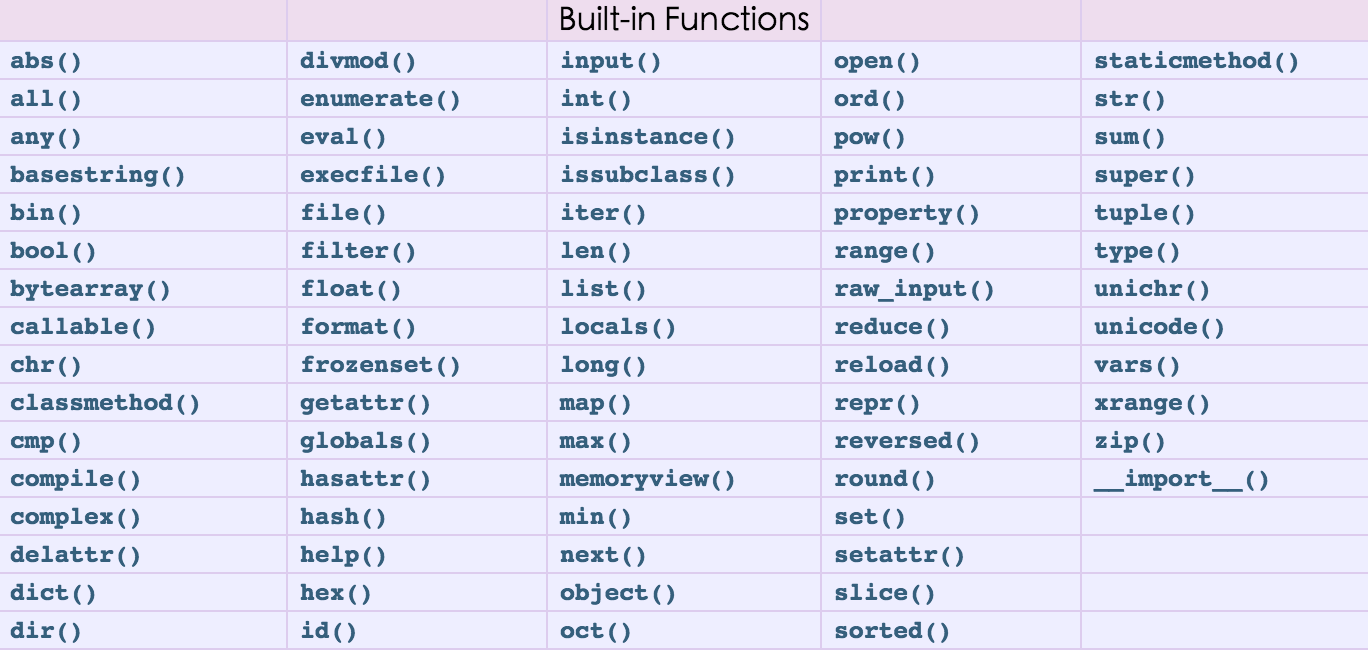
详细见python文档,猛击这里
map
遍历序列,对序列中每个元素进行操作,最终获取新的序列。

 li = [11, 22, 33]

 new_list = map(lambda a: a + 100, li)
每个元素增加100
 li = [11, 22, 33]

 sl = [1, 2, 3]

 new_list = map(lambda a, b: a + b, li, sl)
两个列表相同元素相加
filter
对于序列中的元素进行筛选,最终获取符合条件的序列

 li = [11, 22, 33]

 new_list = filter(lambda arg: arg > 22, li)

 #filter第一个参数为空,将获取原来序列
获取列表中大于12的所有元素集合
reduce
对于序列内所有元素进行累计操作


 li = [11, 22, 33]

 result = reduce(lambda arg1, arg2: arg1 + arg2, li)

 # reduce的第一个参数,函数必须要有两个参数

 # reduce的第二个参数,要循环的序列

 # reduce的第三个参数,初始值
获取序列中所有元素的和
python学习day3的更多相关文章
- python学习-day3
今天是第三天学习,加油! 第一部分 集合 一.集合 1.什么是集合以及特性? 特性:无序的,不重复的序列,可嵌套. 2.创建集合 方法一:创建空集合 s1 = set() print(type(s1) ...
- python学习Day3 变量、格式化输出、注释、基本数据类型、运算符
今天复习内容(7项) 1.语言的分类 -- 机器语言:直接编写0,1指令,直接能被硬件执行 -- 汇编语言:编写助记符(与指令的对应关系),找到对应的指令直接交给硬件执行 -- 高级语言:编写人能识别 ...
- python学习 day3 (3月4日)---字符串
字符串: 下标(索引) 切片[起始:终止] 步长[起始:终止:1] 或者-1 从后往前 -1 -2 -3 15个专属方法: 1-6 : 格式:大小写 , 居中(6) s.capitalize() s ...
- Python学习day3作业
days3作业 作业需求 HAproxy配置文件操作 根据用户输入,输出对应的backend下的server信息 可添加backend 和sever信息 可修改backend 和sever信息 可删除 ...
- python学习day3 编程语言分类 变量 格式化输出
1.编程语言分类 机器语言:直接使用二进制指令直接编写程序,直接操作计算机硬件,必须考虑硬件细节 汇编语言:使用英文标签代替二进制指令去编写程序,直接操作计算机硬件,必须考虑硬件细节对,不过相比机器语 ...
- Python学习day3 数据类型Ⅰ(str,int,bool)
day3 数据类型 @上节内容补充 每周一个思维导图-xmind.exe in / not in #示例:(是否包含敏感字符)while True: text = input('请输入你要说的 ...
- Python学习笔记,day3
Python学习第三天 一.集合 集合是一个无序的,不重复的数据组合,它的主要作用如下: 去重,把一个列表变成集合,就自动去重了 关系测试,测试两组数据之前的交集.差集.并集等关系 常用操作: s = ...
- python s12 day3
python s12 day3 深浅拷贝 对于 数字 和 字符串 而言,赋值.浅拷贝和深拷贝无意义,因为其永远指向同一个内存地址. 1 2 3 4 5 6 7 8 9 10 11 12 13 14 ...
- python学习博客地址集合。。。
python学习博客地址集合... 老师讲课博客目录 http://www.bootcdn.cn/bootstrap/ bootstrap cdn在线地址 http://www.cnblogs. ...
随机推荐
- OS-MAC: An Efficient MAC Protocol for Spectrum-Agile Wireless Networks
IEEE TRANSACTIONS ON MOBILE COMPUTING, VOL. 7, NO. 8, AUGUST 2008 正如之前所说的,这是一个out-of-band local cove ...
- 夏宇闻教授谈FPGA工程师的入门学习
1. 必须清楚自己究竟适合不适合做工程师. 看看自己的性格特点,是不是特别安静,又耐得住寂寞.因为FPGA工程师是一个辛苦的工作,不但要通过不断学习研究提升自己的设计水平,还要经常性的熬夜加班敲写代码 ...
- 关于VMWARE虚拟机安装GHOST版XP后不能硬盘启动问题
工具: VMware Workstation 9.0 Ghost xp sp3 中英 双语版 现象:建立硬盘分区,设置活动分区...ghost安装顺利,安装完成后不能硬盘启动,如果从硬盘启动则黑屏,出 ...
- UESTC_Little Deer and Blue Cat CDOJ 1025
In DOTA, there are two Intellegence heroes. One is Enchantress, who is usually called Little Deer by ...
- Plus One 解答
Question Given a non-negative number represented as an array of digits, plus one to the number. The ...
- Notepad++背景颜色设置
经常试用notepad++看代码,白色的背景连续看的时间长了眼睛很容变花,所以找了相关的设置选项,分享给大家 具体设置步骤如下: 然后如下设置 这样前景色背景色已经发生改变了哟,下面再修改下选中行的背 ...
- ※数据结构※→☆非线性结构(tree)☆============二叉树 顺序存储结构(tree binary sequence)(十九)
二叉树 在计算机科学中,二叉树是每个结点最多有两个子树的有序树.通常子树的根被称作“左子树”(left subtree)和“右子树”(right subtree).二叉树常被用作二叉查找树和二叉堆或是 ...
- 表格td标签在不添加多余标签的情况下实现文本内容单行显示,多余部分省略号表示的方法
#table { table-layout: fixed; } .content { white-space: nowrap; text-overflow: ellipsis; -o-text-ove ...
- php php打乱数组二维数组、多维数组
php中的shuffle函数只能打乱一维数组,有什么办法快速便捷的打乱多维数组?手册上提供了 <?php function shuffle_assoc($list) { if (!is ...
- IOS开发之---触摸和手势
Touch:在与设备的多点触摸屏交互时生成. 响应者对象 响应者对象就是可以响应事件并对事件作出处理.在iOS中,存在UIResponder类,它定义了响应者对象的所有方法.UIApplication ...