
Changes of user relationship in AD can't be correctly synchronized to SCSM
The relationship of users might be not correctly updated if related users were once re-named in AD or have duplicate records in DB.
Cause 1 - Known Issue: a renamed user in AD will be treated as a new object in SCSM
Symptom
There are multiple records for the same user in BaseManagedEntity.
Analysis
There is a blog talking about this kind of behavior: https://blogs.technet.microsoft.com/manageabilityguys/2013/06/17/managing-username-changes-in-service-manager/
I did a test in my lab environment (SCSM 2012 R2). After I rename a user in AD and run AD connector, there will be two objects co-existing in the table [dbo].[ManagedEntity] for the user, and two relationships in the table [dbo].[Relationship].
For example, after I change my user name from "wendi" to "wendii", then to "wendie", there are 3 user objects and 3 relationships in the DB.
Relationship:
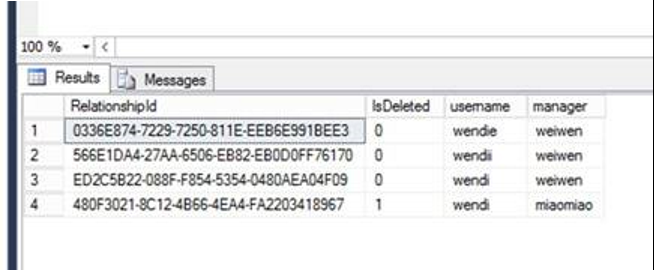
BaseManagedEntity:

Then I manually deleted "wendi" from DB, and changed the manager from "weiwen" to "Administrator" in AD. The relationship got updated for the newest object "wendie", but not for the old object "wendii". That resulted in two managers for the user "wendii"/"wendie", which is actually the same user in AD.

Resolution
Firstly remove the duplicated users from [dbo].[ManagedEntity].
If you don’t want to lose the relationships associated with the old object, please use the script in the blog to move all relationships from old object to new object.
Note: In the script there is a path pointing to SCSM PowerShell Module. You may need to alter it manually based on the real location.
Remove the duplicate user object:
$oldADUser = "wendi"

Get-SCClassInstance -Class (Get-SCClass -Name "System.Domain.User") -Filter "UserName -eq $oldADUser | Remove-SCClassInstance
After confirming there is no duplicate user objects, please change the manager relationship in AD, then check if the relationship can be updated correctly by AD connector.
Cause 2 - Duplicate AD connector introduces duplicate user records
If there is only 1 record in BaseManagedEntity, but multiple records in [LFXSTG].[AD_User], it is probably from duplicate AD connectors.
We can check the data sources of the records in [LFXSTG].[AD_User]:

This query can give you information about all data sources (connectors):
Select * from LFX.Datasource
A sample output:
| DataSourceId | DataSourceName | DataSourceAddress | DisplayName |
|---|---|---|---|
| 2 | ADConnector.af492f92b2d04b4092d2f0c6108a4aff | LDAP://DC=contoso,DC=com | CONTOSO AD Connector |
| 11 | ADConnector.762fe647adc14c2daba1191291e6b37f | LDAP://OU=AdminUsers,OU=Users,DC=contoso,DC=com | CONTOSO AD Connector - Users |
| 12 | ADConnector.b93d4f78d799462280e841e228f5f921 | LDAP://DC=contoso,DC=com | CONTOSO AD Connector - Printers |
| 13 | ADConnector.d49f58ebf7b84c509c3426cde55c7cd5 | LDAP://DC=contoso,DC=com | CONTOSO AD Connector - Computers |
| 14 | ADConnector.e56e3f09b5614c5ea554e3d0c06c7da4 | LDAP://DC=contoso,DC=com | CONTOSO AD Connector - Groups |
| 15 | ADConnector.747d1f1f252f46a59634378686a32dbe | LDAP://OU=SCSM,OU=Groups,DC=contoso,DC=com | CONTOSO AD Connector - SCSM Groups |
Resolution
Disable all duplicate connectors. After that, all users modified in the future could be correctly updated.
For those users which are already affected by the issue, we can follow below steps to process them.
- Run this query in ServiceManager to get the users who have duplicate relationships with relationship isDeleted = 0, as well as the connectors that brought the relationships.
(This query focuses on "manager" relationship)
Select distinct

u.DisplayName 'User Display Name',

u.UserName_6AF77E23_669B_123F_B392_323C17097BBD 'User',

Manager.UserName_6AF77E23_669B_123F_B392_323C17097BBD 'Manager',

r.RelationshipId,

r.IsDeleted 'Is Relationship Deleted',

C.DisplayName 'Connector',

BME.IsDeleted 'Is Connector Deleted',

R.LastModified

from Relationship R

left join RelationshipType RT on R.RelationshipTypeId = RT.RelationshipTypeId

left join MT_System$Domain$User Manager on manager.BaseManagedEntityId = R.SourceEntityId

left join MT_System$Domain$User U on u.BaseManagedEntityId = r.TargetEntityId

inner join DiscoverySourceToRelationship DSTR on R.RelationshipId = DSTR.RelationshipId

Left join DiscoverySource DS on DS.DiscoverySourceId = DSTR.DiscoverySourceId

left join MT_Connector C on convert(nvarchar(256),DS.ConnectorId) = C.Id

Left join BaseManagedEntity BME on C.BaseManagedEntityId = BME.BaseManagedEntityId

where RelationshipTypeName like '%System.UserManagesUser%' and u.BaseManagedEntityId in

(

Select

u.BaseManagedEntityId

from Relationship R

left join RelationshipType RT on R.RelationshipTypeId = RT.RelationshipTypeId

left join MT_System$Domain$User Manager on manager.BaseManagedEntityId = R.SourceEntityId

left join MT_System$Domain$User U on u.BaseManagedEntityId = r.TargetEntityId

where RelationshipTypeName like '%System.UserManagesUser%' and r.IsDeleted = 0

group by U.UserName_6AF77E23_669B_123F_B392_323C17097BBD, u.BaseManagedEntityId

Having count(u.UserName_6AF77E23_669B_123F_B392_323C17097BBD) > 1)

order by U.UserName_6AF77E23_669B_123F_B392_323C17097BBD
- Use below steps to automate the removal of un-needed relationships whilst keeping the most current one.
- Copy the query result with headers and save as a .csv file.
- Remove the needed relationships from the .csv file.
- Use below PowerShell commands to remove the un-needed relationships.
# You may change the file path.

$listcsv = Import-Csv C:\Files\UnneededRelationships.csv

foreach($list in $listcsv)

{

    Get-screlationshipinstance -id $listcsv.RelationshipId | remove-screlationshipinstance

}
Changes of user relationship in AD can't be correctly synchronized to SCSM的更多相关文章
- JMM(java内存模型)
What is a memory model, anyway? In multiprocessorsystems, processors generally have one or more laye ...
- 【翻译九】java-同步方法
Synchronized Methods The Java programming language provides two basic synchronization idioms: synchr ...
- Synchronized Methods
Synchronized Methods The Java programming language provides two basic synchronization idioms: synchr ...
- Java Interview Reference Guide--reference
Part 1 http://techmytalk.com/2014/01/24/java-interview-reference-guide-part-1/ Posted on January 24, ...
- Java Synchronization
Volatile Since Java 5 the volatile keyword guarantees more than just the reading from and writing to ...
- Java内存模型(JSR133)问与答
What is a memory model, anyway? In multiprocessor systems, processors generally have one or more lay ...
- Windows ->> FIX: “The security database on the server does not have a computer account for this workstation trust relationship”
前几天在做AlwaysOn实验时遇到搭建活动目录域时某台已经加入AD的机器无法以域管理员账户登录的情况. 报错信息是:The security database on the server does ...
- Sharepoint2013 AD组用户不同步
背景: SP2013列表库使用AD安全组授权访问,向AD安全组添加一个用户A,在Sharepoint AD同步(增量和完全)后,用户A仍然无法访问列表库:原因: 参考:安全令牌上的缓存 SP2013 ...
- freeradius整合AD域作anyconncet认证服务器
一.服务器要求 Radius服务器:centos6.6.hostname.selinux disabled.stop iptables AD域服务器:Windows Server 2008 R2 E ...
随机推荐
- PAT1129:Recommendation System
1129. Recommendation System (25) 时间限制 400 ms 内存限制 65536 kB 代码长度限制 16000 B 判题程序 Standard 作者 CHEN, Yue ...
- hyper-v 安装Centos及网络配置
新安装的Centos系统默认情况下是不能上网的,需要经过相应的配置:选择对应的虚拟机,点击"虚拟交换机管理器": 设置hyper-v上的网络及分配cpu.内存.磁盘等资源. 安装C ...
- HTTP协议GET HEAD简单介绍
一.HTTP协议简介 超文本传输协议(Hypertext Transfer Protocol,简称HTTP)是应用层协议,自 1990 年起,HTTP 就已经被应用于 WWW 全球信息服务系统. HT ...
- API Gateway性能比较:NGINX vs. ZUUL vs.Cloud Gateway vs. Linkerd[译]
2018-03-04 15:07 联发科的反思 前几天拜读了 OpsGenie 公司(一家致力于 Dev & Ops 的公司)的资深工程师 Turgay elik 博士写的一篇文章(链接在 ...
- JavaWeb(一)JavaWeb应用的概念
JavaWeb应用的概念 在Sun的Java Servlet规范中,对Java Web应用作了这样定义:"Java Web应用由一组Servlet.HTML页.类.以及其它可以被绑定的资源构 ...
- matplotlib简单的使用(二)
1.折线图 import matplotlib as mlb from matplotlib import pylab as pl # 折线图 # 分别创建x,y坐标 x = [1,3,5,7,6,9 ...
- 在线OJ的小demo
牛课网OJ规则 用readLine()代替read_line() 用readLine()代替read_line() 用readLine()代替read_line() 用readLine()代替read ...
- ASP.Net MVC 在控制器中获取View中的form表单值的方法
在网站开发中,我们常常需要用到表单提交的方式,那么在MVC中是如何获取到表单中的数据呢?下面我们来介绍以下几种方式 首先我们先看看View前台页面 添加一个控制器 我们再看看前台页面的代码 @{ La ...
- codeforces 985C Liebig's Barrels
题意: 有n * k块木板,每个木桶由k木板组成,每个木桶的容量定义为它最短的那块木板的长度. 任意两个木桶的容量v1,v2,满足|v1-v2| <= d. 问n个木桶容量的最大的和为多少,或者 ...
- nsq源码阅读笔记之nsqd(三)——diskQueue
diskQueue是backendQueue接口的一个实现.backendQueue的作用是在实现在内存go channel缓冲区满的情况下对消息的处理的对象. 除了diskQueue外还有dummy ...