
@RequestBody与serialize()、serializeArray()、拼接Json 妙用总结
@requestBody注解常用来处理content-type不是默认的application/x-www-form-urlcoded编码的内容,
比如说:application/json或者是application/xml等。一般情况下来说常用其来处理application/json类型。
jQuery序列化表单的方法总结
现在这里贴出案例中静态的html网页内容:
<!DOCTYPE html>
<html lang="en">
<head>
<meta charset="UTF-8">
<title>Title</title>
</head>
<body>
<form id="test_form">
账户:<input type="text" name="username" value="user"/><br>
密码:<input type="password" name="password" value="123"><br>
<input type="button" value="序列化为(Key=Value)格式Url"onclick="testJquerySerializeUrl()" id="serializeUrl"/>
<input type="button" value="序列化为json" onclick="testJquerySerializeArray()" id="serializeJson"/>
<input type="button" value="手动拼接为json" onclick="testAutoSetJsonData()" id="autoSetJson"/>
</form>
</body>
知识点一:表单序列化serialize()
不需要使用@RequestBody
方法介绍:
作用:序列表单内容为字符串。
参数: 无
Content-Type:application/x-www-form-urlencoded; charset=UTF-8
默认返回类型,不需要使用@RequestBody
案例代码:
<script>

    function testJquerySerializeUrl() {

		alert($("#test_form").serialize());

        console.log($("#test_form").serialize());

        $.ajax({

            url: "/SerializeUrl",

            type: "post",

            data: $("#test_form").serialize()

        })

    }

</script>
后台代码:
@RequestMapping("/SerializeUrl")

public void hello( user user){

   System.out.println(user);

}
测试结果:
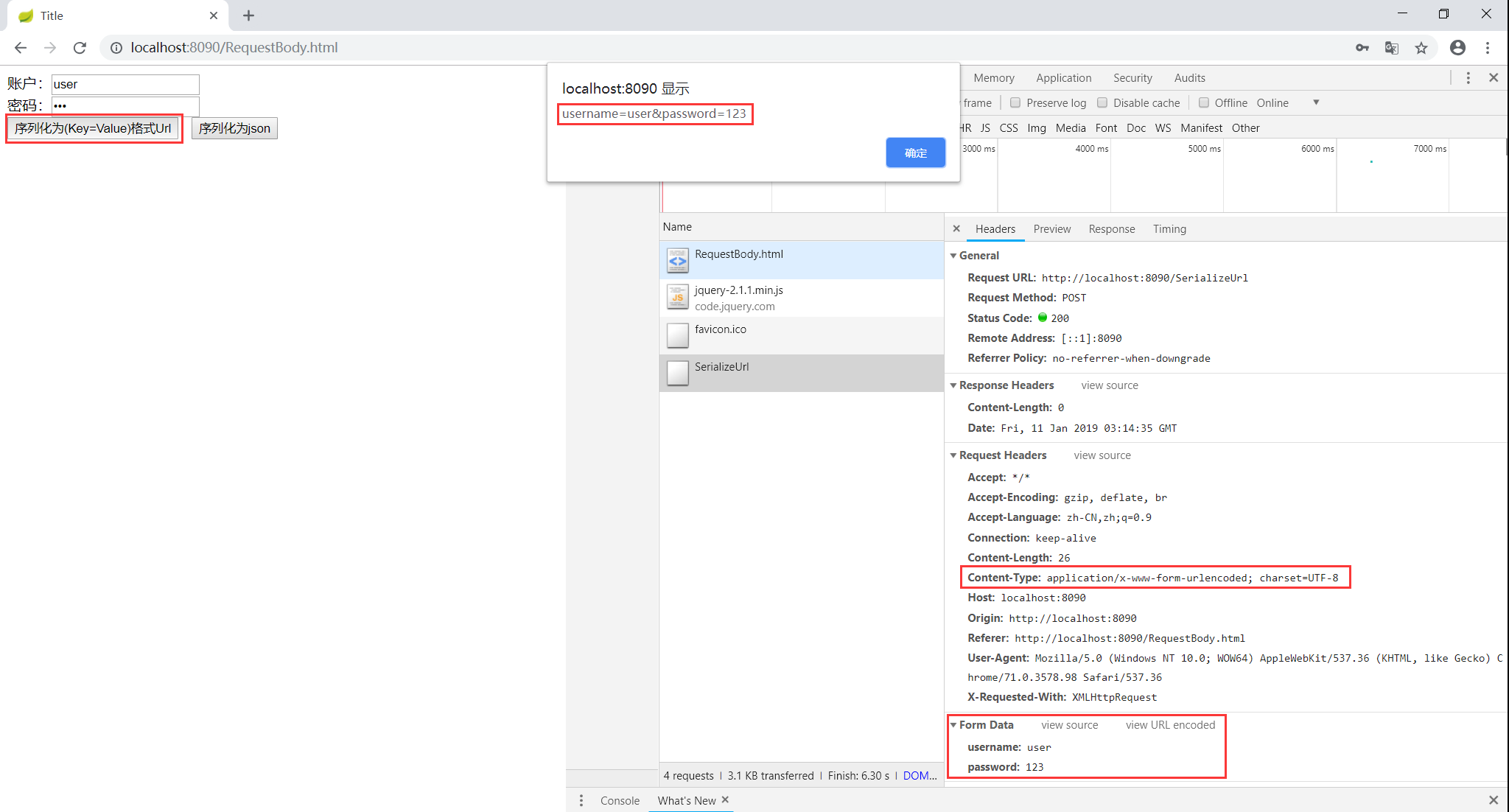
总结: ajax使用默认Content-Type:
application/x-www-form-urlencoded; charset=UTF-81.我们看到输出的结果为表单项中的各表单元素的name和value值
2.格式是以 KEY:VALUE 参数的形式
需要使用@RequestBody
作用:序列表单内容为字符串。
参数: 无
Content-Type:contentType: "application/json"
需要使用@RequestBody
案例:
<script>

    function testJquerySerializeUrl() {

		alert($("#test_form").serialize());

        console.log($("#test_form").serialize());

        $.ajax({

            url: "/SerializeUrl",

            type: "post",

            data: $("#test_form").serialize(),

    		contentType: "application/json"

        })

    }

</script>
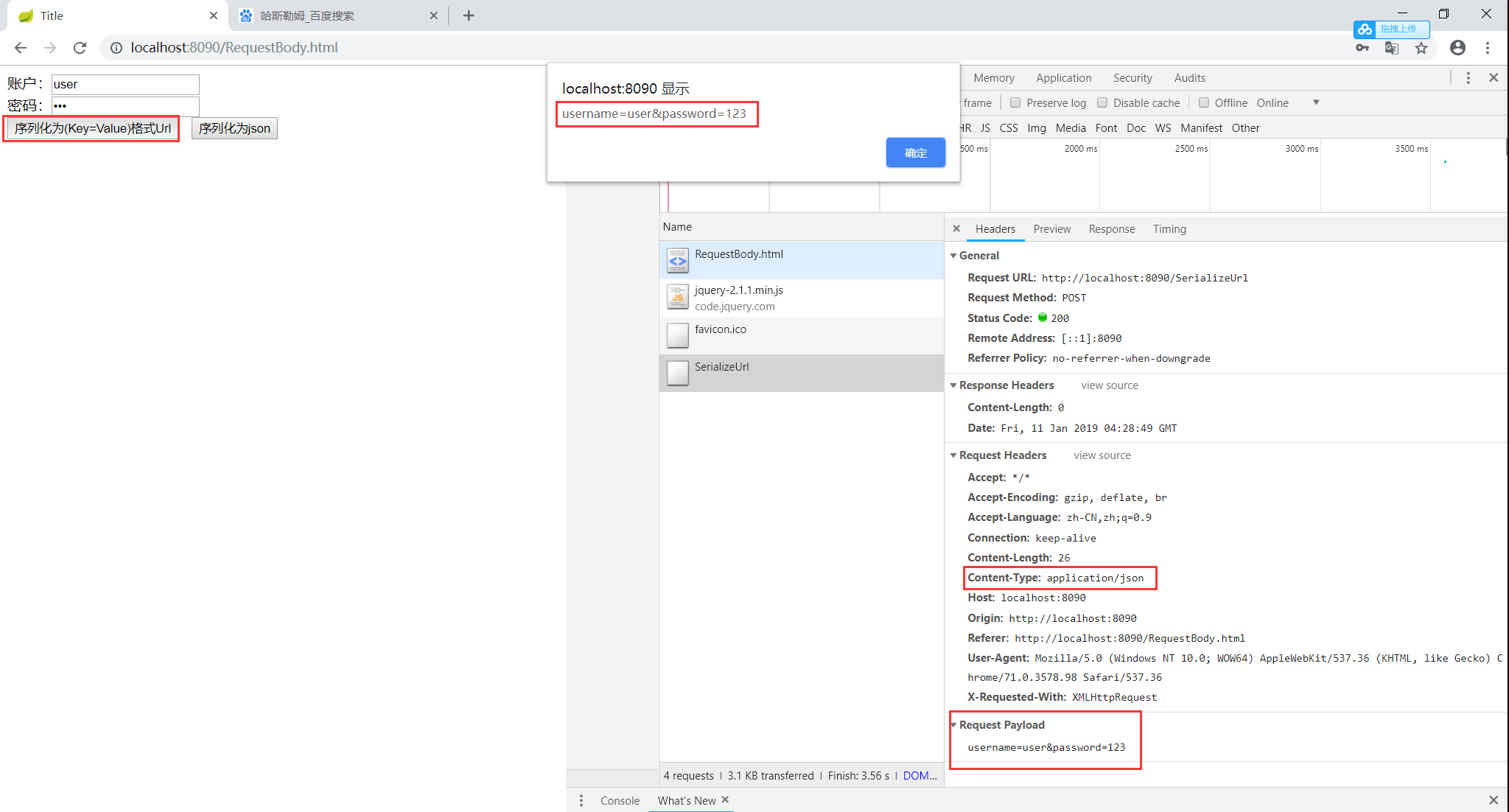
有上图可以看到请求体的值为:username=user&password=123,此时后台使用无法接收到传回的值的。需要重新组装表单序列化Url为Json串,然后通过JSON.stringify()将javascript值转成json字符串
<script>

    function testJquerySerializeUrl() {

        alert(JSON.stringify($("#test_form").serialize()));

        console.log($("#test_form").serialize());

        //重新组装表单序列化Url为Json串

        var jsonData = {}

        var serializeStr = $("#test_form").serialize();

        var array = serializeStr.split("&");

        $(array).each(function (i) {

            jsonData[array[i].split("=")[0]] = array[i].split("=")[1];

        })

        console.log(jsonData);

        $.ajax({

            url: "/SerializeUrl",

            type: "post",

            data: JSON.stringify(jsonData),

            contentType: "application/json"

        })

    }

</script>
后台代码:添加@RequestBody
@RequestMapping("/SerializeUrl")

public void SerializeUrl(@RequestBody user user){

    System.out.println(user);

}
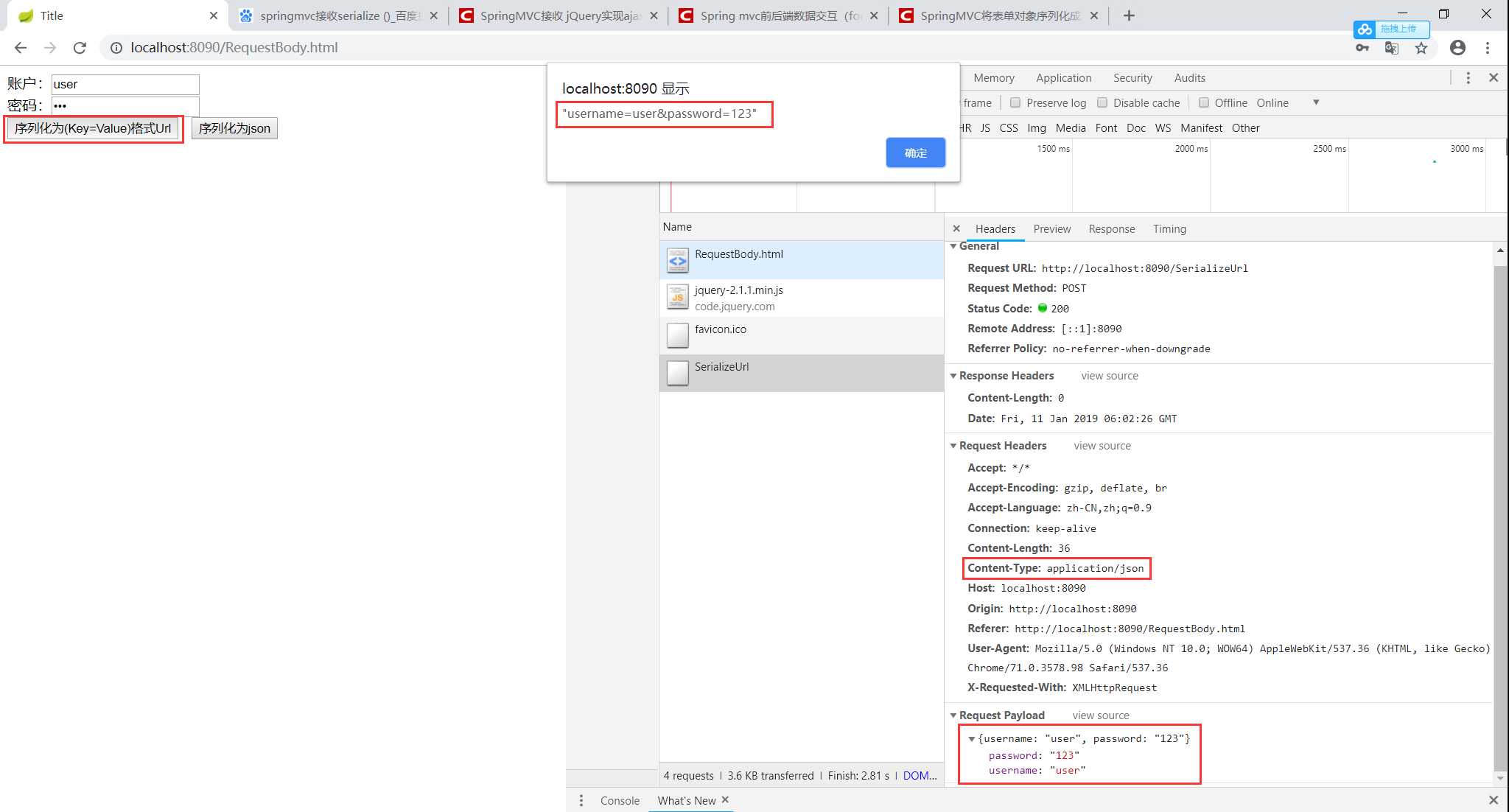
总结:ajax使用Content-Type:
contentType: "application/json"1.我们看到输出的结果为表单项中的各表单元素的name和value值
2.格式是以url参数的形式,第一个参数前面没有&符号
知识点二:表单序列化serializeArray()方法
不需要使用@RequestBody
方法介绍:
作用:序列化表格元素 (类似 '.serialize()' 方法) 返回 JSON 数据结构数据。
参数:无
返回值:返回的是JSON对象而非JSON字符串Content-Type:`application/x-www-form-urlencoded; charset=UTF-8
案例:
<script>

    function testJquerySerializeArray() {

        alert($("#test_form").serializeArray());

        console.log($("#test_form").serializeArray());

        $.ajax({

            url: "/SerializeArray",

            type: "post",

            data: $("#test_form").serializeArray(),

        })

    }

</script>
后台代码:
@RequestMapping("/SerializeArray")

public void SerializeArray(user user){

    System.out.println(user);

}
测试结果:
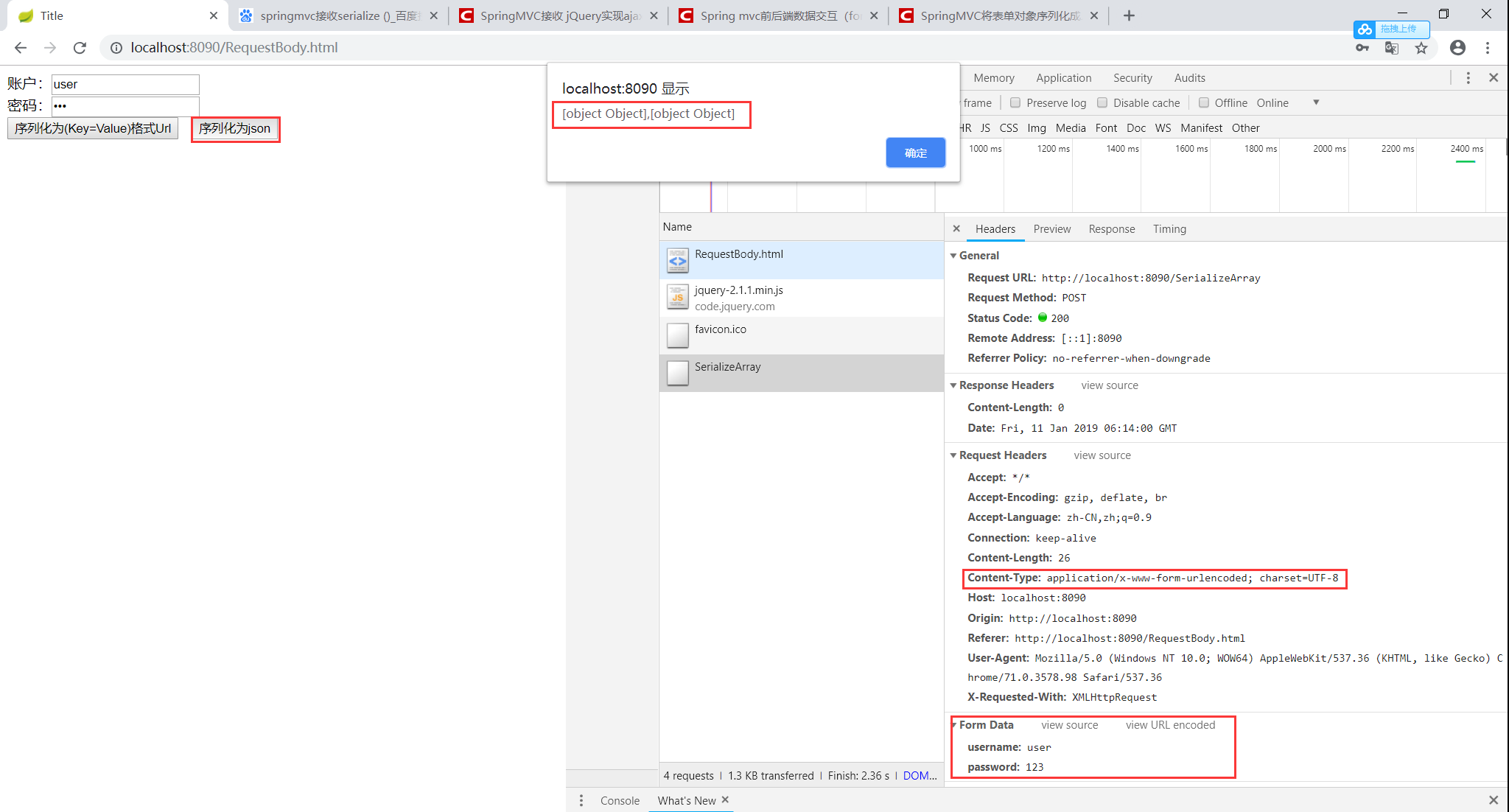
总结: ajax使用默认Content-Type:
application/x-www-form-urlencoded; charset=UTF-81.我们看到输出的结果为Json
[
{name: 'firstname', value: 'Hello'},
{name: 'lastname', value: 'World'},
{name: 'alias'}, // this one was empty
]
需要使用@RequestBody
案例:
<script>

    function testJquerySerializeArray() {

        alert($("#test_form").serializeArray());

        console.log($("#test_form").serializeArray());

        var jsonData = {};

        var serializeArray = $("#test_form").serializeArray();

        // 先转换成{"id": ["12","14"], "name": ["aaa","bbb"], "pwd":["pwd1","pwd2"]}这种形式

        $(serializeArray).each(function () {

            if (jsonData[this.name]) {

                if ($.isArray(jsonData[this.name])) {

                    jsonData[this.name].push(this.value);

                } else {

                    jsonData[this.name] = [jsonData[this.name], this.value];

                }

            } else {

                jsonData[this.name] = this.value;

            }

        });

        console.log(jsonData);

        $.ajax({

            url: "/SerializeArray",

            type: "post",

            data: JSON.stringify(jsonData),

            contentType: "application/json"

        })

    }

</script>
后台代码:添加@RequestBody
@RequestMapping("/SerializeArray")

public void SerializeArray(@RequestBody user user){

    System.out.println(user);

}
测试结果:
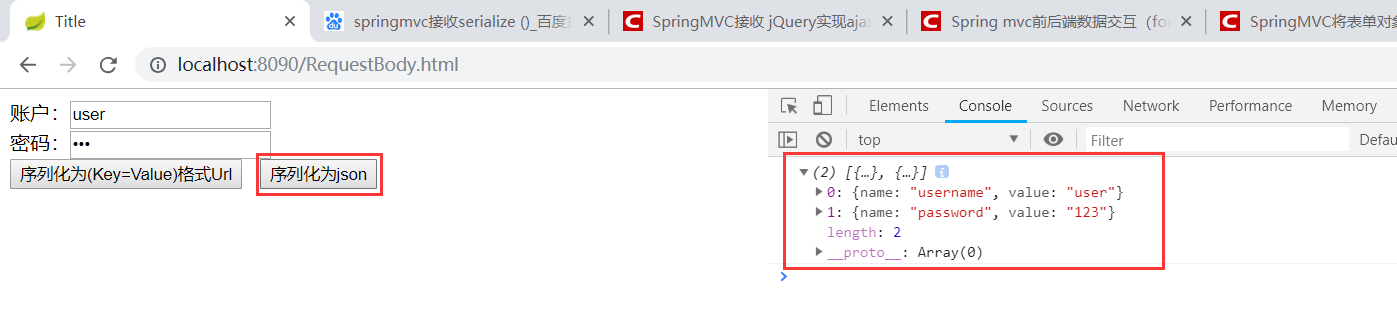
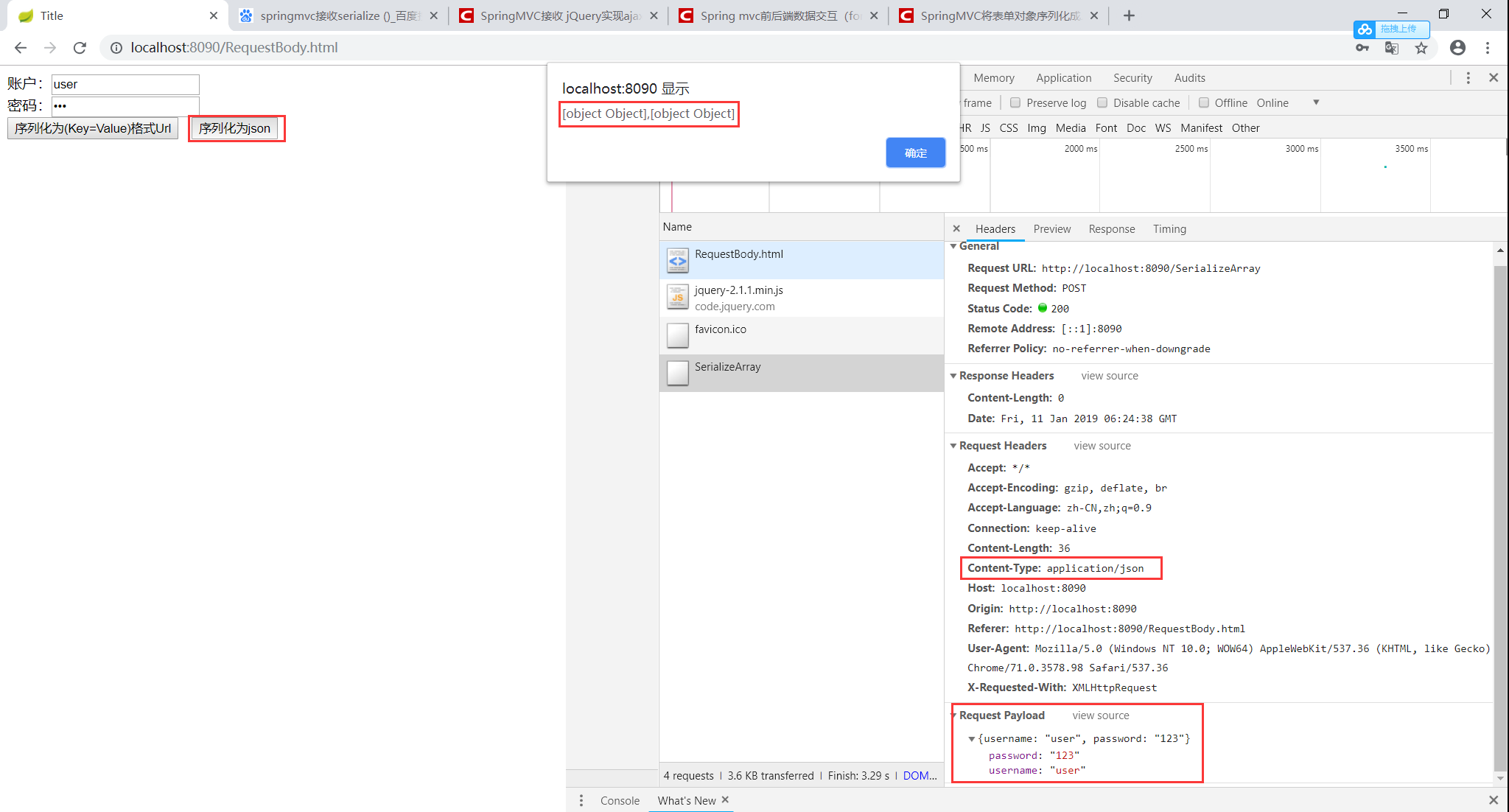
有上图可以看到console.log打印出来为一个json对象,此时使用@RequestBody后台无法接收。需要重新组装表单序列化json对象为Json串,然后通过JSON.stringify()将javascript值转成json字符串
总结:
1.我们看到调用方法返回的是json对象
2.可是用JSON.stringify()方法将json对象转化为json字符串
知识点三:拼接json串
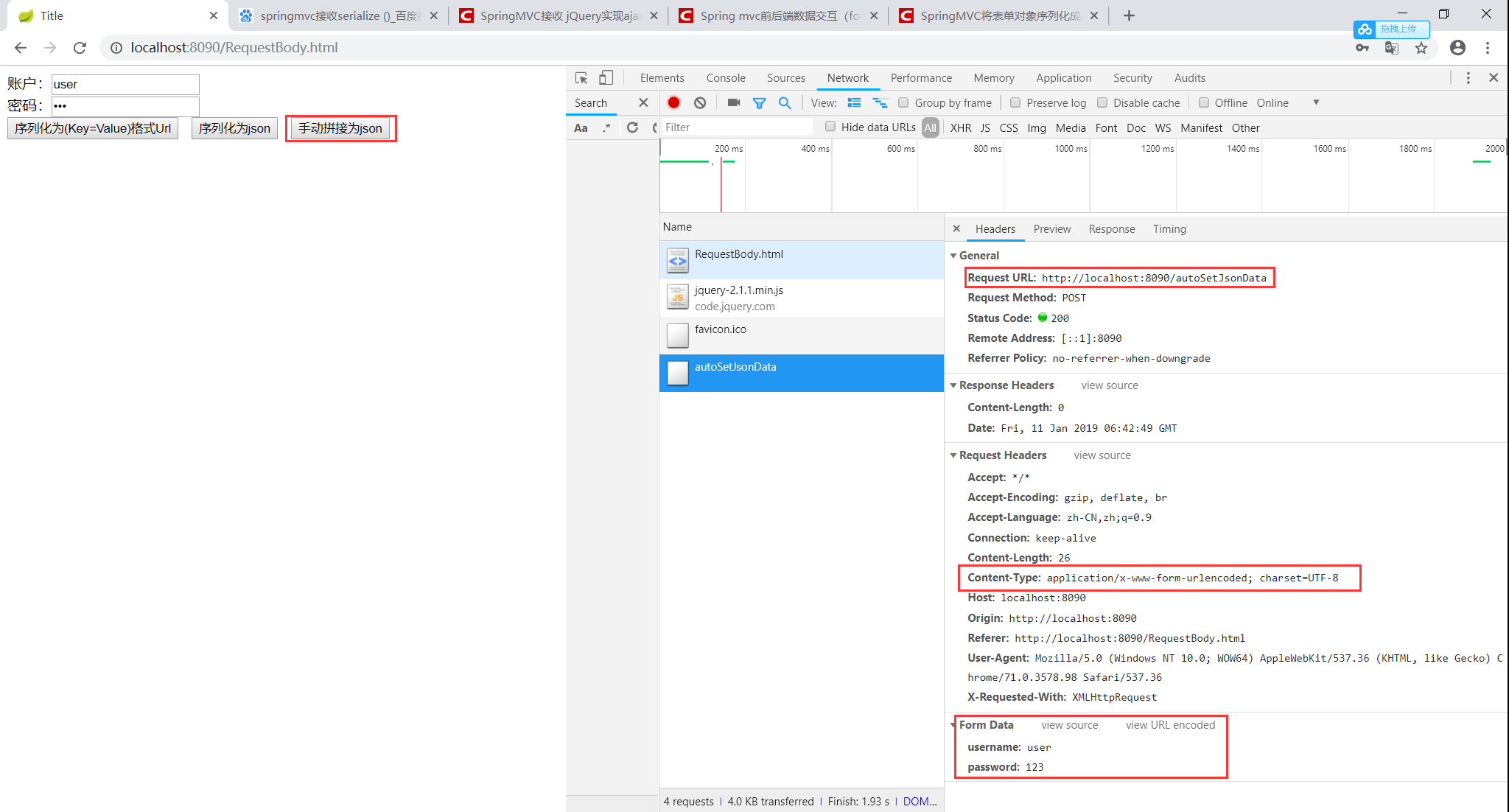
不需要使用@RequestBody
案例:
<script>

    function testAutoSetJsonData() {

        $.ajax({

            url:"/autoSetJsonData",

            type:"post",

            data:{

                username:"user",

                password:"123"

            }

        })

    }

</script>
后台代码:
@RequestMapping("/autoSetJsonData")

public void autoSetJsonData(user user){

    System.out.println(user);

}
测试结果:
需要使用@RequestBody
案例:
<script>

    function testAutoSetJsonData() {

        $.ajax({

            url:"/autoSetJsonData",

            type:"post",

            data:JSON.stringify({

                username:"user",

                password:"123"

            }),

            contentType: "application/json"

        })

    }

</script>
后台代码:添加@RequestBody
@RequestMapping("/autoSetJsonData")

public void autoSetJsonData(@RequestBody user user){

    System.out.println(user);

}
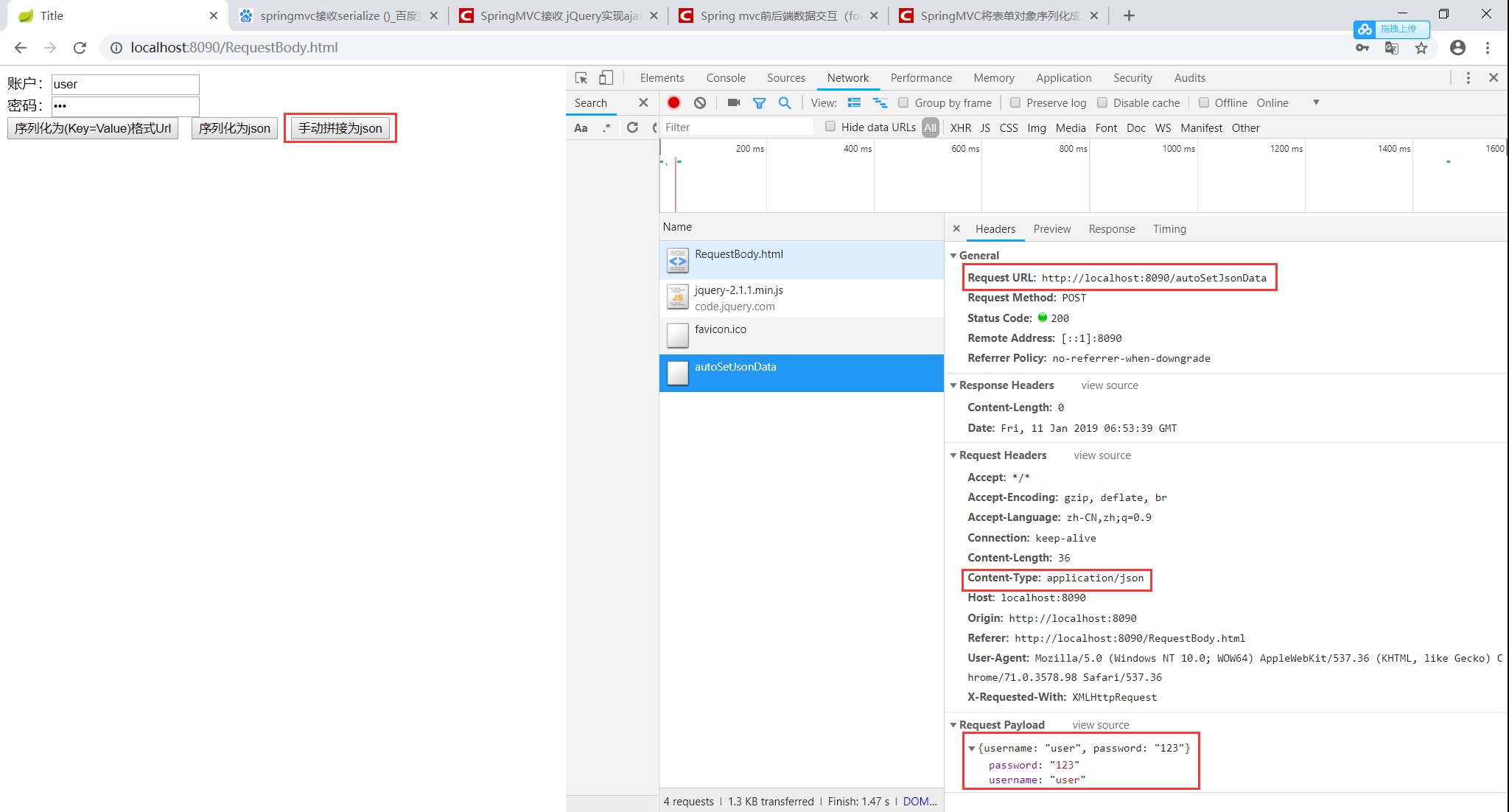
测试结果:
总结
拿好小本子记笔记了
@RequestBody接收的是一个Json对象的字符串,而不是一个Json对象/javascript值(重点)。所以为什么在使用
@RequestBody接收contentType:"application/json"的数据时,后台一直显示为null,是需要将data数据使用JSON.stringify()转换成json字符串,当然也可以使用字符串拼接的方式。
扩展:@RequestParam 用于默认 Content-Type:application/x-www-form-urlencoded; charset=UTF-8,接收Url指定的参数
相关博客连接:
jQuery序列化表单的方法总结(serialize()、serializeArray())
Github测试代码:
https://github.com/YoCiyy/springboot-helloworld
@RequestBody与serialize()、serializeArray()、拼接Json 妙用总结的更多相关文章
- jQuery序列化表单 serialize() serializeArray()
1.serialize()方法 描述:序列化表单内容为字符串,用于Ajax请求. 格式:var data = $(form).serialize(); 2.serializeArray()方法 描述: ...
- jQuery序列化表单 serialize() serializeArray()(非常重要)
https://m.2cto.com/kf/201412/361303.html 2014-12-15 1.serialize()方法 描述:序列化表单内容为字符串,用于Ajax请求. 格式:var ...
- IOS开发之——使用SBJson拼接Json字符串
SBJson包的下载地址在上一篇文章中. 能够使用NSDictionary中的键值对来拼接Json数据,很方便,也能够进行嵌套,直接上代码: //開始拼接Json字符串 NSDictionary *d ...
- 在SpringMVC中使用@RequestBody和@ResponseBody注解处理json时,报出HTTP Status 415的解决方案
我在使用SpringMVC的@RequestBody和@ResponseBody注解处理JSON数据的时候,总是出现415的错误,说是不支持所提交数据格式,我在页面中使用了JQuery的AJAX来发出 ...
- Atitit php序列化 php的serialize序列化和json序列化
Atitit php序列化 php的serialize序列化和json序列化 PHP 对不同类型的数据用不同的字母进行标示,Yahoo 开发网站提供的Using Serialized PHP with ...
- @RequestBody接收的是一个json对象
一直以为在SpringMVC环境中,@RequestBody接收的是一个json对象,调试代码时没有成功,后来才发现,其实 @RequestBody接收的是一个json字符串,而不是一个json对象. ...
- jQuery 序列化表单 serialize() serializeArray()
1.serialize()方法 格式:var data = $("form").serialize(); 功能:将表单内容序列化成一个字符串. 这样在ajax提交表单数据时,就不用 ...
- jQuery 序列化表单数据 serialize() serializeArray()
1.serialize()方法 格式:var data = $("form").serialize(); 功能:将表单内容序列化成一个字符串. 这样在ajax提交表单数据时,就不用 ...
- jQuery使用serialize(),serializeArray()方法取得表单数据+字符串和对象类型两种表单提交的方法
原始form表单值获取方式(手动): $.ajax({ type: "POST", url: "ajax.php", data: "Name=摘取天上 ...
随机推荐
- 洛谷P5211 [ZJOI2017]字符串(线段树+乱搞)
题面 传送门 题解 为什么大佬们全都是乱搞的--莫非这就是传说中的暴力能进队,乱搞能AC-- 似乎有位大佬能有纯暴力+玄学优化\(AC\)(不算上\(uoj\)的\(Hack\)数据的话--这要是放到 ...
- Ionic2实战——按模块划分app 创建多module
http://www.jianshu.com/p/d94324b722af 背景 用ionic2开发过一两个小功能的朋友都会发现,每新建一个页面都需要在\src\app\app.module.ts中添 ...
- PyQt5(4)——菜单栏(使用外部exe)
图像化建立菜单栏: ① 双击输入名称 就可以喽 如何添加工具栏呢: 新建一个快捷工具,拖到快捷栏,出现红色的小竖线. 至此 就完成了菜单栏和快捷方式的建立. 补充: python 如何调用外部的e ...
- 【智能算法】粒子群算法(Particle Swarm Optimization)超详细解析+入门代码实例讲解
喜欢的话可以扫码关注我们的公众号哦,更多精彩尽在微信公众号[程序猿声] 01 算法起源 粒子群优化算法(PSO)是一种进化计算技术(evolutionary computation),1995 年由E ...
- 欧拉筛(线性筛) & 洛谷 P3383 【模板】线性筛素数
嗯.... 埃氏筛和欧拉筛的思想都是相似的: 如果一个数是素数,那么它的所有倍数都不是素数.... 这里主要介绍一下欧拉筛的思路:(欧拉筛的复杂度大约在O(n)左右... 定义一个prime数组,这个 ...
- python全栈开发学习_day2_语言种类及变量
一.编程语言的分类及python相对其他语言的优势 1)三大语言种类及细分 1.机器语言(低级语言):直接用计算能够理解的二进制进行编写,直接控制计算机硬件. 优点:执行效率高. 缺点:开发效率低,跨 ...
- [LnOI2019]加特林轮盘赌
Luogu5249 轮流开枪打一个环上的人 , 每次\(p\)的概率打死 , \(p\)始终相同 , 从第\(1\)个人开始 , 求第\(k\)个人成为唯一幸存者的概率 \(19.3.30\) 官方题 ...
- vue中nextTick的使用(转载)
转载自:https://www.cnblogs.com/chaoyuehedy/p/8985425.html 简介 vue是非常流行的框架,他结合了angular和react的优点,从而形成了一个轻量 ...
- Python 实现flatten功能
from collections import Iterable def flatten(items): for x in items: if isinstance(x, Iterable) and ...
- 性能测试工具Jmeter12-Jmeter连接配置带跳板机(SSH)的mysql服务器
准备工作: 1.下载mysql-connector-java-5.1.13-bin.jar包,然后放在jmeter安装目录lib下 2.重新打开jmeter即可 要完成以上两步才能进行后续操作 要点: ...