
[学习笔记] Splay Tree 从入门到放弃
前几天由于出行计划没有更博QwQ
(其实是因为调试死活调不出来了TAT我好菜啊)
伸展树
伸展树(英语:Splay Tree)是一种二叉查找树,它能在O(log n)内完成插入、查找和删除操作。它是由丹尼尔·斯立特(Daniel Sleator)和罗伯特·塔扬在1985年发明的[1]。
在伸展树上的一般操作都基于伸展操作:假设想要对一个二叉查找树执行一系列的查找操作,为了使整个查找时间更小,被查频率高的那些条目就应当经常处于靠近树根的位置。于是想到设计一个简单方法, 在每次查找之后对树进行调整,把被查找的条目搬移到离树根近一些的地方。伸展树应运而生。伸展树是一种自调整形式的二叉查找树,它会沿着从某个节点到树根之间的路径,通过一系列的旋转把这个节点搬移到树根去。
它的优势在于不需要记录用于平衡树的冗余信息。
优点
缺点
伸展树最显著的缺点是它有可能会变成一条链。这种情况可能发生在以非降顺序访问n个元素之后。然而均摊的最坏情况是对数级的——O(log n)
以上摘自中文Wikipedia
永远不要用单旋代替双旋...单旋那叫Spaly,Splay中的势能分析在单旋时会失效,复杂度不对的...(警告某整天单旋的ryf)
Rotate操作:
在离散数学中,树旋转(英语:Tree rotation)是在二叉树中的一种子树调整操作, 每一次旋转并不影响对该二叉树进行中序遍历的结果. 树旋转通常应用于需要调整树的局部平衡性的场合。
然后上几张图来作一下左旋/右旋的说明:

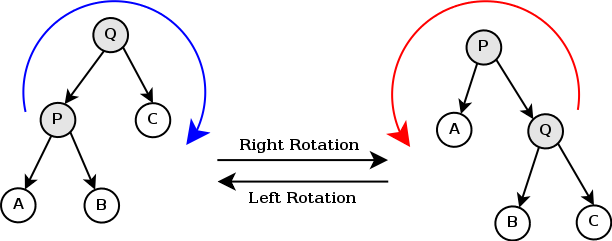
(第一张是动图不知道cnblogs能不能很好地滋磁GIF)
我们可以将左旋理解为将根旋转为右子节点的左子树,右旋为将根旋转为左子节点的右子树(往哪旋根就变成哪边的子树)
附C++袋马实现(左右合并,k=0为左旋,k=1为右旋)
#define lch chd[0]

#define rch chd[1]

#define kch chd[k]

#define xch chd[k^1]

void Rotate(Node* root,int k){

    Node* tmp=root->xch;

    if(root->prt==NULL)

        this->root=tmp;

    else if(root->prt->lch==root)

        root->prt->lch=tmp;

    else

        root->prt->rch=tmp;

    tmp->prt=root->prt;

    root->xch=tmp->kch;

    if(root->xch!=NULL)

        root->xch->prt=root;

    tmp->kch=root;

    root->prt=tmp;

}
Rotate
注:Node的定义:
struct Node{

    int k;

    Node* prt;

    Node* chd[];

    Node(const int& key){

        this->k=key;

        this->prt=NULL;

        this->lch=NULL;

        this->rch=NULL;

    }

    inline int size(){

        return this==NULL?:this->s;

    }

    inline int key(){

        return this==NULL?:this->k;

    }

    inline int Pos(){

        return this==this->prt->lch;

    }

};
Node
这样定义可以直接使用new与空指针NULL而且不必在每次都判空
还可以防止delete野指针造成RE
然后是在前面我为了方便而使用的宏定义:
 #define lch chd[0]

 #define rch chd[1]

 #define kch chd[k]

 #define xch chd[k^1]
Macro Definition
如果要维护子树大小还要记得旋转之后先维护原根(代码中的root)再维护新根(代码中的tmp)
Splay操作:
Splay(伸展)操作是Splay Tree的核心,作用是将一个指定的结点旋转到根的位置.
这时可分三种情况:
I.要伸展的结点的父节点就是根
这时直接一次单旋解决(Zig Step)
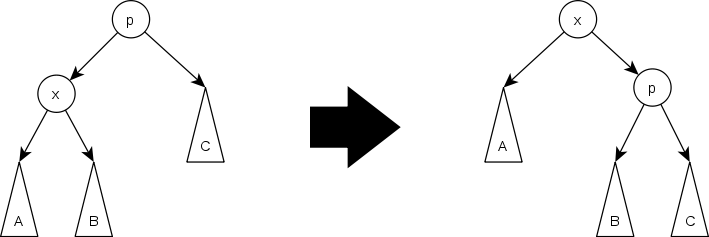
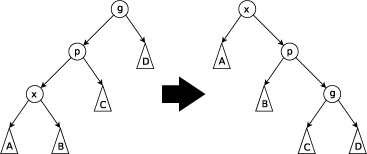
II.要伸展的结点的父节点不是根且要伸展的结点/该结点的父节点/该节点的祖父结点成一条直线
这时要先旋转祖父结点再旋转父节点且旋转方向相同(Zig-zig Step)
III.要伸展的结点的父节点不是根且要伸展的结点/该结点的父结点/该结点的祖父结点不在一条直线上
这时要先旋转父节点再反向旋转祖父结点(Zig-zag Step).需要注意的是旋转父节点后要伸展的结点的祖父结点变成了父结点.
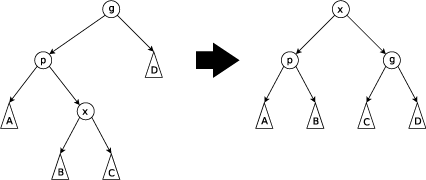
重复上面的情况直至要伸展的结点伸展至根.
实际应用时伸展函数有时候会有两个参数:要伸展的结点指针和根的父节点指针.这样可以控制结点不一定要伸展到整棵树的根而是一个子树的根.后面Insert和Delete操作中会用到.
然后是代码实现.这里将三种情况进行了适当合并,感性理解一下就好
 void Splay(Node* root,Node* prt=NULL){

     while(root->prt!=prt){

         int k=root->Pos();

         if(root->prt->prt==prt){

             this->Rotate(root->prt,k);

         }

         else{

             int d=root->prt->Pos();

             this->Rotate(k==d?root->prt->prt:root->prt,k);

             this->Rotate(root->prt,d);

         }

     }

 }
Splay
Insert操作:
这个操作有多种写法,对于最朴素的Splay可以先按照普通二叉树的方法插入结点,然后将插入的结点伸展到根.
如果题目要求需要维护子树大小来求第K大/小的值与某数的排名的话可以用双参Splay操作与K大/排名操作配合进行,先查找该值前驱伸展到根,然后查找该值后继伸展到根的右子树,然后直接将右子树的左儿子上新建一个结点.
第一种写法的代码是我从Wikipedia上摘录的,其中将模板部分替换为了int并将下划线命名规则改为大驼峰:
 void Insert( const int &key ) {

     Node *z = root;

     Node *p = ;

     while( z ) {

         p = z;

         if( key<z->key ) z = z->lch;

         else z = z->rch;

     }

     z = new Node( key );

     z->prt = p;

     if( !p ) root = z;

     else if( z->key<p->key ) p->lch = z;

     else p->rch = z;

     Splay( z );

 }
Insert:写法1
第二种写法的代码如下:
 void Insert(const int& key){

     int pos=this->Rank(key)-;

     this->Splay(this->Kth(pos));

     this->Splay(this->Kth(pos+),this->root);

     Node* tmp=new Node(key);

     this->root->rch->lch=tmp;

     tmp->prt=this->root->rch;

     this->root->rch->Maintain();

     this->root->Maintain();

 }
Insert: 写法2
注:Maintain()函数的作用为维护子树大小信息,Kth()为求K大函数,Rank()为求排名函数,定义见后续.
Delete操作:
Delete操作同样有多种写法,首先对于无附加信息的普通Splay:
首先查找到要删除的结点,然后伸展到根,并从它的右子树中查找值最小的结点并用它把待删除的结点替换掉.注意维护这两个结点周边结点的指针信息.代码如下,摘自Wikipedia:
 Node* Find( const T &key ) {

     Node *z = root;

     while( z ) {

         if(key<z->key())

             z=z->lch;

         else if(z->key<key)

             z=z->rch;

         else return z;

     }

     return NULL;

 }

 void Delete( const int &key ) {

     Node *z = Find( key );

     if( !z ) return;

     Splay( z );

     if( !z->lch ) Replace( z, z->rch );

     else if( !z->rch ) Replace( z, z->lch );

     else {

         Node *y = SubtreeMinimum( z->rch );

         if( y->prt != z ) {

             Replace( y, y->rch );

             y->rch = z->rch;

             y->rch->prt = y;

         }

         Replace( z, y );

         y->lch = z->lch;

         y->lch->prt = y;

     }

     delete z;

 }

 Node* subtreeMinimum( Node *u ) {

     while( u->lch ) u = u->lch;

     return u;

 }
Delete:写法1
注:Wikipedia中使用了两个辅助函数,一个是Find()用于查找,一个是SubtreeMinimum()用于查找子树最小值.这两个函数也摘录在上面的代码中了.
对于维护了子树大小附加信息的Splay则与Insert类似,不同的是一个是新建结点一个是切断连接并删除罢了
代码如下:
 void Delete(const int& key){

     int pos=this->Rank(key);

     this->Splay(this->Kth(pos-));

     this->Splay(this->Kth(pos+),root);

     delete this->root->rch->lch;

     this->root->rch->lch=NULL;

     this->root->rch->Maintain();

     this->root->Maintain();

 }
Delete:写法2
以上即为伸展树的几种基本操作.如果我们维护了子树大小的话还可以计算第K大/小的值与某数的排名,代码如下,具体原理不再详述.
 int Rank(const int& key){

     Node* root=this->root;

     int rank=;

     while(root!=NULL){

         if(root->key()<key){

             rank+=root->lch->size()+;

             root=root->rch;

         }

         else

             root=root->lch;

     }

     return rank;

 }

 void Insert(const int& key){

     int pos=this->Rank(key)-;

     this->Splay(this->Kth(pos));

     this->Splay(this->Kth(pos+),this->root);

     Node* tmp=new Node(key);

     this->root->rch->lch=tmp;

     tmp->prt=this->root->rch;

     this->root->rch->Maintain();

     this->root->Maintain();

 }
Kth/Rank
通过这两个函数还可求某数的前驱与后继的值,代码如下:
 inline int Predecessor(const int& key){

     return this->Kth(this->Rank(key)-)->key();

 }

 inline int Successor(const int& key){

     return this->Kth(this->Rank(key+))->key();

 }
Predecessor/Successor
对于Insert/Delete操作的第二种写法需要在进行所有操作前新建两个结点,值分别为INF与-INF来保证不会访问空指针
最后附上封装好的完整代码,维护了子树大小,可作为"普通平衡树"的模板.
 #define lch chd[0]

 #define rch chd[1]

 #define kch chd[k]

 #define xch chd[k^1]

 const int INF=0x7FFFFFFF;

 class SplayTree{

 private:

     struct Node{

         int k;

         int s;

         Node* prt;

         Node* chd[];

         Node(const int& key){

             this->k=key;

             this->s=;

             this->prt=NULL;

             this->lch=NULL;

             this->rch=NULL;

         }

         inline int size(){

             return this==NULL?:this->s;

         }

         inline int key(){

             return this==NULL?:this->k;

         }

         inline void Maintain(){

             if(this!=NULL)

                 this->s=this->lch->size()+this->rch->size()+;

         }

         inline int Pos(){

             return this==this->prt->lch;

         }

     }*root;

     void Rotate(Node* root,int k){

         Node* tmp=root->xch;

         if(root->prt==NULL)

             this->root=tmp;

         else if(root->prt->lch==root)

             root->prt->lch=tmp;

         else

             root->prt->rch=tmp;

         tmp->prt=root->prt;

         root->xch=tmp->kch;

         if(root->xch!=NULL)

             root->xch->prt=root;

         tmp->kch=root;

         root->prt=tmp;

         root->Maintain();

         tmp->Maintain();

     }

     void Splay(Node* root,Node* prt=NULL){

         while(root->prt!=prt){

             int k=root->Pos();

             if(root->prt->prt==prt){

                 this->Rotate(root->prt,k);

             }

             else{

                 int d=root->prt->Pos();

                 this->Rotate(k==d?root->prt->prt:root->prt,k);

                 this->Rotate(root->prt,d);

             }

         }

     }

 public:

     Node* Kth(int pos){

         Node* root=this->root;

         while(root!=NULL){

             int k=root->lch->size()+;

             if(pos<k)

                 root=root->lch;

             else if(pos==k)

                 return root;

             else{

                 pos-=k;

                 root=root->rch;

             }

         }

         return NULL;

     }

     int Rank(const int& key){

         Node* root=this->root;

         int rank=;

         while(root!=NULL){

             if(root->key()<key){

                 rank+=root->lch->size()+;

                 root=root->rch;

             }

             else

                 root=root->lch;

         }

         return rank;

     }

     void Insert(const int& key){

         int pos=this->Rank(key)-;

         this->Splay(this->Kth(pos));

         this->Splay(this->Kth(pos+),this->root);

         Node* tmp=new Node(key);

         this->root->rch->lch=tmp;

         tmp->prt=this->root->rch;

         this->root->rch->Maintain();

         this->root->Maintain();

     }

     void Delete(const int& key){

         int pos=this->Rank(key);

         this->Splay(this->Kth(pos-));

         this->Splay(this->Kth(pos+),root);

         delete this->root->rch->lch;

         this->root->rch->lch=NULL;

         this->root->rch->Maintain();

         this->root->Maintain();

     }

     inline int Predecessor(const int& key){

         return this->Kth(this->Rank(key)-)->key();

     }

     inline int Successor(const int& key){

         return this->Kth(this->Rank(key+))->key();

     }

     SplayTree(){

         this->root=new Node(-INF);

         this->root->rch=new Node(INF);

         this->root->rch->prt=this->root;

         this->root->rch->Maintain();

         this->root->Maintain();

     }

 };
Full Splay Tree
然后是图包时间QwQ

[学习笔记] Splay Tree 从入门到放弃的更多相关文章
- js学习笔记:webpack基础入门(一)
之前听说过webpack,今天想正式的接触一下,先跟着webpack的官方用户指南走: 在这里有: 如何安装webpack 如何使用webpack 如何使用loader 如何使用webpack的开发者 ...
- jQuery学习笔记 - 基础知识扫盲入门篇
jQuery学习笔记 - 基础知识扫盲入门篇 2013-06-16 18:42 by 全新时代, 11 阅读, 0 评论, 收藏, 编辑 1.为什么要使用jQuery? 提供了强大的功能函数解决浏览器 ...
- Oracle RAC学习笔记:基本概念及入门
Oracle RAC学习笔记:基本概念及入门 2010年04月19日 10:39 来源:书童的博客 作者:书童 编辑:晓熊 [技术开发 技术文章] oracle 10g real applica ...
- Linux内核学习笔记-1.简介和入门
原创文章,转载请注明:Linux内核学习笔记-1.简介和入门 By Lucio.Yang 部分内容来自:Linux Kernel Development(Third Edition),Robert L ...
- 【转载】【时序约束学习笔记1】Vivado入门与提高--第12讲 时序分析中的基本概念和术语
时序分析中的基本概念和术语 Basic concept and Terminology of Timing Analysis 原文标题及网址: [时序约束学习笔记1]Vivado入门与提高--第12讲 ...
- 卷积神经网络(CNN)学习笔记1:基础入门
卷积神经网络(CNN)学习笔记1:基础入门 Posted on 2016-03-01 | In Machine Learning | 9 Comments | 14935 Vie ...
- Java IO学习笔记八:Netty入门
作者:Grey 原文地址:Java IO学习笔记八:Netty入门 多路复用多线程方式还是有点麻烦,Netty帮我们做了封装,大大简化了编码的复杂度,接下来熟悉一下netty的基本使用. Netty+ ...
- React学习笔记(一)- 入门笔记
React入门指南 作者:狐狸家的鱼 本文链接:React学习笔记 GitHub:sueRimn 1.组件内部状态state的修改 修改组件的每个状态,组件的render()方法都会再次运行.这样就可 ...
- nginx 学习笔记(2) nginx新手入门
这篇手册简单介绍了nginx,并提供了一些可以操作的简单的工作.前提是nginx已经被安装到你的服务器上.如果没有安装,请阅读上篇:nginx 学习笔记(1) nginx安装.这篇手册主要内容:1. ...
随机推荐
- .NET 随记
1. goto 常用于 switch语句中2. 字符串相加用 StringBuilder的Append()方法性能好3. str.Trim(',') 清除字符串后的","4. st ...
- 补:关于man关于SEE ALSO(参见)中代号与vim下常用命令
1.查阅/etc/issue文件时,使用man issue发现manual中see also出现motd(5), agetty(8), mingetty(8)字样.以及文档行首的issue(5)究竟是 ...
- mysqldump 用法总结
mysqldump 备份 备份数据库 my_database $ mysqldump -uUSER -pPASSWD my_database > my_database.sql 备份数据库 my ...
- 日常API之百度翻译
百度翻译是什么,可以吃吗?相信很多人都熟悉,它是我们生活中必不可少的一只东东. 但是,百度翻译开发平台只有每月只能翻译200万个字符,多出的要按照49.00/百万字符来算.对于我酱紫的乞丐程序员来说, ...
- 【Android Developers Training】 20. 创建一个Fragment
注:本文翻译自Google官方的Android Developers Training文档,译者技术一般,由于喜爱安卓而产生了翻译的念头,纯属个人兴趣爱好. 原文链接:http://developer ...
- 0.搭建myeclipse开发环境
1.配置jdk 2.myeclipse集成tomcat 选择默认jdk
- android studio 怎么将项目打包成apk文件
1.Build -> Generate Signed APK...,打开如下窗口 2.假设这里没有打过apk包,点击Create new,窗口如下 这里只要输入几个必要项 Key store p ...
- 浅谈IOC
一.引言 IOC-Invertion of Control,即控制反转,是一种程序设计思想,世上本没有路,走的人多了便有了路,本文将一步步带你了解IOC设计思想的演进之路. 在学习IOC之前我们先初步 ...
- CentOS下源码安装vsftpd-3.0.0,并设置指定用户访问指定目录(附带完整配置文件)
1.卸载系统已经存在的ftp服务器 因为是源码安装,所以不能通过rpm -qa的方式查看是否已经安装ftp服务器,可以通过find / | grep vsftp*方式查看系统中存在哪些与vsftpd相 ...
- Chrome浏览器扩展开发系列之十八:扩展的软件国际化chrome.i18n API
i18n是internationalization 的简写,这里将讨论软件国际化的问题.熟悉软件国际化的朋友应该知道,软件国际化要求,页面中所有用户可见的字符串都必须置于资源属性文件中.资源属性文件中 ...