
poj1324 Holedox Moving
| Time Limit: 5000MS | Memory Limit: 65536K | |
| Total Submissions: 16980 | Accepted: 4039 |
Description
Holedox is a special snake, but its body is not very long. Its lair is like a maze and can be imagined as a rectangle with n*m squares. Each square is either a stone or a vacant place, and only vacant places allow Holedox to move in. Using ordered pair of row and column number of the lair, the square of exit located at (1,1).
Holedox's body, whose length is L, can be represented block by block. And let B1(r1,c1) B2(r2,c2) .. BL(rL,cL) denote its L length body, where Bi is adjacent to Bi+1 in the lair for 1 <= i <=L-1, and B1 is its head, BL is its tail.
To move in the lair, Holedox chooses an adjacent vacant square of its head, which is neither a stone nor occupied by its body. Then it moves the head into the vacant square, and at the same time, each other block of its body is moved into the square occupied by the corresponding previous block.
For example, in the Figure 2, at the beginning the body of Holedox can be represented as B1(4,1) B2(4,2) B3(3,2)B4(3,1). During the next step, observing that B1'(5,1) is the only square that the head can be moved into, Holedox moves its head into B1'(5,1), then moves B2 into B1, B3 into B2, and B4 into B3. Thus after one step, the body of Holedox locates in B1(5,1)B2(4,1)B3(4,2) B4(3,2) (see the Figure 3).
Given the map of the lair and the original location of each block of Holedox's body, your task is to write a program to tell the minimal number of steps that Holedox has to take to move its head to reach the square of exit (1,1). 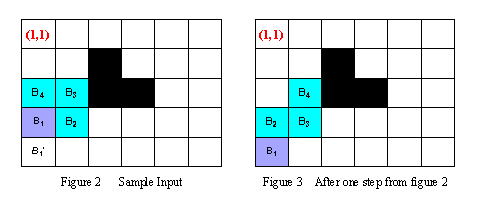
Input
The input is terminated by a line with three zeros.
Note: Bi is always adjacent to Bi+1 (1<=i<=L-1) and exit square (1,1) will never be a stone.
Output
Sample Input
5 6 4

4 1

4 2

3 2

3 1

3

2 3

3 3

3 4

4 4 4

2 3

1 3

1 4

2 4

4

2 1

2 2

3 4

4 2

0 0 0
Sample Output
Case 1: 9

Case 2: -1
Hint
Source
#include <cstdio>

#include <queue>

#include <cstring>

#include <iostream>

#include <algorithm>

using namespace std;

int n, m, l,tot = ,a[][];

int vis[][][ << ],k;

int d[][] = {

    -,,-,

    ,-,,

    -,,-

};

int dx[] = { ,-,, }, dy[] = { ,,,- };

struct node

{

    int x[], y[], cnt;

};

bool check(int x, int y, node u)

{

    for (int i = ; i <= l; i++)

        if (x == u.x[i] && y == u.y[i])

            return false;

    return true;

}

int bfs(node x)

{

    queue<node> q;

    q.push(x);

    while (!q.empty())

    {

        node u = q.front();

        q.pop();

        if (u.x[] ==  && u.y[] == )

            return u.cnt;

        for (int i = ; i < ; i++)

        {

            node v;

            int tx = u.x[] + dx[i], ty = u.y[] + dy[i];

            if (tx <  || tx > n || ty <  || ty > m || a[tx][ty])

                continue;

            if (!check(tx, ty, u))

                continue;

            u.x[] = tx, u.y[] = ty;

            int zhuangtai = ;

            for (int j = l; j >= ; j--)

            {

                v.x[j] = u.x[j - ];

                v.y[j] = u.y[j - ];

                if (j != l)

                {

                    int temp = d[v.x[j] - v.x[j + ] + ][v.y[j] - v.y[j + ] + ];

                    zhuangtai |= (temp << ( - j * ));

                }

            }

            if (vis[tx][ty][zhuangtai] == tot)

                continue;

            vis[tx][ty][zhuangtai] = tot;

            v.cnt = u.cnt + ;

            q.push(v);

        }

    }

    return -;

}

int main()

{

    while (scanf("%d%d%d", &n, &m, &l) == )

    {

        memset(a, , sizeof(a));

        int temp = ,tx,ty;

        node init;

        scanf("%d%d", &init.x[], &init.y[]);

        for (int i = ; i <= l; i++)

        {

            scanf("%d%d", &init.x[i], &init.y[i]);

            tx = init.x[i - ] - init.x[i] + ;

            ty = init.y[i - ] - init.y[i] + ;

            temp |= (d[tx][ty] << ( - (i - ) * ));

        }

        vis[init.x[]][init.y[]][temp] = tot;

        scanf("%d", &k);

        for (int i = ; i <= k; i++)

        {

            int aa, bb;

            scanf("%d%d", &aa, &bb);

            a[aa][bb] = ;

        }

        init.cnt = ;

        printf("Case %d: %d\n", tot++, bfs(init));

    }

    return ;

}
poj1324 Holedox Moving的更多相关文章
- poj 1324 Holedox Moving
poj 1324 Holedox Moving 题目地址: http://poj.org/problem?id=1324 题意: 给出一个矩阵中,一条贪吃蛇,占据L长度的格子, 另外有些格子是石头, ...
- POJ 1324 Holedox Moving (状压BFS)
POJ 1324 Holedox Moving (状压BFS) Time Limit: 5000MS Memory Limit: 65536K Total Submissions: 18091 Acc ...
- POJ 1324 Holedox Moving 搜索
题目地址: http://poj.org/problem?id=1324 优先队列---A*的估价函数不能为蛇头到(1,1)的距离,这样会出错. 看了discuss,有大神说这题A*的估价函数为BFS ...
- UVALive 2520 Holedox Moving(BFS+状态压缩)
这个题目在比赛的时候我们是没有做出来的,但是听到他们说进制哈希的时候,感觉真的是挺高端的,于是赛后开始补题,本着我的习惯在看题解之前自己再试着写一遍,我当时存储状态的方法是string + map,我 ...
- POJ - 1324 Holedox Moving (状态压缩+BFS/A*)
题目链接 有一个n*m(1<=n,m<=20)的网格图,图中有k堵墙和有一条长度为L(L<=8)的蛇,蛇在移动的过程中不能碰到自己的身体.求蛇移动到点(1,1)所需的最小步数. 显然 ...
- ACM/ICPC 之 BFS+状态压缩(POJ1324(ZOJ1361))
求一条蛇到(1,1)的最短路长,题目不简单,状态较多,需要考虑状态压缩,ZOJ的数据似乎比POj弱一些 POJ1324(ZOJ1361)-Holedox Moving 题意:一条已知初始状态的蛇,求其 ...
- HOJ题目分类
各种杂题,水题,模拟,包括简单数论. 1001 A+B 1002 A+B+C 1009 Fat Cat 1010 The Angle 1011 Unix ls 1012 Decoding Task 1 ...
- BFS广搜题目(转载)
BFS广搜题目有时间一个个做下来 2009-12-29 15:09 1574人阅读 评论(1) 收藏 举报 图形graphc优化存储游戏 有时间要去做做这些题目,所以从他人空间copy过来了,谢谢那位 ...
- poj 1324 状态压缩+bfs
http://poj.org/problem?id=1324 Holedox Moving Time Limit: 5000MS Memory Limit: 65536K Total Submis ...
随机推荐
- [论文理解] CornerNet: Detecting Objects as Paired Keypoints
[论文理解] CornerNet: Detecting Objects as Paired Keypoints 简介 首先这是一篇anchor free的文章,看了之后觉得方法挺好的,预测左上角和右下 ...
- SubSonic框架使用图解
简介:SubSonic框架是一个优秀的.开源的ORM映射框架,同时提供符合自身需要的代码生成器. 官方下载地址:http://subsonicproject.com/Download 明白了SubSo ...
- [转]C++中sizeof(struct)怎么计算?
版权属于原作者,我只是排版. 1. sizeof应用在结构上的情况 请看下面的结构: struct MyStruct{ double dda1; char dda; int type;}; 对结构My ...
- .vue公共组件裁减导航
场景: 有一个公共头部和底部,vue搭建的框架,在app.vue里写的公共方法,首页是个登录页面,不需要公共部分,在这基础上进行公共部分的显示隐藏. 即注册页.登录页.404页面都不要导航 代码: ( ...
- Java Marker Interface
先看看什么是标记接口?标记接口有时也叫标签接口(Tag interface),即接口不包含任何方法. 在Java里很容易找到标记接口的例子,比如JDK里的Serializable接口就是一个标记接口. ...
- 虚IP切换原理
高可用性HA(High Availability)指的是通过尽量缩短因日常维护操作(计划)和突发的系统崩溃(非计划)所导致的停机时间,以提高系统和应用的可用性.HA系统是目前企业防止核心计算机系统因故 ...
- equals和HashCode的羁绊
equals和hashcode我一直没弄明白到底怎么回事,今天终于弄懂了. 如下图: 在Person类没有重写equals和hashcode方法时,是如下情况: 但是当我重写了equals方法时,是如 ...
- Windows系统安装docker
下载安装包 官网 点击 Get Started ,打开入门页面,往下拉,找到 Download for Windows 打开 下载页面 ,点击 Please Login To Download ,要注 ...
- 遍历Map的两种方式
取出map集合中所有元素的方式一:keySet()方法. 可以将map集合中的键都取出存放到set集合中.对set集合进行迭代.迭代完成,再通过get方法对获取到的键进行值的获取. Set keySe ...
- iOS--获取文件目录的方法
很多文章都有写这个问题,我只是为了记录一下,免得总翻书... 1.Documents 目录: 你应该将所有的应用程序数据文件写入到这个目录下.这个目录用于存储用户数据或其它应该定期备份的信息. 2.L ...