
广度优先搜索(BreadthFirstSearch)& 迪克斯特拉算法 (Dijkstra's algorithm)
BFS可回答两类问题:
1.从节点A出发,有前往节点B的路径吗?
2.从节点A出发,前往节点B的哪条路径经过的节点最少?
BFS中会用到“队列”的概念。队列是一种先进先出(FIFO, first in first out)的数据结构,与栈不同,栈是后进先出(LIFO, last in first out)的数据结构。
还会用到“字典”的概念。字典在现在很多语言中都存在且广泛使用,字典中的元素是一组<键(key),值(value)>对,key的值是不可以重复的。关于字典的详细内容,网上有很多资料可以查阅。
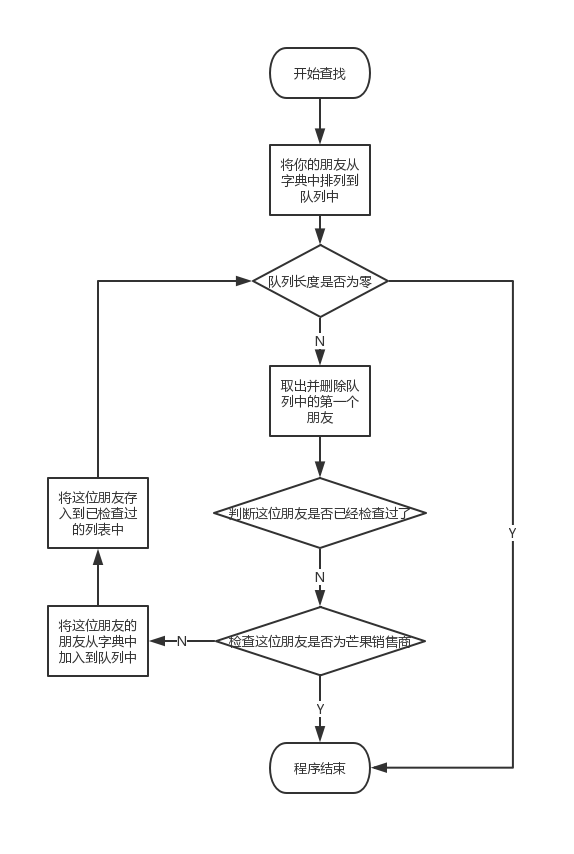
问题描述:想从你的朋友中找出一个芒果销售商,如果你的朋友中没有,那么就从朋友的朋友中查找。(这里假设名字最后一个字母为“m”的即为芒果销售商)。这样就是从“you”这个节点出发,是否有到“Xm”这个节点的路径的问题。
思路:先从你的朋友开始查找,如果朋友A是芒果销售商,则程序结束,如果不是,则将A的朋友排到队列中。然后检查朋友B是否为芒果销售商,循环,直到找到芒果销售商或者队列中的朋友们都被检查了一遍。因为会有某个人C既是A的朋友又是B的朋友,而C只需要检查一次,因此要分配一个列表用于记录已经检查过哪些朋友了。
Python代码:
>>> from collections import deque

>>> graph = {}

>>> graph["you"]=["alice","bob","claire"]

>>> graph["bob"] = ["anuj","peggy"]

>>> graph["alice"] = ["peggy"]

>>> graph["claire"]=["thom","jonny"]

>>> graph["anuj"]=[]

>>> graph["peggy"]=[]

>>> graph["thom"]=[]

>>> graph["jonny"]=[]

>>> def search(name):

    search_queue = deque()

    search_queue += graph[name]

    searched = []

    while search_queue:

        person = search_queue.popleft()

        if person not in searched:

            if person_is_seller(person):

                print (person + " is a mango seller!")

                return True

            else:

                search_queue += graph[person]

                searched.append(person)

    return False

>>> def person_is_seller(name):

    return name[-1] == 'm'

>>> search("you")

thom is a mango seller!

True
C#代码:
namespace Algorithms

{

    public static class BFS

    {

        public static bool BreadthFirstSearch(string name, Dictionary<string,List<string>>graph)

        {

            Queue<string> search_queue = new Queue<string>();

            foreach (var item in graph[name])

                search_queue.Enqueue(item);

            List<string> searched = new List<string>();

            while (search_queue.Count != 0)

            {

                string person = search_queue.Dequeue();

                if (!searched.Contains(person))

                {

                    if (JudgeSeller(person))

                    {

                        Console.WriteLine(person + " is a mango seller!");

                        return true;

                    }

                    else

                    {

                        foreach (var item in graph[person])

                            search_queue.Enqueue(item);

                        searched.Add(person);

                    }

                }

            }

            return false;

        }

        private static bool JudgeSeller(string name)

        {

            if (name[name.Length - 1] == 'm')

                return true;

            return false;

        }

    }

}
测试:
namespace Algorithms

{

    class Program

    {

        static void Main(string[] args)

        {

            Dictionary<string, List<string>> graph = new Dictionary<string, List<string>>();

            graph["you"] = new List<string>() { "alice", "bob", "claire" };

            graph["alice"] = new List<string>() { "peggy" };

            graph["bob"] = new List<string>() { "anuj", "peggy" };

            graph["claire"] = new List<string>() { "thom", "jonny" };

            graph["anuj"] = new List<string>();

            graph["peggy"] = new List<string>();

            graph["thom"] = new List<string>();

            graph["jonny"] = new List<string>();

            if (!BFS.BreadthFirstSearch("you", graph))

            {

                Console.WriteLine("no mango seller!");

            }

            Console.Read();

        }

    }

}
Dijkstra's algorithm 用于计算出最短路径,但是这个算法在使用上有很多限制条件。
问题描述:从A地到B地的各种可能的路径中,哪条路径所用的时间最短。(图中的数字表示从某地到另外某地所用的时间)
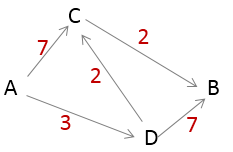
图1
思路:记录从A点到其他各个节点的所需的时间,如表1所示(现在还不知道从A到B的时间,则先设置为无穷大)
| D | 3 |
| C | 7 |
| B | ∞ |
表1
从所需时间最短的D点再出发,计算从A经过D到其他个各节点的时间,如表2所示
| C | 5 |
| B | 10 |
表2
直接前往C点需要的时间为7,而经过D点前往C点所需的时间为5,时间缩短了,则更新从A到各个点所需的时间的列表,如表3所示
| D | 3 |
| C | 5 |
| B | 10 |
表3
现在除了节点D之外,从A到C的时间是最短的了,则计算从A经过C再到其他节点的时间,如表4所示。
| B | 7 |
表4
现在从A经过D再经过C然后到B的时间为7,小于表3记录的到B的时间,则更新这个时间。
就这样得到了花费时间最短的路径。总结一下就是,不断的获得从起点到某点的最短时间,然后更新这个时间列表。在 Dijkstra's algorithm中,这些数字被称为“权重(weight)”,而带权重的图则被称为加权图(weighted graph),那么不带权重的则被称为非加权图(unweighted graph)。对于计算非加权图中的最短路径,可使用BFS,计算加权图中的最短路径,可使用 Dijkstra's algorithm。然而, Dijkstra's algorithm不适用于带环的图,即图1中的箭头如果是双向的话那么就是不适用的。此外,它还不适用于带有负权重的情况。
Dijkstra算法的实现需要使用三个散列表。第一个散列表记录的是每个点的邻居及权重。第二个散列表记录的是从起点开始到每个节点的权重,第三个散列表记录的是各个节点父节点。
Python代码:
#第一个散列表,记录每个点的邻居及权重

graph={}

graph["A"]={}

graph["A"]["C"]=7

graph["A"]["D"]=3

graph["C"]={}

graph["C"]["B"]=2

graph["D"]={}

graph["D"]["C"]=2

graph["D"]["B"]=7

graph["B"]={}

#第二个散列表,记录从起点A到其他各个节点的权重

#由于节点B不是A的邻居,则A到B的权重暂设置为无穷大

costs={}

infinity = float("inf")

costs["C"]=7

costs["D"]=3

costs["B"]=infinity

#第三个散列表,用于存储节点的父节点

parents={}

parents["C"]="A"

parents["D"]="A"

parents["B"]=None

#用于记录已经处理过的节点的数组

processed=[]

#先在未处理的节点数组中找到权重最小的节点

def find_lowest_cost_node(costs):

    lowest_cost = float("inf")

    lowest_cost_node = None

    for node in costs:

        cost = costs[node]

        if cost < lowest_cost and node not in processed:

            lowest_cost = cost

            lowest_cost_node = node

    return lowest_cost_node

node = find_lowest_cost_node(costs)

while node is not None:

    cost = costs[node]

    neighbors=graph[node]

    for n in neighbors.keys():

        new_cost=cost + neighbors[n]

        if costs[n] > new_cost:

            costs[n] = new_cost

            parents[n]=node

    processed.append(node)

    node=find_lowest_cost_node(costs)

for node in costs:

    print("Node:" + node+ "  Cost:" + str(costs[node]) + "\r\n")

for node in parents:

    print("ChildNode:" + node + " ParentNode:" + parents[node] + "\r\n")
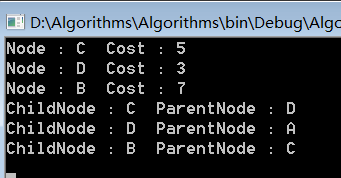
运行结果:
Node:C  Cost:5

Node:D  Cost:3

Node:B  Cost:7

ChildNode:C ParentNode:D

ChildNode:D ParentNode:A

ChildNode:B ParentNode:C

>>>
C#代码:
public class DijkstraAlgorithm

    {

        public Dictionary<string, double> Costs { get; set; }

        public Dictionary<string, string> Parents { get; set; }

        public Dictionary<string, Dictionary<string,double>> Graph { get; set; }

        private List<string> processed = new List<string>();

        public DijkstraAlgorithm()

        {

            Costs = new Dictionary<string, double>();

            Parents = new Dictionary<string, string>();

            Graph = new Dictionary<string, Dictionary<string, double>>();

        }

        public void Dijkstra_Algorithm()

        {

            string node = FindLowestCostNode();

            while(node != null)

            {

                double cost = Costs[node];

                Dictionary<string, double> neighbors = Graph[node];

                foreach(KeyValuePair<string,double> item in neighbors)

                {

                    double new_cost = cost + item.Value;

                    if (Costs[item.Key] > new_cost)

                    {

                        Costs[item.Key] = new_cost;

                        Parents[item.Key] = node;

                    }

                }

                processed.Add(node);

                node = FindLowestCostNode();

            }

        }

        private string FindLowestCostNode()

        {

            string lowestcostnode = null;

            double lowestcost = double.PositiveInfinity;

            foreach(KeyValuePair<string,double> item in Costs)

            {

                if(item.Value < lowestcost && !processed.Contains(item.Key))

                {

                    lowestcost = item.Value;

                    lowestcostnode = item.Key;

                }

            }

            return lowestcostnode;

        }

    }
字典的初始化以及运行结果:
DijkstraAlgorithm Dalgorithm = new DijkstraAlgorithm();

            Dalgorithm.Graph["A"] = new Dictionary<string, double>();

            Dalgorithm.Graph["A"]["C"] = 7;

            Dalgorithm.Graph["A"]["D"] = 3;

            Dalgorithm.Graph["C"] = new Dictionary<string, double>();

            Dalgorithm.Graph["C"]["B"] = 2;

            Dalgorithm.Graph["D"] = new Dictionary<string, double>();

            Dalgorithm.Graph["D"]["C"] = 2;

            Dalgorithm.Graph["D"]["B"] = 7;

            Dalgorithm.Graph["B"] = new Dictionary<string, double>();

            Dalgorithm.Costs["C"] = 7;

            Dalgorithm.Costs["D"] = 3;

            Dalgorithm.Costs["B"] = double.PositiveInfinity;

            Dalgorithm.Parents["C"] = "A";

            Dalgorithm.Parents["D"] = "A";

            Dalgorithm.Parents["B"] = null;

            Dalgorithm.Dijkstra_Algorithm();

            foreach(KeyValuePair<string,double> item in Dalgorithm.Costs)

            {

                Console.WriteLine("Key : " + item.Key + "  Value : " + item.Value);

            }

            foreach(KeyValuePair<string,string> item in Dalgorithm.Parents)

                Console.WriteLine("Key : " + item.Key + "  Value : " + item.Value);

            Console.Read();
广度优先搜索(BreadthFirstSearch)& 迪克斯特拉算法 (Dijkstra's algorithm)的更多相关文章
- 用js简单实现一下迪克斯特拉算法
今天看书看到了迪克斯特拉算法,大概用js实现一下呢,计算最短路径. 首先,迪克斯特拉算法只适用于有向无环图,且没有负权重,本例关系图如下哦,数字为权重,emmmm,画得稍微有点丑~ //大概用js实现 ...
- 迪杰斯特拉算法(Dijkstra) (基础dij+堆优化) BY:优少
首先来一段百度百科压压惊... 迪杰斯特拉算法(Dijkstra)是由荷兰计算机科学家狄克斯特拉于1959 年提出的,因此又叫狄克斯特拉算法.是从一个顶点到其余各顶点的最短路径算法,解决的是有权图中最 ...
- C# 迪杰斯特拉算法 Dijkstra
什么也不想说,现在直接上封装的方法: using System; using System.Collections.Concurrent; using System.Collections.Gener ...
- 图->最短路径->单源最短路径(迪杰斯特拉算法Dijkstra)
文字描述 引言:如下图一个交通系统,从A城到B城,有些旅客可能关心途中中转次数最少的路线,有些旅客更关心的是节省交通费用,而对于司机,里程和速度则是更感兴趣的信息.上面这些问题,都可以转化为求图中,两 ...
- 迪杰斯特拉算法dijkstra(可打印最短路径)
#include <iostream> #include <iomanip> #include <string> using namespace std; #def ...
- [算法导论]迪克斯特拉算法 @ Python
class Graph: def __init__(self): self.V = [] self.w = {} class Vertex: def __init__(self, x): self.k ...
- Dijkstra Algorithm 迪克特斯拉算法--Python
迪克斯拉特算法: 1.找出代价最小的节点,即可在最短时间内到达的节点: 2.更新节点的邻居的开销: 3.重复这个过程,直到图中的每个节点都这样做了: 4.计算最终路径. ''' 迪克斯特拉算法: 1. ...
- CF1272E. Nearest Opposite Parity 题解 广度优先搜索
题目链接:http://codeforces.com/contest/1272/problem/E 题目大意: 有一个长度为n的数组 \(a\) ,数组坐标从 \(1\) 到 \(n\) . 假设你现 ...
- Dijkstra【迪杰斯特拉算法】
有关最短路径的最后一个算法——Dijkstra 迪杰斯特拉算法是由荷兰计算机科学家迪杰斯特拉于1959 年提出的,因此又叫迪杰斯特拉算法.是从一个顶点到其余各顶点的最短路径算法,解决的是有权图中最短路 ...
随机推荐
- 微信小程序入门教程之四:API 使用
今天是这个系列教程的最后一篇. 上一篇教程介绍了,小程序页面如何使用 JavaScript 脚本.有了脚本以后,就可以调用微信提供的各种能力(即微信 API),从而做出千变万化的页面.本篇就介绍怎么使 ...
- Asp-Net-Core开发笔记:接口返回json对象出现套娃递归问题
前言 看了下推送记录,一个月前,OK,我又变成月更了o(╯□╰)o,这绝对不行![○・`Д´・ ○] 所以今天来更新了 其实不是我懒得更新或者是太忙,其实是最近在写一篇很长的博客,一直没写完( Ĭ ^ ...
- Power Apps 创建响应式布局
前言 我们都知道Power Apps作为低代码平台,最大的优势就是各个设备之间的兼容性,尤其是自带的响应式布局,非常好用. 这不,我们就为大家分享一下,如何使用Power Apps画布应用,创建响应式 ...
- MySQL读写问题(锁)
一.概述 读-读:并发不存在问题,不需要加锁 写-写:并发存在问题,可能会造成脏写(一个事务没有写完,另一个事务也对相同的数据进行写),但是这种情况,任何一种隔离级别都不允许发生,在隔离级别的时候就解 ...
- python 小兵(2)
while 条件: 结构体 if=条件: 等于 while 条件: 结构体 else: print(int(Ture)) 1 print(int(False)) 0 切片顾头不顾尾 prin ...
- GDB死锁调试
1.测试代码 代码中开启两个线程,加锁后轮流输出数据,其中一个线程误将pthread_mutex_unlock(),写成pthread_mutex_lock()代码如下: int g_tickets ...
- Ubuntu安装盘的制作
准备工作 Ubuntu系统镜像 win32diskimager U盘(4G以上),对重要文件提前备份 制作 下载系统镜像 进入官网 我们下载的版本是18.04,不是20.04 在页面中,找到BitTo ...
- java实现跳过证书校验
/** * 跳过证书效验的sslcontext * @return * @throws Exception */ private static SSLContext createIgnoreVerif ...
- C 字符串奇数位小写字母转大写
如题 C实现 #include<stdio.h> #include<string.h> #define COUNT 20 //最大接受字符串数,可以使用动态获取空间函数优化 v ...
- Java语言中的访问权限修饰符
一个Java应用有很多类,但是有些类,并不希望被其他类使用.每个类中都有数据成员和方法成员,但是并不是每个数据和方法,都允许在其他类中调用.如何能做到访问控制呢?就需要使用访问权限修饰符. Java语 ...