
Python_4day
函数
- 函数可以用来定义可重复代码,组织和简化
- 一般来说一个函数在实际开发中为一个小功能
- 一个类为一个大功能
- 同样函数的长度不要超过一屏
Python中的所有函数实际上都是有返回值(return None),
如果你没有设置return,那么Python将不显示None.
如果你设置return,那么将返回出return这个值.
def HJN():
print('Hello')
return 1000
b=HJN()
print(b)
Hello

1000
HJN
<function __main__.HJN()>
def panduan(number):
if number % 2 == 0:
print('O')
else:
print('J')
panduan(number=1)
J
panduan(2)
O
定义一个函数
def function_name(list of parameters):
do something
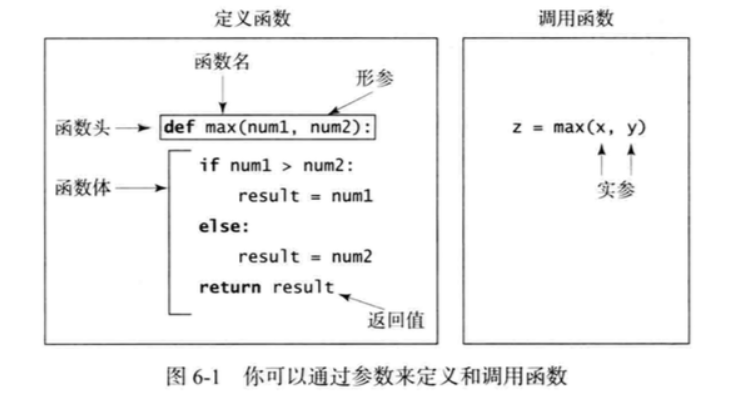

- 以前使用的random 或者range 或者print.. 其实都是函数或者类
函数的参数如果有默认值的情况,当你调用该函数的时候: 可以不给予参数值,那么就会走该参数的默认值 否则的话,就走你给予的参数值.
import random
def hahah():
n = random.randint(0,5)
while 1:
N = eval(input('>>'))
if n == N:
print('smart')
break
elif n < N:
print('太小了')
elif n > N:
print('太大了')
调用一个函数
- functionName()
- "()" 就代表调用
def H():
print('hahaha')
def B():
H()
B()
hahaha
def A(f):
f()
A(B)
hahaha

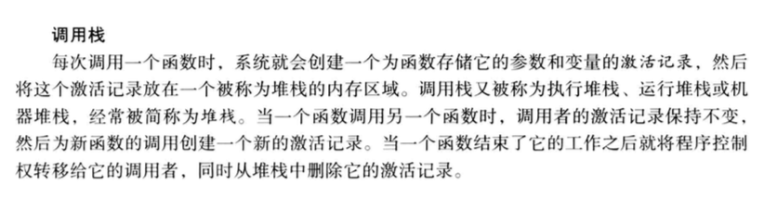
带返回值和不带返回值的函数
- return 返回的内容
- return 返回多个值
- 一般情况下,在多个函数协同完成一个功能的时候,那么将会有返回值
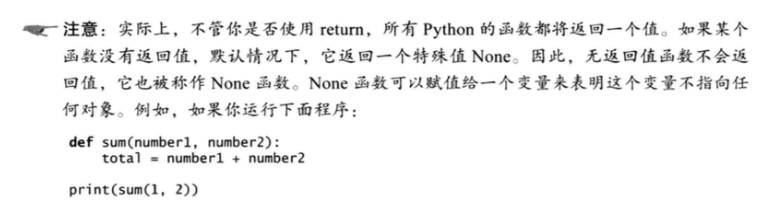

- 当然也可以自定义返回None
EP:
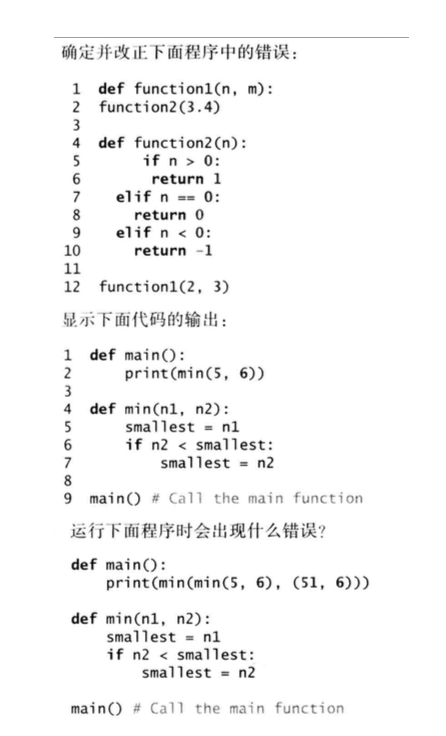

def main():
print(min(min(5,6),(51,6)))
def min(n1,n2):
a = n1
if n2 < a:
a = n2
main()
---------------------------------------------------------------------------

TypeError                                 Traceback (most recent call last)

<ipython-input-9-263240bbee7e> in <module>

----> 1 main()

<ipython-input-8-a7c84f32bfda> in main()

      1 def main():

----> 2     print(min(min(5,6),(51,6)))

      3 def min(n1,n2):

      4     a = n1

      5     if n2 < a:

<ipython-input-8-a7c84f32bfda> in min(n1, n2)

      3 def min(n1,n2):

      4     a = n1

----> 5     if n2 < a:

      6         a = n2

TypeError: '<' not supported between instances of 'tuple' and 'NoneType'
类型和关键字参数
- 普通参数
- 多个参数
- 默认值参数
- 不定长参数
普通参数
多个参数
默认值参数
强制命名
def U(str_):
xiaoxie = 0
for i in str_:
ASCII = ord(i)
if 97<=ASCII<=122:
xiaoxie +=1
elif xxxx:
daxie += 1
elif xxxx:
shuzi += 1
return xiaoxie,daxie,shuzi
U('HJi12')
H

J

i

1

2
不定长参数
- *args
- 不定长,来多少装多少,不装也是可以的
- 返回的数据类型是元组
- args 名字是可以修改的,只是我们约定俗成的是args
- **kwargs
- 返回的字典
- 输入的一定要是表达式(键值对)
- name,*args,name2,**kwargs 使用参数名
def TT(a,b)
def TT(*args,**kwargs):
print(kwargs)
print(args)
TT(1,2,3,4,6,a=100,b=1000)
{'a': 100, 'b': 1000}

(1, 2, 3, 4, 6)
{'key':'value'}
()
TT(1,2,4,5,7,8,9,)
(1, 2, 4, 5, 7, 8, 9)
def B(name1,nam3):
pass
B(name1=100,2)
  File "<ipython-input-39-bd6a38e58465>", line 1

    B(name1=100,2)

               ^

SyntaxError: positional argument follows keyword argument
def sum_(*args,A='sum'):
res = 0
count = 0
for i in args:
res +=i
count += 1
if A == "sum":
return res
elif A == "mean":
mean = res / count
return res,mean
else:
print(A,'还未开放')
sum_(-1,0,1,4,A='var')
var 还未开放
'aHbK134'.__iter__
b = 'asdkjfh'
for i in b :
print(i)
a

s

d

k

j

f

h
2,5
2 + 22 + 222 + 2222 + 22222
变量的作用域
- 局部变量 local
- 全局变量 global
- globals 函数返回一个全局变量的字典,包括所有导入的变量
- locals() 函数会以字典类型返回当前位置的全部局部变量。
a = 1000
b = 10
def Y():
global a,b
a += 100
print(a)
Y()
1100
def YY(a1):
a1 += 100
print(a1)
YY(a)
print(a)
1200

1100
注意:
- global :在进行赋值操作的时候需要声明
- 官方解释:This is because when you make an assignment to a variable in a scope, that variable becomes local to that scope and shadows any similarly named variable in the outer scope.


Homework
- 1


import math
def getPentagonalNumber():
count = 0
for i in range(1, 101):
a = i * ( 3*i - 1) / 2
print(int(a),end = ' ')
count += 1
if count % 10 == 0:
print('\n')
getPentagonalNumber()
- 2

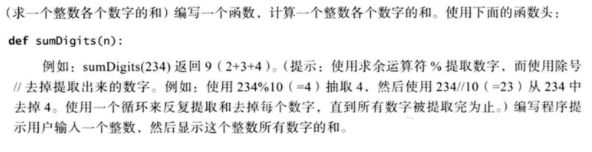
def sumDigits(n):
a = n % 10
b = n // 100
c = (n // 10) - ((n // 100)*10)
d = a + b + c
print(d)
sumDigits(234)
9
- 3


def displaySortedNumbers(num1,num2,num3):
if num1 > num2 > num3:
print(num1,num2,num3)
elif num1 > num3 > num2:
print(num1,num3,num2)
elif num2 > num1 > num3:
print(num2,num1,num3)
elif num2 > num3 > num1:
print(num2,num3,num1)
elif num3 > num1 > num2:
print(num3,num1,num2)
elif num3 > num2 > num1:
print(num3,num2,num1)
displaySortedNumbers(3,8,1)
8 3 1
- 4


def futureInvestmentValue(principal,rate,years):
for i in range(years):
principal = principal * (1+rate)
print("{}年内总额{}: ".format(i+1,principal))
principal = eval(input("输入存款金额: "))
rate = eval(input("输入利率: "))
years = eval(input("输入年份:" ))
futureInvestmentValue(principal,rate,years)
输入存款金额: 10000

输入利率: 0.003

输入年份:10

1年内总额10029.999999999998:

2年内总额10060.089999999997:

3年内总额10090.270269999995:

4年内总额10120.541080809995:

5年内总额10150.902704052423:

6年内总额10181.35541216458:

7年内总额10211.899478401072:

8年内总额10242.535176836274:

9年内总额10273.262782366783:

10年内总额10304.082570713881:
- 5


li = [chr(i) for i in range(ord("A"),ord("Z")+1)]
count=0
for i in li:
print(i,end=' ')
count += 1
if(count%10==0):
print(end='\n')
A B C D E F G H I J

K L M N O P Q R S T

U V W X Y Z
- 6

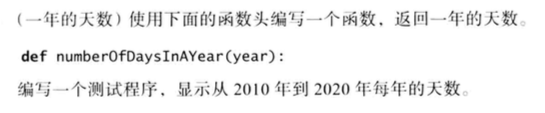
import math
def numberOfDaysInAYear():
for i in range(2010,2021):
if i % 4 == 0 and i % 100 != 0 or i % 400 == 0:
print(i,'是366天')
else:
print(i,'是365天')
numberOfDaysInAYear()
2010 是365天

2011 是365天

2012 是366天

2013 是365天

2014 是365天

2015 是365天

2016 是366天

2017 是365天

2018 是365天

2019 是365天

2020 是366天
- 7


import numpy as np
import math
def xsj(x1,y1,x2,y2):
p1=np.array([x1,y1])
p2=np.array([x2,y2])
p3=p2-p1
p4=math.hypot(p3[0],p3[1])
print(p4)
x1,y1,x2,y2=map(int,input().split(','))
xsj(x1,y1,x2,y2)
1,2,3,4

2.8284271247461903
- 8

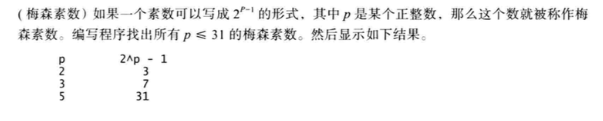
def a():
for i in range(2, 32):
p = (2 ** i) - 1
print(i,p)
a()
- 9



import time
localtime = time.asctime(time.localtime(time.time()))
print("本地时间为 :", localtime)
本地时间为 : Sun Aug 4 19:00:10 2019
- 10

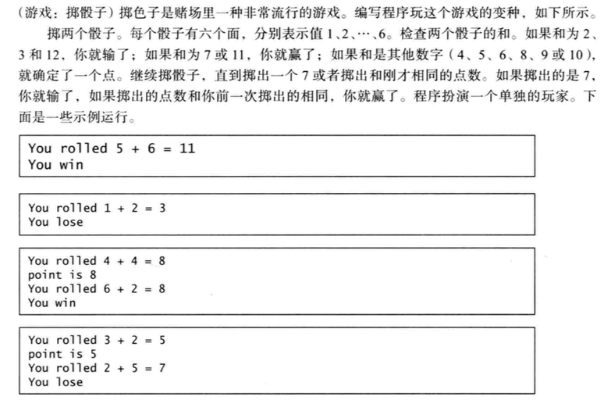
import random
random1 = random.randint(1,7)
random2 = random.randint(1,7)
random3 = random.randint(1,7)
total = random1 + random2
print('第一次摇到:{}'.format(random1))
print('第二次摇到:{}'.format(random2))
if total ==7 or total==11:
print('{}+{}={} you win!'.format(random1,random2,total))
elif total ==2 or total==3 or total ==12:
print('{}+{}={} you lose!'.format(random1,random2,total))
elif total==4 or total ==5 or total==6 or total==8 or total==9 or total==10:
total=total+random3
print('第三次摇到:{}'.format(random3))
print('diercihe{}'.format(total))
第一次摇到:2

第二次摇到:1

2+1=3 you lose!
- 11
去网上寻找如何用Python代码发送邮件
import smtplib
from email.mime.text import MIMEText
def send_mail(username, passwd, recv, title, content, mail_host='smtp.163.com', port=25):
'''
发送邮件函数,默认使用163smtp
:param username: 邮箱账号 xx@163.com
:param passwd: 邮箱密码
:param recv: 邮箱接收人地址,多个账号以逗号隔开
:param title: 邮件标题
:param content: 邮件内容
:param mail_host: 邮箱服务器
:param port: 端口号
:return:
'''
msg = MIMEText(content) # 邮件内容
msg['Subject'] = title # 邮件主题
msg['From'] = username # 发送者账号
msg['To'] = recv # 接收者账号列表
smtp = smtplib.SMTP(mail_host, port=port) # 连接邮箱,传入邮箱地址,和端口号,smtp的端口号是25
smtp.login(username, passwd) # 发送者的邮箱账号,密码
smtp.sendmail(username, recv, msg.as_string())
# 参数分别是发送者,接收者,第三个是把上面的发送邮件的内容变成字符串
smtp.quit() # 发送完毕后退出smtp
print('email send success.')
email_user = 'xxxx@163.com' # 发送者账号
email_pwd = 'xxxxx' # 发送者密码
maillist = 'XXX@XXX.com'
title = '测试邮件标题'
content = '这里是邮件内容'
send_mail(email_user, email_pwd, maillist, title, content)
---------------------------------------------------------------------------

SMTPAuthenticationError                   Traceback (most recent call last)

<ipython-input-4-240ad3b9e6b5> in <module>

     32 title = '测试邮件标题'

     33 content = '这里是邮件内容'

---> 34 send_mail(email_user, email_pwd, maillist, title, content)

<ipython-input-4-240ad3b9e6b5> in send_mail(username, passwd, recv, title, content, mail_host, port)

     20     msg['To'] = recv  # 接收者账号列表

     21     smtp = smtplib.SMTP(mail_host, port=port)  # 连接邮箱,传入邮箱地址,和端口号,smtp的端口号是25

---> 22     smtp.login(username, passwd)  # 发送者的邮箱账号,密码

     23     smtp.sendmail(username, recv, msg.as_string())

     24     # 参数分别是发送者,接收者,第三个是把上面的发送邮件的内容变成字符串

D:\anacoda\lib\smtplib.py in login(self, user, password, initial_response_ok)

    728

    729         # We could not login successfully.  Return result of last attempt.

--> 730         raise last_exception

    731

    732     def starttls(self, keyfile=None, certfile=None, context=None):

D:\anacoda\lib\smtplib.py in login(self, user, password, initial_response_ok)

    719                 (code, resp) = self.auth(

    720                     authmethod, getattr(self, method_name),

--> 721                     initial_response_ok=initial_response_ok)

    722                 # 235 == 'Authentication successful'

    723                 # 503 == 'Error: already authenticated'

D:\anacoda\lib\smtplib.py in auth(self, mechanism, authobject, initial_response_ok)

    640         if code in (235, 503):

    641             return (code, resp)

--> 642         raise SMTPAuthenticationError(code, resp)

    643

    644     def auth_cram_md5(self, challenge=None):

SMTPAuthenticationError: (535, b'Error: authentication failed')
Python_4day的更多相关文章
随机推荐
- mini dc(选做)
一.任务详情 提交测试截图和码云练习项目链接,实现Linux下dc的功能,计算后缀表达式的值 二.源代码 1.MyDC类 import java.util.StringTokenizer; impor ...
- VUE中让由全局变量添加生成的新数组不随全局变量的变化而变化
问题场景: const addOptions = { singleOrComplex, totalNum: this.smallTotalPrice, selectList: this.purchas ...
- win7远程连接ubuntu,出现灰屏解决方法
问题: win7远程虚拟机ubuntu 12.04出现灰色屏幕 打开windows自带的远程桌面连接.输入ubuntu虚拟机的IP地址 可以连接上,输入username和password 点击OK ...
- SQL optimizer -Query Optimizer Deep Dive
refer: http://sqlblog.com/blogs/paul_white/archive/2012/04/28/query-optimizer-deep-dive-part-1.aspx ...
- shell脚本--监控java进程存活脚本
#!/bin/bash base_dir=/opt war_processor="tomcat" jar_processor="manager-server.jar pl ...
- 静态化-VeloCity
1.在spring.xml中配置 <!-- 指定vm模版路径 start --> <bean id="velocityEngine" class="or ...
- 理解MVC/MVP/MVVM的区别
转载至[http://www.ruanyifeng.com/blog/2015/02/mvcmvp_mvvm.html] MVC 所有的通信都是单向的. M(Model)V(View)C(Contro ...
- pandas基础,Serires,Dataframe
DataFrame DataFrame是Pandas中的一个表格型的数据结构,包含有一组有序的列,每列可以是不同的值类型(数值.字符串.布尔型等),DataFrame即有行索引也有列索引,可以被看做是 ...
- Python获取两个文件的交集、并集、差集
题记:朋友在处理数据时,需要解决这方面的问题,所以利用她给的代码,自己重新梳理了下,并成功运行. 代码如下: # coding:utf-8 s1 = set(open(r'C:\\Users\\yan ...
- IntelliJ IDEA 设置护眼背景色
IntelliJ IDEA 设置护眼背景色 1.设置主体和字体 Settings --> Appearance & Behavior --> Appearance Theme: I ...