
Dubbo消费方服务调用过程源码分析
参考:
dubbo消费方服务调用过程源码分析
dubbo基于spring的构建分析
Dubbo概述--调用过程
dubbo 请求调用过程分析
dubbo集群容错机制代码分析1
dubbo集群容错策略的代码分析2
dubbo spi机制源码学习
Dubbo-服务调用过程
一、通过分析一个典型rpc方法调用的调用栈来说明调用过程。
1.定义一个接口
public interface DemoService {

    /**

     * class_name: sayHello

     * param: [param]

     * describe: say hello

     * creat_user: CoderZZ

     * creat_date: 2018-10-11

     * creat_time: 23:06

     **/

    String sayHello(String param);

        /**

     * class_name: sayGoodbye

     * param: [param]

     * describe: TODO

     * creat_user: CoderZZ

     * creat_date: 2018-10-12

     * creat_time: 0:27

     **/

    String sayGoodbye(String param);

    Person getPerson(String name);

}
2.实现该接口
public class DemoServiceImpl implements DemoService{

    public String sayHello(String param) {

        // 本端是否为提供端,这里会返回true

        boolean isProviderSide = RpcContext.getContext().isProviderSide();

        System.out.println("isProviderSide:"+isProviderSide);

        // 获取调用方IP地址

        String clientIP = RpcContext.getContext().getRemoteHost();

        System.out.println("clientIP:"+clientIP);

        // 获取当前服务配置信息,所有配置信息都将转换为URL的参数

        String application = RpcContext.getContext().getUrl().getParameter("application");

        System.out.println("application:"+application);

        String address = RpcContext.getContext().getUrl().getAddress();

        System.out.println("address:"+address);

        String index = RpcContext.getContext().getAttachment("index");

        System.out.println("getAttachment index:"+index);

        return "Hello "+param;

    }

    //以下省略

    ...............

}
3.服务端通过注册中心发布服务,默认是dubbo协议发布(dubbo-provider.xml)
<dubbo:registry id="workpalceRegistry" address="zookeeper://192.168.33.117:2181" default="true"/>

<dubbo:protocol name="dubbo" port="20880" dispatcher="all" threadpool="fixed" threads="100" accepts="10" status="test"/>

<dubbo:service interface="com.zxd.dubbo.learning.api.DemoService" ref="demoServiceImpl" protocol="dubbo" registry="workpalceRegistry" executes="10" timeout="60000"/>

<bean id="demoServiceImpl" class="com.zxd.dubbo.learning.provider.DemoServiceImpl"/>
4.客户端通过注册中心引用这个服务,注册中心用zookeepr协议实现(dubbo-consumer2.xml)
 <dubbo:registry address="zookeeper://192.168.33.117:2181"/>

 <!--客户端连接控制-->

 <!--connections="10"-->

 <!--限制客户端服务使用连接不能超过 10 个-->

 <dubbo:reference interface="com.zxd.dubbo.learning.api.DemoService" id="demoService" retries="2" loadbalance="random" actives="10" connections="10"/>

 <!--如果是线上需求需要点对点,可在 <dubbo:reference> 中配置 url 指向提供者,将绕过注册中心,多个地址用分号隔开-->

 <!--<dubbo:reference id="demoService" interface="com.zxd.dubbo.learning.api.DemoService" url="dubbo://localhost:20880"/>-->
5.启动服务端,客户端调用Dubbo服务
    public static void main(String[] args) throws IOException, ExecutionException, InterruptedException {

        ClassPathXmlApplicationContext classPathXmlApplicationContext =

                new ClassPathXmlApplicationContext("classpath:dubbo-consumer2.xml");

//        classPathXmlApplicationContext.start();

        System.out.println("Consumer started!");

        DemoService demoService = classPathXmlApplicationContext.getBean("demoService",DemoService.class);

        //隐式参数

        //注意:path, group, version, dubbo, token, timeout 几个 key 是保留字段,请使用其它值

        RpcContext.getContext().setAttachment("index","1");

        String rt = demoService.sayHello("world");

        System.out.println(rt);

    }
6.执行main方法获得以下输出
log4j:WARN No appenders could be found for logger (org.springframework.core.env.StandardEnvironment).

log4j:WARN Please initialize the log4j system properly.

log4j:WARN See http://logging.apache.org/log4j/1.2/faq.html#noconfig for more info.

Consumer started!

SLF4J: Failed to load class "org.slf4j.impl.StaticLoggerBinder".

SLF4J: Defaulting to no-operation (NOP) logger implementation

SLF4J: See http://www.slf4j.org/codes.html#StaticLoggerBinder for further details.

Hello world

Process finished with exit code 0
二、断点跟踪(dubbo默认底层的传输框架是netty)
看下 com.alibaba.dubbo.remoting.transport.netty.NettyClient 类 doOpen 方法
 /***

     * 打开到远端服务机器的连接

     * @throws Throwable

     */

    @Override

    protected void doOpen() throws Throwable {

        NettyHelper.setNettyLoggerFactory();

        bootstrap = new ClientBootstrap(channelFactory);

        // config

        // @see org.jboss.netty.channel.socket.SocketChannelConfig

        bootstrap.setOption("keepAlive", true);

        bootstrap.setOption("tcpNoDelay", true);

        bootstrap.setOption("connectTimeoutMillis", getConnectTimeout());

        final NettyHandler nettyHandler = new NettyHandler(getUrl(), this);

        bootstrap.setPipelineFactory(new ChannelPipelineFactory() {

            @Override

            public ChannelPipeline getPipeline() {

                NettyCodecAdapter adapter = new NettyCodecAdapter(getCodec(), getUrl(), NettyClient.this);

                ChannelPipeline pipeline = Channels.pipeline();

                //设置消息流的处理handler,发出去的消息先经过handler再经过encoder,

                //这里断点可以设置在nettyHandler类里。

                pipeline.addLast("decoder", adapter.getDecoder());

                pipeline.addLast("encoder", adapter.getEncoder());

                pipeline.addLast("handler", nettyHandler);

                return pipeline;

            }

        });

    }
NettyHandler 类继承了netty的 SimpleChannelHandler 类,并实现了 writeRequested 方法:
    @Override

    public void writeRequested(ChannelHandlerContext ctx, MessageEvent e) throws Exception {

        super.writeRequested(ctx, e);//此处打断点

        NettyChannel channel = NettyChannel.getOrAddChannel(ctx.getChannel(), url, handler);

        try {

            handler.sent(channel, e.getMessage());

        } finally {

            NettyChannel.removeChannelIfDisconnected(ctx.getChannel());

        }

    }
NettyHandler类的继承关系图: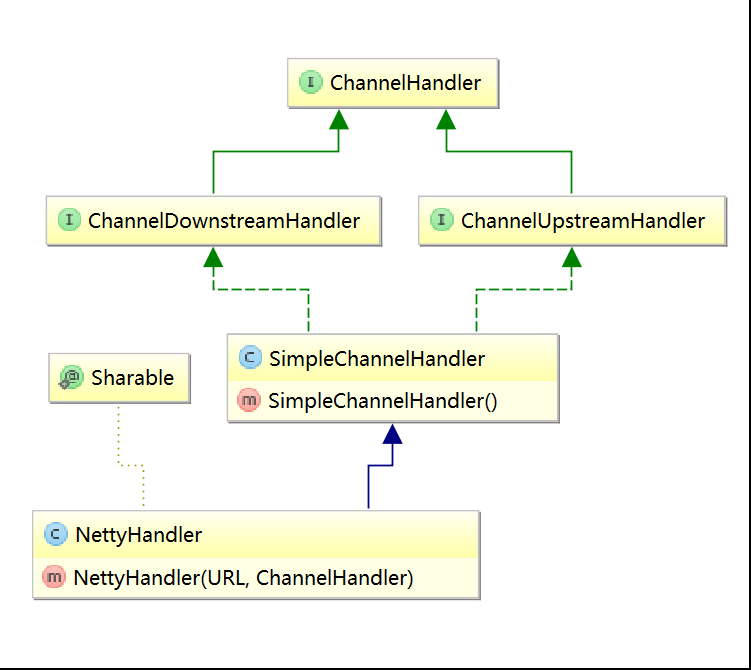
在 super.writeRequested(ctx, e); 处打断点,然后运行main方法,在程序断点处得到以下线程堆栈信息:
"main@1" prio=5 tid=0x1 nid=NA runnable

  java.lang.Thread.State: RUNNABLE

      at com.alibaba.dubbo.remoting.transport.netty.NettyHandler.writeRequested(NettyHandler.java:98)

      at org.jboss.netty.channel.SimpleChannelHandler.handleDownstream(SimpleChannelHandler.java:266)

      at org.jboss.netty.channel.DefaultChannelPipeline.sendDownstream(DefaultChannelPipeline.java:591)

      at org.jboss.netty.channel.DefaultChannelPipeline.sendDownstream(DefaultChannelPipeline.java:582)

      at org.jboss.netty.channel.Channels.write(Channels.java:611)

      at org.jboss.netty.channel.Channels.write(Channels.java:578)

      at org.jboss.netty.channel.AbstractChannel.write(AbstractChannel.java:251)

      at com.alibaba.dubbo.remoting.transport.netty.NettyChannel.send(NettyChannel.java:100)

      at com.alibaba.dubbo.remoting.transport.AbstractClient.send(AbstractClient.java:265)

      at com.alibaba.dubbo.remoting.transport.AbstractPeer.send(AbstractPeer.java:53)

      at com.alibaba.dubbo.remoting.exchange.support.header.HeaderExchangeChannel.request(HeaderExchangeChannel.java:116)

      at com.alibaba.dubbo.remoting.exchange.support.header.HeaderExchangeClient.request(HeaderExchangeClient.java:90)

      at com.alibaba.dubbo.rpc.protocol.dubbo.DubboInvoker.doInvoke(DubboInvoker.java:95)

      at com.alibaba.dubbo.rpc.protocol.AbstractInvoker.invoke(AbstractInvoker.java:155)

      at com.alibaba.dubbo.rpc.listener.ListenerInvokerWrapper.invoke(ListenerInvokerWrapper.java:77)

      at com.alibaba.dubbo.monitor.support.MonitorFilter.invoke(MonitorFilter.java:75)

      at com.alibaba.dubbo.rpc.protocol.ProtocolFilterWrapper$1.invoke(ProtocolFilterWrapper.java:72)

      at com.alibaba.dubbo.rpc.protocol.dubbo.filter.FutureFilter.invoke(FutureFilter.java:54)

      at com.alibaba.dubbo.rpc.protocol.ProtocolFilterWrapper$1.invoke(ProtocolFilterWrapper.java:72)

      at com.alibaba.dubbo.rpc.filter.ActiveLimitFilter.invoke(ActiveLimitFilter.java:70)

      at com.alibaba.dubbo.rpc.protocol.ProtocolFilterWrapper$1.invoke(ProtocolFilterWrapper.java:72)

      at com.alibaba.dubbo.rpc.filter.ConsumerContextFilter.invoke(ConsumerContextFilter.java:49)

      at com.alibaba.dubbo.rpc.protocol.ProtocolFilterWrapper$1.invoke(ProtocolFilterWrapper.java:72)

      at com.alibaba.dubbo.rpc.protocol.InvokerWrapper.invoke(InvokerWrapper.java:56)

      at com.alibaba.dubbo.rpc.cluster.support.FailoverClusterInvoker.doInvoke(FailoverClusterInvoker.java:78)

      at com.alibaba.dubbo.rpc.cluster.support.AbstractClusterInvoker.invoke(AbstractClusterInvoker.java:244)

      at com.alibaba.dubbo.rpc.cluster.support.wrapper.MockClusterInvoker.invoke(MockClusterInvoker.java:75)

      at com.alibaba.dubbo.rpc.proxy.InvokerInvocationHandler.invoke(InvokerInvocationHandler.java:52)

      at com.alibaba.dubbo.common.bytecode.proxy0.sayHello(proxy0.java:-1)

      at com.zxd.dubbo.learning.consumer.Consumer2.main(Consumer2.java:37)
从下向上看,可以看到客户端方法调用经过的类和方法。
第二行栈信息:
at com.alibaba.dubbo.common.bytecode.proxy0.sayHello(proxy0.java:-1)
com.alibaba.dubbo.common.bytecode.proxy0 类是一个代理类,代理了所有RPC服务接口的方法调用。
这个类实例什么时候创建,类代码是什么样的?参见博文dubbo基于spring的构建分析。
大体过程为:
//Dubbo xml scheme解析处理类

public class DubboNamespaceHandler extends NamespaceHandlerSupport {

    static {

        Version.checkDuplicate(DubboNamespaceHandler.class);

    }

    @Override

    public void init() {

        registerBeanDefinitionParser("application", new DubboBeanDefinitionParser(ApplicationConfig.class, true));

        registerBeanDefinitionParser("module", new DubboBeanDefinitionParser(ModuleConfig.class, true));

        registerBeanDefinitionParser("registry", new DubboBeanDefinitionParser(RegistryConfig.class, true));

        registerBeanDefinitionParser("monitor", new DubboBeanDefinitionParser(MonitorConfig.class, true));

        registerBeanDefinitionParser("provider", new DubboBeanDefinitionParser(ProviderConfig.class, true));

        registerBeanDefinitionParser("consumer", new DubboBeanDefinitionParser(ConsumerConfig.class, true));

        registerBeanDefinitionParser("protocol", new DubboBeanDefinitionParser(ProtocolConfig.class, true));

        registerBeanDefinitionParser("service", new DubboBeanDefinitionParser(ServiceBean.class, true));

        registerBeanDefinitionParser("reference", new DubboBeanDefinitionParser(ReferenceBean.class, false));//处理<dubbo:reference>标签

        registerBeanDefinitionParser("annotation", new AnnotationBeanDefinitionParser());

    }

}
以下为 ReferenceBean 的类继承关系图: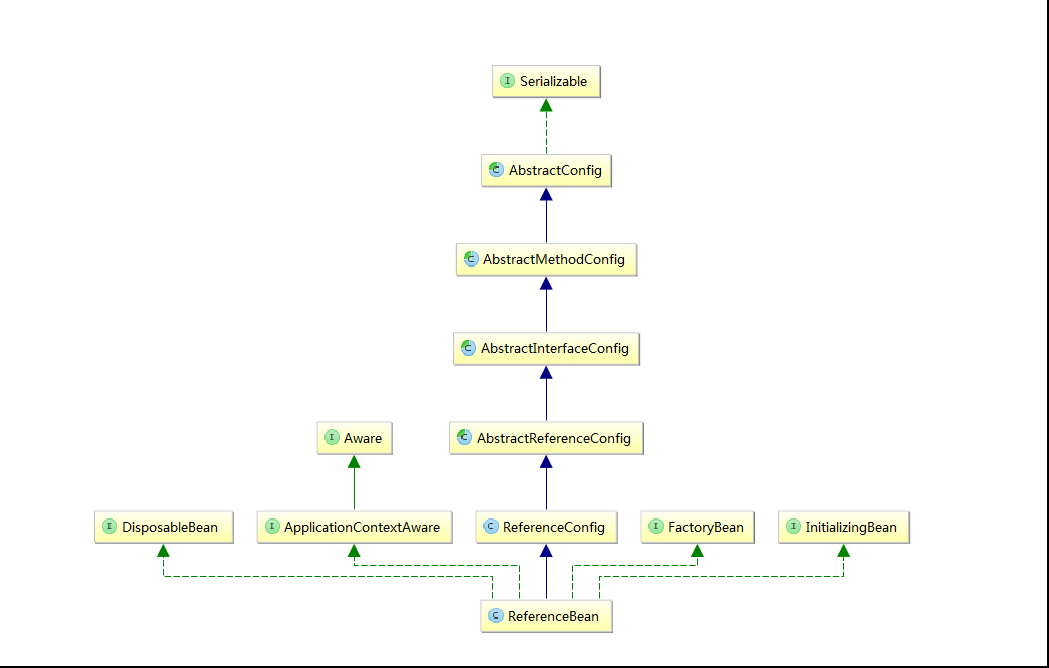
代理的创建是由 ReferenceBean 类里的 getObject() 方法里触发:
   @Override

    public Object getObject() throws Exception {

        return get();

    }
get() 方法在 ReferenceConfig 类中:
    public synchronized T get() {

        if (destroyed) {

            throw new IllegalStateException("Already destroyed!");

        }

        if (ref == null) {

            init();

        }

        return ref;

    }

   private void init() {

           .............

           ref = createProxy(map);

        .............

   }

    /***

     * 创建客户端rpc调用代理

     * @param map

     * @return

     */

       @SuppressWarnings({"unchecked", "rawtypes", "deprecation"})

    private T createProxy(Map<String, String> map) {

       //....用于生成invoker的逻辑

        //创建服务代理

       // create service proxy

       return (T) proxyFactory.getProxy(invoker);

    }
proxyFactory 的声明为:
private static final ProxyFactory proxyFactory = ExtensionLoader.getExtensionLoader(ProxyFactory.class).getAdaptiveExtension();
由博文dubbo spi机制源码学习可以得到 ProxyFactory 接口的 Adaptive 类的 getProxy 方法源码如下:
public class ProxyFactory$Adpative implements com.alibaba.dubbo.rpc.ProxyFactory {

    public java.lang.Object getProxy(com.alibaba.dubbo.rpc.Invoker arg0) throws com.alibaba.dubbo.rpc.RpcException {

        if (arg0 == null) throw new IllegalArgumentException("com.alibaba.dubbo.rpc.Invoker argument == null");

        if (arg0.getUrl() == null)

            throw new IllegalArgumentException("com.alibaba.dubbo.rpc.Invoker argument getUrl() == null");

        com.alibaba.dubbo.common.URL url = arg0.getUrl();

        String extName = url.getParameter("proxy", "javassist");

        if (extName == null)

            throw new IllegalStateException("Fail to get extension(com.alibaba.dubbo.rpc.ProxyFactory) name from url(" + url.toString() + ") use keys([proxy])");

         //这里默认用了ProxyFactory javassist扩展的getProxy方法创建代理

        com.alibaba.dubbo.rpc.ProxyFactory extension = (com.alibaba.dubbo.rpc.ProxyFactory) ExtensionLoader.getExtensionLoader(com.alibaba.dubbo.rpc.ProxyFactory.class).getExtension(extName);

        return extension.getProxy(arg0);

    }

}
ProxyFactory 为接口类,实现类有抽象类 AbstractProxyFactory 和类 StubProxyFactoryWrapper 。 AbstractProxyFactory 包含抽象方法 public abstract <T> T getProxy(Invoker<T> invoker, Class<?>[] types); ,该抽象方法实现类有 JavassistProxyFactory 和 JdkProxyFactory ,如下: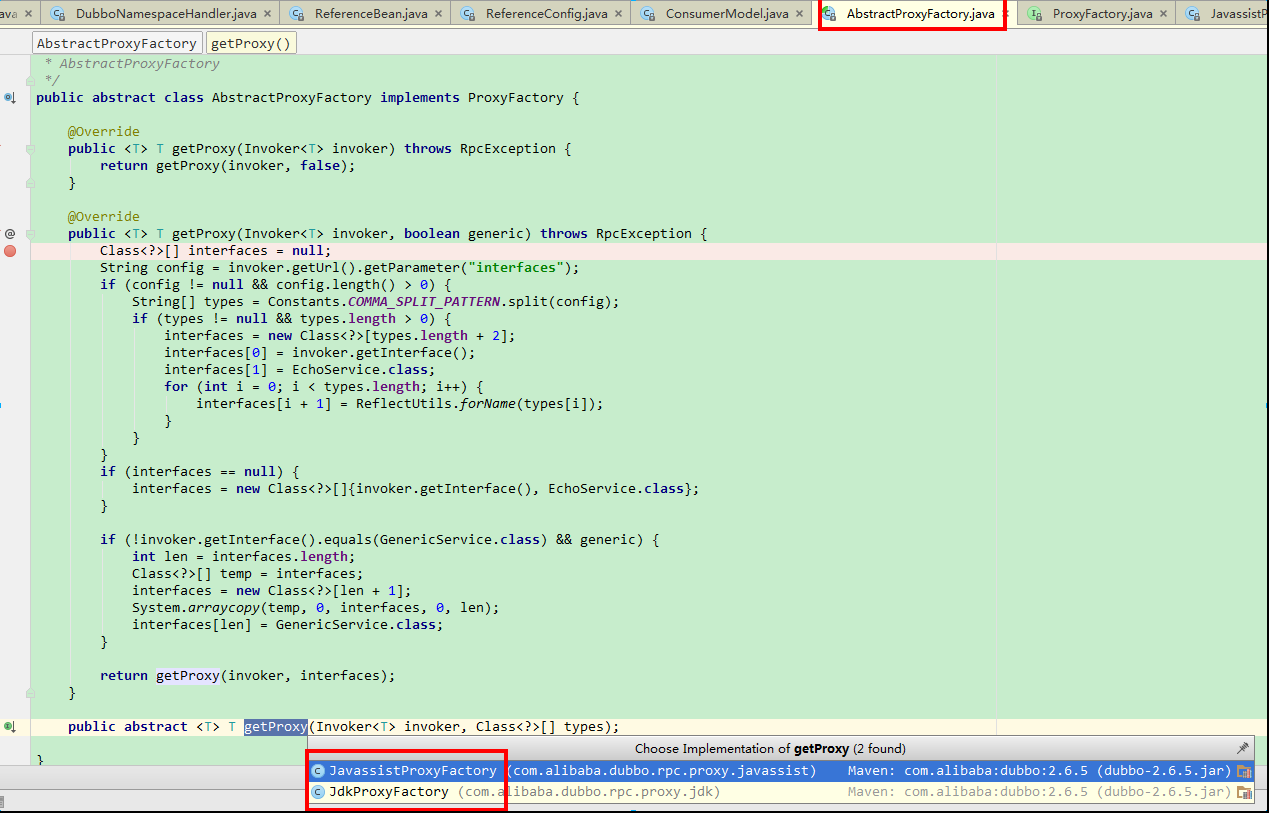
ProxyFactory 接口的javassist扩展类 JavassistProxyFactory 的 getProxy 方法实现如下:
/**

 * JavaassistRpcProxyFactory

 */

public class JavassistProxyFactory extends AbstractProxyFactory {

    @Override

    @SuppressWarnings("unchecked")

    public <T> T getProxy(Invoker<T> invoker, Class<?>[] interfaces) {

          //代理类实现化以new InvokerInvocationHandler(invoker)为参数

        return (T) Proxy.getProxy(interfaces).newInstance(new InvokerInvocationHandler(invoker));

    }

}
生成动态代理的 Proxy 类
    /**

     * Get proxy.

     *

     * @param ics interface class array.

     * @return Proxy instance.

     */

    public static Proxy getProxy(Class<?>... ics) {

        return getProxy(ClassHelper.getClassLoader(Proxy.class), ics);

    }

        /**

     * Get proxy.

     *

     * @param cl  class loader.

     * @param ics interface class array.可以实现多个接口

     * @return Proxy instance.

     */

    public static Proxy getProxy(ClassLoader cl, Class<?>... ics) {

        if (ics.length > 65535)

            throw new IllegalArgumentException("interface limit exceeded");

        StringBuilder sb = new StringBuilder();

        for (int i = 0; i < ics.length; i++) {

            String itf = ics[i].getName();

            if (!ics[i].isInterface())

                throw new RuntimeException(itf + " is not a interface.");

            Class<?> tmp = null;

            try {

                tmp = Class.forName(itf, false, cl);

            } catch (ClassNotFoundException e) {

            }

            if (tmp != ics[i])

                throw new IllegalArgumentException(ics[i] + " is not visible from class loader");

            sb.append(itf).append(';');

        }

        // use interface class name list as key.

        // 用接口类名做key,多个接口以";"分开。

        String key = sb.toString();

        // get cache by class loader.

        // 缓存

        Map<String, Object> cache;

        synchronized (ProxyCacheMap) {

            cache = ProxyCacheMap.get(cl);

            if (cache == null) {

                cache = new HashMap<String, Object>();

                ProxyCacheMap.put(cl, cache);

            }

        }

        Proxy proxy = null;

        synchronized (cache) {

            do {

                Object value = cache.get(key);

                if (value instanceof Reference<?>) {

                    //如果有存在引用对象,返回缓存对象。

                    proxy = (Proxy) ((Reference<?>) value).get();

                    if (proxy != null)

                        return proxy;

                }

                //对象正在生成,线程挂起,等待

                if (value == PendingGenerationMarker) {

                    try {

                        cache.wait();

                    } catch (InterruptedException e) {

                    }

                } else {

                    //放入正在生成标识

                    cache.put(key, PendingGenerationMarker);

                    break;

                }

            }

            while (true);

        }

        //类名称后自动加序列号 0,1,2,3...

        long id = PROXY_CLASS_COUNTER.getAndIncrement();

        String pkg = null;

        //ClassGenerator dubbo用javassist实现的工具类

        ClassGenerator ccp = null, ccm = null;

        try {

            ccp = ClassGenerator.newInstance(cl);

            Set<String> worked = new HashSet<String>();

            List<Method> methods = new ArrayList<Method>();

            for (int i = 0; i < ics.length; i++) {

                //检查包名称及不同包的修饰符

                if (!Modifier.isPublic(ics[i].getModifiers())) {

                    String npkg = ics[i].getPackage().getName();

                    if (pkg == null) {

                        pkg = npkg;

                    } else {

                        if (!pkg.equals(npkg))

                            throw new IllegalArgumentException("non-public interfaces from different packages");

                    }

                }

                //代理类添加要实现的接口Class对象

                ccp.addInterface(ics[i]);

                for (Method method : ics[i].getMethods()) {

                    //获取方法描述符,不同接口,同样的方法,只能被实现一次。

                    String desc = ReflectUtils.getDesc(method);

                    if (worked.contains(desc))

                        continue;

                    worked.add(desc);

                    int ix = methods.size();

                    //方法返回类型

                    Class<?> rt = method.getReturnType();

                    //方法参数类型列表

                    Class<?>[] pts = method.getParameterTypes();

                    //生成接口的实现代码,每个方法都一样

                    StringBuilder code = new StringBuilder("Object[] args = new Object[").append(pts.length).append("];");

                    for (int j = 0; j < pts.length; j++)

                        code.append(" args[").append(j).append("] = ($w)$").append(j + 1).append(";");

                    code.append(" Object ret = handler.invoke(this, methods[" + ix + "], args);");

                    if (!Void.TYPE.equals(rt))

                        code.append(" return ").append(asArgument(rt, "ret")).append(";");

                    methods.add(method);

                    ccp.addMethod(method.getName(), method.getModifiers(), rt, pts, method.getExceptionTypes(), code.toString());

                }

            }

            if (pkg == null)

                pkg = PACKAGE_NAME;

            // create ProxyInstance class.

            // 具体代理类名称,这里是类全名

            String pcn = pkg + ".proxy" + id;

            ccp.setClassName(pcn);

            ccp.addField("public static java.lang.reflect.Method[] methods;");

            ccp.addField("private " + InvocationHandler.class.getName() + " handler;");

            //创建构造函数

            ccp.addConstructor(Modifier.PUBLIC, new Class<?>[]{InvocationHandler.class}, new Class<?>[0], "handler=$1;");

            ccp.addDefaultConstructor();

            Class<?> clazz = ccp.toClass();

            //通过反射,把method数组放入,静态变量methods中,

            clazz.getField("methods").set(null, methods.toArray(new Method[0]));

            // create Proxy class.

            String fcn = Proxy.class.getName() + id;

            ccm = ClassGenerator.newInstance(cl);

            ccm.setClassName(fcn);

            ccm.addDefaultConstructor();

            //设置父类为Proxy类

            ccm.setSuperClass(Proxy.class);

            //生成实现它的抽象方法newInstance代码,new 的实例对象,是上面生成的代理类 pcn

            ccm.addMethod("public Object newInstance(" + InvocationHandler.class.getName() + " h){ return new " + pcn + "($1); }");

            Class<?> pc = ccm.toClass();

            proxy = (Proxy) pc.newInstance();

        } catch (RuntimeException e) {

            throw e;

        } catch (Exception e) {

            throw new RuntimeException(e.getMessage(), e);

        } finally {

            // release ClassGenerator

            if (ccp != null)

                ccp.release();

            if (ccm != null)

                ccm.release();

            synchronized (cache) {

                if (proxy == null)

                    cache.remove(key);

                else

                    //放入缓存,key:实现的接口名,value 代理对象,这个用弱引用,

                    //当jvm gc时,会打断对实例对象的引用,对象接下来就等待被回收。

                    cache.put(key, new WeakReference<Proxy>(proxy));

                cache.notifyAll();

            }

        }

        return proxy;

    }
通过 javaagent 可以导出动态代理class文件源码,以下为生成的代理类源码,动态生成了两个类:
package com.alibaba.dubbo.common.bytecode;

import java.lang.reflect.InvocationHandler;

public class Proxy0 extends Proxy

  implements ClassGenerator.DC

{

  public Object newInstance(InvocationHandler paramInvocationHandler)

  {

    return new proxy0(paramInvocationHandler);

  }

}
这个类继承了抽象类 Proxy ,实现了它的抽象方法 newInstance ,接口 ClassGenerator.DC 是dubbo内部作为动态类标识的接口。
还有一个类 proxy0 ,就是在开始方法栈里看到的代理类,源码如下:
package com.alibaba.dubbo.common.bytecode;

import com.alibaba.dubbo.rpc.service.EchoService;

import com.zxd.dubbo.learning.api.DemoService;

import com.zxd.dubbo.learning.api.Person;

import java.lang.reflect.InvocationHandler;

import java.lang.reflect.Method;

public class proxy0

  implements ClassGenerator.DC, EchoService, DemoService

{

  public static Method[] methods;

  private InvocationHandler handler;

  //实现了接口方法

  public String sayHello(String paramString)

  {

    Object[] arrayOfObject = new Object[1];

    arrayOfObject[0] = paramString;

    Object localObject = this.handler.invoke(this, methods[0], arrayOfObject);//实际调用逻辑

    return (String)localObject;

  }

  //实现了接口方法

  public String sayGoodbye(String paramString)

  {

    Object[] arrayOfObject = new Object[1];

    arrayOfObject[0] = paramString;

    Object localObject = this.handler.invoke(this, methods[1], arrayOfObject);

    return (String)localObject;

  }

 //实现了接口方法

  public Person getPerson(String paramString)

  {

    Object[] arrayOfObject = new Object[1];

    arrayOfObject[0] = paramString;

    Object localObject = this.handler.invoke(this, methods[2], arrayOfObject);

    return (Person)localObject;

  }

  //回显测试接口

  public Object $echo(Object paramObject)

  {

    Object[] arrayOfObject = new Object[1];

    arrayOfObject[0] = paramObject;

    Object localObject = this.handler.invoke(this, methods[3], arrayOfObject);

    return (Object)localObject;

  }

  public proxy0()

  {

  }

  public proxy0(InvocationHandler paramInvocationHandler)

  {

    //public构造函数,这里handler是

    //由Proxy.getProxy(interfaces).newInstance(new InvokerInvocationHandler(invoker))语句传入的InvokerInvocationHandler对象

    this.handler = paramInvocationHandler;

  }

}
可以看到代理类实现了3个接口。
ClassGeneratr.DC 是dubbo动态类标识接口;
DemoService 是实际业务接口。这样代理就可以调用服务方法了;
EchoService 是回显测试接口,它能为所有dubbo rpc服务加上的一个回显测试方法,只有一个方法:
package com.alibaba.dubbo.rpc.service;

/**

 * Echo service.

 * @export

 */

public interface EchoService {

    /**

     * echo test.

     *

     * @param message message.

     * @return message.

     */

    Object $echo(Object message);

}
EchoService echoService = (EchoService) demoService; // 通过强制转型为EchoService,可以测试。
通过查看 proxy0.class 的 sayHello 方法,其实际调用的是O bject localObject = this.handler.invoke(this, methods[0], arrayOfObject);
与上述堆栈信息第三行一致:
at com.alibaba.dubbo.rpc.proxy.InvokerInvocationHandler.invoke(InvokerInvocationHandler.java:52)
InvokerInvocationHandler 如下:
public class InvokerInvocationHandler implements InvocationHandler {

    private final Invoker<?> invoker;

    //通过构造函数传入invoker

    public InvokerInvocationHandler(Invoker<?> handler) {

        this.invoker = handler;

    }

    @Override

    public Object invoke(Object proxy, Method method, Object[] args) throws Throwable {

        String methodName = method.getName();

        Class<?>[] parameterTypes = method.getParameterTypes();

        //如果是Object类方法

        if (method.getDeclaringClass() == Object.class) {

            //反射调用

            return method.invoke(invoker, args);

        }

        //对3个特殊方法的调用,做了处理

        if ("toString".equals(methodName) && parameterTypes.length == 0) {

            return invoker.toString();

        }

        if ("hashCode".equals(methodName) && parameterTypes.length == 0) {

            return invoker.hashCode();

        }

        if ("equals".equals(methodName) && parameterTypes.length == 1) {

            return invoker.equals(args[0]);

        }

        //其他业务方法通过invoker.invoke方法调用

        return invoker.invoke(new RpcInvocation(method, args)).recreate();

    }

}
这里的 invoker 对象,通过 InvokerInvocationHandler 构造方法传入,而 InvokerInvocationHandler 对象是由 JavassistProxyFactory 类 getProxy(Invoker<T> invoker, Class<?>[] interfaces) 方法创建。
回到调用 proxyFactory.getProxy(invoker); 方法的地方,即 ReferenceConfig 类的 createProxy(Map<String, String> map) 方法:
    @SuppressWarnings({"unchecked", "rawtypes", "deprecation"})

    private T createProxy(Map<String, String> map) {

        URL tmpUrl = new URL("temp", "localhost", 0, map);

        final boolean isJvmRefer;

        if (isInjvm() == null) {

            if (url != null && url.length() > 0) { // if a url is specified, don't do local reference

                isJvmRefer = false;

            } else if (InjvmProtocol.getInjvmProtocol().isInjvmRefer(tmpUrl)) {

                // by default, reference local service if there is

                isJvmRefer = true;

            } else {

                isJvmRefer = false;

            }

        } else {

            isJvmRefer = isInjvm().booleanValue();

        }

        if (isJvmRefer) {

            URL url = new URL(Constants.LOCAL_PROTOCOL, NetUtils.LOCALHOST, 0, interfaceClass.getName()).addParameters(map);

            invoker = refprotocol.refer(interfaceClass, url);

            if (logger.isInfoEnabled()) {

                logger.info("Using injvm service " + interfaceClass.getName());

            }

        } else {

            if (url != null && url.length() > 0) { // user specified URL, could be peer-to-peer address, or register center's address.

                String[] us = Constants.SEMICOLON_SPLIT_PATTERN.split(url);

                if (us != null && us.length > 0) {

                    for (String u : us) {

                        URL url = URL.valueOf(u);

                        if (url.getPath() == null || url.getPath().length() == 0) {

                            url = url.setPath(interfaceName);

                        }

                        if (Constants.REGISTRY_PROTOCOL.equals(url.getProtocol())) {

                            urls.add(url.addParameterAndEncoded(Constants.REFER_KEY, StringUtils.toQueryString(map)));

                        } else {

                            urls.add(ClusterUtils.mergeUrl(url, map));

                        }

                    }

                }

            } else { // assemble URL from register center's configuration

                List<URL> us = loadRegistries(false);

                if (us != null && !us.isEmpty()) {

                    for (URL u : us) {

                        URL monitorUrl = loadMonitor(u);

                        if (monitorUrl != null) {

                            map.put(Constants.MONITOR_KEY, URL.encode(monitorUrl.toFullString()));

                        }

                        urls.add(u.addParameterAndEncoded(Constants.REFER_KEY, StringUtils.toQueryString(map)));

                    }

                }

                if (urls.isEmpty()) {

                    throw new IllegalStateException("No such any registry to reference " + interfaceName + " on the consumer " + NetUtils.getLocalHost() + " use dubbo version " + Version.getVersion() + ", please config <dubbo:registry address=\"...\" /> to your spring config.");

                }

            }

            //只有一个直连地址或一个注册中心配置地址

            if (urls.size() == 1) {

                  //这里的urls.get(0)协议,可能是直连地址(默认dubbo协议),也可能是regiter注册地址(zookeeper协议)

                //本例通过配置一个注册中心的形式

                invoker = refprotocol.refer(interfaceClass, urls.get(0));

            } else {

               //多个直连地址或者多个注册中心地址,甚至是两者的组合。

                List<Invoker<?>> invokers = new ArrayList<Invoker<?>>();

                URL registryURL = null;

                for (URL url : urls) {

                    //创建invoker放入invokers

                    invokers.add(refprotocol.refer(interfaceClass, url));

                    if (Constants.REGISTRY_PROTOCOL.equals(url.getProtocol())) {

                        // 多个注册中心,用最后一个registry url

                        registryURL = url; // use last registry url

                    }

                }

                //有注册中心协议的URL,

                //对多个url,其中存在有注册中心的,写死用AvailableCluster集群策略

                 //这其中包括直连和注册中心混合或者都是注册中心两种情况

                if (registryURL != null) { // registry url is available

                    // use AvailableCluster only when register's cluster is available

                    URL u = registryURL.addParameter(Constants.CLUSTER_KEY, AvailableCluster.NAME);

                    invoker = cluster.join(new StaticDirectory(u, invokers));

                } else { // not a registry url (多个直连的url)

                    invoker = cluster.join(new StaticDirectory(invokers));

                }

            }

        }

        Boolean c = check;

        if (c == null && consumer != null) {

            c = consumer.isCheck();

        }

        if (c == null) {

            c = true; // default true

        }

        if (c && !invoker.isAvailable()) {

            throw new IllegalStateException("Failed to check the status of the service " + interfaceName + ". No provider available for the service " + (group == null ? "" : group + "/") + interfaceName + (version == null ? "" : ":" + version) + " from the url " + invoker.getUrl() + " to the consumer " + NetUtils.getLocalHost() + " use dubbo version " + Version.getVersion());

        }

        if (logger.isInfoEnabled()) {

            logger.info("Refer dubbo service " + interfaceClass.getName() + " from url " + invoker.getUrl());

        }

        // create service proxy

        return (T) proxyFactory.getProxy(invoker);

    }
可以看到 invoker 是通过 refprotocol.refer(interfaceClass, urls.get(0)); 或者 cluster.join(new StaticDirectory(u, invokers)); 、 cluster.join(new StaticDirectory(invokers)); 三种构建语句依照条件选一种调用生成。
这里分析第一种生成 invokder 的情况,根据spi机制这里 refprotocol 对象是 Protocol$Adpative 实例,具体refer实现是:
public com.alibaba.dubbo.rpc.Invoker refer(java.lang.Class arg0, com.alibaba.dubbo.common.URL arg1) throws com.alibaba.dubbo.rpc.RpcException {

    if (arg1 == null)

        throw new IllegalArgumentException("url == null");

    com.alibaba.dubbo.common.URL url = arg1;

    String extName = (url.getProtocol() == null ? "dubbo" : url.getProtocol());

    if (extName == null)

        throw new IllegalStateException("Fail to get extension(com.alibaba.dubbo.rpc.Protocol) name from url(" + url.toString() + ") use keys([protocol])");

    com.alibaba.dubbo.rpc.Protocol extension = (com.alibaba.dubbo.rpc.Protocol) ExtensionLoader.getExtensionLoader(com.alibaba.dubbo.rpc.Protocol.class).getExtension(extName);

    return extension.refer(arg0, arg1);

}
通过代码可以得知,Protocol具体实现要根据url的Protocol值再通过spi得到.如果是直连地址,这里就是dubbo协议,最后走 DubboProtocol 类的refer方法.
具体实现是:
    @Override

    public <T> Invoker<T> refer(Class<T> serviceType, URL url) throws RpcException {

        optimizeSerialization(url);

        // create rpc invoker.

        DubboInvoker<T> invoker = new DubboInvoker<T>(serviceType, url, getClients(url), invokers);

        invokers.add(invoker);

        return invoker;

    }
如果是注册中心,这里protocol是 register ,会走 RegistryProtocol 类的 refer 方法:
    @Override

    @SuppressWarnings("unchecked")

    public <T> Invoker<T> refer(Class<T> type, URL url) throws RpcException {

        //通过register 可以获取具体注册中心协议,这里是zookeeper,并设置为url的协议值。

        url = url.setProtocol(url.getParameter(Constants.REGISTRY_KEY, Constants.DEFAULT_REGISTRY)).removeParameter(Constants.REGISTRY_KEY);

        //获取zookeeper Registry 实现,即ZookeeperRegistryFactory ,并调用getRegistry方法实现

         //获取zookeeper类型的registry对象

        Registry registry = registryFactory.getRegistry(url);

        if (RegistryService.class.equals(type)) {

            return proxyFactory.getInvoker((T) registry, type, url);

        }

        // group="a,b" or group="*"

        Map<String, String> qs = StringUtils.parseQueryString(url.getParameterAndDecoded(Constants.REFER_KEY));

        String group = qs.get(Constants.GROUP_KEY);

        if (group != null && group.length() > 0) {

            if ((Constants.COMMA_SPLIT_PATTERN.split(group)).length > 1

                    || "*".equals(group)) {

                return doRefer(getMergeableCluster(), registry, type, url);

            }

        }

        //这里cluster是Cluster$Adpative类对象

        return doRefer(cluster, registry, type, url);

    }

    private <T> Invoker<T> doRefer(Cluster cluster, Registry registry, Class<T> type, URL url) {

       //这里的RegistryDirectory和StaticDirectory向对应的,前者是动态从注册中心获取url目录对象,后者是静态指定url目录。

        RegistryDirectory<T> directory = new RegistryDirectory<T>(type, url);

        directory.setRegistry(registry);

        directory.setProtocol(protocol);

        // all attributes of REFER_KEY

        Map<String, String> parameters = new HashMap<String, String>(directory.getUrl().getParameters());

        URL subscribeUrl = new URL(Constants.CONSUMER_PROTOCOL, parameters.remove(Constants.REGISTER_IP_KEY), 0, type.getName(), parameters);

        if (!Constants.ANY_VALUE.equals(url.getServiceInterface())

                && url.getParameter(Constants.REGISTER_KEY, true)) {

            registry.register(subscribeUrl.addParameters(Constants.CATEGORY_KEY, Constants.CONSUMERS_CATEGORY,

                    Constants.CHECK_KEY, String.valueOf(false)));

        }

        //订阅注册中心,可以获取服务提供方地址等信息

        directory.subscribe(subscribeUrl.addParameter(Constants.CATEGORY_KEY,

                Constants.PROVIDERS_CATEGORY

                        + "," + Constants.CONFIGURATORS_CATEGORY

                        + "," + Constants.ROUTERS_CATEGORY));

        //通过调用Cluster$Adpative类的join方法返回Invoker对象(***看这里***)

        Invoker invoker = cluster.join(directory);

        ProviderConsumerRegTable.registerConsumer(invoker, url, subscribeUrl, directory);

        return invoker;

    }
这里看下 Cluster$Adpative 类 join 方法实现:
public com.alibaba.dubbo.rpc.Invoker join(com.alibaba.dubbo.rpc.cluster.Directory arg0) throws com.alibaba.dubbo.rpc.RpcException {

    if (arg0 == null)

        throw new IllegalArgumentException("com.alibaba.dubbo.rpc.cluster.Directory argument == null");

    if (arg0.getUrl() == null)

        throw new IllegalArgumentException("com.alibaba.dubbo.rpc.cluster.Directory argument getUrl() == null");

    com.alibaba.dubbo.common.URL url = arg0.getUrl();

    //通过cluster获取集群策略,默认是failover

    //本例是使用failover机制

    String extName = url.getParameter("cluster", "failover");

    if(extName == null)

        throw new IllegalStateException("Fail to get extension(com.alibaba.dubbo.rpc.cluster.Cluster) name from url(" + url.toString() + ") use keys([cluster])");

    com.alibaba.dubbo.rpc.cluster.Cluster extension = (com.alibaba.dubbo.rpc.cluster.Cluster)ExtensionLoader.getExtensionLoader(com.alibaba.dubbo.rpc.cluster.Cluster.class).getExtension(extName);

    //通过spi这里得到FailoverCluster对象

    return extension.join(arg0);

    }
再看下 FailoverCluster 的 join 方法:
public class FailoverCluster implements Cluster {

    public final static String NAME = "failover";

    @Override

    public <T> Invoker<T> join(Directory<T> directory) throws RpcException {

        //返回FailoverClusterInvoker对象

        return new FailoverClusterInvoker<T>(directory);

    }

}
由于Cluster spi实现中有个 MockClusterWrapper 是包装类,这里牵涉到是dubbo的aop机制,这里先调用它的join方法:
public class MockClusterWrapper implements Cluster {

    private Cluster cluster;

    public MockClusterWrapper(Cluster cluster) {

        this.cluster = cluster;

    }

    @Override

    public <T> Invoker<T> join(Directory<T> directory) throws RpcException {

        return new MockClusterInvoker<T>(directory,

                this.cluster.join(directory));

    }

}
又由于 FailoverClusterInvoker 是 AbstractClusterInvoker 的子类,它的 invoke 方法实现在其父类中的,所以如下方法栈信息:
      at com.alibaba.dubbo.rpc.cluster.support.FailoverClusterInvoker.doInvoke(FailoverClusterInvoker.java:78)

      at com.alibaba.dubbo.rpc.cluster.support.AbstractClusterInvoker.invoke(AbstractClusterInvoker.java:244)

      at com.alibaba.dubbo.rpc.cluster.support.wrapper.MockClusterInvoker.invoke(MockClusterInvoker.java:75)
这些类都是dubbo的集群容错.博文dubbo集群容错机制代码分析是关于集群容错的介绍.
再往下看 AbstractClusterInvoker 的 invoke 方法实现:
    @Override

    public Result invoke(final Invocation invocation) throws RpcException {

        checkWhetherDestroyed();

        LoadBalance loadbalance = null;

        // binding attachments into invocation.

        Map<String, String> contextAttachments = RpcContext.getContext().getAttachments();

        if (contextAttachments != null && contextAttachments.size() != 0) {

            ((RpcInvocation) invocation).addAttachments(contextAttachments);

        }

        //会调用directory的list方法 返回要调用invokers集合。

        //其实是AbstractDirectory的list方法,这个方法里就是利用路由规则(如果有),从所有

        //提供者中,选出符合规则的提供者

        //接下里才是,集群容错和负载均衡。

        List<Invoker<T>> invokers = list(invocation);

        if (invokers != null && !invokers.isEmpty()) {

            loadbalance = ExtensionLoader.getExtensionLoader(LoadBalance.class).getExtension(invokers.get(0).getUrl()

                    .getMethodParameter(RpcUtils.getMethodName(invocation), Constants.LOADBALANCE_KEY, Constants.DEFAULT_LOADBALANCE));

        }

        RpcUtils.attachInvocationIdIfAsync(getUrl(), invocation);

        return doInvoke(invocation, invokers, loadbalance);

    }

    protected void checkWhetherDestroyed() {

        if (destroyed.get()) {

            throw new RpcException("Rpc cluster invoker for " + getInterface() + " on consumer " + NetUtils.getLocalHost()

                    + " use dubbo version " + Version.getVersion()

                    + " is now destroyed! Can not invoke any more.");

        }

    }
list方法:
    protected List<Invoker<T>> list(Invocation invocation) throws RpcException {

        List<Invoker<T>> invokers = directory.list(invocation);

        return invokers;

    }
跟到 RegistryDirectory 类的 list 方法,实现在其父类 AbstractDirectory 中:
    @Override

    public List<Invoker<T>> list(Invocation invocation) throws RpcException {

        if (destroyed) {

            throw new RpcException("Directory already destroyed .url: " + getUrl());

        }

        //获取所有的提供者

        //这里doList是个抽象方法,由RegistryDirectory实现具体:

        List<Invoker<T>> invokers = doList(invocation);

        List<Router> localRouters = this.routers; // local reference

        if (localRouters != null && !localRouters.isEmpty()) {

            for (Router router : localRouters) {

                try {

                    if (router.getUrl() == null || router.getUrl().getParameter(Constants.RUNTIME_KEY, false)) {

                        //Router接口,实现类的rout的方法。路由获取服务提供者

                        invokers = router.route(invokers, getConsumerUrl(), invocation);

                    }

                } catch (Throwable t) {

                    logger.error("Failed to execute router: " + getUrl() + ", cause: " + t.getMessage(), t);

                }

            }

        }

        return invokers;

    }
RegistryDirectory 实现具体的 doList 方法:
    @Override

    public List<Invoker<T>> doList(Invocation invocation) {

        if (forbidden) {

            // 1. 没有服务提供者 2. 服务提供者被禁用

            // 1. No service provider 2. Service providers are disabled

            throw new RpcException(RpcException.FORBIDDEN_EXCEPTION,

                "No provider available from registry " + getUrl().getAddress() + " for service " + getConsumerUrl().getServiceKey() + " on consumer " +  NetUtils.getLocalHost()

                        + " use dubbo version " + Version.getVersion() + ", please check status of providers(disabled, not registered or in blacklist).");

        }

        List<Invoker<T>> invokers = null;

        //methodInvokerMap在refreshInvoker方法里赋值

        Map<String, List<Invoker<T>>> localMethodInvokerMap = this.methodInvokerMap; // local reference

        if (localMethodInvokerMap != null && localMethodInvokerMap.size() > 0) {

            String methodName = RpcUtils.getMethodName(invocation);

            Object[] args = RpcUtils.getArguments(invocation);

            if (args != null && args.length > 0 && args[0] != null

                    && (args[0] instanceof String || args[0].getClass().isEnum())) {

                invokers = localMethodInvokerMap.get(methodName + "." + args[0]); // The routing can be enumerated according to the first parameter(可根据第一个参数枚举路由)

            }

            if (invokers == null) {

                invokers = localMethodInvokerMap.get(methodName);

            }

            if (invokers == null) {

                invokers = localMethodInvokerMap.get(Constants.ANY_VALUE);

            }

            if (invokers == null) {

                Iterator<List<Invoker<T>>> iterator = localMethodInvokerMap.values().iterator();

                if (iterator.hasNext()) {

                    invokers = iterator.next();

                }

            }

        }

        return invokers == null ? new ArrayList<Invoker<T>>(0) : invokers;

    }
下面是 refreshInvoker(List<URL> invokerUrls) 方法:
    private void refreshInvoker(List<URL> invokerUrls) {

        if (invokerUrls != null && invokerUrls.size() == 1 && invokerUrls.get(0) != null

                && Constants.EMPTY_PROTOCOL.equals(invokerUrls.get(0).getProtocol())) {

            this.forbidden = true; // Forbid to access

            this.methodInvokerMap = null; // Set the method invoker map to null

            destroyAllInvokers(); // Close all invokers

        } else {

            this.forbidden = false; // Allow to access

            Map<String, Invoker<T>> oldUrlInvokerMap = this.urlInvokerMap; // local reference

            if (invokerUrls.isEmpty() && this.cachedInvokerUrls != null) {

                invokerUrls.addAll(this.cachedInvokerUrls);

            } else {

                this.cachedInvokerUrls = new HashSet<URL>();

                this.cachedInvokerUrls.addAll(invokerUrls);//Cached invoker urls, convenient for comparison

            }

            if (invokerUrls.isEmpty()) {

                return;

            }

            //生成Invoker方法 toInvokers

            Map<String, Invoker<T>> newUrlInvokerMap = toInvokers(invokerUrls);// Translate url list to Invoker map

            Map<String, List<Invoker<T>>> newMethodInvokerMap = toMethodInvokers(newUrlInvokerMap); // Change method name to map Invoker Map

            // state change

            // If the calculation is wrong, it is not processed.

            //如果计算错误,则不进行处理

            if (newUrlInvokerMap == null || newUrlInvokerMap.size() == 0) {

                logger.error(new IllegalStateException("urls to invokers error .invokerUrls.size :" + invokerUrls.size() + ", invoker.size :0. urls :" + invokerUrls.toString()));

                return;

            }

            this.methodInvokerMap = multiGroup ? toMergeMethodInvokerMap(newMethodInvokerMap) : newMethodInvokerMap;

            this.urlInvokerMap = newUrlInvokerMap;

            try {

                destroyUnusedInvokers(oldUrlInvokerMap, newUrlInvokerMap); // Close the unused Invoker(关闭未使用的Invoker)

            } catch (Exception e) {

                logger.warn("destroyUnusedInvokers error. ", e);

            }

        }

    }
refreshInvoker() 方法会在 RegistryDirectory 类的 notify(List<URL> urls) 方法里调用,这个方法也是订阅注册中心回调方法.
以下是 toInvokers 方法:
    /**

     * Turn urls into invokers, and if url has been refer, will not re-reference.

     * 将urls转成invokers,如果url已经被refer过,不再重新引用。

     * @param urls

     * @return invokers

     */

    private Map<String, Invoker<T>> toInvokers(List<URL> urls) {

        Map<String, Invoker<T>> newUrlInvokerMap = new HashMap<String, Invoker<T>>();

        if (urls == null || urls.isEmpty()) {

            return newUrlInvokerMap;

        }

        Set<String> keys = new HashSet<String>();

        String queryProtocols = this.queryMap.get(Constants.PROTOCOL_KEY);

        for (URL providerUrl : urls) {

            // If protocol is configured at the reference side, only the matching protocol is selected

            //如果reference端配置了protocol,则只选择匹配的protocol

            if (queryProtocols != null && queryProtocols.length() > 0) {

                boolean accept = false;

                String[] acceptProtocols = queryProtocols.split(",");

                for (String acceptProtocol : acceptProtocols) {

                    if (providerUrl.getProtocol().equals(acceptProtocol)) {

                        accept = true;

                        break;

                    }

                }

                if (!accept) {

                    continue;

                }

            }

            if (Constants.EMPTY_PROTOCOL.equals(providerUrl.getProtocol())) {

                continue;

            }

            if (!ExtensionLoader.getExtensionLoader(Protocol.class).hasExtension(providerUrl.getProtocol())) {

                logger.error(new IllegalStateException("Unsupported protocol " + providerUrl.getProtocol() + " in notified url: " + providerUrl + " from registry " + getUrl().getAddress() + " to consumer " + NetUtils.getLocalHost()

                        + ", supported protocol: " + ExtensionLoader.getExtensionLoader(Protocol.class).getSupportedExtensions()));

                continue;

            }

            URL url = mergeUrl(providerUrl);

            String key = url.toFullString(); // The parameter urls are sorted(URL参数是排序的)

            if (keys.contains(key)) { // Repeated url(重复URL)

                continue;

            }

            keys.add(key);

            // Cache key is url that does not merge with consumer side parameters, regardless of how the consumer combines parameters, if the server url changes, then refer again

            //缓存key为没有合并消费端参数的URL,不管消费端如何合并参数,如果服务端URL发生变化,则重新refer

            Map<String, Invoker<T>> localUrlInvokerMap = this.urlInvokerMap; // local reference

            Invoker<T> invoker = localUrlInvokerMap == null ? null : localUrlInvokerMap.get(key);

            if (invoker == null) { // Not in the cache, refer again( 缓存中没有,重新refer)

                try {

                    boolean enabled = true;

                    if (url.hasParameter(Constants.DISABLED_KEY)) {

                        enabled = !url.getParameter(Constants.DISABLED_KEY, false);

                    } else {

                        enabled = url.getParameter(Constants.ENABLED_KEY, true);

                    }

                    if (enabled) {

                       //这里是invoker的创建的地方

                        invoker = new InvokerDelegate<T>(protocol.refer(serviceType, url), url, providerUrl);

                    }

                } catch (Throwable t) {

                    logger.error("Failed to refer invoker for interface:" + serviceType + ",url:(" + url + ")" + t.getMessage(), t);

                }

                if (invoker != null) { // Put new invoker in cache(将新的引用放入缓存)

                    newUrlInvokerMap.put(key, invoker);

                }

            } else {

                newUrlInvokerMap.put(key, invoker);

            }

        }

        keys.clear();

        return newUrlInvokerMap;

    }
invoker = new InvokerDelegate<T>(protocol.refer(serviceType, url), url, providerUrl) 是 invoker 的创建语句。
InvokerDelegate 是 RegistryDirectory 的内部类:
    /**

     * The delegate class, which is mainly used to store the URL address sent by the registry,and can be reassembled on the basis of providerURL queryMap overrideMap for re-refer.

     * 代理类,主要用于存储注册中心下发的url地址, 用于重新refer时能够根据providerURL queryMap overrideMap重新组装

     * @param <T>

     */

    private static class InvokerDelegate<T> extends InvokerWrapper<T> {

        private URL providerUrl;

        public InvokerDelegate(Invoker<T> invoker, URL url, URL providerUrl) {

            //调用父类构造方法

            super(invoker, url);

            this.providerUrl = providerUrl;

        }

        public URL getProviderUrl() {

            return providerUrl;

        }

    }
invoke 方法在其父类 InvokerWrapper 里实现:
    @Override

    public Result invoke(Invocation invocation) throws RpcException {

        //这里的invoker是从它的构造方法里传入的

        return invoker.invoke(invocation);

    }
所以方法栈里可以看到下面一行栈信息:
at com.alibaba.dubbo.rpc.protocol.InvokerWrapper.invoke(InvokerWrapper.java:56)
InvokerDelegete 构造方法调用的父类 InvokerWrapper 的构造方法并传入 invoker ,回头看 new InvokerDelegete<T>(protocol.refer(serviceType, url), url, providerUrl); 这句。可知上面的 invoker 是由 protocol.refer(serviceType, url) 创建的。
通过debug,可知这里的 protocol 是 Protocol$Adpative 类型,这里的url的Protocol是dubbo,通过spi可以得到这里最后走 DubboProtocol 类refer方法但是由于 Protocal 接口实现中,有两个包装类:
filter=com.alibaba.dubbo.rpc.protocol.ProtocolFilterWrapper

listener=com.alibaba.dubbo.rpc.protocol.ProtocolListenerWrapper
所以这里先执行 ProtocolFilterWrapper 的 refer 方法,再执行 ProtocolListenerWrapper 的 refer 方法,最后才执行 DubboProtocol 类 refer 方法。
ProtocolFilterWrapper 的 refer 方法如下:
    @Override

    public <T> Invoker<T> refer(Class<T> type, URL url) throws RpcException {

        if (Constants.REGISTRY_PROTOCOL.equals(url.getProtocol())) {

            return protocol.refer(type, url);

        }

        return buildInvokerChain(protocol.refer(type, url), Constants.REFERENCE_FILTER_KEY, Constants.CONSUMER);

    }

    private static <T> Invoker<T> buildInvokerChain(final Invoker<T> invoker, String key, String group) {

        Invoker<T> last = invoker;

        //先获取激活的过滤器,我们这里手动配置了monitor MonitorFilter过滤器,

        // 另外两个自动激活的过滤器是FutureFilter,ConsumerContextFilter

        //这里需要看spi机制的getActivateExtension方法相关代码

        List<Filter> filters = ExtensionLoader.getExtensionLoader(Filter.class).getActivateExtension(invoker.getUrl(), key, group);

        if (!filters.isEmpty()) {

            for (int i = filters.size() - 1; i >= 0; i--) {

                final Filter filter = filters.get(i);

                final Invoker<T> next = last;

                last = new Invoker<T>() {

                    @Override

                    public Class<T> getInterface() {

                        return invoker.getInterface();

                    }

                    @Override

                    public URL getUrl() {

                        return invoker.getUrl();

                    }

                    @Override

                    public boolean isAvailable() {

                        return invoker.isAvailable();

                    }

                    //实现invoker的 invoke方法

                    @Override

                    public Result invoke(Invocation invocation) throws RpcException {

                        //嵌套进过滤器链

                        return filter.invoke(next, invocation);

                    }

                    @Override

                    public void destroy() {

                        invoker.destroy();

                    }

                    @Override

                    public String toString() {

                        return invoker.toString();

                    }

                };

            }

        }

        return last;

    }
所以有以下调用栈信息:
      at com.alibaba.dubbo.monitor.support.MonitorFilter.invoke(MonitorFilter.java:75)

      at com.alibaba.dubbo.rpc.protocol.ProtocolFilterWrapper$1.invoke(ProtocolFilterWrapper.java:72)

      at com.alibaba.dubbo.rpc.protocol.dubbo.filter.FutureFilter.invoke(FutureFilter.java:54)

      at com.alibaba.dubbo.rpc.protocol.ProtocolFilterWrapper$1.invoke(ProtocolFilterWrapper.java:72)

      at com.alibaba.dubbo.rpc.filter.ActiveLimitFilter.invoke(ActiveLimitFilter.java:70)

      at com.alibaba.dubbo.rpc.protocol.ProtocolFilterWrapper$1.invoke(ProtocolFilterWrapper.java:72)

      at com.alibaba.dubbo.rpc.filter.ConsumerContextFilter.invoke(ConsumerContextFilter.java:49)

      at com.alibaba.dubbo.rpc.protocol.ProtocolFilterWrapper$1.invoke(ProtocolFilterWrapper.java:72)
接着 ProtocolListenerWrapper 的 refer 方法:
    @Override

    public <T> Invoker<T> refer(Class<T> type, URL url) throws RpcException {

        if (Constants.REGISTRY_PROTOCOL.equals(url.getProtocol())) {

            return protocol.refer(type, url);

        }

        return new ListenerInvokerWrapper<T>(protocol.refer(type, url),

               //获取激活的监听器,目前dubbo没有提供合适的监听器,只有一个DeprecatedInvokerListener实现类,还是个Deprecated的

               //所以这里为空

                Collections.unmodifiableList( ExtensionLoader.getExtensionLoader(InvokerListener.class).getActivateExtension(url, Constants.INVOKER_LISTENER_KEY)));

    }
这个可以解释下面这句堆栈信息:
at com.alibaba.dubbo.rpc.listener.ListenerInvokerWrapper.invoke(ListenerInvokerWrapper.java:77)
最后看下 DubboProtocol 类 refer 方法,这里创建了 DubboInvoker 对象:
    @Override

    public <T> Invoker<T> refer(Class<T> serviceType, URL url) throws RpcException {

        optimizeSerialization(url);

        // create rpc invoker.

        DubboInvoker<T> invoker = new DubboInvoker<T>(serviceType, url, getClients(url), invokers);

        invokers.add(invoker);

        return invoker;

    }
DubboInvoker 的父类 AbstractInvoker 实现了 invoke 方法:
    @Override

    public Result invoke(Invocation inv) throws RpcException {

        // if invoker is destroyed due to address refresh from registry, let's allow the current invoke to proceed

        if (destroyed.get()) {

            logger.warn("Invoker for service " + this + " on consumer " + NetUtils.getLocalHost() + " is destroyed, "

                    + ", dubbo version is " + Version.getVersion() + ", this invoker should not be used any longer");

        }

        RpcInvocation invocation = (RpcInvocation) inv;

        invocation.setInvoker(this);

        if (attachment != null && attachment.size() > 0) {

            invocation.addAttachmentsIfAbsent(attachment);

        }

        Map<String, String> contextAttachments = RpcContext.getContext().getAttachments();

        if (contextAttachments != null && contextAttachments.size() != 0) {

            /**

             * invocation.addAttachmentsIfAbsent(context){@link RpcInvocation#addAttachmentsIfAbsent(Map)}should not be used here,

             * because the {@link RpcContext#setAttachment(String, String)} is passed in the Filter when the call is triggered

             * by the built-in retry mechanism of the Dubbo. The attachment to update RpcContext will no longer work, which is

             * a mistake in most cases (for example, through Filter to RpcContext output traceId and spanId and other information).

             */

            invocation.addAttachments(contextAttachments);

        }

        if (getUrl().getMethodParameter(invocation.getMethodName(), Constants.ASYNC_KEY, false)) {

            invocation.setAttachment(Constants.ASYNC_KEY, Boolean.TRUE.toString());

        }

        RpcUtils.attachInvocationIdIfAsync(getUrl(), invocation);

        try {

            //doInvoke 具体实现在子类中

            return doInvoke(invocation);

        } catch (InvocationTargetException e) { // biz exception

            Throwable te = e.getTargetException();

            if (te == null) {

                return new RpcResult(e);

            } else {

                if (te instanceof RpcException) {

                    ((RpcException) te).setCode(RpcException.BIZ_EXCEPTION);

                }

                return new RpcResult(te);

            }

        } catch (RpcException e) {

            if (e.isBiz()) {

                return new RpcResult(e);

            } else {

                throw e;

            }

        } catch (Throwable e) {

            return new RpcResult(e);

        }

    }
DubboInvoker 实现的 doInvoke 方法:
    @Override

    protected Result doInvoke(final Invocation invocation) throws Throwable {

        RpcInvocation inv = (RpcInvocation) invocation;

        final String methodName = RpcUtils.getMethodName(invocation);

        inv.setAttachment(Constants.PATH_KEY, getUrl().getPath());

        inv.setAttachment(Constants.VERSION_KEY, version);

        ExchangeClient currentClient;

        if (clients.length == 1) {

            currentClient = clients[0];

        } else {

            currentClient = clients[index.getAndIncrement() % clients.length];

        }

        try {

            boolean isAsync = RpcUtils.isAsync(getUrl(), invocation);

            boolean isOneway = RpcUtils.isOneway(getUrl(), invocation);

            int timeout = getUrl().getMethodParameter(methodName, Constants.TIMEOUT_KEY, Constants.DEFAULT_TIMEOUT);

            if (isOneway) {

                boolean isSent = getUrl().getMethodParameter(methodName, Constants.SENT_KEY, false);

                currentClient.send(inv, isSent);

                RpcContext.getContext().setFuture(null);

                return new RpcResult();

            } else if (isAsync) {

                ResponseFuture future = currentClient.request(inv, timeout);

                RpcContext.getContext().setFuture(new FutureAdapter<Object>(future));

                return new RpcResult();

            } else {

                RpcContext.getContext().setFuture(null);

                //实际的请求语句 ,这里的currentClient是自身对象属性clients[0]值

                return (Result) currentClient.request(inv, timeout).get();

            }

        } catch (TimeoutException e) {

            throw new RpcException(RpcException.TIMEOUT_EXCEPTION, "Invoke remote method timeout. method: " + invocation.getMethodName() + ", provider: " + getUrl() + ", cause: " + e.getMessage(), e);

        } catch (RemotingException e) {

            throw new RpcException(RpcException.NETWORK_EXCEPTION, "Failed to invoke remote method: " + invocation.getMethodName() + ", provider: " + getUrl() + ", cause: " + e.getMessage(), e);

        }

    }
所以有以下两句调用栈输出信息:
      at com.alibaba.dubbo.rpc.protocol.dubbo.DubboInvoker.doInvoke(DubboInvoker.java:95)

      at com.alibaba.dubbo.rpc.protocol.AbstractInvoker.invoke(AbstractInvoker.java:155)
接下来看用于发起请求的 currentClient 对象的的实现,它的实现可追踪到 DubboProtocol 类 refer 方法里:
    @Override

    public <T> Invoker<T> refer(Class<T> serviceType, URL url) throws RpcException {

        optimizeSerialization(url);

        // create rpc invoker.

        //getClients(url) 创建 DubboInvoker 属性clients对象,

        DubboInvoker<T> invoker = new DubboInvoker<T>(serviceType, url, getClients(url), invokers);

        invokers.add(invoker);

        return invoker;

    }

    private ExchangeClient[] getClients(URL url) {

        // whether to share connection

        //是否共享连接

        boolean service_share_connect = false;

        int connections = url.getParameter(Constants.CONNECTIONS_KEY, 0);

        // if not configured, connection is shared, otherwise, one connection for one service

        //如果connections不配置,则共享连接,否则一个连接一个服务

        if (connections == 0) {

            service_share_connect = true;

            connections = 1;

        }

        ExchangeClient[] clients = new ExchangeClient[connections];

        for (int i = 0; i < clients.length; i++) {

            if (service_share_connect) {

                  //获取共享连接

                clients[i] = getSharedClient(url);

            } else {

                //初始化client,本例子不是共享连接,走这个逻辑

                clients[i] = initClient(url);

            }

        }

        return clients;

    }

    /**

     * Create new connection

     */

    private ExchangeClient initClient(URL url) {

        // client type setting.

        String str = url.getParameter(Constants.CLIENT_KEY, url.getParameter(Constants.SERVER_KEY, Constants.DEFAULT_REMOTING_CLIENT));

        url = url.addParameter(Constants.CODEC_KEY, DubboCodec.NAME);

        // enable heartbeat by default

        //默认开启heartbeat

        url = url.addParameterIfAbsent(Constants.HEARTBEAT_KEY, String.valueOf(Constants.DEFAULT_HEARTBEAT));

        // BIO is not allowed since it has severe performance issue.

        // BIO存在严重性能问题,暂时不允许使用

        if (str != null && str.length() > 0 && !ExtensionLoader.getExtensionLoader(Transporter.class).hasExtension(str)) {

            throw new RpcException("Unsupported client type: " + str + "," +

                    " supported client type is " + StringUtils.join(ExtensionLoader.getExtensionLoader(Transporter.class).getSupportedExtensions(), " "));

        }

        ExchangeClient client;

        try {

            // connection should be lazy

            //设置连接应该是lazy的

            if (url.getParameter(Constants.LAZY_CONNECT_KEY, false)) {

                client = new LazyConnectExchangeClient(url, requestHandler);

            } else {

                //通过 Exchangers.connect(url, requestHandler); 构建client ,接下来跟踪Exchangers.connect方法

                   //这里会传入一个requestHandler,这个是客户端接收服务端方法返回回调的

                client = Exchangers.connect(url, requestHandler);

            }

        } catch (RemotingException e) {

            throw new RpcException("Fail to create remoting client for service(" + url + "): " + e.getMessage(), e);

        }

        return client;

    }
这里用到了 facade 设计模式, Exchangers 是个门面类,封装了具体查找合适的 Exchanger 实现,并调用 connect 方法返回 ExchangeClient 的过程,相关方法代码如下:
    public static ExchangeClient connect(URL url, ExchangeHandler handler) throws RemotingException {

        if (url == null) {

            throw new IllegalArgumentException("url == null");

        }

        if (handler == null) {

            throw new IllegalArgumentException("handler == null");

        }

        url = url.addParameterIfAbsent(Constants.CODEC_KEY, "exchange");

        //把codec key 设置为exchange

        return getExchanger(url).connect(url, handler);

    }

    public static Exchanger getExchanger(URL url) {

        String type = url.getParameter(Constants.EXCHANGER_KEY, Constants.DEFAULT_EXCHANGER);

        //通过exchanger key 获取 Exchanger的spi实现,默认是header,这里是HeaderExchanger类

        return getExchanger(type);

    }

    public static Exchanger getExchanger(String type) {

        //这里返回Exchanger接口的header扩展类HeaderExchanger

        return ExtensionLoader.getExtensionLoader(Exchanger.class).getExtension(type);

    }
HeaderExchanger 类 connect 方法如下:
public class HeaderExchanger implements Exchanger {

    public static final String NAME = "header";

    //客户端的连接操作

    @Override

    public ExchangeClient connect(URL url, ExchangeHandler handler) throws RemotingException {

        //返回HeaderExchangeClient对象

        return new HeaderExchangeClient(Transporters.connect(url, new DecodeHandler(new HeaderExchangeHandler(handler))), true);

    }

    @Override

    public ExchangeServer bind(URL url, ExchangeHandler handler) throws RemotingException {

        return new HeaderExchangeServer(Transporters.bind(url, new DecodeHandler(new HeaderExchangeHandler(handler))));

    }

}
所以有栈信息:
at com.alibaba.dubbo.remoting.exchange.support.header.HeaderExchangeClient.request(HeaderExchangeClient.java:90)
再看 HeaderExchangeClient 的 request 方法:
    @Override

    public ResponseFuture request(Object request) throws RemotingException {

        //这里channel对象是从类构造函数中赋值,this.channel = new HeaderExchangeChannel(client);如下

        return channel.request(request);

    }

    public HeaderExchangeClient(Client client, boolean needHeartbeat) {

        if (client == null) {

            throw new IllegalArgumentException("client == null");

        }

        this.client = client;

        this.channel = new HeaderExchangeChannel(client);//channel赋值

        String dubbo = client.getUrl().getParameter(Constants.DUBBO_VERSION_KEY);

        this.heartbeat = client.getUrl().getParameter(Constants.HEARTBEAT_KEY, dubbo != null && dubbo.startsWith("1.0.") ? Constants.DEFAULT_HEARTBEAT : 0);

        this.heartbeatTimeout = client.getUrl().getParameter(Constants.HEARTBEAT_TIMEOUT_KEY, heartbeat * 3);

        if (heartbeatTimeout < heartbeat * 2) {

            throw new IllegalStateException("heartbeatTimeout < heartbeatInterval * 2");

        }

        if (needHeartbeat) {

            startHeartbeatTimer();

        }

    }
所以有栈信息:
atcom.alibaba.dubbo.remoting.exchange.support.header.HeaderExchangeChannel.request(HeaderExchangeChannel.java:116)
继续查看 HeaderExchangeChannel 类 request 方法:
    @Override

    public ResponseFuture request(Object request) throws RemotingException {

        return request(request, channel.getUrl().getPositiveParameter(Constants.TIMEOUT_KEY, Constants.DEFAULT_TIMEOUT));

    }

    @Override

    public ResponseFuture request(Object request, int timeout) throws RemotingException {

        if (closed) {

            throw new RemotingException(this.getLocalAddress(), null, "Failed to send request " + request + ", cause: The channel " + this + " is closed!");

        }

        // create request.

        Request req = new Request();

        req.setVersion(Version.getProtocolVersion());

        req.setTwoWay(true);

        req.setData(request);

        DefaultFuture future = new DefaultFuture(channel, req, timeout);

        try {

           //通过具体channel 发送请求

            channel.send(req);

        } catch (RemotingException e) {

            future.cancel();

            throw e;

        }

        return future;

    }
这里有 channel 对象,这里的 channel 对象也是通过 HeaderExchangeChannel 类的构造函数,从上层方法传进来的,而 HeaderExchangeChannel 是由 HeaderExchangeClient 构造的, HeaderExchangeClient 对象是由 HeaderExchanger 的 connect 方法里创建的。这里回到 HeaderExchanger 的 connect 方法:
/**

 * DefaultMessenger

 *

 *

 */

public class HeaderExchanger implements Exchanger {

    public static final String NAME = "header";

    @Override

    public ExchangeClient connect(URL url, ExchangeHandler handler) throws RemotingException {

        return new HeaderExchangeClient(Transporters.connect(url, new DecodeHandler(new HeaderExchangeHandler(handler))), true);

    }

    @Override

    public ExchangeServer bind(URL url, ExchangeHandler handler) throws RemotingException {

        return new HeaderExchangeServer(Transporters.bind(url, new DecodeHandler(new HeaderExchangeHandler(handler))));

    }

}
可以看到上文中 HeaderExchangeChannel 类中发送消息的 channel 对象是 Transporters.connect(url, new DecodeHandler(new HeaderExchangeHandler(handler))) 这句创建的。这里的 Transporters 也是个门面类,是 facade 设计模式的实现, Transporters 具体 connect 方法实现如下:
    public static Client connect(URL url, ChannelHandler... handlers) throws RemotingException {

        if (url == null) {

            throw new IllegalArgumentException("url == null");

        }

        ChannelHandler handler;

        if (handlers == null || handlers.length == 0) {

            handler = new ChannelHandlerAdapter();

        } else if (handlers.length == 1) {

            handler = handlers[0];

        } else {

            handler = new ChannelHandlerDispatcher(handlers);

        }

        //这里具体走 NettyTransporter.connect

        //        public Client connect(URL url, ChannelHandler listener) throws RemotingException {

        //            return new NettyClient(url, listener);

        //        }

        /所以这里默认返回的NettyClient

        return getTransporter().connect(url, handler);

    }

    //这个方法根据spi返回NettyTransporter扩展类

    public static Transporter getTransporter() {

       //这里通过生成的Transporter$Adaptive 的实现如下:

        return ExtensionLoader.getExtensionLoader(Transporter.class).getAdaptiveExtension();

    }
所以最后是通过 NettyClient 类实例的 send 方法发送的具体请求, NettyClient 类 send 方法实现在其祖先类 AbstractPeer 中:
    @Override

    public void send(Object message) throws RemotingException {

        send(message, url.getParameter(Constants.SENT_KEY, false));

    }
这个实现又调用 NettyClient 父类 AbstractClient 的 send 方法实现:
    @Override

    public void send(Object message, boolean sent) throws RemotingException {

        if (send_reconnect && !isConnected()) {

            connect();

        }

        //获取具体channel实例

        Channel channel = getChannel();

        //TODO Can the value returned by getChannel() be null? need improvement.

        //TODO getChannel返回的状态是否包含null需要改进

        if (channel == null || !channel.isConnected()) {

            throw new RemotingException(this, "message can not send, because channel is closed . url:" + getUrl());

        }

        channel.send(message, sent);

    }
这里的 getChannel() 方法由NettyClient自身实现,如下:
    @Override

    protected com.alibaba.dubbo.remoting.Channel getChannel() {

        Channel c = channel;

        if (c == null || !c.isConnected())

            return null;

        return NettyChannel.getOrAddChannel(c, getUrl(), this);

    }

   //再到NettyChannel.getOrAddChannel方法

   static NettyChannel getOrAddChannel(org.jboss.netty.channel.Channel ch, URL url, ChannelHandler handler) {

        if (ch == null) {

            return null;

        }

        //返回NettyChannel类

        NettyChannel ret = channelMap.get(ch);

        if (ret == null) {

            NettyChannel nc = new NettyChannel(ch, url, handler);

            if (ch.isConnected()) {

                ret = channelMap.putIfAbsent(ch, nc);

            }

            if (ret == null) {

                ret = nc;

            }

        }

        return ret;

    }
所以有以下栈信息:
      at com.alibaba.dubbo.remoting.transport.netty.NettyChannel.send(NettyChannel.java:100)

      at com.alibaba.dubbo.remoting.transport.AbstractClient.send(AbstractClient.java:265)

      at com.alibaba.dubbo.remoting.transport.AbstractPeer.send(AbstractPeer.java:53)
后面就是jboss内部的调用和消息转换:
      at org.jboss.netty.channel.SimpleChannelHandler.handleDownstream(SimpleChannelHandler.java:266)

      at org.jboss.netty.channel.DefaultChannelPipeline.sendDownstream(DefaultChannelPipeline.java:591)

      at org.jboss.netty.channel.DefaultChannelPipeline.sendDownstream(DefaultChannelPipeline.java:582)

      at org.jboss.netty.channel.Channels.write(Channels.java:611)

      at org.jboss.netty.channel.Channels.write(Channels.java:578)

      at org.jboss.netty.channel.AbstractChannel.write(AbstractChannel.java:251)
最后就走到开始打断点的 NettyHandler 类 writeRequested 方法:
at com.alibaba.dubbo.remoting.transport.netty.NettyHandler.writeRequested(NettyHandler.java:98)
Dubbo消费方服务调用过程源码分析的更多相关文章
- Dubbo服务调用过程源码解析④
目录 0.服务的调用 1.发送请求 2.请求编码 3.请求的解码 4.调用具体服务 5.返回调用结果 6.接收调用结果 Dubbo SPI源码解析① Dubbo服务暴露源码解析② Dubbo服务引用源 ...
- SpringCloud(4)---Ribbon服务调用,源码分析
SpringCloud(4)---Ribbon 本篇模拟订单服务调用商品服务,同时商品服务采用集群部署. 注册中心服务端口号7001,订单服务端口号9001,商品集群端口号:8001.8002.800 ...
- (转)Dubbo服务暴露过程源码分析
参考
- SDP服务搜索流程源码分析
BREDR的设备 在进行配对完成之后,进行;连接之前都要进行服务的搜索,服务搜索走的流程是SDP,这篇文章就分析一下,bluedroid中SDP的代码流程,我们从配对完成的回调函数开始分析: /*** ...
- 【图解源码】Zookeeper3.7源码分析,包含服务启动流程源码、网络通信源码、RequestProcessor处理请求源码
Zookeeper3.7源码剖析 能力目标 能基于Maven导入最新版Zookeeper源码 能说出Zookeeper单机启动流程 理解Zookeeper默认通信中4个线程的作用 掌握Zookeepe ...
- Android应用程序绑定服务(bindService)的过程源码分析
Android应用程序组件Service与Activity一样,既能够在新的进程中启动,也能够在应用程序进程内部启动:前面我们已经分析了在新的进程中启动Service的过程,本文将要介绍在应用程序内部 ...
- Netty入门一:服务端应用搭建 & 启动过程源码分析
最近周末也没啥事就学学Netty,同时打算写一些博客记录一下(写的过程理解更加深刻了) 本文主要从三个方法来呈现:Netty核心组件简介.Netty服务端创建.Netty启动过程源码分析 如果你对Ne ...
- [Android]Android系统启动流程源码分析
以下内容为原创,欢迎转载,转载请注明 来自天天博客:http://www.cnblogs.com/tiantianbyconan/p/5013863.html Android系统启动流程源码分析 首先 ...
- Spring加载流程源码分析03【refresh】
前面两篇文章分析了super(this)和setConfigLocations(configLocations)的源代码,本文来分析下refresh的源码, Spring加载流程源码分析01[su ...
随机推荐
- 输出变量的界值(int、float、long.....)
//整型.浮点型变量表示的关键字,并给出它们各自的界值 #include<iostream> #include<climits> //包含整型数据范围的头文件 #include ...
- C++入门经典-例7.9-对象数组,批量化生产
1:在数组内容中我们了解到,数组是通过指针分配到的一段额定大小的内容.同样,数组也可以包含对象.声明对象数组的形式如下: box boxArray[5]; box boxArray2[2]={box( ...
- TCP->IP输出 之 ip_queue_xmit、ip_build_and_send_pkt、ip_send_unicast_reply
概述 ip_queue_xmit是ip层提供给tcp层发送回调,大多数tcp发送都会使用这个回调,tcp层使用tcp_transmit_skb封装了tcp头之后,调用该函数,该函数提供了路由查找校验. ...
- CentOS6.4_x64配置OpenLDAP+PhpldapAdmin
一:前言 LDAP是轻量目录访问协议,英文全称是Lightweight Directory Access Protocol,一般都简称为LDAP.它是基于X.500标准的,但是简单多了并且可以根据需要 ...
- ZT:我们身边大多数的事都是暂时性的
1. 家庭放在首位. 2. 戒酒能有助于身体健康. 3. 经常跑步以及运动有益于身心健康. 4. 保证心胸开阔.让爱自动来到你的身边,而不需要你自己去拼命寻找. 5. 区分优秀的导师和老师.不断提升自 ...
- LC 962. Maximum Width Ramp
Given an array A of integers, a ramp is a tuple (i, j) for which i < j and A[i] <= A[j]. The ...
- 非监督的降维算法--PCA
PCA是一种非监督学习算法,它能够在保留大多数有用信息的情况下,有效降低数据纬度. 它主要应用在以下三个方面: 1. 提升算法速度 2. 压缩数据,减小内存.硬盘空间的消耗 3. 图示化数据,将高纬数 ...
- System.Windows.Forms.Timer、System.Timers.Timer、System.Threading.Timer的差别和分别什么时候用
System.Windows.Forms.Timer.System.Timers.Timer.System.Threading.Timer的 区别和用法http://space.itpub.net/1 ...
- 阶段3 3.SpringMVC·_07.SSM整合案例_04.ssm整合之编写SpringMVC框架
搭建SpringMvc的环境, 首先是提供前端控制器 再配置serletMapping 加载Springmvc.xml的配置文件, 使用init-param里面有个属性contextConfigLoc ...
- SqlServer索引的原理与应用(转载)
SqlServer索引的原理与应用 索引的概念 索引的用途:我们对数据查询及处理速度已成为衡量应用系统成败的标准,而采用索引来加快数据处理速度通常是最普遍采用的优化方法. 索引是什么:数据库中的索引类 ...