
Akka-CQRS(9)- gRPC,实现前端设备与平台系统的高效集成
前面我们完成了一个CQRS模式的数据采集(录入)平台。可以预见:数据的产生是在线下各式各样的终端系统中,包括web、桌面、移动终端。那么,为了实现一个完整的系统,必须把前端设备通过某种网络连接形式与数据采集平台集成为一体。有两种方式可以实现需要的网络连接:Restful-api, gRPC。由于gRPC支持http/2通讯协议,支持持久连接方式及双向数据流。所以对于POS设备这样的前端选择gRPC作为网络连接方式来实现实时的操作控制应该是正确的选择,毕竟采用恒久连接和双向数据流效率会高很多。gRPC是google公司的标准,基于protobuffer消息:一种二进制序列化数据交换机制。gRPC的优势在这里就不再细说,读者可以参考前面有关gRPC的讨论博文。
下面是系统结构示意图:
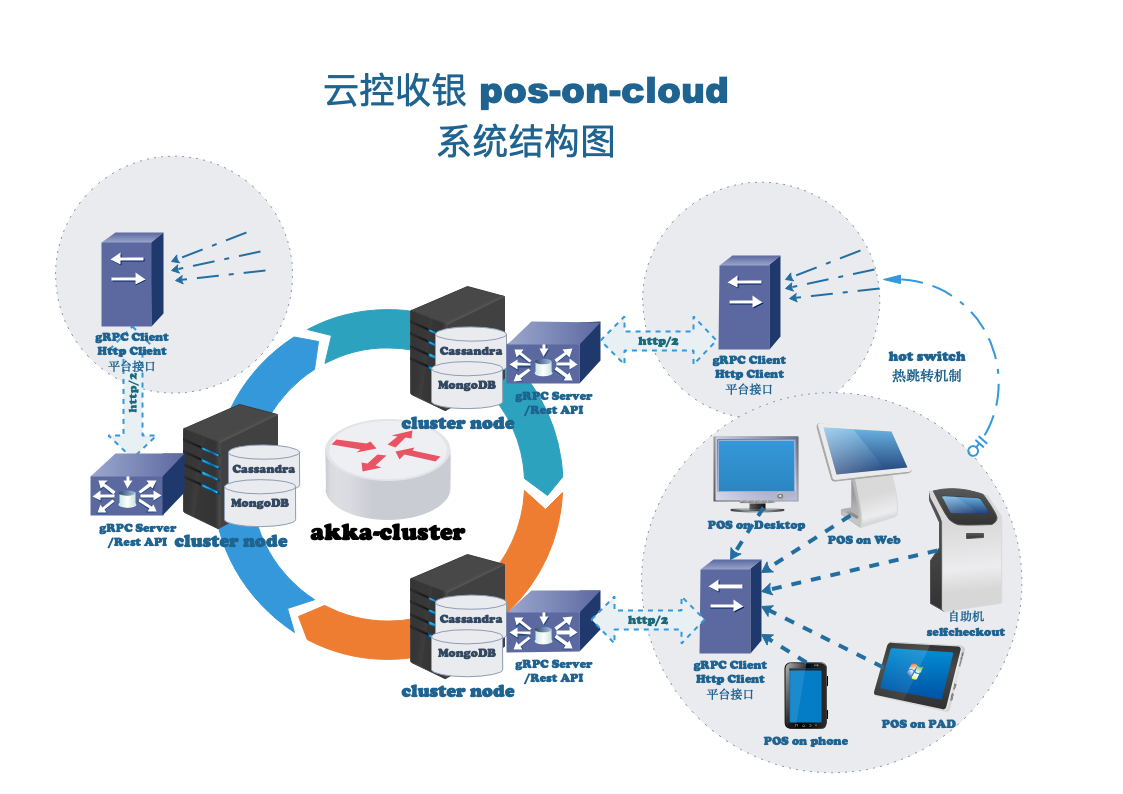
这篇讨论焦点集中在gRPC的server,client两头的具体实现。刚才提过,gRPC是google公司的开源库,同时还提供了各种语言的客户端,有:java, C++,python,go ... 但就是没有scala的,只能找第三方的scala客户端了。现在市面可供选择的gRPC-scala-客户端有scalaPB和akka-grpc两个,akka-grpc是基于akka-stream和akka-http构建的,按理来说会更合适,但由于还是处于preview版本,以后再说吧,现在只有scalaPB可选了。scalaPB是一个比较成熟的gRPC客户端,在前面的博客里我们也进行了介绍和示范。下面我们就用scalaPB来实现上面这个例子的客户端-平台集成。
首先,gRPC是通过protobuffer进行序列化数据传输的。下面是这个例子的.proto定义文件:
syntax = "proto3";

import "google/protobuf/wrappers.proto";

import "google/protobuf/any.proto";

import "scalapb/scalapb.proto";

option (scalapb.options) = {

  // use a custom Scala package name

  // package_name: "io.ontherocks.introgrpc.demo"

  // don't append file name to package

  flat_package: true

  // generate one Scala file for all messages (services still get their own file)

  single_file: true

  // add imports to generated file

  // useful when extending traits or using custom types

  // import: "io.ontherocks.hellogrpc.RockingMessage"

  // code to put at the top of generated file

  // works only with `single_file: true`

  //preamble: "sealed trait SomeSealedTrait"

};

package com.datatech.pos.messages;

message PBVchState {      //单据状态

    string opr  = 1;    //收款员

    int64  jseq = 2;    //begin journal sequence for read-side replay

    int32  num  = 3;    //当前单号

    int32  seq  = 4;    //当前序号

    bool   void = 5;    //取消模式

    bool   refd = 6;    //退款模式

    bool   susp = 7;    //挂单

    bool   canc = 8;    //废单

    bool   due  = 9;    //当前余额

    string su   = 10;   //主管编号

    string mbr  = 11;   //会员号

    int32  mode = 12;   //当前操作流程:0=logOff, 1=LogOn, 2=Payment

}

message PBTxnItem {       //交易记录

    string txndate    = 1;   //交易日期

    string txntime    = 2;   //录入时间

    string opr        = 3;   //操作员

    int32  num        = 4;   //销售单号

    int32  seq        = 5;   //交易序号

    int32  txntype    = 6;   //交易类型

    int32  salestype  = 7;   //销售类型

    int32  qty        = 8;   //交易数量

    int32  price      = 9;   //单价(分)

    int32  amount     = 10;  //码洋(分)

    int32  disc       = 11;  //折扣率 (%)

    int32  dscamt     = 12;  //折扣额:负值  net实洋 = amount + dscamt

    string member     = 13;  //会员卡号

    string code       = 14;  //编号(商品、卡号...)

    string acct       = 15;  //账号

    string dpt        = 16;  //部类

}

message PBPOSResponse {

    int32  sts                  = 1;

    string msg                  = 2;

    PBVchState voucher          = 3;

    repeated PBTxnItem txnitems   = 4;

}

message PBPOSCommand {

    int64  shopid = 1;

    string commandname = 2;

    string delimitedparams = 3;   //for multiple parameters, use ; to delimit

}

service SendCommand {

    rpc SingleResponse(PBPOSCommand) returns (PBPOSResponse) {};

    rpc MultiResponse(PBPOSCommand) returns (stream PBPOSResponse) {};

}
前端通过两种模式向平台发送指令PBPOSCommand: SingleResponse代表传统的request/response交互模式,MultiResponse,又或者server-streaming,代表前端发送一个指令,服务端返回一串Response, 或response-stream。Command和PBCommand、POSResponse和PBPOSResponse之间必须具备相互转换函数:
package com.datatech.pos.cloud

import Messages._

import com.datatech.pos.messages._

object PBConverter {

  implicit class PBConverter(pbmsg: PBPOSCommand) {

    def toPOSComand: POSMessage = pbmsg.commandname.toUpperCase match {

      case "LOGON" => POSMessage(pbmsg.shopid,LogOn(pbmsg.delimitedparams))

      case "LOGOFF" => POSMessage(pbmsg.shopid,LogOff)

      ...

    }

  }

  implicit class POSResponseConvert(resp: POSResponse) {

    def toPBPOSResponse: PBPOSResponse = new PBPOSResponse(

      sts = resp.sts,

      msg = resp.msg,

      voucher = Some(resp.voucher.toPBVchState),

      txnitems = resp.txnItems.map(_.toPBTxnItem)

    )

  }

  implicit class VchStateConvert(state: VchStates) {

    def toPBVchState: PBVchState = new PBVchState(

    opr  = state.opr,   //收款员

    jseq = state.jseq,   //begin journal sequence for read-side replay

    num  = state.num,  //当前单号

    seq  = state.seq,   //当前序号

    void = state.void,  //取消模式

    refd = state.refd, //退款模式

    susp = state.susp,   //挂单

    canc = state.canc,  //废单

    due  = state.due,   //当前余额

    su   = state.su,  //主管编号

    mbr  = state.mbr,   //会员号

    mode = state.mode //当前操作流程:0=logOff, 1=LogOn, 2=Payment

    )

  }

  implicit class TxnItemConvert(item: TxnItem) {

    def toPBTxnItem: PBTxnItem = new PBTxnItem(

    txndate    = item.txndate,   //交易日期

    txntime    = item.txntime,   //录入时间

    opr        = item.opr,   //操作员

    num        = item.num,   //销售单号

    seq        = item.seq,  //交易序号

    txntype    = item.txntype,   //交易类型

    salestype  = item.salestype,  //销售类型

    qty        = item.qty,  //交易数量

    price      = item.price,  //单价(分)

    amount     = item.amount,  //码洋(分)

    disc       = item.disc,  //折扣率 (%)

    dscamt     = item.dscamt, //折扣额:负值  net实洋 = amount + dscamt

    member     = item.member,  //会员卡号

    code       = item.code,  //编号(商品、卡号...)

    acct       = item.acct,  //账号

    dpt        = item.dpt  //部类

    )

  }

}
然后可以开始实现平台端POS接口服务了:
package com.datatech.pos.cloud

import com.datatech.pos.messages._

import io.grpc.stub.StreamObserver

import PBConverter._

import akka.actor.ActorRef

import akka.pattern.ask

import scala.concurrent.duration._

import akka.util.Timeout

import Messages._

import scala.concurrent.{Await, Future}

import com.typesafe.config.ConfigFactory

import com.datatech.sdp

import sdp.logging._

class gRPCServices(writerRouter: ActorRef) extends SendCommandGrpc.SendCommand with LogSupport {

  import gRPCServices._

  import PBConverter._

  var posConfig: com.typesafe.config.Config = _

  var exetimeout: Int = 5

  try {

    posConfig = ConfigFactory.load("pos.conf").getConfig("pos.server")

    exetimeout = posConfig.getInt("executimeout")

  }

  catch {

    case excp : Throwable =>

      log.warn(s"gRPCServices: ${excp.getMessage}")

      exetimeout = 5

  }

  override def singleResponse(request: PBPOSCommand): Future[PBPOSResponse] = {

    getPBResponse(writerRouter,request.toPOSComand, exetimeout)

  }

  override def multiResponse(request: PBPOSCommand, responseObserver: StreamObserver[PBPOSResponse]): Unit = ???

}

object gRPCServices {

  import scala.concurrent.ExecutionContext.Implicits.global

  def getPBResponse(ref: ActorRef, cmd: POSMessage, executimeout: Int = 5): Future[PBPOSResponse] = {

    implicit val timeout = Timeout(executimeout second)

    val futRes: Future[POSResponse] = ask(ref, cmd).mapTo[POSResponse]

    futRes.map(_.toPBPOSResponse)

  }

}
现在需要把gRPCService与POS系统集成为一体,这样前端发来的PBCommand转换成Command后经POSAgent转发给集群分片writerRouter,writeRouter再发给writer去进行具体的操作处理,完后把POSResponse转换成PBPOSResponse通过service再返回前端:
  def getPBResponse(ref: ActorRef, cmd: POSMessage, executimeout: Int = 5): Future[PBPOSResponse] = {

    implicit val timeout = Timeout(executimeout second)

    val futRes: Future[POSResponse] = ask(ref, cmd).mapTo[POSResponse]

    futRes.map(_.toPBPOSResponse)

  }
可以看到上面使用了ask()模式来进行双向沟通。这个ref是一个中间信息交互actor (POSAgent):
    var config = ConfigFactory.parseString("akka.remote.netty.tcp.port=\"" + port + "\"")

      .withFallback(ConfigFactory.parseString("akka.remote.netty.tcp.hostname=\"" + host + "\""))

      .withFallback(ConfigFactory.parseString("cassandra-journal.contact-points=[\"" + host + "\"]"))

      .withFallback(ConfigFactory.parseString("cassandra-snapshot-store.contact-points=[\"" + host + "\"]"))

    if (!seednodes.isEmpty)

      config = config.withFallback(ConfigFactory.parseString("akka.cluster.seed-nodes=[" + seednodes + "]"))

    //roles can be deployed on this node

    config = config.withFallback(ConfigFactory.parseString("akka.cluster.roles = [poswriter]"))

      .withFallback(ConfigFactory.load())

    val posSystem = ActorSystem(systemName, config)

    posSystem.actorOf(ClusterMonitor.props, "cps-cluster-monitor")

    posSystem.actorOf(ActionReader.readerProps(showSteps),"reader")

    val readerRouter = posSystem.actorOf(ReaderRouter.props(showSteps),"reader-router")

    WriterShard.deployShard(posSystem)(ReaderInfo(readerRouter,writeOnly),showSteps)

    val posHandler = ClusterSharding(posSystem).shardRegion(WriterShard.shardName)

    val posref = posSystem.actorOf(WriterRouter.props(posHandler), "writer-router")

    val passer = posSystem.actorOf(POSAgent.props(posref), "pos-agent")

    val svc = SendCommandGrpc.bindService(new gRPCServices(passer), posSystem.dispatcher)

    runServer(svc)

...

package com.datatech.pos.cloud

import akka.actor._

import com.datatech.sdp

import sdp.logging._

import Messages._

object POSAgent {

  def props(pos: ActorRef) = Props(new WriterRouter(pos))

}

class POSAgent(posHandler: ActorRef) extends Actor with LogSupport {

  var _sender: ActorRef = _

  override def receive: Receive = {

    case msg @ POSMessage(_,_) =>

      _sender = sender()

      posHandler ! msg

    case resp: POSResponse  => _sender ! resp

  }

}

...

package com.datatech.pos.cloud

import akka.actor._

import com.datatech.sdp

import sdp.logging._

import Messages._

object WriterRouter {

  def props(pos: ActorRef) = Props(new WriterRouter(pos))

}

class WriterRouter(posHandler: ActorRef) extends Actor with LogSupport {

  var _sender: ActorRef = _

  override def receive: Receive = {

    case msg @ POSMessage(_,_) =>

      _sender = sender()

      posHandler ! msg

    case resp: POSResponse  => _sender ! resp

//      log.info(s"*********response from server: $resp *********")

  }

}
前端是gRPC的客户端。我们构建一个来测试后台控制逻辑:
package poc.client

import scala.concurrent.Future

import com.datatech.pos.messages._

import com.datatech.pos.messages.SendCommandGrpc

import io.grpc.netty.{NegotiationType, NettyChannelBuilder}

object POCClient {

  def main(args: Array[String]): Unit = {

    val channel = NettyChannelBuilder

      .forAddress("192.168.11.189",50051)

        .negotiationType(NegotiationType.PLAINTEXT)

        .build()

 /*

    //build connection channel

    val channel = io.grpc.ManagedChannelBuilder

      .forAddress("192.168.11.189",50051)

      .usePlaintext(true)

      .build()

    val pbCommand = PBPOSCommand(1022,"LogOn","888")

    //async call

   val asyncStub = SendCommandGrpc.blockingStub(channel)

    val futResponse: Future[PBPOSResponse] = asyncStub.singleResponse(pbCommand)

    import scala.concurrent.ExecutionContext.Implicits.global

    futResponse.foreach(result => println(result)) */

    val pbCommand = PBPOSCommand(1022,"LogOn","888")

    val syncStub1: SendCommandGrpc.SendCommandBlockingClient = SendCommandGrpc.blockingStub(channel)

    val response1: PBPOSResponse = syncStub1.singleResponse(pbCommand)

    println(s"${response1.msg}")

    val pbCommand2 = PBPOSCommand(1022,"LogOff","")

    //sync call

    val syncStub: SendCommandGrpc.SendCommandBlockingClient = SendCommandGrpc.blockingStub(channel)

    val response: PBPOSResponse = syncStub.singleResponse(pbCommand2)

    println(s"${response.msg}")

    scala.io.StdIn.readLine()

    channel.shutdown()

  }

}
这里有几点必须注意:
1、protobuffer对象的强名称必须一致。在客户端用了同一个posmessages.proto定义文件:
syntax = "proto3";

import "google/protobuf/wrappers.proto";

import "google/protobuf/any.proto";

import "scalapb/scalapb.proto";

option (scalapb.options) = {

  // use a custom Scala package name

  // package_name: "io.ontherocks.introgrpc.demo"

  // don't append file name to package

  flat_package: true

  // generate one Scala file for all messages (services still get their own file)

  single_file: true

  // add imports to generated file

  // useful when extending traits or using custom types

  // import: "io.ontherocks.hellogrpc.RockingMessage"

  // code to put at the top of generated file

  // works only with `single_file: true`

  //preamble: "sealed trait SomeSealedTrait"

};

package com.datatech.pos.messages;

message PBVchState {      //单据状态

    string opr  = 1;    //收款员

    int64  jseq = 2;    //begin journal sequence for read-side replay

    int32  num  = 3;    //当前单号

    int32  seq  = 4;    //当前序号

    bool   void = 5;    //取消模式

    bool   refd = 6;    //退款模式

    bool   susp = 7;    //挂单

    bool   canc = 8;    //废单

    bool   due  = 9;    //当前余额

    string su   = 10;   //主管编号

    string mbr  = 11;   //会员号

    int32  mode = 12;   //当前操作流程:0=logOff, 1=LogOn, 2=Payment

}

message PBTxnItem {       //交易记录

    string txndate    = 1;   //交易日期

    string txntime    = 2;   //录入时间

    string opr        = 3;   //操作员

    int32  num        = 4;   //销售单号

    int32  seq        = 5;   //交易序号

    int32  txntype    = 6;   //交易类型

    int32  salestype  = 7;   //销售类型

    int32  qty        = 8;   //交易数量

    int32  price      = 9;   //单价(分)

    int32  amount     = 10;  //码洋(分)

    int32  disc       = 11;  //折扣率 (%)

    int32  dscamt     = 12;  //折扣额:负值  net实洋 = amount + dscamt

    string member     = 13;  //会员卡号

    string code       = 14;  //编号(商品、卡号...)

    string acct       = 15;  //账号

    string dpt        = 16;  //部类

}

message PBPOSResponse {

    int32  sts                  = 1;

    string msg                  = 2;

    PBVchState voucher          = 3;

    repeated PBTxnItem txnitems   = 4;

}

message PBPOSCommand {

    int64  shopid = 1;

    string commandname = 2;

    string delimitedparams = 3;

}

service SendCommand {

    rpc SingleResponse(PBPOSCommand) returns (PBPOSResponse) {};

    rpc MultiResponse(PBPOSCommand) returns (stream PBPOSResponse) {};

}
注意package com.datatech.pos.messages, 这项在服务端和客户端必须一致。
2、另外就是客户端的channelbuilder:在scalaPB例子里使用的是ManagedChannelBuilder,这是一个实验阶段的东东:
    //build connection channel

    val channel = io.grpc.ManagedChannelBuilder

      .forAddress("132.232.229.60",50051)

      .usePlaintext(true)

      .build()
要用gRPC中正式的channelbuilder:
    val channel = NettyChannelBuilder

      .forAddress("192.168.11.189",50051)

        .negotiationType(NegotiationType.PLAINTEXT)

        .build()
上面这个NettyChannelBuilder的设置与那个io.grpc.ManagedChannelBuilder功能相等。但NettyChannelBuilder还具备更多的设置参数,如ssl/tls设置。
3、还有:因为客户端是按照顺序来发送操作指令的,每发一个指令,等待返回结果后才能再发下一个指令。所以必须使用同步客户端调用函数blockingStub。
下面是本次示范的一些配置文档:
project/plugins.sbt
addSbtPlugin("com.eed3si9n" % "sbt-assembly" % "0.14.9")

addSbtPlugin("net.virtual-void" % "sbt-dependency-graph" % "0.9.2")

addSbtPlugin("com.typesafe.sbt" % "sbt-native-packager" % "1.3.15")

addSbtPlugin("com.thesamet" % "sbt-protoc" % "0.99.21")

libraryDependencies += "com.thesamet.scalapb" %% "compilerplugin" % "0.9.0-M6"
build.sbt
name := "pos-on-cloud"

version := "0.1"

scalaVersion := "2.12.8"

scalacOptions += "-Ypartial-unification"

val akkaVersion = "2.5.23"

libraryDependencies := Seq(

  "com.typesafe.akka" %% "akka-cluster-metrics" % akkaVersion,

  "com.typesafe.akka" %% "akka-cluster-sharding" % akkaVersion,

  "com.typesafe.akka" %% "akka-persistence" % akkaVersion,

  "com.lightbend.akka" %% "akka-stream-alpakka-cassandra" % "1.0.1",

  "org.mongodb.scala" %% "mongo-scala-driver" % "2.6.0",

  "com.lightbend.akka" %% "akka-stream-alpakka-mongodb" % "1.0.1",

  "com.typesafe.akka" %% "akka-persistence-query" % akkaVersion,

  "com.typesafe.akka" %% "akka-persistence-cassandra" % "0.97",

  "com.datastax.cassandra" % "cassandra-driver-core" % "3.6.0",

  "com.datastax.cassandra" % "cassandra-driver-extras" % "3.6.0",

  "ch.qos.logback"  %  "logback-classic"   % "1.2.3",

  "io.monix" %% "monix" % "3.0.0-RC2",

  "org.typelevel" %% "cats-core" % "2.0.0-M1",

  "io.grpc" % "grpc-netty" % scalapb.compiler.Version.grpcJavaVersion,

  "com.thesamet.scalapb" %% "scalapb-runtime" % scalapb.compiler.Version.scalapbVersion % "protobuf",

  "com.thesamet.scalapb" %% "scalapb-runtime-grpc" % scalapb.compiler.Version.scalapbVersion

)

PB.targets in Compile := Seq(

  scalapb.gen() -> (sourceManaged in Compile).value

)

enablePlugins(JavaAppPackaging)
resouces/application.conf
akka.actor.warn-about-java-serializer-usage = off

akka.log-dead-letters-during-shutdown = off

akka.log-dead-letters = off

akka.remote.use-passive-connections=off

akka {

  loglevel = INFO

  actor {

    provider = "cluster"

  }

  remote {

    log-remote-lifecycle-events = on

    netty.tcp {

      hostname = "127.0.0.1"

      # port set to 0 for netty to randomly choose from

      port = 0

    }

  }

  cluster {

    seed-nodes = [

      "akka.tcp://cloud-pos-server@172.27.0.8:2551"

      ,"akka.tcp://cloud-pos-server@172.27.0.7:2551"

    ]

    log-info = off

    sharding {

      role = "poswriter"

      passivate-idle-entity-after = 30 m

    }

  }

  persistence {

    journal.plugin = "cassandra-journal"

    snapshot-store.plugin = "cassandra-snapshot-store"

  }

}

cassandra-journal {

  contact-points = [

    "172.27.0.8",

    "172.27.0.7",

    "172.27.0.15"

  ]

}

cassandra-snapshot-store {

  contact-points = [

    "172.27.0.8",

    "172.27.0.7",

    "172.27.0.15"

  ]

}

# Enable metrics extension in akka-cluster-metrics.

akka.extensions=["akka.cluster.metrics.ClusterMetricsExtension"]

akka.actor.deployment {

  /reader-router/readerRouter = {

    # Router type provided by metrics extension.

    router = cluster-metrics-adaptive-group

    # Router parameter specific for metrics extension.

    # metrics-selector = heap

    # metrics-selector = load

    # metrics-selector = cpu

    metrics-selector = mix

    #

    routees.paths = ["/user/reader"]

    cluster {

      max-nr-of-instances-per-node = 10

      max-total-nr-of-instances = 1000

      enabled = on

      #set to on when there is a instance of routee created

      #on the same node as the router

      #very important to set this off, could cause missing msg in local cluster

      allow-local-routees = on

    }

  }

}

dbwork-dispatcher {

  # Dispatcher is the name of the event-based dispatcher

  type = Dispatcher

  # What kind of ExecutionService to use

  executor = "fork-join-executor"

  # Configuration for the fork join pool

  fork-join-executor {

    # Min number of threads to cap factor-based parallelism number to

    parallelism-min = 2

    # Parallelism (threads) ... ceil(available processors * factor)

    parallelism-factor = 2.0

    # Max number of threads to cap factor-based parallelism number to

    parallelism-max = 10

  }

  # Throughput defines the maximum number of messages to be

  # processed per actor before the thread jumps to the next actor.

  # Set to 1 for as fair as possible.

  throughput = 100

}
resources/logback.xml
<?xml version="1.0" encoding="UTF-8"?>

<configuration>

    <appender name="STDOUT" class="ch.qos.logback.core.ConsoleAppender">

        <encoder>

            <Pattern>

                %d{yyyy-MM-dd HH:mm:ss} [%thread] %-5level %logger{36} - %msg%n

            </Pattern>

        </encoder>

    </appender>

    <logger name="com.datatech" level="info"

            additivity="false">

        <appender-ref ref="STDOUT" />

    </logger>

    <logger name="com.datatech.sdp" level="info"

            additivity="false">

        <appender-ref ref="STDOUT" />

    </logger>

    <root level="warn">

        <appender-ref ref="STDOUT" />

    </root>

</configuration>
resources/pos.conf
pos {

  server {

    debug = false

    cqlport = 9042

    readinterval = 1000

    executimeout = 5

  }

}
Akka-CQRS(9)- gRPC,实现前端设备与平台系统的高效集成的更多相关文章
- 深入浅出 - Android系统移植与平台开发(十)- Android编译系统与定制Android平台系统(瘋耔修改篇二)
第四章.Android编译系统与定制Android平台系统 4.1Android编译系统 Android的源码由几十万个文件构成,这些文件之间有的相互依赖,有的又相互独立,它们按功能或类型又被放到不同 ...
- 《pigcms v6.2最新完美至尊版无任何限制,小猪微信源码多用户微信营销服务平台系统》
<pigcms v6.2最新完美至尊版无任何限制,小猪微信源码多用户微信营销服务平台系统> 前两天分享了套小猪CMS(PigCms)多用户微信营销服务平台系统V6.1完美破解至尊版带微用户 ...
- 《小猪CMS(PigCms)多用户微信营销服务平台系统V6.1完美破解至尊版带微用户管理CRM+微信支付》
<小猪CMS(PigCms)多用户微信营销服务平台系统V6.1完美破解至尊版带微用户管理CRM+微信支付> 之前发布了不少微赢的多用户微信网站源码,今天为我的小伙伴们准备的是功能非常强悍, ...
- 东正王增涛浅析OA信息化整合平台系统在企业中的应用价值
王增涛说OA信息化整合平台系统作为企业管理中最基础的管理软件,已在企业成长道路上存在多年,它的应用开启了智能移动办公的先河,也让企业的办公流程管理更加的便捷.高效.流畅.省时.省力,它的使用不但让企业 ...
- Java开源生鲜电商平台-系统简介
Java开源生鲜电商平台-系统简介 1.生鲜电商平台的价值与定位. 生鲜电商平台是一家致力于打造全国餐饮行业智能化.便利化.平台化与透明化服务的创新型移动互联网平台,连接买家与卖家之间的一个平台 看以 ...
- Java开源生鲜电商平台-系统架构与技术选型(源码可下载)
Java开源生鲜电商平台-系统架构与技术选型(源码可下载) 1. 硬件环境 公司服务器 2. 软件环境 2.1 操作系统 Linux CentOS 6.8系列 2.2 反向代理/web服务器 ...
- 《微赢微信公众平台系统5月14最新破解高级运营版+水果机+邀请函+微汽车+微食品+用户CRM》
<微赢微信公众平台系统5月14最新破解高级运营版+水果机+邀请函+微汽车+微食品+用户CRM> 此版本号眼下是淘宝卖600RMB的,其他VIP源代码论坛也都还没有公布.咱们这里全然免费分享 ...
- ShopNC【B2B2C】多用户电商平台系统,带WAP,微商城,圈子,门户
<ShopNC[B2B2C]多用户电商平台系统,带WAP,微商城,圈子,门户> 早上发了套ShopNC B2B2C多用户商城2014商业版,带微商城,但不带圈子.WAP.圈子和门户,如今发 ...
- 点菜网---Java开源生鲜电商平台-系统架构图(源码可下载)
点菜网---Java开源生鲜电商平台-系统架构图(源码可下载) 1.点菜网-生鲜电商平台的价值与定位. 生鲜电商平台是一家致力于打造全国餐饮行业智能化.便利化.平台化与透明化服务的创新型移动互联网平台 ...
随机推荐
- luogu P3975 [TJOI2015]弦论 SAM
luogu P3975 [TJOI2015]弦论 链接 bzoj 思路 建出sam. 子串算多个的,统计preant tree的子树大小,否则就是大小为1 然后再统计sam的节点能走到多少串. 然后就 ...
- js限制输入数字能输入小数点,js定义数组,js往数组中添加数据,js将字符型转为数字型,除法结果保留两位小数——js小测:计算比赛得分
一个朋友跟我说要去给某个比赛算分: 规则:去掉最低分最高分求平均分: 最近在学习大数据可视化——图谱,用到js一些东西,所以今天就用js练练 用到知识点: js限制输入数字能输入小数点,js定义数组, ...
- Golang 接口
1 接口是什么 Golang中没有像Python.Java拥有类和对象的概念,其封装对象或说明对象是通过接口来实现的.比如谁能够实现什么样的功能,便能够将其抽象化封装. 接口定义了一组方法(抽象方法集 ...
- Spring中为什么继承了ApplicationContextAware接口就可以使用ApplicationContext对象?
1.Spring中使用applicationContext对象 public class SpringContextUtil implements ApplicationContextAware { ...
- Server Tomcat v8.5 Server at localhost was unable to start within 45 seconds. If the server requires more time, try increasing the timeout in the server editor.
Server Tomcat v9.0 Server at localhost was unable to start within 45 seconds. If the server requires ...
- CSRF的防御
声明 本文转自:跨站请求伪造漏洞
- 配置Zuul代理下游的认证
配置Zuul代理下游的认证 您可以通过proxy.auth.*设置控制@EnableZuulProxy下游的授权行为.例: application.yml proxy: auth: routes: c ...
- CAS单点登录源码解析之【客户端】
cas 3.5.3服务器搭建+spring boot集成+shiro模拟登录(不修改现有shiro认证架构).因为我们属于供应商,所以有些客户那里会需要接对方的CAS,所以没有使用shiro和cas的 ...
- 阿里云OSS设置跨域访问 H5的时候
OSS 提供 HTML5 协议中的跨域资源共享 CORS 设置,帮助您实现跨域访问.当 OSS 收到一个跨域请求(或者 OPTIONS 请求)时,会读取存储空间对应的 CORS 规则,然后进行相应的权 ...
- [转]怎样与 CORS 和 cookie 打交道
原文地址:https://segmentfault.com/a/1190000018756960 前言 CORS 与 cookie 在前端是个非常重要的问题,不过在大多数情况下,因为前后端的 doma ...