
std::copy的使用
看到有人在用std::copy这个东西,很简洁和爽啊,,所以找些帖子学习学习
http://blog.sina.com.cn/s/blog_8655aeca0100t6qe.html
https://www.so.com/s?q=std%3A%3Acopy%E5%87%BD%E6%95%B0&ie=utf-8&src=se7_newtab_new
copy函数的函数原型:
 //fist [IN]: 要拷贝元素的首地址

 //last [IN]:要拷贝元素的最后一个元素的下一个地址

 //x [OUT] : 拷贝的目的地的首地址

 template<class InIt, class OutIt>

     OutIt copy(InIt first, InIt last, OutIt x);
如果要把一个序列(sequence)拷贝到一个容器(container)中去,通常用std::copy算法,代码如下:std::copy(start, end, std::back_inserter(container));
这里,start和end是输入序列(假设有N各元素)的迭代器(iterator)[例如start = iterator.begin(); end = iterator.end()],container是一个容器[例如vector],该容器的接口包含函数push_back。
假设container开始是空的,那么copy完毕后它就包含N个元素,并且顺序与原来队列中的元素顺序一样。标准库提供的back_inserter模板函数很方便,因为它为container返回一个back_insert_iterator迭代器,这样,复制的元素都被追加到container的末尾了。
现在假设container开始非空(例如:container必须在循环中反复被使用好几次)。那么,要达到原来的目标,必须先调用clear函数然后才能插入新序列。这会导致旧的元素对象被析构,新添加进来的被构造。不仅如此,container自身使用的动态内存也会被释放然后又创建,就像list,map,set的节点。某些vector的实现在调用clear的时候甚至会释放所有内存。
通常,考虑到在一个已有的元素上直接copy覆盖更高效。keyi这样做:
std::copy(start, end, container.begin());
在这里你在container的头部执行了copy-over(覆盖赋值)操作,但是,如果container的大小小于输入序列的长度N的话,这段代码会导致崩溃(crash)。
eg1: //可以使用copy给数组赋值啊!!! 但是要注意 sizeof(b) 必须大于 [(a+3) - (a)] 的长度
int a[3]={1,2,3};
int b[3];
std::copy(a,(a+3),b); ------>[a, a+3)
for(int j=0;j<3;j++)
cout<<b[j]
eg2:
vector<int> temp(3); //初始化一个有3个元素的vector
int a[3]={1,2,3};
std::copy(a,a+3,&temp.front()); // 或者是 std::copy(a, a+3, temp.begin())也可以
cout<<<endl;
for(int j=0;j < temp.size(); j++)
cout<<temp[j];
copy只负责复制,不负责申请空间,所以复制前必须有足够的空间
copy只负责复制,不负责申请空间,所以复制前必须有足够的空间
copy只负责复制,不负责申请空间,所以复制前必须有足够的空间
copy只负责复制,不负责申请空间,所以复制前必须有足够的空间
接下来,让我们来看看数组之间直接用for拷贝和用copy拷贝的效率比较http://blog.csdn.net/zhouxuguang236/article/details/10834567
在C++编程中,经常会配到数据的拷贝,如数组之间元素的拷贝,一般的人可能都会用for循环逐个元素进行拷贝,在数据量不大的情况下还可以,如果数据量比较大,那么效率会比较地下。而STL中就提供了一个专门用来进行容器元素拷贝的函数copy
 #include<iostream>

 #include<vector>

 #include<sys/time.h>

 #include<time.h>

 #include<iosfwd>

 #include<algorithm>

 #include<stdio.h>

 using namespace std;

 const long SECOND_IN_NS = ;  //1second in nanoseconds

 class Timer  //计算时间差的类

 {

     private:

     struct timespec m_start;

     struct timespec m_end;

     clockid_t m_clockId;

     public:

     Timer(){

         init(true, true);

     }

     Timer(bool realTime){

         init(realTime, true);

     }

     Timer(bool realTime, bool startImmediately){

         init(realTime, startImmediately);

     }

     void init(bool realTime, bool startImmediately){

         if (realTime){

             //Real time

             m_clockId = CLOCK_REALTIME; // is not a system call

             //m_clockId = CLOCK_MONOTONIC_RAW; //is a system call

         }

         else{

             //Process CPU time across all CPU core (threads)

             m_clockId = CLOCK_PROCESS_CPUTIME_ID;

         }

         if (startImmediately){

             start();

         }

     }

     void start(){

         clock_gettime(m_clockId, &m_start);

         m_end = m_start;

     }

     void stop(){

         clock_gettime(m_clockId, &m_end);

     }

     //return - the passed time between start and last stop in nanoseconds

     double getNseconds() const{

         return (m_end.tv_sec - m_start.tv_sec) * SECOND_IN_NS + (m_end.tv_nsec - m_start.tv_nsec);

     }

     //return - the passed time between start and last stop in seconds

     double getSeconds() const{

         return (m_end.tv_sec - m_start.tv_sec) + double(m_end.tv_nsec - m_start.tv_nsec) / SECOND_IN_NS;

     }

     //return - the passed seconds without need of stopping the execution

     double getSecondsAndContinue() const{

         struct timespec tempEnd;

         clock_gettime(m_clockId, &tempEnd);

         return (tempEnd.tv_sec - m_start.tv_sec) + double(tempEnd.tv_nsec - m_start.tv_nsec) / SECOND_IN_NS;

     }

     time_t getS() const{

         time_t ret = m_end.tv_sec - m_start.tv_sec;

         if (m_end.tv_nsec < m_start.tv_nsec){

            ret -= ;

         }

         return ret;

     }

     time_t getNs() const{

         if (m_end.tv_nsec >= m_start.tv_nsec){

             return m_end.tv_nsec - m_start.tv_nsec;

         }

         return SECOND_IN_NS + m_end.tv_nsec - m_start.tv_nsec;

     }

     friend std::ostream& operator <<(std::ostream& os, const Timer& timer);

 };

 std::ostream& operator <<(std::ostream& os, const Timer& timer){

     char nsBuf[];  //999, 999, 999

     if (timer.m_end.tv_nsec >= timer.m_start.tv_nsec){

         os << timer.m_end.tv_nsec - timer.m_start.tv_sec;

         snprintf(nsBuf, sizeof(nsBuf), "%09li", timer.m_end.tv_nsec - timer.m_start.tv_nsec);

     }

     else{

         os << timer.m_end.tv_nsec - timer.m_start.tv_sec - ;

         snprintf(nsBuf, sizeof(nsBuf), "%09li", SECOND_IN_NS + timer.m_end.tv_nsec - timer.m_start.tv_nsec);

     }

     return os<<"."<<nsBuf;

 }

 void set(int& n){       //被for_each调用

     static int value = ;

     n = value++;

 }

 void print(int n){      //被for_each调用

     cout<<n<<endl;

 }

 int main(){

     /*test short copy*/

     vector<int> iVec();

     for_each(iVec.begin(), iVec.end(), set);

     //for_each(iVec.begin(), iVec.end(), print);

     int* pInt = new int[iVec.size()];

     Timer timer;

     copy(iVec.begin(), iVec.end(), pInt);

     timer.stop();

     cout<<"the short copy cost("<<timer.getSeconds()<<")'s"<<endl;

     timer.start();

     int size = iVec.size();

     for (int i = ; i < iVec.size(); i++)

     {

         pInt[i] = iVec[size - i - ];

     }

     timer.stop();

     cout<<"the short loop cost("<<timer.getSeconds()<<")'s"<<endl;

    delete []pInt;

     cout<<"---------------------------------------"<<endl;

     /*test long copy*/

     vector<int> iVec2();

     for_each(iVec2.begin(), iVec2.end(), set);

     //for_each(iVec.begin(), iVec.end(), print);

     int* pInt2 = new int[iVec2.size()];

     Timer timer2;

     copy(iVec2.begin(), iVec2.end(), pInt2);

     timer2.stop();

     cout<<"the long copy cost("<<timer2.getSeconds()<<")'s"<<endl;

     timer2.start();

     int size2 = iVec2.size();

     for (int i = ; i < iVec2.size(); i++)

     {

         pInt2[i] = iVec2[size2 - i - ];

     }

     timer2.stop();

     cout<<"the long loop cost("<<timer2.getSeconds()<<")'s"<<endl;

     delete []pInt2;

     return ;

 }
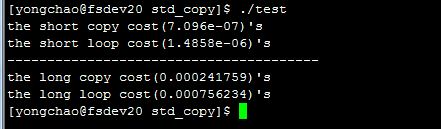
编译命令: g++ -o test main.cpp -lrt
测试结果,跟作者的大相径庭,不知是和原因:
std::copy的使用的更多相关文章
- std::copy性能分析与memmove机器级实现
复制数据的快速方法std::copy C++复制数据各种方法大家都会,很多时候我们都会用到std::copy这个STL函数,这个效率确实很不错,比我们一个一个元素复制或者用迭代器复制都来的要快很多. ...
- 闲:测试memcpy和std::copy vector之间拷贝
预测:底层C函数肯定比stl算法快 结果:少量数据底层快,大数据以上则stl对vector的处理可能更好 C/C++: #include <iostream> #include <v ...
- std::copy 和 std::back_inserter
#define print_vector(v1) \ for(auto iter = v1.begin();iter != v1.end();iter++) \ cout<<*iter&l ...
- std::copy ( myvector.begin(), myvector.end(), out_it )
在实际生产环境中,不能进行调试,所以程序通常需要编译一个DEBUG版本来辅助我们找出问题所在,编译这样的DEBUG版本最常用的手段就是在关键处输出我们关心一些变量的值到屏幕. 如果输出的简单的变量值, ...
- std::copy使用方法
推荐2个c++函数库,类定义的资料库: http://en.cppreference.com/w/cpp/algorithm/copy http://www.cplusplus.com/referen ...
- C++11 std::copy
这个函数并不是简单的 while(first != last) { *result = *first; result++; first++; } 事实上这种写法是最具普适性的,值要求inputIter ...
- How to copy the contents of std::vector to c-style static array,safely?
[问题] I am getting warning when using the std copy function. I have a byte array that I declare. byte ...
- std::vector数据复制
std::vector<boost::shared_ptr <ITEM> > srcItemList; // 数据源 std::vector<ITEM> des ...
- C++ STL copy函数效率分析
在C++编程中,经常会配到数据的拷贝,如数组之间元素的拷贝,一般的人可能都会用for循环逐个元素进行拷贝,在数据量不大的情况下还可以,如果数据量比较大,那么效率会比较地下.而STL中就提供了一个专门用 ...
随机推荐
- eclipse设置快捷键sysout+Alt+/后出System.out.println!亲測可用!
曾经一直用myeclipse,没有这方面的顾虑,如今换到了eclipse,非常多要自己设置了,比方非常多快捷键. 最经常使用的,执行到sysout ,eclipse总是不自己主动补全,非常是恼火!!! ...
- 基于XMPP协议的aSmack源码分析
在研究如何实现Pushing功能期间,收集了很多关于Pushing的资料,其中有一个androidnp开源项目用的人比较多,但是由于长时间没有什么人去维护,听说bug的几率挺多的,为了以后自己的产品稳 ...
- zoj 3672 思考题
http://acm.zju.edu.cn/onlinejudge/showProblem.do? problemId=4915 真是老了.脑子不会动了,可是事实上就算如今搜了题解A了,还是没总结出思 ...
- 回击MLAA:NVIDIA FXAA抗锯齿性能实測、画质对照
PC游戏玩家肯定会对各式各样的AA抗锯齿技术很熟悉,而今天本文的主角就是NVIDIA今年才推出的新型抗锯齿技术"FXAA". FXAA在某种程度上有些类似于AMD之前宣传的MLAA ...
- Java中创建线程的两种方式
创建线程的第一种方式: 创建一个类继承Thread 重写Thread中的run方法 (创建线程是为了执行任务 任务代码必须有存储位置,run方法就是任务代码的存储位置.) 创建子类对象,其实就是在创建 ...
- Java synchronized 总结
在Java开发的时候经常会用到关键字synchronized来对代码进行同步,在使用的过程中,对于synchronized确不是很熟悉,最近在看Spring源码时,发现有不少地方都用到同步,因此,趁此 ...
- .Net设计模式_建造者模式
引言: 建造者的特点是过程,需要建造对象的过程是一样的,如:软件项目,过程都是,POC.投标.立项.软件过程.收款,那么标准的软件项目都是这个过程,只是不同的项目在做这个过程的内容不一样.所以需要有一 ...
- input 的 placeholder属性在IE8下的兼容处理
placeholder是input标签的新属性,在使用的时候有两个问题: 1.IE8 下不兼容 处理思路: 如果浏览器不识别placeholder属性,给input添加类名placeholder,模仿 ...
- MySQL索引视图
一.索引 索引是存放在模式(schema)中的一个数据库对象,索引的作用就是提高对表的检索查询速度, 索引是通过快速访问的方法来进行快速定位数据,从而减少了对磁盘的读写操作. 索引是数据库的一个对象, ...
- Unity3D用vistual studio打卡C#脚本卡死解决
小黑已经跟我3年了,不仅很喜欢他方正酷黑的外表,而且稳定性绝对没的说.我已经3年没有重装过系统了,而且现在装了3个系统!虽然小黑很适合程序员,但是他最大的缺点就是做设计比较吃力,显卡512M.像uni ...