
Mybatis技术原理理——整体流程理解
前言:2018年,是最杂乱的一年!所以你看我的博客,是不是很空!
网上有很多关于Mybatis原理介绍的博文,这里介绍两篇我个人很推荐的博文 Mybatis3.4.x技术内幕和 MyBaits源码分析!让我找到了学习的入口,当然另外你必须要看的官方文档 MyBatis学习。那么有了这些知识,就让我们愉快的吃鸡之路吧!
一:你首先得知道的知识点。
1.1 JDBC
在个人看来, Mybatis的核心就是对SQL语句的管理!那么在JAVA环境下,对SQL的管理或者其他任何的实现,肯定是离不开JAVA的数据库操作接口,包括Connrction接口、Statement接口、PreparadStatement接口以及ResultSet接口等等的属性,你可以先通过JDBC来操作一次或者更多次的数据库。这个就不多做赘述了!
1.2 动态代理
不知道你最初有没有和我一样,有这样的疑问。Mybatis的mapper层明明就是一个接口,都没有实现类!即使是在TMapper.xml中做了映射,也没有看到任何关于接口的实现类,那他是怎么被实例化的呢,又是怎么实现方法的功能的呢?动态代理会告诉你答案!
先来看看jdk动态代理的一个小例子:
建立一个实体
public class TestDemo {

    private Integer id;

    private String name;

    public Integer getId() {

        return id;

    }

    public void setId(Integer id) {

        this.id = id;

    }

    public String getName() {

        return name;

    }

    public void setName(String name) {

        this.name = name;

    }

}
建立一个mapper
public interface TestDemoMapper {

    TestDemo getById(Integer id);

}
建立一个Mapper的代理类,需要继承一个 InvocationHandler 即可
public class DemoMapperProxy<T> implements InvocationHandler {

    @SuppressWarnings("unchecked")

    public T newInstance(Class<T> clz) {

        return (T)Proxy.newProxyInstance(clz.getClassLoader(), new Class[] { clz }, this);

    }

    @Override

    public Object invoke(Object proxy, Method method, Object[] args) throws Throwable {

        TestDemo testDemo = new TestDemo();

        testDemo.setId(1);

        testDemo.setName("proxyName");

        return testDemo;

    }

}
测试类
public static void main(String[] args) {

        DemoMapperProxy<TestDemoMapper> demoMapperProxy = new DemoMapperProxy<TestDemoMapper>();

        TestDemoMapper testDemoMapper = demoMapperProxy.newInstance(TestDemoMapper.class);

        TestDemo byId = testDemoMapper.getById(1);

        System.out.println(byId);

    }
结果:TestDemo{id=1, name='proxyName'},
所以这就应该大致能够说明Mybatis中的mapper是怎么工作的了吧!
二:关于mapper的整体流程理解
2.1 先来看看官方网站的一个例子吧
在官方文档中的 Mybatis 3 的入门介绍中,介绍了怎么配置一个mybatis的测试类
mybatis-config.xml 中的一个简单配置:
<configuration>
<environments default="development">
<environment id="development">
<transactionManager type="JDBC" />
<dataSource type="POOLED">
<property name="driver" value="com.mysql.jdbc.Driver" />
<property name="url" value="jdbc:mysql://172.20.139.237:3306/rubber-fruit?useUnicode=true&characterEncoding=utf-8&autoReconnect=true" />
<property name="username" value="user123" />
<property name="password" value="u123" />
</dataSource>
</environment>
</environments>
<mappers>
<mapper resource="UserMapper.xml" />
</mappers>
</configuration>
然后在写一个测试类:
  public static void main(String[] args) throws Exception {

        String resouse = "mybatis-config.xml";

        InputStream stream = Resources.getResourceAsStream(resouse);

        SqlSessionFactory sqlSessionFactory = new SqlSessionFactoryBuilder().build(stream);

        SqlSession sqlSession = sqlSessionFactory.openSession();

        UserMapper mapper = sqlSession.getMapper(UserMapper.class);

        User byId = mapper.getById(1);

        sqlSession.close();

        System.out.println(byId);

    }
其实这个逻辑很简单,首先是拿到mabatis-config.xml 中的配置对象,生成SqlSessionFactory,然后通过sqlSession拿到mapper,通过动态代理完成方法的执行,并返回结果!那么我们就可以简单的拆分成两个部分,第一:配置文件的初始化,第二:sql的执行,后面的文章也会更具这个大模块来更具细化的讲解
其实上面的第四行代码 可以更换成config对象的,可能看的更清楚一些:
     String resouse = "mybatis-config.xml";

        InputStream stream = Resources.getResourceAsStream(resouse);

        XMLConfigBuilder configBuilder = new XMLConfigBuilder(stream,null,null);

        Configuration parse = configBuilder.parse();

        SqlSessionFactory build = new SqlSessionFactoryBuilder().build(parse);
其实Mybatis的前期初始化的一个重要的对象就是 Configuration对象,后面会慢慢揭开它的面纱!
2.2 整体流程图
通过上面的这个测试方法,我们通过源码流程,大致可以拆分出这样的一个图:
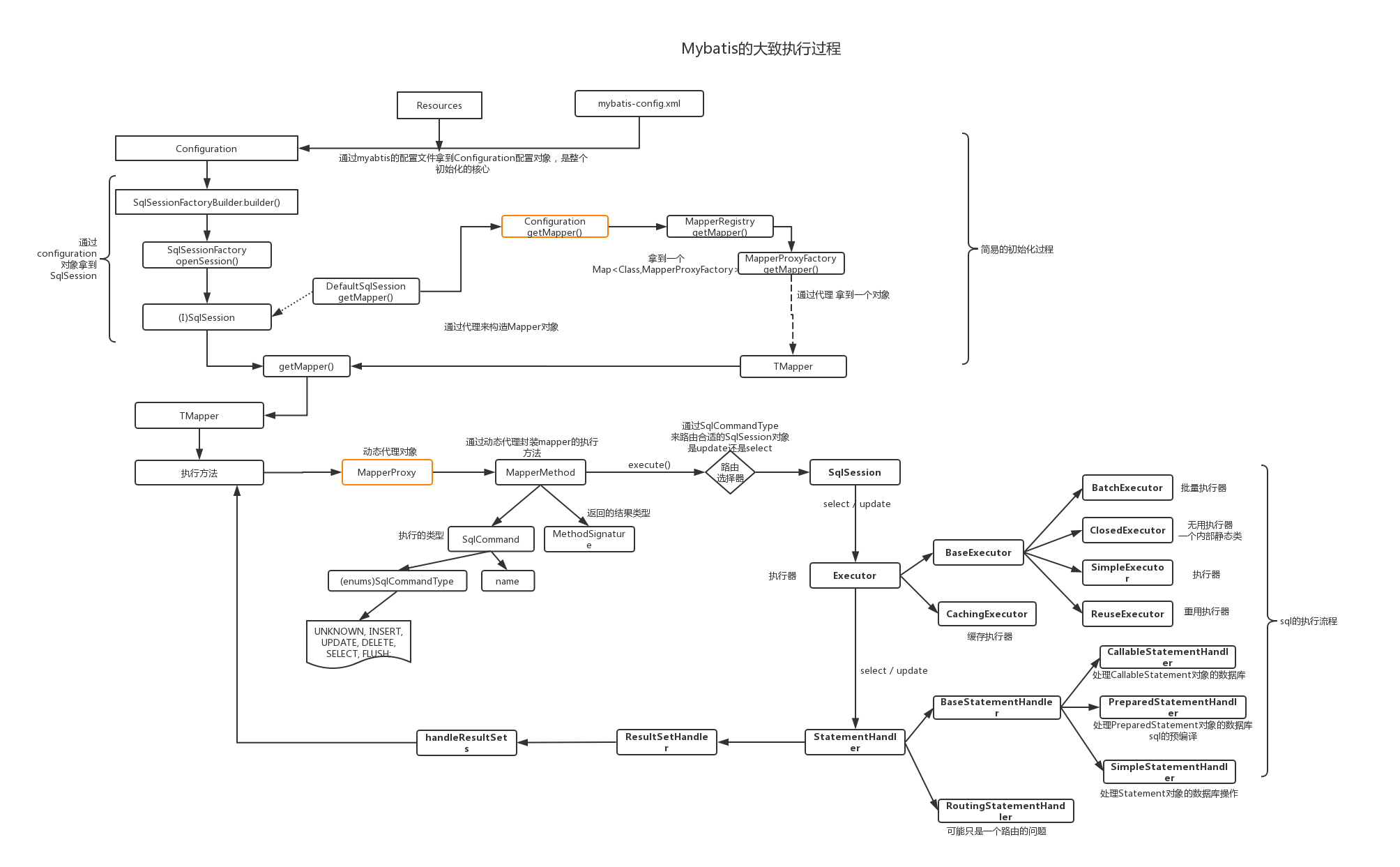 其实从这个图中我们已经可以看出Mybatis划分先两个部分:
1:初始化过程
首先是通过XMLConfigBuilder解析 mybatis-config.xml 对象来进行初始化,拿到Configuration对象,然后SqlSessionFactoryBuilder通过初始化的Configuration对象,生成SqlSession,SqlSession中调用getMapper对象方法,其实也就是Configuration中的getMapper方法 通过MapperProxy代理对象生成一个mapper。到这里位置就是一个简单的初初始化思路了!当然Mybatis的初始化远远不止这些。
2:mybatia中执行一个sql的完整流程
从图中也是能够很较清晰的看出这个执行流程的。因为Mapper是一个接口,所以不能直接实例化的!那么MapperProxy的作用,就是通过JDK的动态代理,来间接的对mapper进行实例化,不了解的可以看上面的1.2中的例子。那么我们可以看看org.apache.ibatis.binding.MapperProxy源码中的对象方法:
@Override

  public Object invoke(Object proxy, Method method, Object[] args) throws Throwable {

    try {

      if (Object.class.equals(method.getDeclaringClass())) {

        return method.invoke(this, args);

      } else if (isDefaultMethod(method)) {

        return invokeDefaultMethod(proxy, method, args);

      }

    } catch (Throwable t) {

      throw ExceptionUtil.unwrapThrowable(t);

    }

    final MapperMethod mapperMethod = cachedMapperMethod(method);

    return mapperMethod.execute(sqlSession, args);

  }
通过代理的对象方法方法,拿到了一个MapperMethod对象,并对mapperMethod对象进行来缓存。为啥要缓存呢?这个时候可以看看MapperMethod对象是什么?org.apache.ibatis.binding.MapperMethod中对两个私有方法
  private final SqlCommand command;

  private final MethodSignature method;

  public MapperMethod(Class<?> mapperInterface, Method method, Configuration config) {

    this.command = new SqlCommand(config, mapperInterface, method);

    this.method = new MethodSignature(config, mapperInterface, method);

  }
MapperMethod中的SqlCommand对象中的两个私有方法,
public static class SqlCommand {

    private final String name;

    private final SqlCommandType type;

}
public enum SqlCommandType {

  UNKNOWN, INSERT, UPDATE, DELETE, SELECT, FLUSH;

}
而MapperMethod中的MethodSignature对象呢?
   private final boolean returnsMany;

    private final boolean returnsMap;

    private final boolean returnsVoid;

    private final boolean returnsCursor;

    private final Class<?> returnType;

    private final String mapKey;

    private final Integer resultHandlerIndex;

    private final Integer rowBoundsIndex;

    private final ParamNameResolver paramNameResolver;
所以这些很清晰了,MapperMethod对象是把mapper中的sql进行了封装,获取了sql的执行类型和返回值。
MapperMethod中的另外一个重要的方法:execute() 则担任这路由的重要任务:
public Object execute(SqlSession sqlSession, Object[] args) {

    Object result;

    switch (command.getType()) {

      case INSERT: {

      Object param = method.convertArgsToSqlCommandParam(args);

        result = rowCountResult(sqlSession.insert(command.getName(), param));

        break;

      }

      case UPDATE: {

        Object param = method.convertArgsToSqlCommandParam(args);

        result = rowCountResult(sqlSession.update(command.getName(), param));

        break;

      }

      case DELETE: {

        Object param = method.convertArgsToSqlCommandParam(args);

        result = rowCountResult(sqlSession.delete(command.getName(), param));

        break;

      }

      case SELECT:

        if (method.returnsVoid() && method.hasResultHandler()) {

          executeWithResultHandler(sqlSession, args);

          result = null;

        } else if (method.returnsMany()) {

          result = executeForMany(sqlSession, args);

        } else if (method.returnsMap()) {

          result = executeForMap(sqlSession, args);

        } else if (method.returnsCursor()) {

          result = executeForCursor(sqlSession, args);

        } else {

          Object param = method.convertArgsToSqlCommandParam(args);

          result = sqlSession.selectOne(command.getName(), param);

        }

        break;

      case FLUSH:

        result = sqlSession.flushStatements();

        break;

      default:

        throw new BindingException("Unknown execution method for: " + command.getName());

    }

    if (result == null && method.getReturnType().isPrimitive() && !method.returnsVoid()) {

      throw new BindingException("Mapper method '" + command.getName()

          + " attempted to return null from a method with a primitive return type (" + method.getReturnType() + ").");

    }

    return result;

  }
通过执行的sql类型 选取不通的sqlSession进行执行。其实可以看出,转了一圈,最后的最后还是落在了SqlSession当中。而SqlSession又把这个重要的操作交个了执行器Executor。最后又到了StatementHandler来负责执行最后的sql,ResultSetHandler放回执行的结果。
2.3 记一个知识点
看到这里,突然是想问一下一个问题的,Mapper的方法是否支持重载呢?
答案是不能的!mybatis是使用package+Mapper+method 全名称作为Key值 去xml中寻找一个唯一sql来执行的那么,重载方法时将导致矛盾。对于Mapper接口,Mybatis禁止方法重载。通过代码断点可以看到。
org.apache.ibatis.session.Configuration对象中有一个方法,addMappedStatement()
protected final Map<String, MappedStatement> mappedStatements = new StrictMap<MappedStatement>("Mapped Statements collection");
/**中间部分省略掉**
public void addMappedStatement(MappedStatement ms) {
    mappedStatements.put(ms.getId(), ms);

  }

而这个地方put的ms.getId 就是通过mapper的配置文件组合成的一个唯一的key值。那我们在看看StrictMap 中的put方法源码,那么就一目了然了
 @SuppressWarnings("unchecked")

    public V put(String key, V value) {

      if (containsKey(key)) {

        throw new IllegalArgumentException(name + " already contains value for " + key);

      }

      if (key.contains(".")) {

        final String shortKey = getShortName(key);

        if (super.get(shortKey) == null) {

          super.put(shortKey, value);

        } else {

          super.put(shortKey, (V) new Ambiguity(shortKey));

        }

      }

      return super.put(key, value);

    }
如果有相同的key的,那么会抛出异常,这也就是为啥mapper不能重载的原因!
Mybatis技术原理理——整体流程理解的更多相关文章
- Mybatis技术内幕(一)——整体架构概览
Mybatis技术内幕(一)--整体架构概览 Mybatis的整体架构分为三层,分别是基础支持层.核心处理层和接口层. 如图所示: 一.基础支持层 基础支持层包含整个Mybatis的基础模块,这些模块 ...
- TAF /tars必修课(一):整体架构理解
来自零点智能社区 一.前言 TAF,一个后台逻辑层的高性能RPC框架,目前支持C++,Java, node 三种语言, 往后可能会考虑提供更多主流语言的支持如 go等,自定义协议JCE,同时也支持HT ...
- 流水线技术原理和Verilog HDL实现(转)
源:流水线技术原理和Verilog HDL实现 所谓流水线处理,如同生产装配线一样,将操作执行工作量分成若干个时间上均衡的操作段,从流水线的起点连续地输入,流水线的各操作段以重叠方式执行.这使得操作执 ...
- (转)linux内存源码分析 - 内存回收(整体流程)
http://www.cnblogs.com/tolimit/p/5435068.html------------linux内存源码分析 - 内存回收(整体流程) 概述 当linux系统内存压力就大时 ...
- MyBatis 源码篇-整体架构
MyBatis 的整体架构分为三层, 分别是基础支持层.核心处理层和接口层,如下图所示. 基础支持层 反射模块 该模块对 Java 原生的反射进行了良好的封装,提供了更加简洁易用的 API ,方便上层 ...
- [原]Jenkins(一)---我理解的jenkins是这样的
/** * lihaibo * 文章内容都是根据自己工作情况实践得出. *版权声明:本博客欢迎转发,但请保留原作者信息! http://www.cnblogs.com/horizonli/p/5330 ...
- 使用git整体流程
一.git提交代码走meger请求的整体流程 工作中使用git推代码时,如果走merge请求,那么也就是说拉代码时拉公共代码库的代码,但是提交时需要先提交到自己的代码库,然后在gitlab上提交mer ...
- iOS开发从申请开发账号到APP上架的整体流程详解
应公司要求,写一份文档从申请账号一直到APP上架的整体流程,下面进入正文. https://blog.csdn.net/qq_35612929/article/details/78754470 首先第 ...
- [原]Jenkins(一)---我理解的jenkins是这样的(附全套PDF下载)
/** * lihaibo * 文章内容都是根据自己工作情况实践得出. *版权声明:本博客欢迎转发,但请保留原作者信息! http://www.cnblogs.com/horizonli/p/5330 ...
随机推荐
- es6 generator函数
es6 新增了Generator函数,一种异步编程的解决方案 回顾一下,es6 提供了新的遍历方法,for of ,适用于各种数据集合,统一了遍历操作,原生支持for of 集合的数据集合有.数组,字 ...
- Source-Based XSS Test Cases
Single Reflection Case 01 - Direct URL Injection (no parameter) payload: https://brutelogic.com.br/x ...
- odoo12 物流 自动计算运费 ,采购销售使用不同计量单位自动换算
在物流和食品生鲜类行业,重量是很重要的因素,不仅要处理产品的数量,也要处理产品的重量.在多数行业,重量也是订单的重要数据. odoo原生包含了对重量的处理,下文中将指导如何优雅应用odoo原生模块处理 ...
- 深圳市共创力推出独家课程《AHB和OSG》高级实务培训课程!
<AHB和OSG>高级实务培训课程大纲 [适合对象]:高层管理者.产品经理.资源经理.各专项经理.研发等部门的负责人和骨干员工. [课程受益]:高层如何对项目的优先级进行排序和资源分配. ...
- EOS开发入门
EOS开发入门 在上一篇文章<EOS开发环境搭建>中,我们已经完成了EOS开发环境的搭建,本次为大家带来的是EOS开发入门的相关内容. 1. EOS的合约开发基础 智能合约是一种旨 ...
- eclipse启动报.log错误
解决办法: windows: D:\Program Files\eclipse\eclipse.ini 在文件末尾添加一行: --add-modules=ALL-SYSTEM
- selenium之表格的定位
浏览器网页常常会包含各类表格,自动化测试工程师可能会经常操作表格中的行,列以及某些特定的单元格,因此熟练掌握表格的定位方法是自动化测试实施过程中必要的技能. 被测试网页的HTML代码 <!DOC ...
- casbin-权限管理
概要 权限管理几乎是每个系统或者服务都会直接或者间接涉及的部分. 权限管理保障了资源(大部分时候就是数据)的安全, 权限管理一般都是和业务强关联, 每当有新的业务或者业务变化时, 不能将精力完全放在业 ...
- [ gczdac ] HDU1000
地址:http://acm.hdu.edu.cn/showproblem.php?pid=1000 Problem Description Calculate A + B. Input Eac ...
- 《Python神经网络编程》的读书笔记
文章提纲 全书总评 读书笔记 C01.神经网络如何工作? C02.使用Python进行DIY C03.开拓思维 附录A.微积分简介 附录B.树莓派 全书总评 书本印刷质量:4星.纸张是米黄色,可以保护 ...