
LWIP学习
转自:https://blog.csdn.net/kzq_qmi/article/details/46900589
数据包pbuf:
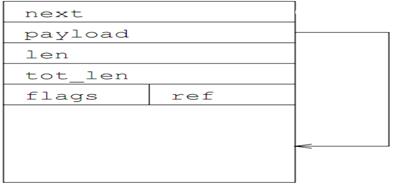
LwIP采用数据结构 pbuf 来描述数据包,其结构如下:
struct pbuf {

  /** next pbuf in singly linked pbuf chain */

  struct pbuf *next;

  /** pointer to the actual data in the buffer */

  void *payload;

  /**

   * total length of this buffer and all next buffers in chain

   * belonging to the same packet.

   *

   * For non-queue packet chains this is the invariant:

   * p->tot_len == p->len + (p->next? p->next->tot_len: 0)

   */

  u16_t tot_len;

  /** length of this buffer */

  u16_t len;

  /** pbuf_type as u8_t instead of enum to save space */

  u8_t /*pbuf_type*/ type;

  /** misc flags */

  u8_t flags;

  /**

   * the reference count always equals the number of pointers

   * that refer to this pbuf. This can be pointers from an application,

   * the stack itself, or pbuf->next pointers from a chain.

   */

  u16_t ref;

};
各成员含义上面的注释已经说得很清楚了。
关于采用链表结构,是因为实际发送或接收的数据包可能很大,而每个 pbuf 能够管理的数据可能很少,所以,往往需要多个 pbuf 结构才能完全描述一个数据包。
另外,最后的 ref 字段表示该 pbuf 被引用的次数。这里又是一个纠结的地方啊。初始化一个 pbuf 的时候, ref 字段值被设置为 1,当有其他 pbuf 的 next 指针指向该 pbuf 时,该 pbuf 的 ref 字段值加一。所以,要删除一个 pbuf 时, ref 的值必须为 1 才能删除成功,否则删除失败。
上图中注意 payload 并没有指向 ref 字段之后,而是隔了一定的区域。这段区域就是offset 的大小,这段区域用来存储数据的包头,如 TCP 包头, IP 包头等。当然, offset 也可以是 0。
来看代码:
/**

 * Allocates a pbuf of the given type (possibly a chain for PBUF_POOL type).

 *

 * The actual memory allocated for the pbuf is determined by the

 * layer at which the pbuf is allocated and the requested size

 * (from the size parameter).

 *

 * @param layer flag to define header size

 * @param length size of the pbuf's payload

 * @param type this parameter decides how and where the pbuf

 * should be allocated as follows:

 *

 * - PBUF_RAM: buffer memory for pbuf is allocated as one large

 *             chunk. This includes protocol headers as well.

 * - PBUF_ROM: no buffer memory is allocated for the pbuf, even for

 *             protocol headers. Additional headers must be prepended

 *             by allocating another pbuf and chain in to the front of

 *             the ROM pbuf. It is assumed that the memory used is really

 *             similar to ROM in that it is immutable and will not be

 *             changed. Memory which is dynamic should generally not

 *             be attached to PBUF_ROM pbufs. Use PBUF_REF instead.

 * - PBUF_REF: no buffer memory is allocated for the pbuf, even for

 *             protocol headers. It is assumed that the pbuf is only

 *             being used in a single thread. If the pbuf gets queued,

 *             then pbuf_take should be called to copy the buffer.

 * - PBUF_POOL: the pbuf is allocated as a pbuf chain, with pbufs from

 *              the pbuf pool that is allocated during pbuf_init().

 *

 * @return the allocated pbuf. If multiple pbufs where allocated, this

 * is the first pbuf of a pbuf chain.

 */

struct pbuf *

pbuf_alloc(pbuf_layer layer, u16_t length, pbuf_type type)

{

  struct pbuf *p, *q, *r;

  u16_t offset;

  s32_t rem_len; /* remaining length */

  LWIP_DEBUGF(PBUF_DEBUG | LWIP_DBG_TRACE, ("pbuf_alloc(length=%"U16_F")\n", length));

  /* determine header offset */

  offset = 0;

  switch (layer) { //注意这里从协议栈上层开始,方便offset从上层往下叠加,因此也没加 break

  case PBUF_TRANSPORT:

    /* add room for transport (often TCP) layer header */

    offset += PBUF_TRANSPORT_HLEN;

    /* FALLTHROUGH */

  case PBUF_IP:

    /* add room for IP layer header */

    offset += PBUF_IP_HLEN;

    /* FALLTHROUGH */

  case PBUF_LINK:

    /* add room for link layer header */

    offset += PBUF_LINK_HLEN;

    break;

  case PBUF_RAW:

    break;

  default:

    LWIP_ASSERT("pbuf_alloc: bad pbuf layer", 0);

    return NULL;

  }

  switch (type) {

  case PBUF_POOL:

    /* allocate head of pbuf chain into p */

    p = (struct pbuf *)memp_malloc(MEMP_PBUF_POOL); //分配第一个pbuf

    if (p == NULL) {

      return NULL;

    }

    p->type = type;

    p->next = NULL;

    /* make the payload pointer point 'offset' bytes into pbuf data memory */

    p->payload = LWIP_MEM_ALIGN((void *)((u8_t *)p + (SIZEOF_STRUCT_PBUF + offset)));

    /* the total length of the pbuf chain is the requested size */

    p->tot_len = length; //该pbuf及其以后pbuf的负载数据总长度

    /* set the length of the first pbuf in the chain */

    p->len = LWIP_MIN(length, PBUF_POOL_BUFSIZE_ALIGNED - LWIP_MEM_ALIGN_SIZE(offset)); //负载数据可能大于分配空间长度,也有可能小于,取当前pbuf实际的负载长度

    /* set reference count (needed here in case we fail) */

    p->ref = 1;

    /* now allocate the tail of the pbuf chain */

    //如果一个pbuf不够的话,接着分配

    /* remember first pbuf for linkage in next iteration */

    r = p;

    /* remaining length to be allocated */

    rem_len = length - p->len;

    /* any remaining pbufs to be allocated? */

    while (rem_len > 0) {

      q = (struct pbuf *)memp_malloc(MEMP_PBUF_POOL); //从第二个pbuf开始,不再需要TCP/IP之类的头,所以没有offset

      if (q == NULL) {

        /* free chain so far allocated */

        pbuf_free(p);     //注意这里,如果当前pbuf分配不成功,要把之前分配的所有pbuf都释放掉

        /* bail out unsuccesfully */

        return NULL;

      }

      q->type = type;

      q->flags = 0;

      q->next = NULL;

      /* make previous pbuf point to this pbuf */

      r->next = q;

      /* set total length of this pbuf and next in chain */

      q->tot_len = (u16_t)rem_len;

      /* this pbuf length is pool size, unless smaller sized tail */

      q->len = LWIP_MIN((u16_t)rem_len, PBUF_POOL_BUFSIZE_ALIGNED);

      q->payload = (void *)((u8_t *)q + SIZEOF_STRUCT_PBUF);

      q->ref = 1;

      /* calculate remaining length to be allocated */

      rem_len -= q->len;

      /* remember this pbuf for linkage in next iteration */

      r = q;

    }

    /* end of chain */

    /*r->next = NULL;*/

    break;

  case PBUF_RAM:

    /* If pbuf is to be allocated in RAM, allocate memory for it. */

    p = (struct pbuf*)mem_malloc(LWIP_MEM_ALIGN_SIZE(SIZEOF_STRUCT_PBUF + offset) + LWIP_MEM_ALIGN_SIZE(length));

    if (p == NULL) {

      return NULL;

    }

    /* Set up internal structure of the pbuf. */

    p->payload = LWIP_MEM_ALIGN((void *)((u8_t *)p + SIZEOF_STRUCT_PBUF + offset));

    p->len = p->tot_len = length;

    p->next = NULL;

    p->type = type;

    break;

  /* pbuf references existing (non-volatile static constant) ROM payload? */

  case PBUF_ROM:

  /* pbuf references existing (externally allocated) RAM payload? */

  case PBUF_REF:

    /* only allocate memory for the pbuf structure */

    p = (struct pbuf *)memp_malloc(MEMP_PBUF);

    if (p == NULL) {

      return NULL;

    }

    /* caller must set this field properly, afterwards */

    p->payload = NULL;

    p->len = p->tot_len = length;

    p->next = NULL;

    p->type = type;

    break;

  default:

    return NULL;

  }

  /* set reference count */

  p->ref = 1;

  /* set flags */

  p->flags = 0;

  return p;

}

/**

 * Dereference a pbuf chain or queue and deallocate any no-longer-used

 * pbufs at the head of this chain or queue.

 *

 * Decrements the pbuf reference count. If it reaches zero, the pbuf is

 * deallocated.

 *

 * For a pbuf chain, this is repeated for each pbuf in the chain,

 * up to the first pbuf which has a non-zero reference count after

 * decrementing. So, when all reference counts are one, the whole

 * chain is free'd.

 *

 * @param p The pbuf (chain) to be dereferenced.

 *

 * @return the number of pbufs that were de-allocated

 * from the head of the chain.

 *

 * @note MUST NOT be called on a packet queue (Not verified to work yet).

 * @note the reference counter of a pbuf equals the number of pointers

 * that refer to the pbuf (or into the pbuf).

 *

 * @internal examples:

 *

 * Assuming existing chains a->b->c with the following reference

 * counts, calling pbuf_free(a) results in:

 *

 * 1->2->3 becomes ...1->3

 * 3->3->3 becomes 2->3->3

 * 1->1->2 becomes ......1

 * 2->1->1 becomes 1->1->1

 * 1->1->1 becomes .......

 *

 */

u8_t

pbuf_free(struct pbuf *p)

{

  u16_t type;

  struct pbuf *q;

  u8_t count;

  if (p == NULL) {

    return 0;

  }

  count = 0;

  /* de-allocate all consecutive pbufs from the head of the chain that

   * obtain a zero reference count after decrementing*/

  while (p != NULL) {

    u16_t ref;

    SYS_ARCH_DECL_PROTECT(old_level); //申请临界变量保护

    /* Since decrementing ref cannot be guaranteed to be a single machine operation

     * we must protect it. We put the new ref into a local variable to prevent

     * further protection. */

    SYS_ARCH_PROTECT(old_level);   //进入临界区

    /* all pbufs in a chain are referenced at least once */

    LWIP_ASSERT("pbuf_free: p->ref > 0", p->ref > 0);

    /* decrease reference count (number of pointers to pbuf) */

    ref = --(p->ref);

    SYS_ARCH_UNPROTECT(old_level); //退出临界区

    /* this pbuf is no longer referenced to? */

    if (ref == 0) {

      /* remember next pbuf in chain for next iteration */

      q = p->next;

      type = p->type;

      /* is this a pbuf from the pool? */

      if (type == PBUF_POOL) {

        memp_free(MEMP_PBUF_POOL, p);

      /* is this a ROM or RAM referencing pbuf? */

      } else if (type == PBUF_ROM || type == PBUF_REF) {

        memp_free(MEMP_PBUF, p);

      /* type == PBUF_RAM */

      } else {

        mem_free(p);

      }

      count++;

      /* proceed to next pbuf */

      p = q;

    /* p->ref > 0, this pbuf is still referenced to */

    /* (and so the remaining pbufs in chain as well) */

    } else {

      /* stop walking through the chain */

      p = NULL;

    }

  }

  /* return number of de-allocated pbufs */

  return count;

}

/**

 *

 * Create PBUF_RAM copies of pbufs.

 *

 * Used to queue packets on behalf of the lwIP stack, such as

 * ARP based queueing.

 *

 * @note You MUST explicitly use p = pbuf_take(p);

 *

 * @note Only one packet is copied, no packet queue!

 *

 * @param p_to pbuf destination of the copy

 * @param p_from pbuf source of the copy

 *

 * @return ERR_OK if pbuf was copied

 *         ERR_ARG if one of the pbufs is NULL or p_to is not big

 *                 enough to hold p_from

 */

err_t

pbuf_copy(struct pbuf *p_to, struct pbuf *p_from)

{

  u16_t offset_to=0, offset_from=0, len;

  /* is the target big enough to hold the source? */

  LWIP_ERROR("pbuf_copy: target not big enough to hold source", ((p_to != NULL) &&

             (p_from != NULL) && (p_to->tot_len >= p_from->tot_len)), return ERR_ARG;);

  /* iterate through pbuf chain */

  do

  {

    LWIP_ASSERT("p_to != NULL", p_to != NULL);

    /* copy one part of the original chain */

    if ((p_to->len - offset_to) >= (p_from->len - offset_from)) { //每次拷贝的长度是源端和目标端当前pbuf所剩空间的较小值,offset为当前pbuf拷贝数据的偏移量

      /* complete current p_from fits into current p_to */

      len = p_from->len - offset_from;

    } else {

      /* current p_from does not fit into current p_to */

      len = p_to->len - offset_to;

    }

    MEMCPY((u8_t*)p_to->payload + offset_to, (u8_t*)p_from->payload + offset_from, len);

    offset_to += len;

    offset_from += len;

    if (offset_to == p_to->len) { //目标端当前pbuf空间已满,转向下一个pbuf,记得offset清零

      /* on to next p_to (if any) */

      offset_to = 0;

      p_to = p_to->next;

    }

    if (offset_from >= p_from->len) { //源端当前pbuf数据已拷贝完,转向下一个pbuf,记得offset清零

      /* on to next p_from (if any) */

      offset_from = 0;

      p_from = p_from->next;

    }

    if((p_from != NULL) && (p_from->len == p_from->tot_len)) {

      /* don't copy more than one packet! */

      LWIP_ERROR("pbuf_copy() does not allow packet queues!\n",

                 (p_from->next == NULL), return ERR_VAL;);

    }

    if((p_to != NULL) && (p_to->len == p_to->tot_len)) {

      /* don't copy more than one packet! */

      LWIP_ERROR("pbuf_copy() does not allow packet queues!\n",

                  (p_to->next == NULL), return ERR_VAL;);

    }

  } while (p_from);

  LWIP_DEBUGF(PBUF_DEBUG | LWIP_DBG_TRACE, ("pbuf_copy: end of chain reached.\n"));

  return ERR_OK;

}
可以看到,回收 pbuf 使用pbuf_free()函数,该函数首先要减少 pbuf 索引计数(reference count)。如果引用计数已经减为 0,这个 pbuf 被回收。对于一个pbuf链来说,只有前一个pbuf被回收,才会考虑回收后面的pbuf,如果前面pbuf计数还不为0,则直接返回。
LWIP学习的更多相关文章
- 内存管理pbuf.c源码解析——LwIP学习
声明:个人所写所有博客均为自己在学习中的记录与感想,或为在学习中总结他人学习成果,但因本人才疏学浅,如果大家在阅读过程中发现错误,欢迎大家指正. 本文自己尚有认为写的不完整的地方,源代码没有完全理清, ...
- 内存管理pbuf.h头文件源码解析——LwIP学习
声明:个人所写所有博客均为自己在学习中的记录与感想,或为在学习中总结他人学习成果,但因本人才疏学浅,如果大家在阅读过程中发现错误,欢迎大家指正. LwIP的内核(core文件夹)文件中pbuf.c是包 ...
- LwIP学习笔记——STM32 ENC28J60移植与入门
0.前言 去年(2013年)的整理了LwIP相关代码,并在STM32上"裸奔"成功.一直没有时间深入整理,在这里借博文整理总结.LwIP的移植过程细节很多,博文也不可能一一 ...
- LWIP学习之一些细节
一 绑定端口后,开启监听,为何监听还要返回一个新的连接?:监听状态的连接只需要很小的内存,于是tcp_listen()就会收回原始连接的内存,而重新分配一个较小内存块供处于监听状态的连接使用. 二 t ...
- LWIP学习之流程架构
一 STM32F107的网络接口配置:#include "stm32_eth.h" 1.1 打开网口时钟,响应IO配置.NVIC中断:通过调用Ethernet_Configurat ...
- TCP/IP协议学习(二) LWIP用户自定义配置文件解析
LWIP协议支持用户配置,可以通过用户裁剪实现最优化配置,LWIP默认包含opts.h作为系统默认配置,不过通过添加lwipopts.h文件并包含在opts.h头文件之前就可以对lwip进行用户裁剪, ...
- TCP/IP协议学习(一) LWIP实现网络远程IAP下载更新
最近需要实现通过TCP/IP远程IAP在线更新功能,忙了2周终于在原有嵌入式服务器的基础上实现了该功能,这里就记录下实现的过程. IAP又称在应用编程,其实说简单点就是实现不需要jlink,仅通过芯片 ...
- lwip协议栈学习---udp
书籍:<嵌入式网络那些事-lwip协议> udp协议的优点: 1)基于IP协议,无连接的用户数据报协议,适用于传送大批量数据, 2)实时性比较高,适用于嵌入式网络 发送函数:udp_sen ...
- LwIP的SNMP学习笔记
关于这方面的资料网上非常少,做一下笔记. 在LwIP中,在\lwip-1.4.1\src\core\snmp目录下有SNMP相关的c文件,在lwip-1.4.1\src\include\lwip目录下 ...
随机推荐
- C++笔记(1)
C++笔记1文件与流笔记 参考博客: https://blog.csdn.net/kingstar158/article/details/6859379 关闭文件中: 当文件读写操作完成之 ...
- 使用pageoffice进行多个文档的合并
提前给test模板文件中 手动插入一个书签,因为pageoffice必须有一个书签后,才能在后台进行书签的创建 //多个word文件进行合并 string strCopyFolder = System ...
- npm i 出错
npm i npm ERR! code ECONNRESET npm ERR! errno ECONNRESET npm ERR! network request to https://registr ...
- dll文件32位64位检测工具以及Windows文件夹SysWow64的坑【转发】
原文地址:http://www.cnblogs.com/hbccdf/archive/2014/03/09/3590916.html 自从操作系统升级到64位以后,就要不断的需要面对32位.64位的问 ...
- C++Primer第五版——习题答案详解(四)
习题答案目录:https://www.cnblogs.com/Mered1th/p/10485695.html 第5章 语句 练习5.9 #include<iostream> #inclu ...
- Linux报错:bash: pip: command not found
$ wget https://bootstrap.pypa.io/get-pip.py$ python get-pip.py$ pip -V #查看pip版本 接下来就可以随便pip安装东西了
- html/css/js-横向滚动条的实现
在前端UI设计时,网页的制作很麻烦,深有感悟!碰到太多的不懂,或是第一次见,就要去网上找资料!横向滚动条就是我遇到麻烦中其中的一个,其实也 很简单,只是在几次项目中都用到了这个横向滚动条所以就拿出来说 ...
- vue+窗格切换+田字+dicom显示_03
环境:vue+webpack+cornerstone ide:vs code 需求:窗格设置+拼图设置 代码: 主体:printPage.vue <div class="div mid ...
- JAVA方法参数传递
package demo.methodparamDemo; public class MethodParamsDemo { public static void main(String[] args) ...
- py库: GUI(tkinter)
图形用户界面(Graphical User Interface,简称 GUI) http://www.runoob.com/python/python-gui-tkinter.html Python ...