
HUAWEI SECURITY 2023 山东大学专场 WP
Crypto
by Smera1d0
1.ezrsa
题干如下:
from Crypto.Util.number import getPrime

from secret import flag

p = getPrime(512)

print(p,pow(flag, 2, p))
给出了\(p\)和\({flag}^2modp\)
即我们需要解一个已知\(n\)和\(p\),求解\(x^2=n(modp)\)中\(x\)的值
上网查阅发现\(Tonelli \ Shanks\)算法可以求解模意义下的平方根
from Crypto.Util.number import getPrime

from Crypto.Util.number import long_to_bytes

# from secret import flag

#

# p = getPrime(512)

# print(p,pow(flag, 2, p))

import gmpy2

import math

# 4124820799737107236308837008524397355107786950414769996181324333556950154206980059406402767327725312238673053581148641438494212320157665395208337575556385 13107939563507459774616204141253747489232063336204173944123263284507604328885680072478669016969428366667381358004059204207134817952620014738665450753147857

c=4124820799737107236308837008524397355107786950414769996181324333556950154206980059406402767327725312238673053581148641438494212320157665395208337575556385

p=13107939563507459774616204141253747489232063336204173944123263284507604328885680072478669016969428366667381358004059204207134817952620014738665450753147857

from Crypto.Util.number import *

def Legendre(n, p):

    return pow(n, (p - 1) // 2, p)

def Tonelli_Shanks(n, p):

    assert Legendre(n, p) == 1

    if p % 4 == 3:

        return pow(n, (p + 1) // 4, p)

    q = p - 1

    s = 0

    while q % 2 == 0:

        q = q // 2

        s += 1

    for z in range(2, p):

        if Legendre(z, p) == p - 1:

            c = pow(z, q, p)

            break

    r = pow(n, (q + 1) // 2, p)

    t = pow(n, q, p)

    m = s

    if t % p == 1:

        return r

    else:

        i = 0

        while t % p != 1:

            temp = pow(t, 2 ** (i + 1), p)

            i += 1

            if temp % p == 1:

                b = pow(c, 2 ** (m - i - 1), p)

                r = r * b % p

                c = b * b % p

                t = t * c % p

                m = i

                i = 0

        return r

result = Tonelli_Shanks(c, p)

print(result)

print(long_to_bytes(-result%p))
解出来方程的两根分别为result和(-result)%p
long_to_bytes(-result%p)得到flag:flag{9971e255f0c020e8e57fbae75f43d7fb}
2.hdRsa
在github上查阅到一道极为相似的题目idekctf2021/crypto/DestroyedRSA
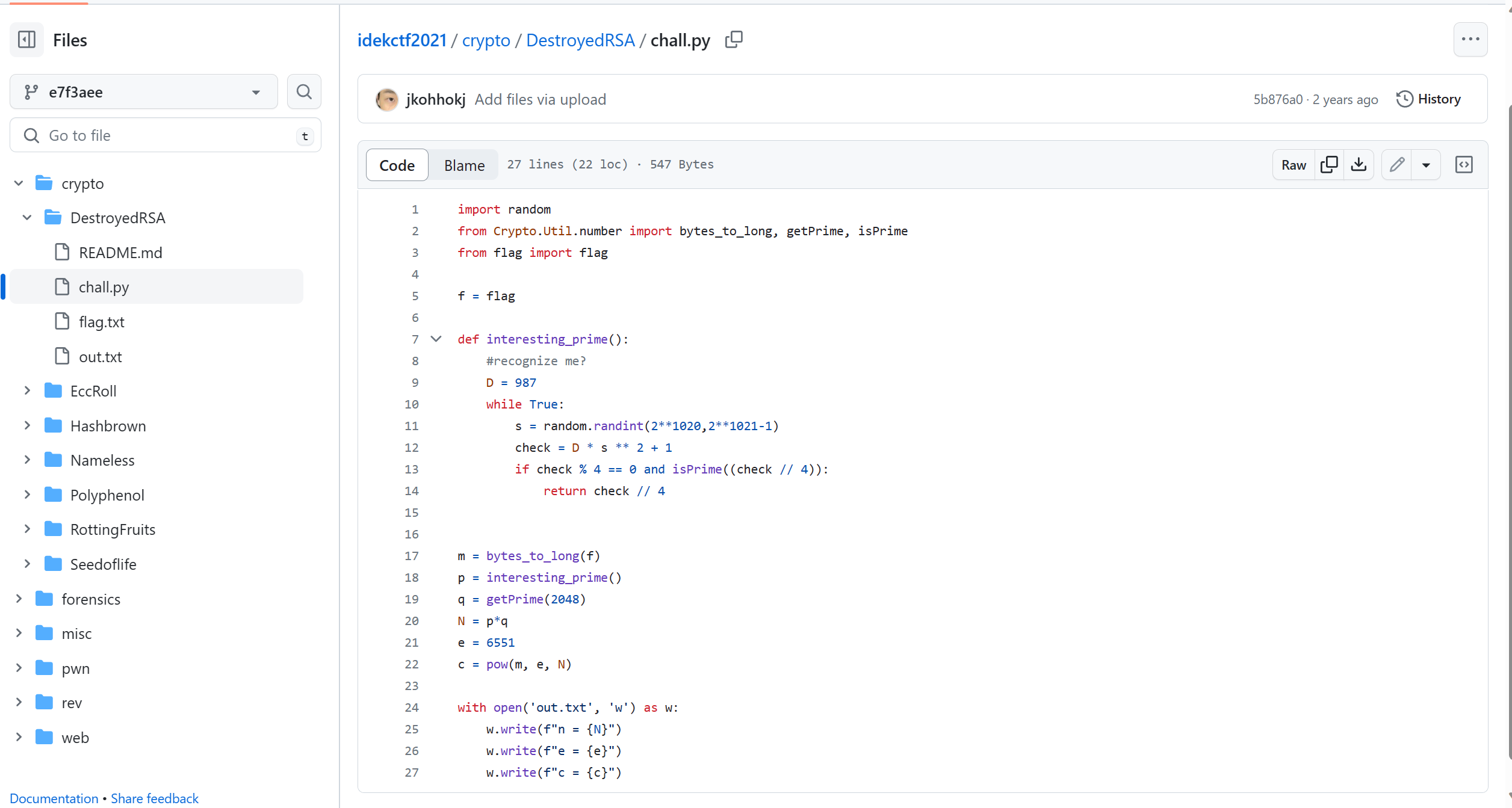
查阅到了这道题的题解 https://angmar2722.github.io/CTFwriteups/2021/idek2021/#destroyed-rsa
此题D是从列表a里选取的,于是我们修改一下脚本
from sage.all import *

from math import gcd

import sys

from Crypto.Util.number import *

from tqdm import tqdm

sys.setrecursionlimit(100000)

def polynomial_xgcd(a, b):

    """

    Computes the extended GCD of two polynomials using Euclid's algorithm.

    :param a: the first polynomial

    :param b: the second polynomial

    :return: a tuple containing r, s, and t

    """

    assert a.base_ring() == b.base_ring()

    r_prev, r = a, b

    s_prev, s = 1, 0

    t_prev, t = 0, 1

    while r:

        try:

            q = r_prev // r

            r_prev, r = r, r_prev - q * r

            s_prev, s = s, s_prev - q * s

            t_prev, t = t, t_prev - q * t

        except RuntimeError:

            raise ArithmeticError("r is not invertible", r)

    return r_prev, s_prev, t_prev

def polynomial_inverse(p, m):

    """

    Computes the inverse of a polynomial modulo a polynomial using the extended GCD.

    :param p: the polynomial

    :param m: the polynomial modulus

    :return: the inverse of p modulo m

    """

    g, s, t = polynomial_xgcd(p, m)

    return s * g.lc() ** -1

def factorize(N, D):

    """

    Recovers the prime factors from a modulus using Cheng's elliptic curve complex multiplication method.

    More information: Sedlacek V. et al., "I want to break square-free: The 4p - 1 factorization method and its RSA backdoor viability"

    :param N: the modulus

    :param D: the discriminant to use to generate the Hilbert polynomial

    :return: a tuple containing the prime factors

    """

    assert D % 8 == 3, "D should be square-free"

    zmodn = Zmod(N)

    pr = zmodn["x"]

    H = pr(hilbert_class_polynomial(-D))

    Q = pr.quotient(H)

    j = Q.gen()

    try:

        k = j * polynomial_inverse((1728 - j).lift(), H)

    except ArithmeticError as err:

        # If some polynomial was not invertible during XGCD calculation, we can factor n.

        p = gcd(int(err.args[1].lc()), N)

        return int(p), int(N // p)

    E = EllipticCurve(Q, [3 * k, 2 * k])

    while True:

        x = zmodn.random_element()

        #print(f"Calculating division polynomial of Q{x}...")

        z = E.division_polynomial(N, x=Q(x))

        try:

            d, _, _ = polynomial_xgcd(z.lift(), H)

        except ArithmeticError as err:

            # If some polynomial was not invertible during XGCD calculation, we can factor n.

            p = gcd(int(err.args[1].lc()), N)

            return int(p), int(N // p)

        p = gcd(int(d), N)

        if 1 < p < N:

            return int(p), int(N // p)

n = 330961752887996173328854935965112588884403584531022561119743740650364958220684640754584393850796812833007843940336784599719224428969119533284286424077547165101460469847980799370419655082069179038497637761333327079374599506574723892143817226751806802676013225188467403274658211563655876500997296917421904614128056847977798146855336939306463059440416150493262973269431000762285579221126342017624118238829230679953011897314722801993750454924627074264353692060002758521401544361385231354313981836056855582929670811259113019012970540824951139489146393182532414878214182086999298397377845534568556100933934481180701997394558264969597606662342898026915506749002491326250792107348176681795942799954526068501499100232598658650184565873243525176833451664254917655703178472944744658628534195346977023418550761620254528178516972066618936960223660362493931786389085393392950207048675797593816271435700130995225483316625836104802608163745376633884840588575355936746173068655319645572100149515524131883813773486917122153248495022372690912572541775943614626733948206252900473118240712831444072243770979419529210034883903111038448366933374841531126421441232024514486168742686297481063089161977054825621099768659097509939405315056325336120929492838479309609958696957890570295444494277819063443427972643459784894450787015151715676537385237767990406742547664321563688829289809321534752244260529319454316532580416182438749849923354060125229328043961355894086576238519138868298499249023773237770103057707912709725417033309061308880583988666463892828633292839968866953776989722310954204550783825704710017434214644199415756584929214239679433211393230307782953067246529626136446314941258877439356094775337541321331600788042698664632064112896956898222397445497695982546922871549828242938368486774617350420790711093069910914135319635330786253331223459637232106417577225350441291

e = 65537

c = 187275367513186345104534865239994699892170904489725413330767115192172530253625393062151741036312498277557971553595091826062438445856091864605758318579599363539202154625683947568962358702545878760994434813222953503460910447662183200334960821110618746899798165363389255347363192576250804362413854445821046755759458439443253294822553986237695607000569717855942461517564526611106601774100617668231506539201297550376834067118784548951699927659889815770492684106287801610261026674778509245649501695344652216367741171392139049785280654043804502329999760613658697298671602787929199239524617160567336634126185042907593427921016129734757065504417112269027028799047579450965076835882020261162192475637278445255805339324893626400179818784574957669576516363342104273184813708475202313539634027764340858242764934872804570810575764191987921655276520658100755510986290562980055133376750812535713567917823663134974180449002466833109112866681229626239871954125027501071383217816313440079294139254989413050731511516498127225020975071747314764552267845933494600295296885808466296844091612401062566502515356974852161817112538289440970059783116540091633055220150093646069438113246518726017868258339512247175386052684861670431148484455765445960495130308147156436998327553854387741014177421559585683382003377803158283603889312107837885491964835073892174406797445622388505256985237867456926792546588756970045576002345376035346727906264683596628903417932566383221754976804148878057310066885140776352202510584461556988179369177560403923399529842871087532495739921906849249072433614545319458973155343802539527630971239359995893495205324483418191744545506744253222956232506980824457995662900264427265978239540089825733734306363153471606200228841997928021468359645661221933848545854596097640552489404777927679709089475954033350287287833943519423030861868256961619722983499902810335

a = [427,403,267,235,187,123,115,91,35,51]

for D in a:

    p, q = factorize(n, D)

    assert p*q == n

    def roots_of_unity(e, phi, n, rounds=250):

        # Divide common factors of `phi` and `e` until they're coprime.

        phi_coprime = phi

        while gcd(phi_coprime, e) != 1:

            phi_coprime //= gcd(phi_coprime, e)

        # Don't know how many roots of unity there are, so just try and collect a bunch

        roots = set(pow(i, phi_coprime, n) for i in range(1, rounds))

        assert all(pow(root, e, n) == 1 for root in roots)

        return roots, phi_coprime

    # n is prime

    # Problem: e and phi are not coprime - d does not exist

    phi = (p - 1) * (q-1)

    # Find e'th roots of unity modulo n

    roots, phi_coprime = roots_of_unity(e, phi, n)

    # Use our `phi_coprime` to get one possible plaintext

    d = inverse_mod(e, phi_coprime)

    pt = pow(c, d, n)

    assert pow(pt, e, n) == c

    # Use the roots of unity to get all other possible plaintexts

    pts = [(pt * root) % n for root in roots]

    pts = [long_to_bytes(pt) for pt in pts]

    for pt in pts:

        if b'flag' in pt:

            print(pt)
用sagemath跑一下,得到:
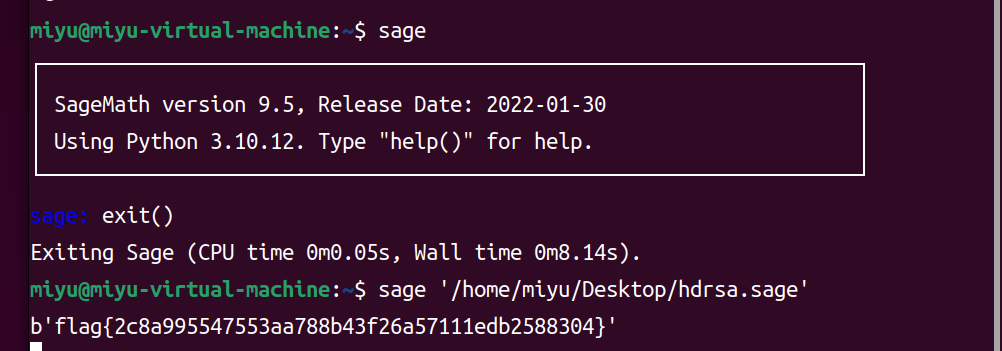
后来欧阳学长说这个分解来自一篇论文 https://www.researchgate.net/publication/335162606_I_Want_to_Break_Square-free_The_4p_-_1_Factorization_Method_and_Its_RSA_Backdoor_Viability
HUAWEI SECURITY 2023 山东大学专场 WP的更多相关文章
- sed用法——在指定行后面添加内容
文档内容如下: # cat 123.txt linuxciscohuaweinetworksystem 1. 使用sed命令在cisco行下面添加CCIE: # sed -i "/cisco ...
- ICSFUZZ:操纵I/O、二进制代码重用以及插桩,来Fuzzing工业控制应用程序
本文系原创,转载请说明出处 Please Subscribe Wechat Official Account:信安科研人,获取更多的原创安全资讯 源码:GitHub - momalab/ICSFu ...
- 2023云数据库技术沙龙MySQL x ClickHouse专场成功举办
4月22日,2023首届云数据库技术沙龙 MySQL x ClickHouse 专场,在杭州市海智中心成功举办.本次沙龙由玖章算术.菜根发展.良仓太炎共创联合主办.围绕"技术进化,让数据更智 ...
- 华为 huawei 查看系统中存在的安全风险信息 display security risk
查看系统中存在的安全风险信息. 应用场景 由于协议自身的安全性能不同,用户配置时使用的某些协议可能存在安全风险.通过该命令可查看系统中存在的安全风险,并根据给出的修复建议解除风险.例如,用户配置了SN ...
- HGAME 2023 WP week1
WEEK1 web Classic Childhood Game 一眼顶真,直接翻js文件,在Events.js中找到mota(),猜测是获取flag,var a = ['\x59\x55\x64\x ...
- 【WP开发】加密篇:双向加密
说起双向加密,如果以前在.NET开发中弄过加/解密的朋友都不会陌生,常用的算法有DES.AES等.在RT应用程序中,也提供了加密相关的API,算法自然是一样的,只是API的封装方式不同罢了,因为RT不 ...
- Android Security
Android Security¶ 确认签名¶ Debug签名: $ jarsigner -verify -certs -verbose bin/TemplateGem.apk sm 2525 Sun ...
- SpringMVC 3.2集成Spring Security 3.2
参考:http://www.cnblogs.com/Beyond-bit/p/springmvc_and_springsecurity.html SpringMVC 3.2集成Spring Secur ...
- Java Spring Boot VS .NetCore (九) Spring Security vs .NetCore Security
Java Spring Boot VS .NetCore (一)来一个简单的 Hello World Java Spring Boot VS .NetCore (二)实现一个过滤器Filter Jav ...
- 分享:五个非常有用的WP插件
一全老师(www.yiquanseo.com)认为非常有用的几款WP插件,用WordPress做站的可以看下,估计你很可能用得到! 第一款WooCommerce Page Builder: 这款插件是 ...
随机推荐
- CSS – background and styling img
前言 之前写过一些: W3Schools 学习笔记 (2) – CSS Image Sprites W3Schools 学习笔记 (3) – CSS Styling Images & CSS ...
- CSS – Aspect Ratio
参考: Youtube – Chrome 88 adds aspect-ratio and 2 awesome new devtool features! MDN – aspect-ratio W3S ...
- Asp.net core 学习笔记 ( 小东西 )
简单的为 url 添加 query var parametersToAdd = new System.Collections.Generic.Dictionary<string, string& ...
- MyBatisPlus——DQL编程控制——条件查询
DQL编程控制 条件查询--设置查询条件 格式一:常规格式 //方式一:按条件查询 QueryWrapper qw = new QueryWrapper(); // 10岁到30岁之间的用户 qw.g ...
- QT数据可视化框架编程实战之三维柱状图_补天云QT技术培训专家
QT数据可视化框架编程实战之三维柱状图_补天云QT技术培训专家 文章目录 QT数据可视化框架编程实战:三维柱状图可视化运行效果 主程序实现C++代码 主场景 QML代码 坐标轴QML代码 数据模型定义 ...
- LinerProgression
手动实现线性回归 点击查看代码 import torch import pandas as pd import numpy as np import matplotlib.pyplot as plt ...
- HeaderFile (1.2-1.6) 中 hct.h 使用教程
下载 HeaderFile 1.2 HCT 是干什么的 辅助数据生成 主干框架 你需要包含必须的头文件 hct.h 此外,你需要实现如下函数: void create() 数据生成函数 void so ...
- [Tkey] A decorative fence
还是看看简单而富有美感的爆搜吧 #include<bits/stdc++.h> using namespace std; #define int long long #define tes ...
- 《Vue.js 设计与实现》读书笔记 - 第5章、非原始值的响应式方案
第5章.非原始值的响应式方案 5.1 理解 Proxy 和 Reflect Proxy Proxy 只能代理对象,不能代理非对象原始值,比如字符串. Proxy 会拦截对对象的基本语义,并重新定义对象 ...
- 使用BPF之前和之后生成直方图过程的对比
以bitehist为例: 使用BPF之前: 1.在内核中:开启磁盘IO事件的插桩观测. 2.在内核中,针对每个事件:向perf缓冲区写入一条记录.如果使用了跟踪点技术(推荐方式),记录中会包含关于磁盘 ...