
Emergency Evacuation 题解
The Japanese government plans to increase the number of inbound tourists to forty million in the year 2020, and sixty million in 2030. Not only increasing touristic appeal but also developing
tourism infrastructure further is indispensable to accomplish such numbers.
One possible enhancement on transport is providing cars extremely long and/or wide, carrying many passengers at a time. Too large a car, however, may require too long to evacuate all
passengers in an emergency. You are requested to help estimating the time required.
The car is assumed to have the following seat arrangement.
- A center aisle goes straight through the car, directly connecting to the emergency exit
door at the rear center of the car. - The rows of the same number of passenger seats are on both sides of the aisle.
A rough estimation requested is based on a simple step-wise model. All passengers are initially
on a distinct seat, and they can make one of the following moves in each step. - Passengers on a seat can move to an adjacent seat toward the aisle. Passengers on a seat
adjacent to the aisle can move sideways directly to the aisle. - Passengers on the aisle can move backward by one row of seats. If the passenger is in front of the emergency exit, that is, by the rear-most seat rows, he/she can get off the car.
The seat or the aisle position to move to must be empty; either no other passenger is there before the step, or the passenger there empties the seat by moving to another position in the
same step. When two or more passengers satisfy the condition for the same position, only one of them can move, keeping the others wait in their original positions.
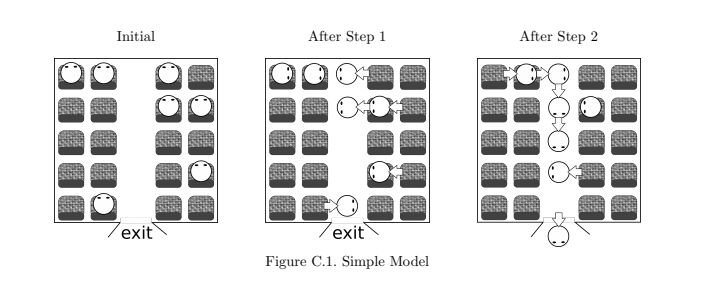
The leftmost figure of Figure C.1 depicts the seat arrangement of a small car given in Sample Input 1. The car have five rows of seats, two seats each on both sides of the aisle, totaling twenty. The initial positions of seven passengers on board are also shown.
The two other figures of Figure C.1 show possible positions of passengers after the first and the second steps. Passenger movements are indicated by fat arrows. Note that, two of the passengers in the front seat had to wait for a vacancy in the first step, and one in the second row had to wait in the next step.
Your task is to write a program that gives the smallest possible number of steps for all the passengers to get off the car, given the seat arrangement and passengers’ initial positions.
输入格式
The input consists of a single test case of the following format.
put consists of a single test case of the following format.
\(
r\ s\ p\\
i_1\ j_1\\
.\\
.\\
.\\
i_p\ j_p\\
\)
Here, \(r\) is the number of passenger seat rows, \(s\) is the number of seats on each side of the aisle, and \(p\) is the number of passengers. They are integers satisfying \(1 \le r \le 500, 1 \le s \le 500\), and \(1 \le p \le 2rs\).
The following \(p\) lines give initial seat positions of the passengers. The k-th line with ik and \(jk\) means that the k-th passenger’s seat is in the ik-th seat row and it is the jk-th seat on that row.
Here, rows and seats are counted from front to rear and left to right, both starting from one.
They satisfy \(1 \le ik \le r\) and \(1 \le jk \le 2s\). Passengers are on distinct seats, that \(i_s, i_k \ne i_l\) or \(j_k \ne j_l\) holds if \(k \ne l\).
输出格式
The output should be one line containing a single integer, the minimum number of steps required for all the passengers to get off the car.
样例输入1
5 2 7

1 1

1 2

1 3

2 3

2 4

4 4

5 2
样例输出1
9
样例输入2
500 500 16

1 1

1 2

1 999

1 1000

2 1

2 2

2 999

2 1000

3 1

3 2

3 999

3 1000

499 500

499 501

499 999

499 1000
样例输出2
1008
题解
这个题还有点绕,但是想通了之后就简单了
首先假设不会有人挡住别人,这样很容易求出来每个人的时间,但是这时候就会发现,会有人一起到达出口,而假设实际上是不成立的,所以需要依次延后.
比如某个时间有3个人同时到达了出口,那么这一秒只能有一个人出去,而剩下的两个人只能再接下来的两秒出去.
这又遇到一个问题,如果这两个人等待的时候,后面又有人被堵了,怎么办?只能继续延后,这样延后到都出去.
如果真的是一个一个出去的话,显然答案就是人数,但是实际上可能又空缺,而这个空缺数量也不难算,当出口出现堵塞的时候,看看最后延后到哪里,如果从现在到堵塞结束的时间都没有人到达出口,就出现了空缺.
把接下来第一个到达出口的时间和堵塞结束的时间相减,就得出了空缺大小,人数加上总的空缺大小,就是最后的答案
代码
#include <cstdio>

#define max(a, b) ((a) > (b) ? (a) : (b))

int cnt[2010], r, s, p, y, x, last, ans;

int main() {

    scanf("%d%d%d", &r, &s, &p);

    for (int i = 1; i <= p; i++) {

        scanf("%d%d", &y, &x);

        cnt[max(s - x + 1, x - s) + r - y + 1]++;  // 下标是时间,记录这个时间有多少人到达出口(若人不挡人)

    }

    for (int i = 1; i < 2010; i++)

        if (cnt[i])

            if (last >= i - 1) // last是堵塞结束的时间

                last = cnt[i] + last;  // 继续延后

            else {

                ans += i - last - 1;  // 记录空缺

                last = i - 1 + cnt[i];  // 更新last

            }

    printf("%d", ans + p);

    return 0;

}
Emergency Evacuation 题解的更多相关文章
- ICPC 2018 亚洲横滨赛 C Emergency Evacuation(暴力,贪心)
ICPC 2018 亚洲横滨赛 C Emergency Evacuation 题目大意 你一个车厢和一些人,这些人都坐在座位上,求这些人全部出去的时间最小值 Solution 题目咋说就咋做 直接模拟 ...
- Emergency Evacuation,题解
题目: 题意: 在某一秒,每个人可以进行一个移动:去旁边座位,去过道,在过道向出口走,求最少多少秒可以让所有人离开(具体如图和样例). 分析: 首先,我们先考虑简单的,只考虑出口前有什么事件发生:1. ...
- POJ 3057 Evacuation 题解
题目 Fires can be disastrous, especially when a fire breaks out in a room that is completely filled wi ...
- codeforces gym #102082C Emergency Evacuation(贪心Orz)
题目链接: https://codeforces.com/gym/102082 题意: 在一个客车里面有$r$排座位,每排座位有$2s$个座位,中间一条走廊 有$p$个人在车内,求出所有人走出客车的最 ...
- POJ3057:Evacuation——题解
http://poj.org/problem?id=3057 题目大意: .为人,D为门,X为障碍,门每秒只能出去一个人,问多少秒出光. 如果无法出光输出impossible. ——————————— ...
- Emergency Evacuation(最短下车时间)———(思维)
题意: 给你一个车厢和一些人的位置,这些人都坐在座位上,求这些人全部出去的时间最小值. 注意: 有许多行座位,且每行关于过道对称,出口在过道一端,一个时间只能移动一个单位,且每时刻每个格子只能有一人 ...
- 【贪心】Emergency Evacuation
题目 大致题意 把指定的人从同一出口送出车外,且同一位置不能同时有两个人,求所需的最短时间. 分析 第一感觉就是利用贪心思想解决问题,但是这道题的数据范围用模拟的话肯定是会爆掉的,所以这是不可取的.我 ...
- Problem C Emergency Evacuation 一道思维题
题目描述 输入 输出 样例 样例输入 样例输入一 样例输入二 样例输出 样例输出一 9 样例输出二 1008 一句话题意:给你一个车厢和一些人,这些人都坐在座位上,求这些人全部出去的时间最小值. 分析 ...
- 【贪心算法】CF Emergency Evacuation
题目大意 vjudge链接 给你一个车厢和一些人,这些人都坐在座位上,求这些人全部出去的时间最小值. 样例1输入 5 2 71 11 21 32 32 44 45 2 样例1输出 9 样例2输入 50 ...
随机推荐
- ESXI多网卡网络配置
1.两台路由器接入不同网络: 2.一台4网口服务器,网口分别为:vmnic0.vmnic1.vmnic2.vmnic3 3.ESXI6.5服务器虚拟机系统 测试环境模拟: 路由1:192.168.0. ...
- 深入理解JVM(③)判断对象是否还健在?
前言 因为Java对象主要存放在Java堆里,所以垃圾收集器(Garbage Collection)在对Java堆进行回收前,第一件事情就是要确定这些对象之中哪些还"存活"着,哪些 ...
- android在service中stopself遇到的问题
在service的oncreate中直接调用stopservice停止自己,依然会执行onstartcommand方法后,最后才调用ondestory方法
- 别在重复造轮子了,几个值得应用到项目中的 Java 开源库送给你
我是风筝,公众号「古时的风筝」.文章会收录在 JavaNewBee 中,更有 Java 后端知识图谱,从小白到大牛要走的路都在里面.公众号回复『666』获取高清大图. 风筝我作为一个野路子开发者,直到 ...
- 小谢第23问: chorme的性能优化工具
问题场景:在前端日趋工程化的今天,前端性能优化是一名合格的前端工程师必备的技能,那么,如何正确的使用性能分析工具呢? 解决方案: 性能分析的流程: 在开发中我一般使用公司开发的测试脚本-kbase-w ...
- (前端)angular报错日常以及记录日常
目录1 json的key...value问题 遍历json的key...value的时候报错: [tslint] for (... in ...) statements must be filtere ...
- laravel里的队列学习
首先,我们要搞明白几个概念,从小到大依次有:队列任务,队列,连接. 他们属于依次被包含的关系,一个队列里有许多的队列任务,一个连接中可以有许多队列. 队列任务:对每个用户都会进行的操作,理解为队列任务 ...
- NASH:基于丰富网络态射和爬山算法的神经网络架构搜索 | ICLR 2018
论文提出NASH方法来进行神经网络结构搜索,核心思想与之前的EAS方法类似,使用网络态射来生成一系列效果一致且继承权重的复杂子网,本文的网络态射更丰富,而且仅需要简单的爬山算法辅助就可以完成搜索,耗时 ...
- 浅淡i.MX8M Mini处理器的效能以及平台对比
i.MX 8M Mini是恩智浦首款嵌入式多核应用处理器,定位在任何通用工业和物联网的应用,是一款针对边缘计算应用的芯片,也是恩智普i.MX系列中第一个加了机器学习核的产品线.这颗芯片采用先进的14L ...
- HTML中doctype的作用及几种类型详解
一.DOCTYPE标签的定义与作用 <!DOCTYPE>是一个用于声明当前HTMl版本,用来告知web浏览器该文档使用是哪种 HTML 或者 XHTML 规范来解析页面,以便浏览器更加准确 ...