
FT232H USB转串口,I2C,JTAG高速芯片
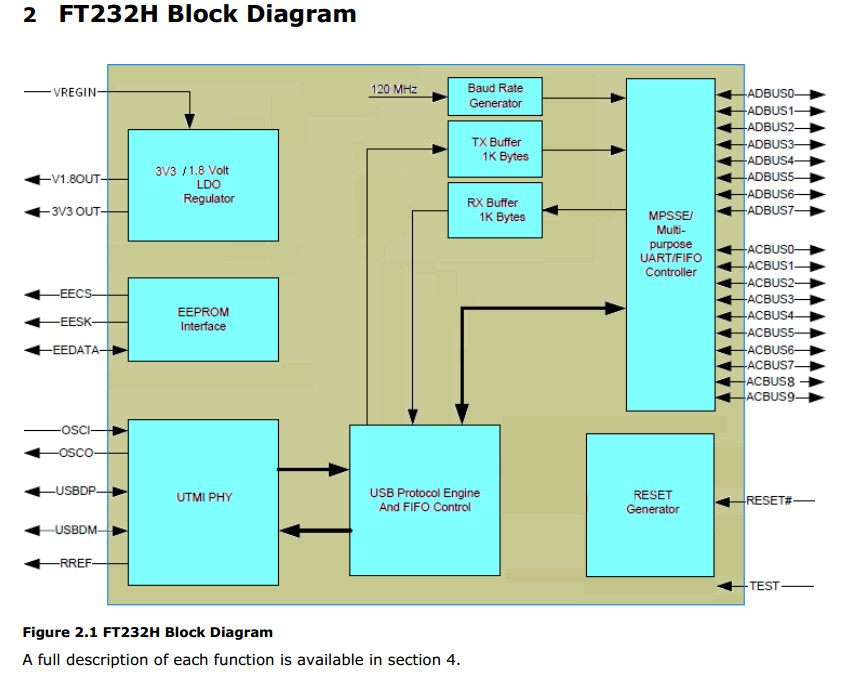
FT232H不仅支持异步串行接口(UART),还通过其内建的多协议同步串行引擎(MPSSE)支持许多同步IO接口,比如SPI, I2C,JTAG以及FPGA编程接口,MPSSE通信速度能够达到30M比特/秒。另外,MPSSE可用于执行设计工程师自己的同步串行总线协议。
新的FT1248 总线是FT232H集成的一个接口功能,为专有的同步半双工串行/并行接口,与外部逻辑通信速率可以达到30M Byte/秒。FT1248 总线独特之处在于能够根据可用物理数据总线的数量(1,2,4或8)调整FT232H与外部逻辑连接的带宽, 从而为系统设计提供最优的适应性。
集成的1.8V和3.3V低压差稳压器减少了所需外部元件,同时与现有的USB2.0兼容的全速产品相比较而言,1 K字节大的收发数据缓存加上USB2.0高速技术大大改善了数据吞吐量, 缩减了延迟响应时间。FTDI网站可下载用于Windows, Linux, MAC 和 WinCE操作系统的免税驱动。
FT232H的封装选择有48针LQFP(FT232HL)或48针QFN(FT232HQ)无铅封装。这两种FT232H工作范围是-40⁰C ~ +85⁰C。FT232HL定价为$2.75(1,000片以上),FT232HQ定价为$2.60(1000片以上)。UM232H用户评估模块有助于快速建立原型或测试FT232H平台,与一个标准的0.6英寸宽,28针的DIP插座连接。UM232H模块单价定为$20(1~9片)。
Operating at USB Hi-Speed 480Mbps rate, this fast single channel bridge chip features either a flexible serial interface or parallel FIFO interface, with data transfer speeds up to 40Mbytes/s. Using a serial EEPROM interface, this device can be configured for a wide variety of asynchronous and synchronous serial standards, such as JTAG, SPI, I2C and UART as well as synchronous and asynchronous parallel FIFO interfaces. In addition, this device features the new synchronous, half-duplex FT1248 bus, which allows an engineer to trade off bandwidth for pin count using 1, 2, 4, or 8 data lines at up to 30Mbytes/s. The I/O structure is 3.3V with built-in tolerance for 5V, allowing the designer maximum flexibility when interfacing with FPGAs. On-board voltage regulation provides 3.3V and 1.8V supplies from a 5V source, as well as a power-on-reset function. FTDI provides royalty-free virtual com port and D2XX drivers for Microsoft Windows (XP – Windows7), Apple Mac OSX, and Linux. This 48 pin device is available in either LQFP or QFN packaging, and is ROHS compliant.
- Single channel USB to serial / parallel ports with a variety of configurations.
- Entire USB protocol handled on the chip. No USB specific firmware programming required.
- USB 2.0 Hi-Speed (480Mbits/Second) and Full Speed (12Mbits/Second) compatible.
- Multi-Protocol Synchronous Serial Engine (MPSSE) to simplify synchronous serial protocol (USB to JTAG, I2C, SPI or bit-bang) design.
- UART transfer data rate up to 12Mbaud. (RS232 Data Rate limited by external level shifter).
- USB to asynchronous 245 FIFO mode for transfer data rate up to 8 MByte/Sec.
- USB to synchronous 245 parallel FIFO mode for transfers up to 40 Mbytes/Sec
- Supports a half duplex FT1248 interface with a configurable width, bi-directional data bus (1, 2, 4 or 8 bits wide).
- CPU-style FIFO interface mode simplifies CPU interface design.
- Fast serial interface option.
- FTDI's royalty-free Virtual Com Port (VCP) and Direct (D2XX) drivers eliminate the requirement for USB driver development in most cases.
- Adjustable receive buffer timeout.
- Option for transmit and receive LED drive signals.
- Bit-bang Mode interface option with RD# and WR strobes
- Highly integrated design includes 5V to 3.3/+1.8V LDO regulator for VCORE, integrated POR function
- Asynchronous serial UART interface option with full hardware handshaking and modem interface signals.
- Fully assisted hardware or X-On / X-Off software handshaking.
- UART Interface supports 7/8 bit data, 1/2 stop bits, and Odd/Even/Mark/Space/No Parity.
- Auto-transmit enable control for RS485 serial applications using TXDEN pin.
- Operation configuration mode and USB Description strings configurable in external EEPROM over the USB interface.
- Configurable I/O drives strength (4, 8, 12 or 16mA) and slew rate.
- Low operating and USB suspend current.
- Supports self powered, bus powered and high-power bus powered USB configurations.
- UHCI/OHCI/EHCI host controller compatible.#
- USB Bulk data transfer mode (512 byte packets in Hi-Speed mode).
- +1.8V (chip core) and +3.3V I/O interfacing (+5V Tolerant).
- Extended -40°C to 85°C industrial operating temperature range.
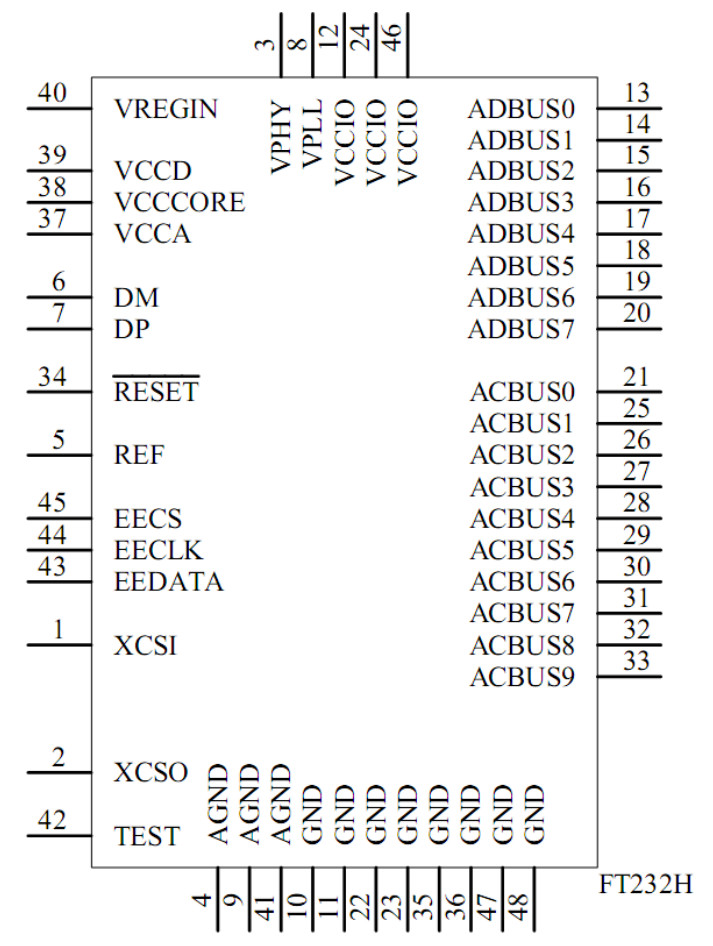
- Compact 48-pin Lead Free LQFP or QFN package
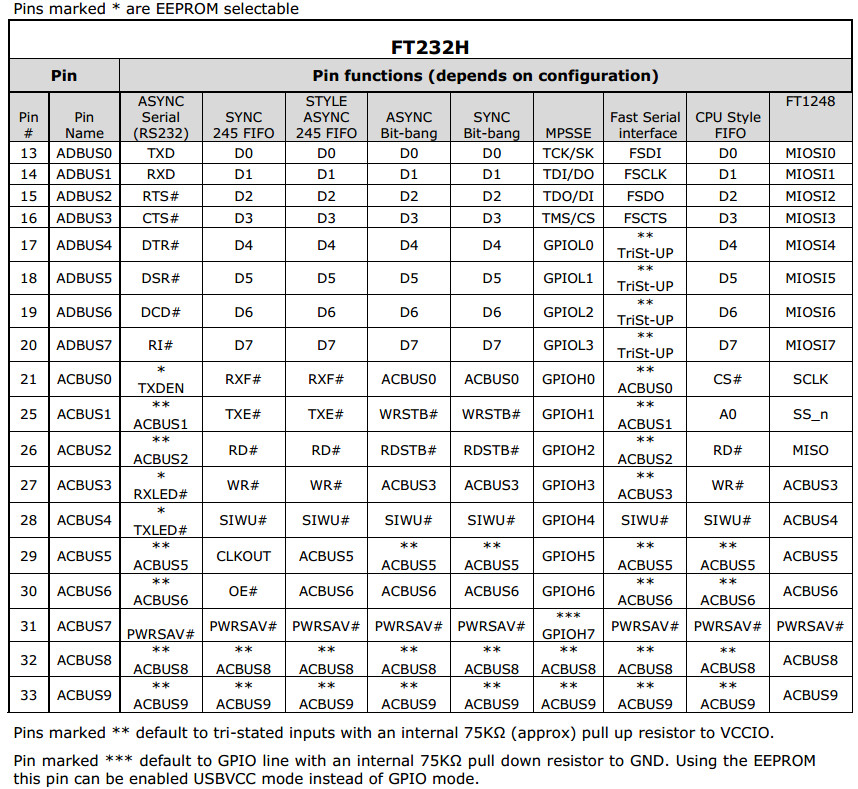
- Configurable ACBUS I/O pins.

This mode uses a synchronous interface to get high data transfer speeds. The chip drives a 60 MHz CLKOUT clock for the external system to use.
Note that Asynchronous FIFO mode must be selected in the EEPROM before selecting the Synchronous FIFO mode in software.
4.4.1 FT245 Synchronous FIFO Read Operation
A read operation is started when the chip drives RXF# low. The external system can then drive OE# low to turn the data bus drivers around before acknowledging the data with the RD# signal going low. The first data byte is on the bus after OE# is low. The external system can burst the data out of the chip by keeping RD# low or it can insert wait states in the RD# signal. If there is more data to be read it will change on the clock following RD# sampled low. Once all the data has been consumed, the chip will drive RXF# high. Any data that appears on the data bus, after RXF# is high, is invalid and should be ignored.
4.4.2 FT245 Synchronous FIFO Write Operation
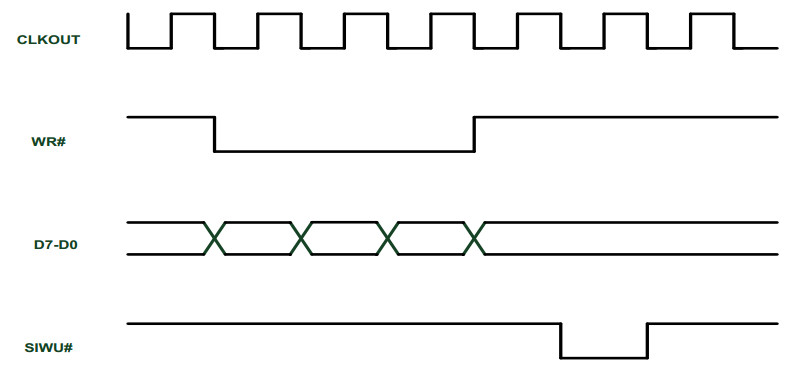
A write operation can be started when TXE# is low. WR# is brought low when the data is valid. A burst operation can be done on every clock providing TXE# is still low. The external system must monitor TXE# and its own WR# to check that data has been accepted. Both TXE# and WR# must be low for data to be accepted.
4.12 Send Immediate / Wake Up (SIWU#)
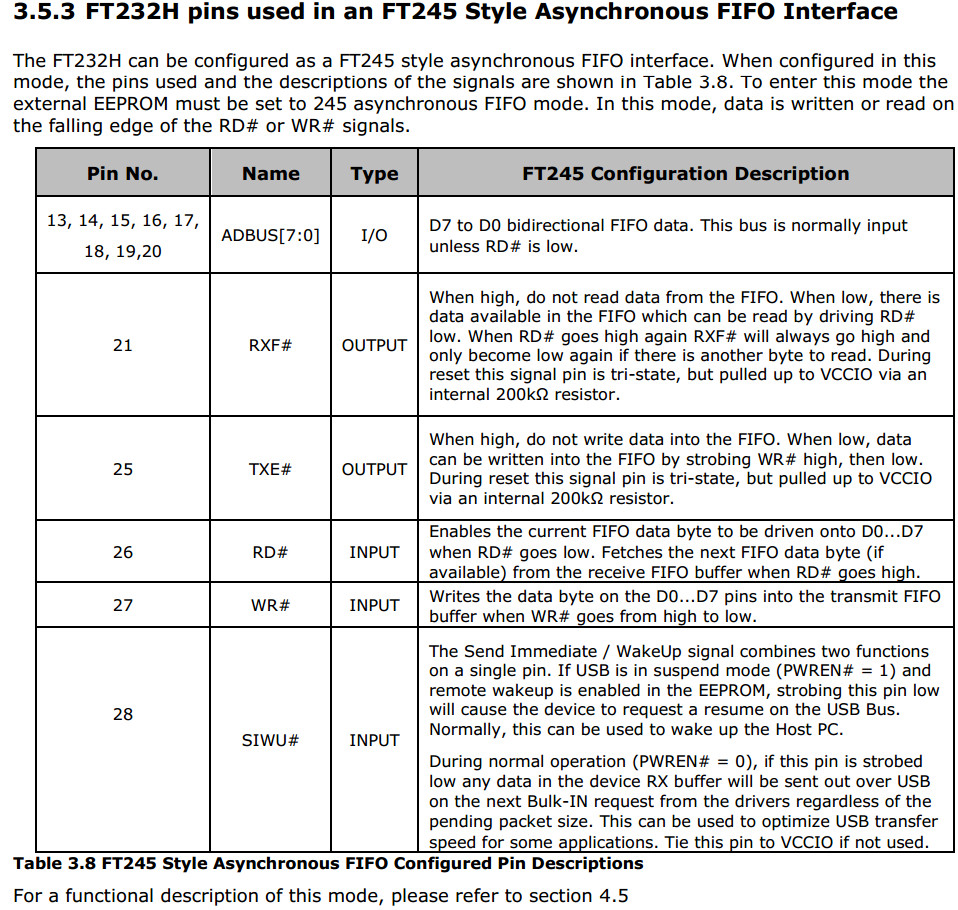
The SIWU# pin is available in the FIFO modes and in bit bang mode.
The Send Immediate portion is used to flush data from the chip back to the PC. This can be used to force
short packets of data back to the PC without waiting for the latency timer to expire.
To avoid overrunning, this mechanism should only be used when a process of sending data to the chip
has been stopped.
The data transfer is flagged to the USB host by the falling edge of the SIWU# signal. The USB host will
schedule the data transfer on the next USB packet.
Figure 4.25: Using SIWU#
When the pin is being used for a Wake Up function to wake up a sleeping PC a 20ms negative pulse on
this pin is required. When the pin is used to immediately flush the buffer (Send Immediate) a 250ns
negative pulse on this pin is required.
Notes
1. When using remote wake-up, ensure the resistors are pulled-up in suspend. Also ensure peripheral
designs do not allow any current sink paths that may partially power the peripheral.
2. If remote wake-up is enabled, a peripheral is allowed to draw up to 2.5mA in suspend. If remote
wake-up is disabled, the peripheral must draw no more than 500uA in suspend.
3. If a Pull-down is enabled, the FT232H will not wake up from suspend when using SIWU#
4.In UART mode the RI# pin acts as the wake up pin.
FT232H USB转串口,I2C,JTAG高速芯片的更多相关文章
- Mac OS X Yosemite & Arduino安装CH340 USB转串口驱动
新买的Arduino开发板 USB转串口使用了CH340芯片,在Mac OS X Yosemite上正常安装驱动后,在Arduino IDE的端口没发现相应的设备,使用以下方法后就能使用USB转串口调 ...
- USB转串口 FT232/PL2303芯片使用体会
现在笔记本上很少带有串口了,而串口又是做电子设计必备的通讯接口之一,好在USB转串口比较方便,市面上常用的USB转串口芯片有很多,最常见的有FT232.PL2303.CH340三种 原理:单片机的TX ...
- 快速上手CH340N电路设计(CH340N USB转串口模块 USB Type-C接口 CH340系列芯片讲解)
一.上模块 二.功能分析 l 芯片:CH340N l 输入接口:USB.TYPE-C l 输出接口:TTL(5V\3.3V\GND\TX\RX) l 指示灯:电源.TX.RX ...
- [驱动]内核添加USB转串口驱动支持
转自:http://blog.csdn.net/gatieme/article/details/49491325 目录 1. 问题 2. 驱动源码 3. 内核配置 4. 编译内核和模块驱动 5. 加载 ...
- 在MAC OS X下安装usb转串口驱动(PL2303主控芯片)
本文原创于http://www.cnblogs.com/humaoxiao,非法转载者请自重! 因为最近手里有一块STM32Discovery开发板,所以想搞一下STM32的开发,我前面的 ...
- usb转串口如何配置?
概述 USB转串口输出,在kernel启动阶段加载相应的usb转串口芯片驱动,加载成功后,可通过usb转串口与pc机端交互. 步骤 1. 在kernel配置中选中usb转串口驱动: 2. 传给内核 ...
- 利用FT232实现USB转串口
FT232B数据手册:http://www.ftdichip.com/Support/Documents/DataSheets/ICs/DS_FT232BL_BQ.pdf 常用的USB转串口的芯片有F ...
- Linux 串口、usb转串口驱动分析(2-1) 【转】
转自:http://blog.chinaunix.net/xmlrpc.php?r=blog/article&uid=26807463&id=4186851 Linux 串口.usb转 ...
- LINUX下 USB转串口 【转】
转自:http://blog.163.com/smilexiao_11015461/blog/static/2122052182012102410399459/ 1.将设备u口插入pc2.输入#lsm ...
随机推荐
- 【前端开发】localStorage的用法
localStorage.setItem("name","value") //存储name的值 var type = localStorage.getItem ...
- 基于vue配置axios
转载地址:https://juejin.im/post/5a02a898f265da43052e0c85 1.背景 在项目开发中ajax请求是必不可缺少 一部分ajax请求不需要loading或则请求 ...
- mac idea内存溢出
VM options: -mx2048m -XX:MaxPermSize=2048m -Drebel.spring_plugin=true -Drebel.hibernate_plugin=true
- 分析new delete 的本质
在程序设计中,数据可能会存在不同的内存空间,如函数栈 堆 全局变量区 ,今天我们来分析一下C++中堆分配方式和C语言的堆分配方式异同,从而更好的理解new delete本质 C语言使用mall ...
- wpf设置某容器透明,而不应用到容器的子元素的方法
以Border打比方: <Border.Background> <SolidColorBrush Opacity="0.4" Color="Black& ...
- SQL SERVER2008 存储过程、表、视图、函数的权限
EXEC sp_addrolemember N'db_owner', N'db'----将db 设置为 db_owner 角色中的一员 EXEC sp_droprolemember N'db_owne ...
- Effective STL 学习笔记 31:排序算法
Effective STL 学习笔记 31:排序算法 */--> div.org-src-container { font-size: 85%; font-family: monospace; ...
- CF 576A 猜数
A给出一个数x,B每次猜一个y,A回答B,x是否可以被y整除,求出要猜的最小次数和需要猜的数. 枚举每个素数p,可以知道如果p^k<=n,则p^k一定需要选 Sample test(s)inpu ...
- Android 客户端 okhttp3 与服务器之间的双向验证
[原文]https://blog.csdn.net/leng_wen_rou/article/details/58596142 本篇是Android 客户端基于okhttp3的网络框架 和后台服务器之 ...
- 提高eclipse使用效率(二)—— 提高Android开发效率的小技巧
XML文件的代码提示 adt中也有xml文件的代码提示,为了让提示来的更加猛烈,我们还要设置一下 打开eclipse - Window - Preferences,在右边的目录树中切换到XML - X ...