
Non-Inverting Level Shifter : +/-5V signal into a 0 to 3.3V
With portable battery-operated devices continuing to add functionality while shrinking in size, printed-circuit-board real estate becomes increasingly valuable. Single-supply circuitry can help by saving space and cost. Adding audio or video, however, may pose a problem because those signals are usually referenced to ground, and most single-supply ICs must be configured for signals above ground.
Therefore, the circuit must shift most audio or video input signals to an appropriate level above ground. Also, polarity must be preserved for video signals. Unfortunately, using a single-supply voltage while preserving signal polarity is impossible with traditional op-amp level shifters, which require two op amps and a negative rail.
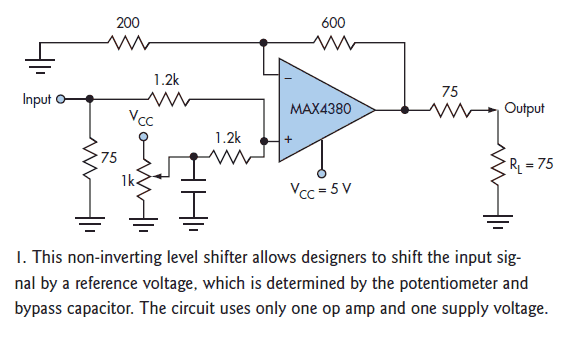
The circuit in Figure 1 meets all of these requirements, level-shifting a ground-referenced signal with one op amp while running on a single-supply voltage. The op amp’s non-inverting summing configuration creates the level-shifted output by summing a reference voltage with the input signal. A standard potentiometer with a bypass capacitor sets the reference voltage, but any voltage reference able to provide enough bias current for the op amp and summing resistors will suffice.
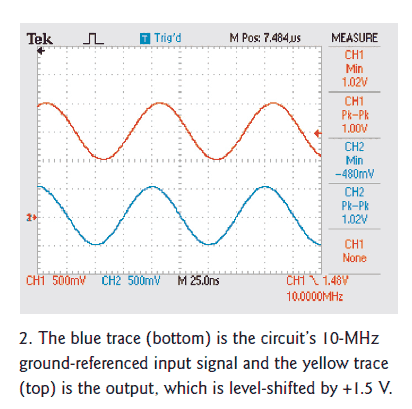
This example circuit includes the 75-Ω termination resistors required in a standard video application. The op amp shown features a small footprint plus the wide bandwidth needed for video. Figure 2 shows the circuit’s operation, shifting a 10-MHz ground-referenced input signal by +1.5 V.
http://www.daycounter.com/Calculators/Op-Amp/NonInverting-Op-Amp-Resistor-Calculator.phtml
A common engineering task is to convert a positive to negative signal into a range suitable for a single supply ADC.
This circuit will convert a +/-5V signal into a 0 to 3.3V signal so that it can be sampled by an ADC on a 3.3V microprocessor.

Equations:
A = (R4/R1) x (R1+R2)/(R3+R4)
If R1= R3, and R2=R4, then
A= (R4/R1)
We want to convert a 10Vpp signal to a 3.3V signal so the gain should be 1/3. We can choose R4 to be 33K and R1 to be 100K.
Now we need to choose the positive offset such that the signal is centered at 1.6V.
The gain off the offset voltage is:
Aoffset= (R2+R1)/R1 x R3/(R3+R4) = R3/R1.
For the previous resistor values, the gain is 1 since R3=R1, and so we use an offset voltage of 1.6V.
http://www.daycounter.com/Calculators/Op-Amp/NonInverting-Op-Amp-Resistor-Calculator.phtml

This calculator determines the bias and feedback resistors for a non-inverting op-amp, given the gain and desired output bias point.
There are many free parameters to the design so enter the value of R1, which will scale the other resistors.
Use V1 as the input for the inverting Op-Amp, and V2 as a voltage offset if needed.
Set V2 to zero if no offset is required.
To use the calculator you first need to determine the desired gain of the ac signal,
and the quiescent output voltage (the value when the AC input signal is zero).
R4 injects a non-zero V2 voltage component into the circuit and correspondingly offset Vout.
Another way of looking at it is, if V2 is zero and the DC component of V1 is zero then Vout will also be zero.
The amplified output signal will ride on the quiescent output voltage.
Non-Inverting Level Shifter : +/-5V signal into a 0 to 3.3V的更多相关文章
- Level shifting a +/- 2.5V signal to 0 - 5V
Google : Op-Amp Level Shifter Level shifting a +/- 2.5V signal to 0 - 5V I have a front end module t ...
- Retimer、Redriver(Level Shifter)
重定时器Retimer和驱动器Redriver9(Level Shifter) 在高速串行通道的信号传输中,需要使用Redriver 和Retimer来保证信号传输的质量. Redriver,可以重新 ...
- 5V and 3V Level Translators
http://www.daycounter.com/Circuits/Level-Translators/Level-Translators.phtml Interfacing 5V and 3V l ...
- XBee Level Shifting
http://www.faludi.com/bwsn/xbee-level-shifting/ The XBee communication (RX/TX) pins definitely opera ...
- linux内核剖析(九)进程间通信之-信号signal
信号及信号来源 什么是信号 信号是UNIX和Linux系统响应某些条件而产生的一个事件,接收到该信号的进程会相应地采取一些行动.通常信号是由一个错误产生的.但它们还可以作为进程间通信或修改行为的一种方 ...
- 低功耗设计技术--Multi VDD--Level shifter
本文转自:自己的微信公众号<集成电路设计及EDA教程> 前面的推文中我们分别介绍了低功耗设计中的Multi-VDD技术以及门控电源技术.在实际的低功耗设计中,门控电源技术中也常常结合Mul ...
- slot signal机制
有一个比较 经典的实现:http://sigslot.sourceforge.net/很精简的 signal slot的实现,跨平台.webrtc项目在用,我在自己项目里也用了.这个源码有2000多行 ...
- signal()函数
转自:http://blog.csdn.net/sddzycnqjn/article/details/7285760 1. 信号概念 信号是进程在运行过程中,由自身产生或由进程外部发过来的消息(事件) ...
- 版本和API Level对照表
版本和API Level对照表 Code name Version API level (no code name) 1.0 API level 1 (no code name) 1.1 API le ...
随机推荐
- 【前端vue开发架构】vue开发单页项目架构总结
为营销活动设计的前端架构 主要的技术栈为 Vuejs,Webpack,请自行阅读如下技术或者框架的文档: 一.基础说明: node (https://nodejs.org/en/) npm (http ...
- hibernate cascade
默认:none Cascade 属性值: none:在保存.删除修改对象的时候,不考虑其附属物的操作 save-update:在保存.更新当前对象时,级联保存.更新附属物. delete:在删除当前对 ...
- js字符串基本操作
<!DOCTYPE html PUBLIC "-//W3C//DTD XHTML 1.0 Strict//EN""http://www.w3.org/TR/xhtm ...
- Centos7.3安装vsftp服务
我们需要向centos操作系统的服务器上上传文件或者下载文件,这时候,ftp有必要安装下, 我们选择主流的vsftp: 第一步:安装vsftp yum install -y vsftpd 第二步:设置 ...
- (一)问候 Jsoup
第一节: Jsoup 简介 Jsoup简介 jsoup 是一款Java 的HTML解析器,可直接解析某个URL地址.HTML文本内容.它提供了一套非常省力的API,可通过DOM,CSS以及类似于jQu ...
- 为什么有些网页QQ浏览器右键没有检查
改成[极速内核]. 设置->高级设置 改成[极速内核]: 如下图:
- CentOS7的firewall和安装iptables
前言:CentOS7 的防火墙默认使用是firewall,而我们通常使用iptables: 本文记录了firewall基础的命令和iptables的安装和使用. firewall部分: part1 : ...
- 【考古向翻译】Pwn2Own 2010 Windows 7 Internet Explorer 8 exploit
正好在Google搜到了这篇文章,就打算自己翻译一下,也不清楚国内是否有人已经翻译过了.作者是Pwn2Own 2010的获奖者来自荷兰的皮特·维莱格登希尔(Peter Vreugdenhil). 20 ...
- Asp.Net Core2.0 WebAPI 使用Swagger生成漂亮的接口文档
1.引用NuGet: Swashbuckle.AspNetCore.Swagger Swashbuckle.AspNetCore.SwaggerGen 或 <PackageReference I ...
- RabbitMQ错误检查
今天使用RabbitMQ做数据下发操作,当在发送端声明了Exchange后 打开RabbitMQ的管理控制台,可以查看,其中已经创建了Exchange 但并没有Queue 接着运行接收端,发现以下错误 ...