
introduction to my business card
http://www.t4f.org/projects/business-card/
After 4 years working in an international IT consulting company, I have decided that now it is time to change my current professional career.
The world of the business software (for banking, insurance, services…) is boring, monotone and it is not challenging enough for me. I would like to redirect my labor situation toward a field more related with the electronic engineering, which is my real passion.
Unfortunately, if the opportunities to work in electronics were scarce and poor (specially with ASIC or RF design, my two favorites areas), now with the current economical crisis… finding a job (or even an internship) in this field is almost impossible. Or at least, I had no luck so far even considering that I am open to work anywhere in the world.
First impressions matter
In this hard scenario, the Human Resources recruiters receive hundreds of resumes a day from people competing for the same position.
With this avalanche of CVs is impossible for HR to make a full assessment of each candidate. Therefore, the first filtering criteria that is usually applied is the presentation: If your resume does not cause a good impression to the recruiter from the first moment, you will be automatically discarded, regardless of your qualifications.
Any chance to make your CV stand out from others must be seized. A good cover letter and a good presentation is essential, but do not ensure you that will catch enough attention from the reader.
Is at this point when I had the idea to design my own business cards to attach with my resume or give in interviews.
This card, in order to be “flashy”, had to meet the following requirements:
- Contain my contact information (Captain Obvious to the rescue!).
- Convey professionalism.
- Serve as an example of my engineering skills.
- Have some use besides being a business card. This way, it would prevent to be throw away at the first opportunity.
At first I thought about making a version of my Open RFID Tag with one side of the PCB printed with my contact details and a firmware preloaded to emulate some RFID tag containing the same contact info.
I discard the idea because few HR recruiters must have an RFID reader in their offices or homes, so they could hardly see the card working.
At the end I opted to do some kind of USB-device card.
My business card
The result is a card with the size of a credit card (85.6 × 54 mm, although thicker) with two punched corners.
In the center there is a “window” to accommodate the microcontroller soldered bottom-up. Otherwise, If the micro was soldered on the PCB (bottom-down), the card would have been very thick and could not be stored comfortably in a pocket wallet.
The front side has my contact details and the back side has all the electronic parts soldered.

Front side, with the contact information (phone number censored in the image)
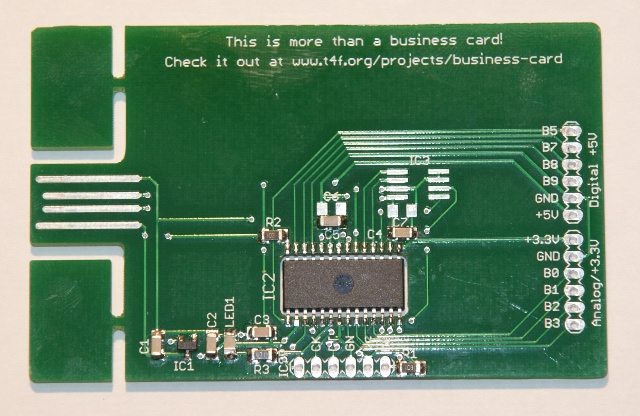
Back side, with the soldered parts.

The corners can be torn apart, exposing an USB connector that lets you plug the card directly to your computer

When the card is connected, the computer recognize it as a mass storage unit and will open automatically (Autorun.inf) my resume, cover letter, portfolio, website or any other document.
Functionalities
The main purpose of the card is to work as an USB memory.
The firmware uses the internal flash of the microcontroller, so the capacity of the mass storage unit is only 24 KB max. Enough to put a cover letter and resume in HTML.
If more memory is needed, the current PCB and circuitry supports an external 8-pin SPI (or I2C) flash memory chip (up to 32MB!). Interesting for providing the project documentation or code!
In addition, the microcontroller firmware includes a bootloader that allows you to run small programs stored in the USB drive. These programs add functionalities to the card.
At the moment, the following applications are available:
- Datalogger:
Capture digital signals. Capturing modes (without compression / worst case):- 8 channels @ 500KHz
- 4 channels @ 1MHz
- 2 channels @ 2MHz
- 1 channel @ 4MHz.
- Oscilloscope :
10 bits of resolution. Capture modes:- 4 channels @ 67.5KHz
- 2 channels @ 125KHz;
- 1 channel @ 250KHz;
These other applications are under development:
- USB to RS232, SPI, I2C or CAN adapter (bridge)
- General purpose I/O port for controlling electronic devices and circuits.
Moreover, all the microcontroller pins are available thanks to a Molex connector (not soldered), so the card can also be used as a trainer board for the PIC 24FJ64GB002. Useful for those who wants to enter into the world of microelectronics and embedded systems.
Clearly, it is not the cheaper business card in the world (about 5 euros/piece for a small batch order), but it is a (relatively) small price for having a card in your pocket that has more CPU power than the computer that led the man to the moon.
Technical specifications
- 16 bits microcontroller PIC 24FJ64GB002 @ 32 MHz (16 MIPS)
- 64 KB of Flash and 8KB of RAM. External SPI or I2C memory optional (up to 32MB)
- Up to 11 digital I/Os available (Four of them tolerant to 5 volts)
- Up to 4 analog channels.
- ICSP port for debugging and programming. The 3 pins of the ICSP connector can be also used as GP I/Os.
Applications, source and schematics
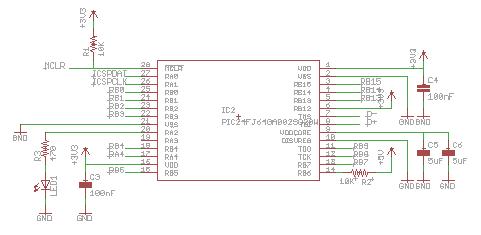
I will release the apps and sources under a GPL (or similar) as soon as I solve some questions regarding to the licensing.
The firmware uses part of the Microchip USB stack implementation, whose source is royalty free but is not licensed under an Open Software License. I need to know the limitations of this license before releasing the code.
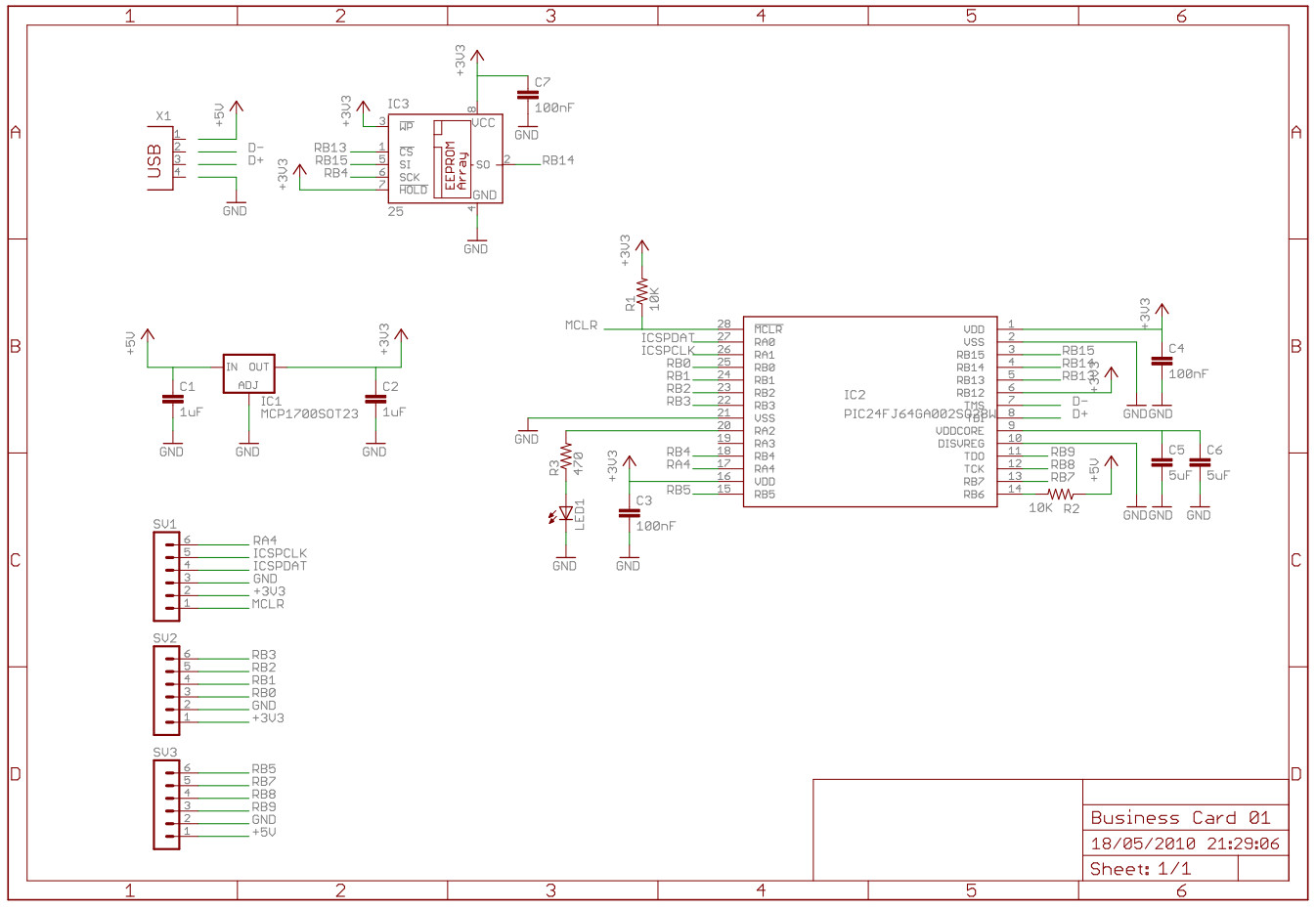
http://www.t4f.org/archives/Business%20Card/Business%20Card%20Schematics.pdf
introduction to my business card的更多相关文章
- free online business card generator
free online business card generator 免费在线名片生成器 https://www.logaster.cn/business-card/ https://www.chu ...
- composer - No business network has been specified for this connection 解决方案
I have installed hyperledger composer locally. But on localhost it gives error : Error : Error tryin ...
- Business Cards
Problem Description Running a paper shop is not an easy job, especially with harsh customers. Today ...
- (原创)北美信用卡(Credit Card)个人使用心得与总结(个人理财版) [精华]
http://forum.chasedream.com/thread-766972-1-1.html 本人2010年 8月F1 二度来美,现在credit score 在724-728之间浮动,最高的 ...
- RFC3261--sip
本文转载自 http://www.ietf.org/rfc/rfc3261.txt 中文翻译可参考 http://wenku.baidu.com/view/3e59517b1711cc7931b716 ...
- 每日英语:How to Be a Better Conversationalist
Jason Swett still cringes when he remembers the party in Atlanta 10 years ago, where, drink in hand, ...
- pdi vcard-2.1
vCard The Electronic Business Card Version 2.1 A versit Consortium Specification September 18, 1996 ...
- 22套精致的用户界面 PSD 源文件素材《免费下载》
在这里,我们给大家分享一组精美的 PSD 源文件素材,可以免费下载使用.PSD 素材是很好的资源,对于每个设计师都非常有用,这是设计师之所以不断发布新的和有用的 PSD 文件的原因.高品质的 PSD ...
- 50款免费 PSD 名片设计模板源文件下载《下篇》
名片是陌生人之间建立联系的最便捷.最有效的工具.名片它可能是给你的客户留下正面的印象第一步,另一方面,名片是一个企业最重要和最符合成本效益的营销工具之一,尤其是对于刚刚起步的企业.这里收集了50款免费 ...
随机推荐
- ThoughtWorks代码挑战——FizzBuzzWhizz游戏 通用高速版(C/C++ & C#)
最早看到这个题目是从@ 程序媛想事儿(Alexia) 的 最难面试的IT公司之ThoughtWorks代码挑战——FizzBuzzWhizz游戏 开始的,然后这几天陆陆续续有N个小伙伴发表了自己的文章 ...
- Ubuntu 各版本的几个国内更新源
Ubuntu 国内更新源(各版本通用) 前言:为了下载更方便,速度更快,我们在使用Linux系列系统时修改 apt源 为国内的源 1.复制源文件备份,以防万一 修改文件sources.list,在目录 ...
- 次短路经(dijsktra)
#include <cstdio>#include <cstring>#include <queue>#include <algorithm>#defi ...
- Django 注册
一. 本地图片上传预览 1. 上传文件框隐藏到图片上面,点击图片相当于点上传文件框 <div class="login"> <div style="po ...
- LightOJ - 1010 Knights in Chessboard(规律)
题目链接:https://vjudge.net/contest/28079#problem/B 题目大意:给你一个nxm的棋盘,问你最多可以放几个骑士让他们互相攻击不到.骑士攻击方式如下图: 解题思路 ...
- linux crontab 常用时间设置
时间格式 分钟 小时 日期 月份 周 命令 数字范围 0-59 0-23 1-31 1-12 0-7 echo "hello" >> abc.log 特殊字符的含义 * ...
- [转]Java中堆和栈创建对象的区别
转载自http://blog.csdn.net/hbhhww/article/details/8152838 栈与堆都是Java用来在Ram中存放数据的地方.与C++不同,Java自动管理栈和堆,程序 ...
- MySql学习笔记——触发器
今天又学习了一下mysql触发器的相关知识,对此做了一些笔记和总结. 定义及作用 触发器是一个被指定关联到一个表的数据对象,触发器不需要调用,当对一个表的特别事件出现时,它就会被激活.触发器的代码也是 ...
- 0ra-12170 tns 连接超时
https://blog.csdn.net/zhaoxiangchong/article/details/8296980
- [实战]MVC5+EF6+MySql企业网盘实战(25)——种子列表
写在前面 上篇文章实现了视频列表,本篇文章继续实现其他的文件列表.功能相似.这里就不再赘述. 系列文章 [EF]vs15+ef6+mysql code first方式 [实战]MVC5+EF6+MyS ...