
【STL】帮你复习STL泛型算法 一
STL泛型算法
#include <iostream>

#include <vector>

#include <algorithm>

#include <iterator>

#include <numeric>

#include  <list>

using std::cout;

using std::endl;

using std::vector;

using std::list;

bool  IsOushu(const int& nNum);

bool IsBigger(const int& nFirst, const int& nSecond);

int main()

{

    vector<int> iVec;

    for(int i = ; i < ; ++ i)

        iVec.push_back(i);

    cout << endl;

    typedef vector<int> IVEC;

    //std::find

    IVEC::const_iterator iter = std::find(iVec.begin(), iVec.end(), );

    if(iVec.end() != iter)

        cout << endl << "The value is " << *iter << endl;

    else

        cout << endl << "Can not find the value " <<  << endl;

    //std::accumulate

    int nSum = std::accumulate(iVec.begin(), iVec.end(), );

    cout << endl << "The sum is " << nSum << endl;

    cout << endl;

    //fill

    vector<int> iVec2();

    std::fill(iVec2.begin(), iVec2.end(), );

    for(IVEC::const_iterator iter = iVec2.begin(); iter != iVec2.end(); ++ iter)

        cout << *iter << ", ";

    cout << endl;

    //fill_n

    vector<int> iVec3();

    std::fill_n(back_inserter(iVec3), , );

    cout << endl << "size of iVec3 is " << iVec3.size() << endl;

    for(IVEC::const_iterator iter = iVec3.begin(); iter != iVec3.end(); ++ iter)

        cout << *iter << ", ";

    cout << endl;

    cout << endl;

    //copy

    vector<int> iVec4;

    list<int> lst1;

    for(int i = ; i < ; ++ i)

        lst1.push_back(i);

    std::copy(lst1.begin(), lst1.end(), back_inserter(iVec4));

    for(IVEC::const_iterator iter = iVec4.begin(); iter != iVec4.end(); ++ iter)

        cout << *iter << ", ";

    cout << endl << endl;

    //copy

    vector<int> iVec5();

    std::copy(lst1.begin(), lst1.end(), iVec5.begin());

    for(IVEC::const_iterator iter = iVec5.begin(); iter != iVec5.end(); ++ iter)

        cout << *iter << ", ";

    cout << endl << endl;

    //replace

    list<int> lst2;

    for(int i = ; i < ; ++ i)

        lst2.push_back(i * );

    cout << endl;

    //打印replace之前到值

    cout << endl << "打印lst2 replace之前到值 " << endl;

    for(list<int>::const_iterator iter = lst2.begin(); iter != lst2.end(); ++ iter)

        cout << *iter << ", ";

    cout << endl;

    cout << "打印replace之后到值 " << endl;

    std::replace(lst2.begin(), lst2.end(), , );

    for(list<int>::const_iterator iter = lst2.begin(); iter != lst2.end(); ++ iter)

        cout << *iter << ", ";

    cout << endl;

   cout << endl;

   //replace_copy

   list<int> lst3(lst2.size());

   std::replace_copy(lst2.begin(), lst2.end(), lst3.begin(), , );

   cout << endl << "打印lst2 replace_copy 之后 lst3 到值 " << endl;

   for(list<int>::const_iterator iter = lst3.begin(); iter != lst3.end(); ++ iter)

         cout << *iter << ", ";

   cout << endl;

   //stable_sort

   vector<int> iVec6;

   for(int i = ; i < ; ++ i)

      iVec6.push_back(i);

   cout << endl;

   cout << endl << "打印stable_sort之前到iVec6到值 " << endl;

   for(IVEC::const_iterator iter = iVec6.begin(); iter != iVec6.end(); ++ iter)

      cout << *iter << ", ";

   cout << endl << "打印stable_sort之后到iVec6到值 " << endl;

   std::stable_sort(iVec6.begin(), iVec6.end(), IsBigger);

   for(IVEC::const_iterator iter = iVec6.begin(); iter != iVec6.end(); ++ iter)

      cout << *iter << ", ";

   cout << endl << endl;

   //count_if

   cout << endl << "计算iVec6中偶数到个数 " << endl;

   int nNums = std::count_if(iVec6.begin(), iVec6.end(), IsOushu);

   cout << endl << "iVec6中偶数个数为 " << nNums <<" 个" << endl;

    cout << endl << endl;

    cout << "\nThis is main function \n";

    return ;

}

//stable_sort 降序排列

bool IsBigger(const int& nFirst, const int& nSecond)

{

    return nFirst > nSecond;

}

//是偶数

bool  IsOushu(const int& nNum)

{

    return ( == nNum % );

}
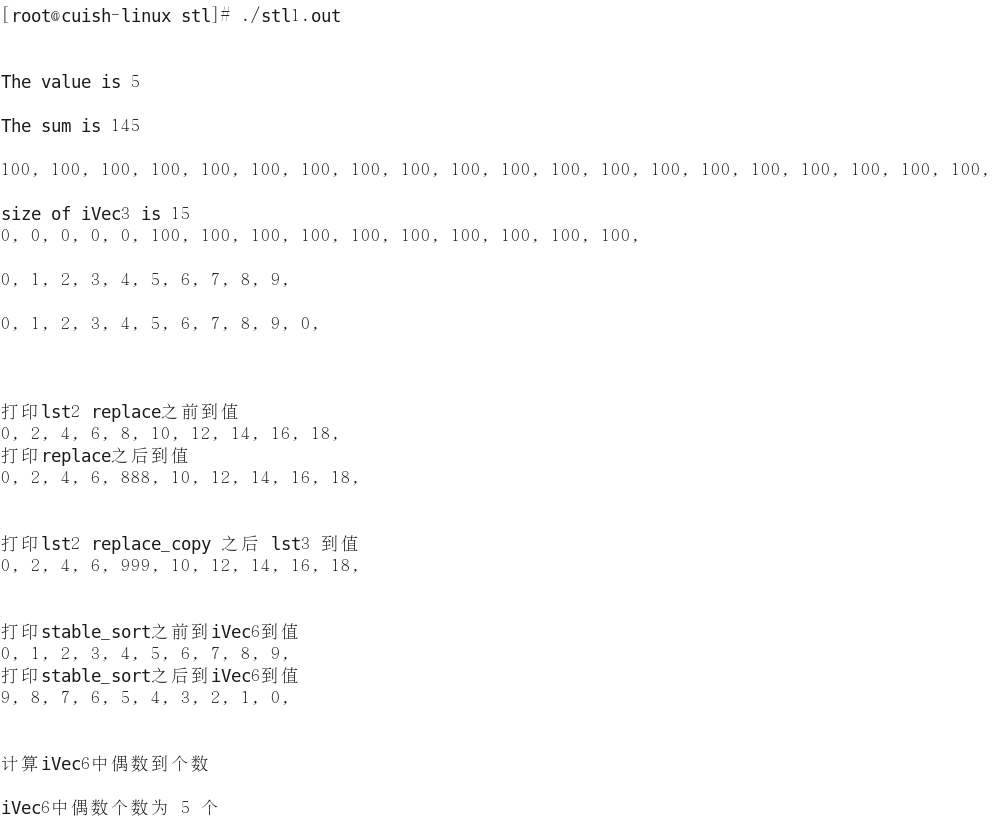
执行结果
【STL】帮你复习STL泛型算法 一的更多相关文章
- STL的一些泛型算法
源地址:http://blog.csdn.net/byijie/article/details/8142859 从福州大学资料里摘下来的我现在能理解的泛型算法 algorithm min(a,b) 返 ...
- STL区间成员函数及区间算法总结
STL区间成员函数及区间算法总结 在这里总结下可替代循环的区间成员函数和区间算法: 相比单元素遍历操作,使用区间成员函数的优势在于: 1)更少的函数调用 2)更少的元素移动 3)更少的内存分配 在区间 ...
- stl之容器、迭代器、算法几者之间的关系
转自:https://blog.csdn.net/bobodem/article/details/49386131 stl包括容器.迭代器和算法: 容器 用于管理一些相关的数据类型.每种容器都有它的优 ...
- Effective STL 学习笔记 31:排序算法
Effective STL 学习笔记 31:排序算法 */--> div.org-src-container { font-size: 85%; font-family: monospace; ...
- 泛型编程、STL的概念、STL模板思想及其六大组件的关系,以及泛型编程(GP)、STL、面向对象编程(OOP)、C++之间的关系
2013-08-11 10:46:39 介绍STL模板的书,有两本比较经典: 一本是<Generic Programming and the STL>,中文翻译为<泛型编程与STL& ...
- C++ Primer 学习笔记_45_STL实践与分析(19)--泛型算法的结构
STL实践与分析 --泛型算法的结构 引言: 正如全部的容器都建立在一致的设计模式上一样,算法也具有共同的设计基础. 算法最主要的性质是须要使用的迭代器种类.全部算法都指定了它的每一个迭代器形參可使用 ...
- C++ 泛型算法
<C++ Primer 4th>读书笔记 标准容器(the standard container)定义了很少的操作.标准库并没有为每种容器类型都定义实现这些操作的成员函数,而是定义了一组泛 ...
- C++的那些事:容器和泛型算法
一.顺序容器 1,标准库定义了3种类型的顺序容器:vector.list和deque.它们的差别主要在于访问元素的方式,以及添加或删除元素相关操作运算代价.标准库还提供了三种容器适配器:stack.q ...
- C++ Primer : 第十章 : 泛型算法 之 只读、写和排序算法
大多数算法都定义在<algorithm>头文件里,而标准库还在头文件<numeric>里定义了一组数值泛型算法,比如accumulate. ● find算法,算法接受一对迭代 ...
随机推荐
- lintcode 中等题:Submatrix sum is 0 和为零的子矩阵
和为零的子矩阵 给定一个整数矩阵,请找出一个子矩阵,使得其数字之和等于0.输出答案时,请返回左上数字和右下数字的坐标. 样例 给定矩阵 [ [1 ,5 ,7], [3 ,7 ,-8], [4 ,-8 ...
- NGUI中Button与原生2D精灵的混合使用
一些废话 每一篇的首段都是这个“一些废话”,原因是我太能逼逼了,不逼逼一些废话我就觉得难受.这是我第四篇关于Unity的博文,前两篇还是去年写的,“从一点儿不会开始”系列,类似教程和学习笔记的博文,这 ...
- context:component-scan扫描使用上的容易忽略的use-default-filters
问题 如下方式可以成功扫描到@Controller注解的Bean,不会扫描@Service/@Repository的Bean.正确 <context:component-scan base-pa ...
- Maven找不到java编译器的问题
当使用mvn package打包项目的时候,抛出下面这个错误: [ERROR] Unable to locate the Javac Compiler in: D:\jdk\..\lib\tools. ...
- sql 随笔 2015-07-02
sql 自定义函数 --检查函数是否存在 if exists (select * from dbo.sysobjects where id = object_id(N'dbo.pTitleCase') ...
- svn 版本升级的问题
原创文章,转载请注明 svn本地版本由1.6升级到1.7后,再使用时遇到一些问题,这里记录一下以备忘. 升级后,使用任何命令 不能用了,提示的意思大致是本地的workcopy版本太低了(之前用1.6版 ...
- hive学习笔记——表的基本的操作
1.hive的数据加载方式 1.1.load data 这中方式一般用于初始化的时候 load data [local] inpath '...' [overwrite] into table t1 ...
- iOS开发:视图生命周期
iOS应用的视图状态分为以下几种 在viewcontroller的父类UIViewController中可以看到如下代码,通过重写不同的方法对操作视图渲染. @available(iOS 2.0, * ...
- UVa 12034 (递推) Race
题意: 有n个人赛马,名次可能并列,求一共有多少种可能. 分析: 设所求为f(n),假设并列第一名有i个人,则共有C(n, i)种可能,接下来确定后面的名次,共有f(n-1)种可能 所以递推关系为: ...
- UVa 11584 Partitioning by Palindromes【DP】
题意:给出一个字符串,问最少能够划分成多少个回文串 dp[i]表示以第i个字母结束最少能够划分成的回文串的个数 dp[i]=min(dp[i],dp[j]+1)(如果从第j个字母到第i个字母是回文串) ...