
poj——1470 Closest Common Ancestors
| Time Limit: 2000MS | Memory Limit: 10000K | |
| Total Submissions: 20804 | Accepted: 6608 |
Description
Input
nr_of_vertices
vertex:(nr_of_successors) successor1 successor2 ... successorn
...
where vertices are represented as integers from 1 to n ( n <= 900 ). The tree description is followed by a list of pairs of vertices, in the form:
nr_of_pairs
(u v) (x y) ...
The input file contents several data sets (at least one).
Note that white-spaces (tabs, spaces and line breaks) can be used freely in the input.
Output
For example, for the following tree:
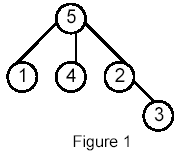
Sample Input
5
5:(3) 1 4 2
1:(0)
4:(0)
2:(1) 3
3:(0)
6
(1 5) (1 4) (4 2)
      (2 3)
(1 3) (4 3)
Sample Output
2:1
5:5
Hint
Source
#include<cstdio>
#include<vector>
#include<cstring>
#include<cstdlib>
#include<iostream>
#include<algorithm>
#define N 10100
using namespace std;
char ch;
vector<int>vec[N],que[N];
int t,s,n,m,x,y,num,qx[N],qy[N],fa[N],dad[N],ans[N],root,ans1[N];
int read()
{
    ,f=; char ch=getchar();
    ; ch=getchar();}
    +ch-'; ch=getchar();}
    return x*f;
}
int find(int x)
{
    if(fa[x]==x) return x;
    fa[x]=find(fa[x]);
    return fa[x];
}
int tarjan(int x)
{
    fa[x]=x;
    ;i<vec[x].size();i++)
     if(vec[x][i]!=dad[x])
      dad[vec[x][i]]=x,tarjan(vec[x][i]);
    ;i<que[x].size();i++)
     if(dad[y=qx[que[x][i]]^qy[que[x][i]]^x])
      ans1[que[x][i]]=find(y);
    fa[x]=dad[x];
}
void begin()
{
    ;i<=n;i++)
     vec[i].clear(),que[i].clear();
    memset(fa,,sizeof(fa));
    memset(ans,,sizeof(ans));
    memset(dad,,sizeof(dad));
    memset(ans1,,sizeof(ans1));
}
int main()
{
    while(scanf("%d",&t)!=EOF)
    {
        s=t;begin();
        while(t--)
        {
            x=read();
            n=read();
            ;i<=n;i++)
            {
                y=read();fa[y]=x;
                vec[x].push_back(y);
                vec[y].push_back(x);
             }
        }
        ;i<=s;i++)
         if(!fa[i]) root=i;
        memset(fa,,sizeof(fa));
        memset(ans,,sizeof(ans));
        m=read();
        ;i<=m;i++)
        {
            qx[i]=read(),qy[i]=read();
            que[qx[i]].push_back(i);
            que[qy[i]].push_back(i);
        }
        tarjan(root);
        ;i<=m;i++)
          ans[ans1[i]]++;
        ;i<=s;i++)
         if(ans[i]) printf("%d:%d\n",i,ans[i]);
    }
    ;
}
tarjan暴空间、、、
O(≧口≦)O气死了,蒟蒻表示以后再也不用tarjan了!!!!!!!!!!!!
#include<vector>
#include<cstdio>
#include<cstring>
#include<cstdlib>
#include<iostream>
#include<algorithm>
#define N 910
using namespace std;
vector<int>vec[N];
int n,m,s,x,y,dad[N],fa[N],top[N],deep[N],size[N],ans[N];
int read()
{
    ,f=; char ch=getchar();
    ; ch=getchar();}
    +ch-'; ch=getchar();}
    return x*f;
}
int lca(int x,int y)
{
    for(;top[x]!=top[y];)
    {
        if(deep[top[x]]<deep[top[y]])
         swap(x,y);
        x=fa[x];
    }
    if(deep[x]>deep[y])
     swap(x,y);
    return x;
}
int dfs(int x)
{
    size[x]=;
    deep[x]=deep[fa[x]]+;
    ;i<vec[x].size();i++)
     if(vec[x][i]!=fa[x])
    {
        fa[vec[x][i]]=x;
        dfs(vec[x][i]);
        size[x]+=size[vec[x][i]];
    }
}
int dfs1(int x)
{
    ;
    if(!top[x]) top[x]=x;
    ;i<vec[x].size();i++)
     if(vec[x][i]!=fa[x]&&size[t]<size[vec[x][i]])
      t=vec[x][i];
    if(t) top[t]=top[x],dfs1(t);
    ;i<vec[x].size();i++)
     if(vec[x][i]!=fa[x]&&vec[x][i]!=t)
      dfs1(vec[x][i]);
}
int begin()
{
    ;i<=n;i++)
      vec[i].clear();
    memset(fa,,sizeof(fa));
    memset(top,,sizeof(top));
    memset(ans,,sizeof(ans));
    memset(dad,,sizeof(dad));
    memset(deep,,sizeof(deep));
    memset(size,,sizeof(size));
}
int main()
{
    while(scanf("%d",&n)!=EOF)
    {
        s=n;begin();
        while(n--)
        {
            x=read();m=read();
            ;i<=m;i++)
            {
                y=read();dad[y]=x;
                vec[x].push_back(y);
                vec[y].push_back(x);
            }
        }
        ;i<=s;i++)
         if(!dad[i])
          {dfs(i);dfs1(i);break;}
        m=read();
        ;i<=m;i++)
        {
            x=read(),y=read();
            ans[lca(x,y)]++;
        }
        ;i<=s;i++)
         if(ans[i]) printf("%d:%d\n",i,ans[i]);
    }
    ;
}
poj——1470 Closest Common Ancestors的更多相关文章
- POJ 1470 Closest Common Ancestors(最近公共祖先 LCA)
POJ 1470 Closest Common Ancestors(最近公共祖先 LCA) Description Write a program that takes as input a root ...
- POJ 1470 Closest Common Ancestors 【LCA】
任意门:http://poj.org/problem?id=1470 Closest Common Ancestors Time Limit: 2000MS Memory Limit: 10000 ...
- POJ 1470 Closest Common Ancestors (LCA,离线Tarjan算法)
Closest Common Ancestors Time Limit: 2000MS Memory Limit: 10000K Total Submissions: 13372 Accept ...
- POJ 1470 Closest Common Ancestors
传送门 Closest Common Ancestors Time Limit: 2000MS Memory Limit: 10000K Total Submissions: 17306 Ac ...
- POJ 1470 Closest Common Ancestors (LCA, dfs+ST在线算法)
Closest Common Ancestors Time Limit: 2000MS Memory Limit: 10000K Total Submissions: 13370 Accept ...
- poj 1470 Closest Common Ancestors LCA
题目链接:http://poj.org/problem?id=1470 Write a program that takes as input a rooted tree and a list of ...
- POJ - 1470 Closest Common Ancestors(离线Tarjan算法)
1.输出测试用例中是最近公共祖先的节点,以及这个节点作为最近公共祖先的次数. 2.最近公共祖先,离线Tarjan算法 3. /* POJ 1470 给出一颗有向树,Q个查询 输出查询结果中每个点出现次 ...
- POJ 1470 Closest Common Ancestors【近期公共祖先LCA】
版权声明:本文为博主原创文章,未经博主同意不得转载. https://blog.csdn.net/u013912596/article/details/35311489 题目链接:http://poj ...
- POJ 1470 Closest Common Ancestors【LCA Tarjan】
题目链接: http://poj.org/problem?id=1470 题意: 给定若干有向边,构成有根数,给定若干查询,求每个查询的结点的LCA出现次数. 分析: 还是很裸的tarjan的LCA. ...
随机推荐
- SpringBoot2.1.3修改tomcat参数支持请求特殊符号
最近遇到一个问题,比如GET请求中,key,value中带有特殊符号,请求会报错,见如下URL: http://xxx.xxx.xxx:8081/aaa?key1=val1&a.[].id=1 ...
- hihocoder offer收割编程练习赛11 C 岛屿3
思路: 并查集的应用. 实现: #include <iostream> #include <cstdio> using namespace std; ][]; int n, x ...
- CAS4.0 server 环境的搭建
1.上cas的官网下载cas server 官网地址:https://github.com/Jasig/cas/releases,下载好后 解压下载的 cas-server-4.0.0-release ...
- mysql提升效率
1.对查询进行优化,应尽量避免全表扫描,首先应考虑在 where 及 order by 涉及的列上建立索引. 2.应尽量避免在 where 子句中对字段进行 null 值判断,否则将导致引擎放弃使用索 ...
- 获取请求服务器传输协议http or https
$protocol = (!empty($_SERVER['HTTPS']) && $_SERVER['HTTPS'] !== 'off' || $_SERVER['SERVER_PO ...
- 数组(Arry)几个常用方法的详解
join() 方法用于把数组中的所有元素放入一个字符串.元素是通过指定的分隔符进行分隔的. arrayObject.join(separator)separator 可选.指定要使用的分隔符.如果省略 ...
- vue2.0 vue.set()
<!DOCTYPE html> <html lang="en"> <head> <meta charset="UTF-8&quo ...
- opencv-flag
http://blog.csdn.net/yiyuehuan/article/details/43701797 在Mat类中定义了这样一个成员变量: /*! includes several bit- ...
- 禁止浏览器static files缓存篇
由于CSS/JS文件经常需要改动,前端调试时是不希望浏览器缓存这些文件的. Meta法 目前在chrome调试还没有遇到问题,好用!此方法假设浏览器是个好人!很听我们的话! <meta http ...
- jq进度条
<!doctype html><html><head><meta charset="utf-8"><title>JQue ...