
线索二叉树的理解和实现(Java)
线索二叉树的基本概念
我们按某种方式对二叉树进行遍历,将二叉树中所有节点排序为一个线性序列,在该序列中,除第一个结点外每个结点有且仅有一个直接前驱结点;除最后一个结点外每一个结点有且仅有一个直接后继结点。
在有N个节点的二叉树中需要利用N+1个空指针添加线索,这是因为在N个节点的二叉树中,每个节点有2个指针,所以一共有2N个指针,除了根节点以外,每一个节点都有一个指针从它的父节点指向它,所以一共使用了N-1个指针,所以剩下2N-(N-1)也就是N+1个空指针;
我们利用这些空指针域来存放指向该节点的直接前驱或是直接后继的指针,则可由此信息直接找到在该遍历次序下的前驱结点或后继结点,从而比递归遍历提高了遍历速度,节省了建立系统栈所使用的存储空间;
这些被重新利用起来的空指针就被称为线索(Thread),加上了这些线索的二叉树就是线索二叉树
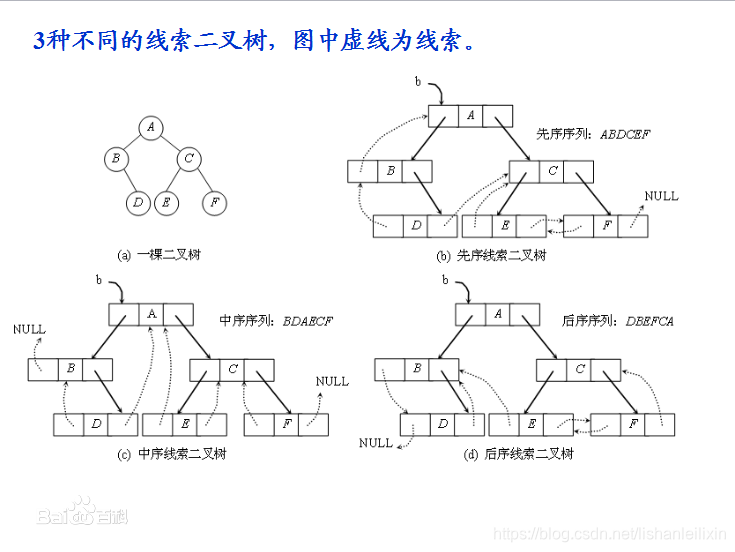
根据线索性质的不同,线索二叉树可以分为前序线索二叉树,中序线索二叉树,后序线索二叉树。
记node指向二叉链表中的一个结点,以下是建立线索的规则:
(1)如果node的左指针域为空,则存放指向某种遍历序列中该结点的前驱结点,这个结点称为node的前驱;
(2)如果node的右指针域为空,则存放指向中序遍历序列中该结点的后继结点。这个结点称为node的后继;
代码实现
修改二叉树节点数据结构,节点类:
package 线索二叉树;

public class ClueNode {

	private Object data;

	private ClueNode left;

	private ClueNode right;

	private boolean leftIsThread;

	private boolean rightIsThread;

	public ClueNode(Object data) {

		this.data = data;

		this.left = null;

		this.right = null;

		this.leftIsThread = false;

		this.rightIsThread = false;

	}

	public ClueNode(Object data, ClueNode left, ClueNode right, boolean leftIsThread, boolean rightIsThread) {

		this.data = data;

		this.left = left;

		this.right = right;

		this.leftIsThread = leftIsThread;

		this.rightIsThread = rightIsThread;

	}

	public Object getData() {

		return this.data;

	}

	public void setData(Object data ) {

		this.data = data;

	}

	public ClueNode getLeft() {

		return left;

	}

	public void setLeft(ClueNode left)

	{

		this.left = left;

	}

	public boolean isLeftIsThread()

	{

		return leftIsThread;

	}

	public void setLeftIsThread(boolean leftIsThread)

	{

		this.leftIsThread = leftIsThread;

	}

	public ClueNode getRight()

	{

		return right;

	}

	public void setRight(ClueNode right)

	{

		this.right = right;

	}

	public boolean isRightIsThread()

	{

		return rightIsThread;

	}

	public void setRightIsThread(boolean rightIsThread)

	{

		this.rightIsThread = rightIsThread;

	}

	public boolean equals(Object o) {

		if(o instanceof ClueNode) {

			ClueNode clue = (ClueNode)o;

			return (clue.getData() == this.data) ? true : false;

		}

		else return false;

	}

}
线索二叉树类:
package 线索二叉树;

public class ClueForkTree {

	private ClueNode preNode;

	//根据数组构建完全二叉树

	public static ClueNode createClueForkTree(Object[] array, int index) {

		ClueNode node = null;

		if(index < array.length) {

			node = new ClueNode(array[index]);

			ClueNode left = createClueForkTree(array, index * 2 + 1);

			ClueNode right = createClueForkTree(array, index * 2 + 2);

			node.setLeft(left);

			node.setRight(right);

			return node;

		}

		else return null;

	}

	//中序线索化二叉树

	public void inThReading(ClueNode node) {

		if(node == null) return;

		inThReading(node.getLeft());

		if(node.getLeft() == null) {

			node.setLeft(preNode);

			node.setLeftIsThread(true);

		}

		if(preNode != null && preNode.getRight() == null) {

			preNode.setRight(node);

			preNode.setRightIsThread(true);

		}

		preNode = node;

		inThReading(node.getRight());

	}

	//中序按后继方式遍历线索二叉树

	public void inThreadList(ClueNode node) {

		while(node != null && !node.isLeftIsThread()) {

			node = node.getLeft();

		}

		while(node != null) {

			System.out.print(node.getData() + ",");

			if(node.isRightIsThread()) {

				node = node.getRight();

			}

			else {

				node = node.getRight();

				while(node != null && !node.isLeftIsThread()) {

					node = node.getLeft();

				}

			}

		}

	}

	//中序按前驱方式遍历线索二叉树

	public void inPreThreadList(ClueNode node) {

		while(node.getRight() != null && !node.isRightIsThread()) {

			node = node.getRight();

		}

		while(node != null) {

			System.out.print(node.getData() + ",");

			if(node.isLeftIsThread()) {

				node = node.getLeft();

			}

			else {

				node = node.getLeft();

				while(node.getRight() != null && !node.isRightIsThread()) {

					node = node.getRight();

				}

			}

		}

	}

	//前序线索化二叉树

	public void inThFrontReading(ClueNode node) {

		if(node == null) return;

		if(node.getLeft() == null) {

			node.setLeft(preNode);

			node.setLeftIsThread(true);

		}

		if(preNode != null && preNode.getRight() == null) {

			preNode.setRight(node);

			preNode.setRightIsThread(true);

		}

		preNode = node;

		if(!node.isLeftIsThread()) {

			inThFrontReading(node.getLeft());

		}

		if(!node.isRightIsThread()) {

			inThFrontReading(node.getRight());

		}

	}

	//前序按后继方式进行遍历二叉树

	public void preThreadList(ClueNode node) {

		while(node != null) {

			while(!node.isLeftIsThread()) {

				System.out.print(node.getData() + ",");

				node = node.getLeft();

			}

			System.out.print(node.getData() + ",");

			node = node.getRight();

		}

	}

	public static void main(String[] args) {

		String[] array = {"A", "B", "C", "D", "E", "F", "G", "H"};

		ClueNode root = createClueForkTree(array, 0);

		ClueForkTree tree = new ClueForkTree();

		tree.inThReading(root);

		System.out.println("中序按后继节点遍历线索二叉树结果:");

	    tree.inThreadList(root);

	    System.out.println("\n中序按前驱节点遍历线索二叉树结果:");

        tree.inPreThreadList(root);

        ClueNode root1 = createClueForkTree(array, 0);

        tree.inThFrontReading(root1);

        tree.preNode = null;

        System.out.println("\n前序按后继节点遍历线索二叉树结果:");

        tree.preThreadList(root1);

	}

}
线索二叉树的理解和实现(Java)的更多相关文章
- 【Java】 大话数据结构(9) 树(二叉树、线索二叉树)
本文根据<大话数据结构>一书,对Java版的二叉树.线索二叉树进行了一定程度的实现. 另: 二叉排序树(二叉搜索树) 平衡二叉树(AVL树) 二叉树的性质 性质1:二叉树第i层上的结点数目 ...
- 【PHP数据结构】完全二叉树、线索二叉树及树的顺序存储结构
在上篇文章中,我们学习了二叉树的基本链式结构以及建树和遍历相关的操作.今天我们学习的则是一些二叉树相关的概念以及二叉树的一种变形形式. 完全二叉树 什么叫完全二叉树呢?在说到完全二叉树之前,我们先说另 ...
- Atitit 深入理解命名空间namespace java c# php js
Atitit 深入理解命名空间namespace java c# php js 1.1. Namespace还是package1 1.2. import同时解决了令人头疼的include1 1.3 ...
- 数据结构《9》----Threaded Binary Tree 线索二叉树
对于任意一棵节点数为 n 的二叉树,NULL 指针的数目为 n+1 , 线索树就是利用这些 "浪费" 了的指针的数据结构. Definition: "A binary ...
- 线索二叉树Threaded binary tree
摘要 按照某种遍历方式对二叉树进行遍历,可以把二叉树中所有结点排序为一个线性序列.在该序列中,除第一个结点外每个结点有且仅有一个直接前驱结点:除最后一个结点外每一个结点有且仅有一个直接后继结点.这 ...
- 遍历二叉树 traversing binary tree 线索二叉树 threaded binary tree 线索链表 线索化
遍历二叉树 traversing binary tree 线索二叉树 threaded binary tree 线索链表 线索化 1. 二叉树3个基本单元组成:根节点.左子树.右子树 以L.D.R ...
- 理解和解决Java并发修改异常ConcurrentModificationException(转载)
原文地址:https://www.jianshu.com/p/f3f6b12330c1 理解和解决Java并发修改异常ConcurrentModificationException 不知读者在Java ...
- 树和二叉树->线索二叉树
文字描述 从二叉树的遍历可知,遍历二叉树的输出结果可看成一个线性队列,使得每个结点(除第一个和最后一个外)在这个线形队列中有且仅有一个前驱和一个后继.但是当采用二叉链表作为二叉树的存储结构时,只能得到 ...
- 图解中序遍历线索化二叉树,中序线索二叉树遍历,C\C++描述
body, table{font-family: 微软雅黑; font-size: 13.5pt} table{border-collapse: collapse; border: solid gra ...
随机推荐
- 5- 如何把MyEclipse中的web项目导入到Eclipse中运行
from: 如何把MyEclipse中的web项目导入到Eclipse中运行 2016年09月12日 20:57:51 dancheren 阅读数:35329 标签: eclipse 更多 个人分类: ...
- 枚举Enum转换为List,获取枚举的描述
代码: public class EnumberHelper { public static List<EnumberEntity> EnumToList<T>() { Lis ...
- jetty tutorial
http://www.eclipse.org/jetty/documentation/current/embedding-jetty.html#d0e18726 Version: 9.2.2-SNAP ...
- Centos 7 安装和配置Redis
一. 安装 操作系统:Centos 7. 最小化安装 redis版本: 4.0.6 服务器地址:*** 第一步:下载redis安装包(如果有新的,下载最新的redis安装包) wget http:// ...
- UI / UX设计师如何玩转用户心理学原理?
以下内容由Mockplus团队翻译整理,仅供学习交流,Mockplus是更快更简单的原型设计工具. 众所周知,心理学在APP的用户体验设计中起着非常重要的作用.通过了解我们的设计是如何被感知的,我们可 ...
- 从YouTube改版看“移动优先”——8个移动优先网站设计案例赏析
2011年,Luke Wroblewski大神提出了移动优先的设计理念.在当时看来这无疑是一个打破行业常规的新型设计原则.而在移动互联网大行其道的今天,谁遵守移动优先的设计理念,设计出最好的移动端网站 ...
- Send [1] times, still failed
com.alibaba.rocketmq.client.exception.MQClientException: Send [1] times, still failed, cost [696094] ...
- 2016-2017 《移动平台开发》实验三 敏捷开发与XP实践
概述 软件=程序+软件工程 软件企业=软件+商业模式 XP是一种轻量(敏捷).高效.低风险.柔性.可预测.科学而且充满乐趣的软件开发方式. 在更短的周期内,更早地提供具体.持续的反馈信息. 在迭代的进 ...
- Mixin模式
Mixin是JavaScript中用的最普遍的模式,几乎所有流行类库都会有Mixin的实现. Mixin是掺合,混合,糅合的意思,即可以就任意一个对象的全部或部分属性拷贝到另一个对象上. 从提供的接口 ...
- linux常见命令-查看磁盘空间
linux查看磁盘使用情况命令 1. 统一每个目录下磁盘的整体情况: df -h 2. 查看指定目录,在命令后直接放目录名,比如查看“usr”目录使用情况:df -h /usr/ 3. 查看当前目录 ...