
js程序设计03——面向对象
ECMAScript中有2中属性:数据属性、访问器属性。
数据属性是为了指定某对象的指定key上的一些行为,比如value是否可删除、修改、key可循环遍历等特点。而访问器属性不包含数据值,包含一堆get、set方法(非必须),读取访问对象属性时,采用getter、setter分别实现。
数据属性包括:
- Configurable:表示能否通过delete删除该属性,或者修改重新定义属性,默认false
- Enumerable:表示for-in循环返回属性,默认false
- Writable:表示能否修改属性值,默认false
- Value:包含这个数据的值
一旦把属性定义为不可配置的,就不能再把它变回可配置了:
var person = {};

Object.defineProperty(person,"name",{

  configurable:false,

  value:"admin"

});

//直接报错:TypeError: Cannot redefine property: name

Object.defineProperty(person,"name",{

  configurable:true,

  value:"test"

})
因为这里的"name"属性已经定义为configurable:false,即不可重新修改属性,所以再次修改会报错。
var person = {

  name:"我是没修改前的值",

  _age:22

};

Object.defineProperty(person,"age",{

  get:function(){

    return this._age;

  },

  set:function(newValue){

    if(newValue > this.age){

      this._age = newValue;

      this.name += " 哈哈,我是修改后的name值";

    }

  }

});

person.age = 22;

console.log(person);

person.age = 23;

console.log(person);
执行结果:
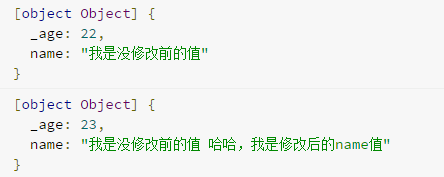
注意:这里的属性下划线是一种记号,表示只能通过对象方法访问的属性,这样一来,对该属性的读取会使用get、set来实现,如果只指定get表示不能写入,只指定set表示不能读取。
那么,如何一次性声明定义多个属性呢,可以使用Object的defineProperties方法,如下:
var person = {};

Objetc.defineProperties(person,{

  _name:{

    value:"chaozhou"

  },

  age:{

    value:23,

    set:function(newValue){

      this.age = newValue;

    },

    get:function(){

      return this.age;

    }

  },

  sex:{

    value:"男"

  }

});
关于对象创建(设计模式)
1、工厂模式
function createPerson(name,age){

  var o = new Object();

  o.name = name;

  o.age = age;

  o.sayName = function(){

    console.log(this.name);

  }

  return o;

}

var p = new createPerson("admin",23);

p.sayName();   //"admin"
2、构造器模式
function Person(name,age){

  this.name = name;

  this.age = age;

  this.sayName = function(){

    console.log(this.name);

  }

}

var p = new Person("admin",23);

p.sayName();   //"admin"

console.log(p instanceof Object);  //true

console.log(p instanceof Person);  //true

function Person2(name,age){

  this.name = name;

  this.age = age;

  this.sayName = sayname;

}

function sayname(){

  console.log(this.name);

}

var p2 = new Person2("admin2",22);

p2.sayName();   //"admin2"

console.log(p2 instanceof Object);  //true

console.log(p2 instanceof Person2);  //true
3、原型模式
function Person(){

  Person.prototype.name = "admin";

  Person.prototype.age = 12;

  Person.prototype.sayName = function(){

    console.log(Person.prototype.name);

  };

}

var p1 = new Person();

p1.sayName();    //"admin"

function Person2(){}

Person2.prototype.name = "admin1";

Person2.prototype.age = 14;

Person2.prototype.sayName = function(){

  console.log(Person2.prototype.name);

};

var p1 = new Person2();

p1.sayName();   //"admin1"
原型模式下,所有对象实例共享prototype定义的属性和方法,相当于直接将这些信息添加到原型中。原型设计中的关系如下图(摘自:“javascript高级程序设计”):

自我理解与解释:创建Person构造函数后,Person默认拥有prototype属性,指向的是Person的原型,而Person的原型默认拥有constructor属性,该属性指向一个包含了prototype属性的函数的指针,即Person构造函数,Person原型中的其它属性比如name,是在Person原型属性之上添加的其它属性。person1、person2实例的prototype属性同是一个指向Person.prototype的指针。
判断对象是否是某原型:
Person.prototype.isPrototypeOf(person1) //判断person1内部是否含所有指向Person.prototype的指针
获取某对象的原型:
alert(Object.getPrototypeOf(person1) == Person.prototype); //true
使用delete操作符只能删除实例对象上的属性,不能删除原型上的同名属性:
首先看不使用delete时:
function Person2(){}

Person2.prototype.name = "我是原型的name";

Person2.prototype.age = 14;

Person2.prototype.sayName = function(){

  console.log(Person2.prototype.name);    //"我是原型的name"

  console.log(this.name);   //"我是实例的name"

};

var p1 = new Person2();

p1.name = "我是实例的name"

p1.sayName();
使用delete后:
function Person2(){}

Person2.prototype.name = "我是原型的name";

Person2.prototype.age = 14;

Person2.prototype.sayName = function(){

  console.log(Person2.prototype.name);    //"我是原型的name"

  console.log(this.name);   //"我是原型的name"

};

var p1 = new Person2();

p1.name = "我是实例的name"

delete p1.name;

p1.sayName();
判断实例中是否包含某属性hasOwnProperty使用:
function Person2(){}

Person2.prototype.name = "我是原型的name";

Person2.prototype.age = 14;

Person2.prototype.sayName = function(){

  console.log(this.name);   //"我是实例的name"

};

var p1 = new Person2();

p1.name = "我是实例的name"

p1.sayName();

console.log(p1.hasOwnProperty("name"));   //true

delete p1.name;

console.log(p1.hasOwnProperty("name"));   //false
相比于hasOwnProperty,in操作符可以判断该实例是否包含该属性,不管该属性存在于实例还是原型中,in可以单独使用,也可以在for-in循环(只能遍历数据属性中Enumerable为true的属性)中使用:
function Person2(){}

Person2.prototype.name = "我是原型的name";

Person2.prototype.age = 14;

Person2.prototype.sayName = function(){

  console.log(this.name);   //"我是实例的name"

};

var p = new Person2();

var arr = [];

for(var attr in p){

  arr.push(attr);

}

console.log(arr);  //["name", "age", "sayName"]
使用Object.keys同样可以列出所有对象属性,不同的是对原型使用会返回原型中的所有属性数组,对实例使用仅仅返回实例属性数组:
function Person2(){}

Person2.prototype.name = "我是原型的name";

Person2.prototype.age = 14;

Person2.prototype.sayName = function(){

  console.log(this.name);   //"我是实例的name"

};

var p = new Person2();

p.test = "admin"

console.log(Object.keys(Person2.prototype));   //["name", "age", "sayName"]

console.log(Object.keys(p));   //["test"]

console.log(Object.getOwnPropertyNames(Person2.prototype));  //["constructor", "name", "age", "sayName"] 获取所有原型属性(不管是否可枚举)
关于原型简写:
可以直接使用如下字面量形式简写:
function Person(){

}

//constructor 属性不再指向Person 了,而是指向Object

Person.prototype = {

  name:"admin",

  age:23,

  sayName:function(){

    console.log(this.name);

  }

};

var p = new Person();

console.log(p instanceof Object);   //true

console.log(p instanceof Person);   //true

console.log(p.constructor == Object);   //true

console.log(p.constructor == Person);   //false
简写之后只有一个问题,就是constructor指向变了,可以人为指定constructor指向:
function Person(){

}

//constructor 属性不再指向Person 了,而是指向Object

Person.prototype = {

  constructor:Person,

  name:"admin",

  age:23,

  sayName:function(){

    console.log(this.name);

  }

};

var p = new Person();

console.log(p instanceof Object);   //true

console.log(p instanceof Person);   //true

console.log(p.constructor == Object);   //false

console.log(p.constructor == Person);   //true
原型的动态性
也就说,可以先声明一个实例,然后修改实例原型某属性(如果修改整个原型,则情况有变),则修改后的原型属性或者方法实例可立即调用:
function Person(){

}

var p = new Person();

Person.prototype.name = "admin";

console.log(p.name);  //"admin"
组合使用构造模式及原型模式
function Person(name,age){

  this.name = name;

  this.age = age;

  this.friends = ["jefy","lorry"];

}

Person.prototype = {

  constructor:Person,

  sayName:function(){

    console.log(this.name);

  }

}

var p1 = new Person("p1",11);

var p2 = new Person("p2",22);

p1.friends.push("gatu");

console.log(p1.friends);   //["jefy", "lorry", "gatu"]

console.log(p2.friends);   //["jefy", "lorry"]

console.log(p1.friends === p2.friends);   //false

console.log(p1.sayName === p2.sayName);   //true
关于对象继承
function SuperType(){

  this.property = true;

}

SuperType.prototype.getSuperValue = function(){

  return this.property;

};

function SubType(){

  this.subproperty = false;

}

//继承了SuperType

SubType.prototype = new SuperType();

SubType.prototype.getSubValue = function (){

 return this.subproperty;

};

var instance = new SubType();

alert(instance.getSuperValue()); //true

alert(instance.getSubValue()); //false
继承实现的本质是重写原型对象,换句话说,原来存在于SuperType 的实例中的所有属性和方法,现在也存在于SubType.prototype 中了。在确立了继承关系之后,我们给SubType.prototype 添加了一个方法,这样就在继承了SuperType 的属性和方法的基础上又添加了一个新方法,结构如下:
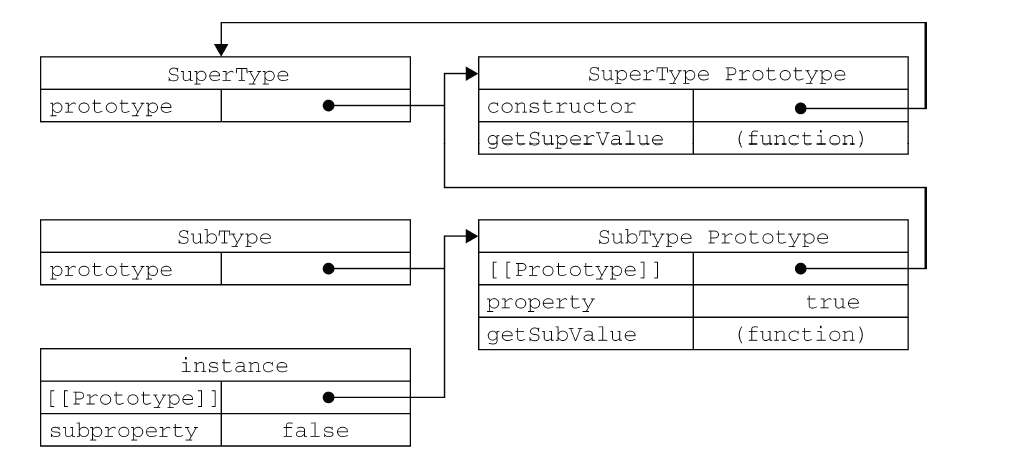
我们没有使用SubType 默认提供的原型,而是给它换了一个新原型;这个新原型就是SuperType 的实例。于是,新原型不仅具有作为一个SuperType 的实例所拥有的全部属性和方法,而且其内部还有一个指针,指向了SuperType 的原型。最终结果就是这样的:instance 指向SubType的原型, SubType 的原型又指向SuperType 的原型。getSuperValue() 方法仍然还在SuperType.prototype 中,但property 则位于SubType.prototype 中。这是因为property 是一个实例属性,而getSuperValue()则是一个原型方法。既然SubType.prototype 现在是SuperType的实例,那么property 当然就位于该实例中了。
关于应用类型值的原型问题
先看一个例子:
function SuperType(){

 this.colors = ["red", "blue", "green"];

}

function SubType(){

}

//继承了SuperType

SubType.prototype = new SuperType();

var instance1 = new SubType();

instance1.colors.push("black");

alert(instance1.colors); //"red,blue,green,black"

var instance2 = new SubType();

alert(instance2.colors); //"red,blue,green,black"
当SubType 通过原型链继承了SuperType 之后,SubType.prototype 就变成了SuperType 的一个实例,因此它也拥有了一个它自己的colors 属性——就跟专门创建了一个SubType.prototype.colors 属性一样。但结果是什么呢?结果是SubType 的所有实例都会共享这一个colors 属性。而我们对instance1.colors 的修改能够通过instance2.colors 反映出来,就已经充分证实了这一点。
如下方式可以解决这个问题:
function SuperType(){

  this.colors = ["red", "blue", "green"];

}

function SubType(){

//继承了SuperType

SuperType.call(this);

}

var instance1 = new SubType();

instance1.colors.push("black");

alert(instance1.colors); //"red,blue,green,black"

var instance2 = new SubType();

alert(instance2.colors); //"red,blue,green"
通过使用call()方法(或apply()方法也可以),我们实际上是在(未来将要)新创建的SubType 实例的环境下调用了SuperType 构造函数。这样一来,就会在新SubType 对象上执行SuperType()函数中定义的所有对象初始化代码。
借用构造函数向超类传递参数:
function SuperType(name){

  this.name = name;

}

function SubType(){

  //继承了SuperType,同时还传递了参数

  SuperType.call(this, "Nicholas");

  //实例属性

  this.age = ;

}

var instance = new SubType();

alert(instance.name); //"Nicholas";

alert(instance.age); //
组合继承
function SuperType(name){

this.name = name;

this.colors = ["red", "blue", "green"];

}

SuperType.prototype.sayName = function(){

alert(this.name);};

function SubType(name, age){

//继承属性

SuperType.call(this, name);

this.age = age;

}

//继承方法

SubType.prototype = new SuperType();

SubType.prototype.constructor = SubType;

SubType.prototype.sayAge = function(){

alert(this.age);

};

var instance1 = new SubType("Nicholas", );

instance1.colors.push("black");

alert(instance1.colors); //"red,blue,green,black"

instance1.sayName(); //"Nicholas";

instance1.sayAge(); //

var instance2 = new SubType("Greg", );

alert(instance2.colors); //"red,blue,green"

instance2.sayName(); //"Greg";

instance2.sayAge(); //
在这个例子中,SuperType 构造函数定义了两个属性:name 和colors。SuperType 的原型定义了一个方法sayName()。SubType 构造函数在调用SuperType 构造函数时传入了name 参数,紧接着又定义了它自己的属性age。然后,将SuperType 的实例赋值给SubType 的原型,然后又在该新原型上定义了方法sayAge()。这样一来,就可以让两个不同的SubType 实例既分别拥有自己属性——包括colors 属性,又可以使用相同的方法了。
js程序设计03——面向对象的更多相关文章
- Day046--JavaScript-- DOM操作, js中的面向对象, 定时
一. DOM的操作(创建,追加,删除) parentNode 获取父级标签 nextElementSibling 获取下一个兄弟节点 children 获取所有的子标签 <!DOCTYPEhtm ...
- 前端 ---JS中的面向对象
JS中的面向对象 创建对象的几种常用方式 1.使用Object或对象字面量创建对象 2.工厂模式创建对象 3.构造函数模式创建对象 4.原型模式创建对象 1.使用Object或对象字面量创建对象 ...
- python 全栈开发,Day52(关于DOM操作的相关案例,JS中的面向对象,定时器,BOM,client、offset、scroll系列)
昨日作业讲解: 京东购物车 京东购物车效果: 实现原理: 用2个盒子,就可以完整效果. 先让上面的小盒子向下移动1px,此时就出现了压盖效果.小盒子设置z-index压盖大盒子,将小盒子的下边框去掉, ...
- node.js 学习03
node.js学习03 解决浏览器接收服务端信息之后乱码的问题: 服务器通过设置http响应报文头,告诉浏览器使用相应的编码 来解析网页. res.setHeader('Content','text/ ...
- 前端JavaScript(3)-关于DOM操作的相关案例,JS中的面向对象、定时器、BOM、位置信息
小例子: 京东购物车 京东购物车效果: 实现原理: 用2个盒子,就可以完整效果. 先让上面的小盒子向下移动1px,此时就出现了压盖效果.小盒子设置z-index压盖大盒子,将小盒子的下边框去掉,就可以 ...
- 轻松理解JS中的面向对象,顺便搞懂prototype和__proto__
这篇文章主要讲一下JS中面向对象以及 __proto__,ptototype和construcator,这几个概念都是相关的,所以一起讲了. 在讲这个之前我们先来说说类,了解面向对象的朋友应该都知道, ...
- 086 01 Android 零基础入门 02 Java面向对象 01 Java面向对象基础 03 面向对象基础总结 01 面向对象基础(类和对象)总结
086 01 Android 零基础入门 02 Java面向对象 01 Java面向对象基础 03 面向对象基础总结 01 面向对象基础(类和对象)总结 本文知识点:面向对象基础(类和对象)总结 说明 ...
- 轻松理解JS中的面向对象,顺便搞懂prototype和__proto__的原理介绍
这篇文章主要讲一下JS中面向对象以及 __proto__,ptototype和construcator,这几个概念都是相关的,所以一起讲了. 在讲这个之前我们先来说说类,了解面向对象的朋友应该都知道, ...
- 重学js之JavaScript 面向对象的程序设计(创建对象)
注意: 本文章为 <重学js之JavaScript高级程序设计>系列第五章[JavaScript引用类型]. 关于<重学js之JavaScript高级程序设计>是重新回顾js基 ...
随机推荐
- storyboard xib下label怎么自适应宽度高度
先看需求:两个Label,要求蓝色的label紧跟在红色的label文字后面 ok首选正常添加约束 红色的Label添加宽度,高度,左边,上边约束 蓝色的Label添加宽度,高度,左边,和红色的水平 ...
- LeetCode OJ 274. H-Index
Given an array of citations (each citation is a non-negative integer) of a researcher, write a funct ...
- 同一web系统,不同端口的跨域问题
部署web系统的时候,发现了跨域问题,子系统是用Iframe嵌入到系统里面的,导致父窗口获取子系统的webService和图片时发现跨域问题,如下图所示:问题1:父窗口获取子系统的对象跨域 原因:用这 ...
- wpf 旋转效果
<Grid> <Grid.Triggers> <EventTrigger RoutedEvent="Page.Loaded"> <Begi ...
- ZT “樱花小萝莉”走红网络 网友:好想生个女儿
“樱花小萝莉”走红网络 网友:好想生个女儿 投递人 itwriter 发布于 2014-04-02 17:39 评论(3) 有717人阅读 原文链接 [收藏] « » 近日,一组被网友亲切地称呼 ...
- jsp学习--JSP运行原理,九大隐式对象和JSP常用标签
一.JSP运行原理 每个JSP 页面在第一次被访问时,WEB容器都会把请求交给JSP引擎(即一个Java程序)去处理.JSP引擎先将JSP翻译成一个_jspServlet(实质上也是一个servlet ...
- Windows CMD命令大全【转】
命令简介 cmd是command的缩写.即命令行 . 虽然随着计算机产业的发展,Windows 操作系统的应用越来越广泛,DOS 面临着被淘汰的命运,但是因为它运行安全.稳定,有的用户还在使用,所以一 ...
- 简单介绍智能DNS解析+双线路接入
导读:在讨论这个问题,其中群友老孤同志也提供了不少非常有参考价值的资料,所以我们再把这些资料再整理一次,从比较底层的技术原理上重新进行一次分析. 我们知道,因为南电信北网通现象的存在,我们的服务器 ...
- jquery css
jQuery提供css()的方法来实现嵌入式改变元素样式,css()方法在使用上具有多样性.其中一种接受两个输入参数:样式属性和样式值,它们之间用逗号分开.比如我们要改变链接颜色,我们可以使用下面的代 ...
- su - root 报su: incorrect password的错误
检查/bin/下面的文件的组属 和 sh 文件 的权限 是否有问题 例如:-rwxr-xr-x. 1 weblogic dba 34904 Jul 15 2011 /bin/su1 修改这个文件 ...