
[转帖]A Quick Look at the Huawei HiSilicon Kunpeng 920 Arm Server CPU
https://www.servethehome.com/a-quick-look-huawei-hisilicon-kunpeng-920-arm-server-cpu/
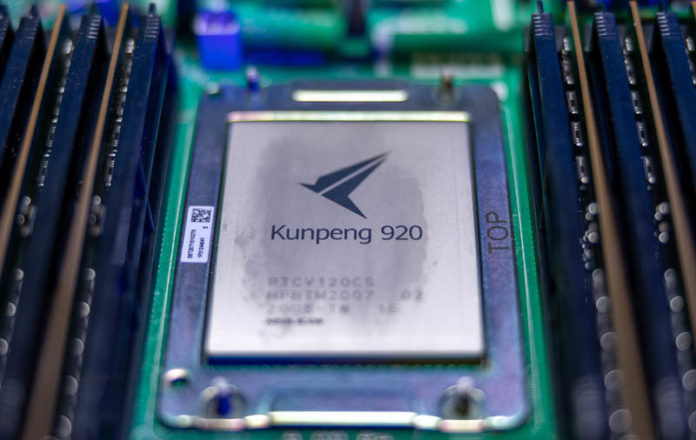 Huawei HiSilicon Kunpeng 920 1
Recently, we had the opportunity to take a look at the Huawei TaiShan 200 or 2280 server. The server we were able to get had two Huawei/ HiSilicon Kunpeng 920 Arm server CPUs. Each had 48 Armv8 cores, although the family scales to 64 cores per processor. In the server, we saw a number of very interesting features that we wanted to point out when it comes to the CPU itself. After publishing that piece, several folks asked to see the actual chip, and that is what we have today.
A Quick Look at the Banned Kunpeng 920 Arm Server CPU
In January 2019, we covered the Huawei Kunpeng 920 64-Core Arm Server CPU with CCIX and PCIe Gen4 Launch. Just for some perspective, Intel was still selling its Skylake server CPUs (1st Generation Intel Xeon Scalable) as its newest. Cascade Lake was still almost two quarters from launch but it was shipping. The AMD EPYC 7002 Series “Rome” was still almost three-quarters away. To be clear, when the new chip was launched, it felt like an ark of new technology.
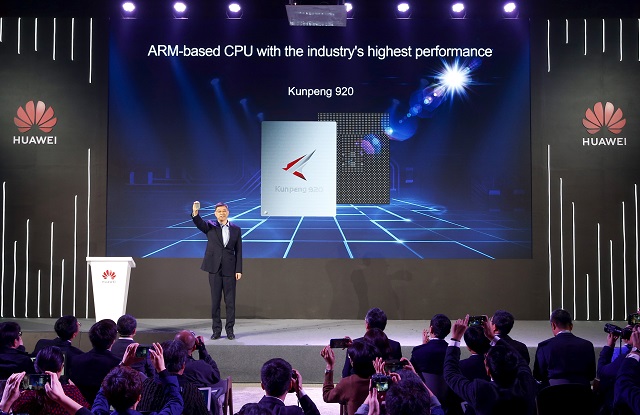 Huawei Kunpeng 920 Launch Cover
Huawei was using an Arm with up to 64 cores per socket. Intel was at 28 cores/ 56 threads and AMD was at 32 cores/ 64 threads in its still new x86 re-entry. It had 8 channels of DDR4 when the rest of the industry was at 6 channels (Intel) or 8 channels (AMD, but AMD “Naples” was very low volume.) Using PCIe Gen4 was not until Rome for AMD (2019) or Ice Lake for Intel (2021.) Beyond that, Huawei had 100GbE RoCE onboard. That was like the original idea with Zen/ Naples of having 10GbE, but just faster 25GbE links.
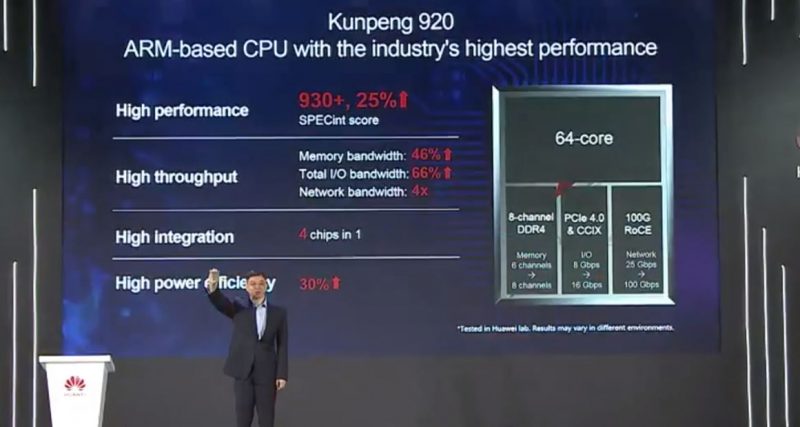 Huawei Kunpeng 920 Performance
Just for some sense, at SC18 in November 2018, Huawei’s booth had the HiSilicon Hi1616 on display in a number of servers. This was up to 32 cores and had only 1MB of L2 cache for 4 cores. It was also produced on 16nm. Frankly, this was a bit behind the Skylake Xeons of its day in terms of performance.
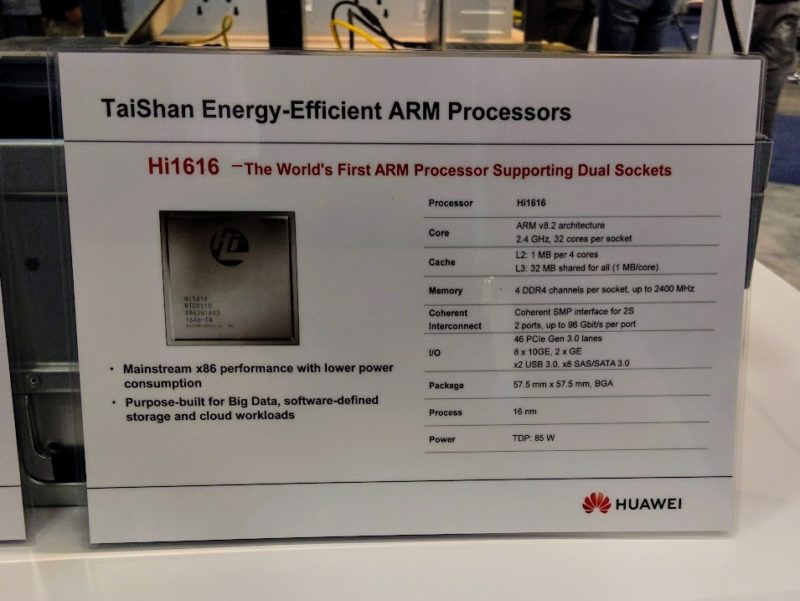 Huawei HiSilicon Hi1616 Placard At SC18
The Hi1616 was not just a placard. Instead, it was shown on the show floor in a number of different servers. We did not cover it at the time, but I looked through old photos, and I found a few shots.
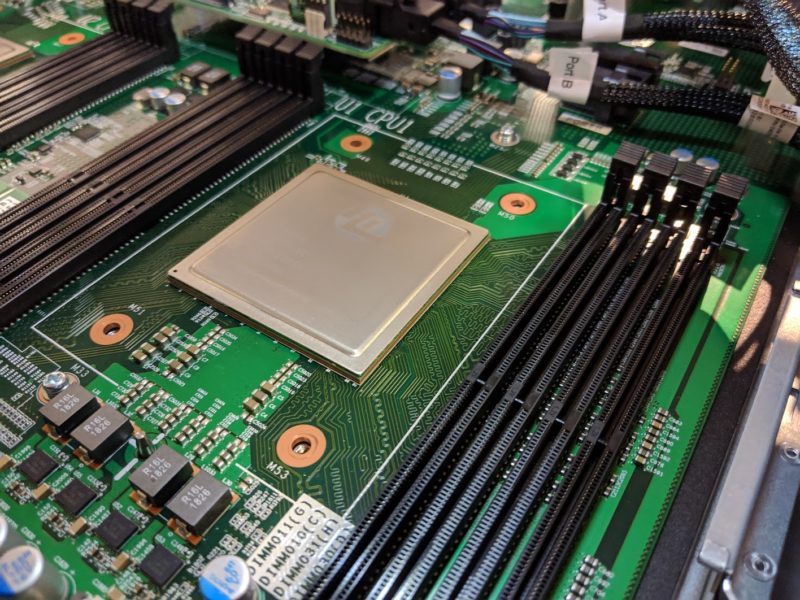 Huawei HiSilicon Hi1616 At SC18
What we did not necessarily know, was that the Hi1620 would come as a 7nm data center Arm processor before others. Just for some sense here, AWS Graviton2 at 64 vCPUswas launched over a year after we saw this at SC18 and almost a year after the Kunpeng 920 / Hi1620 launch.
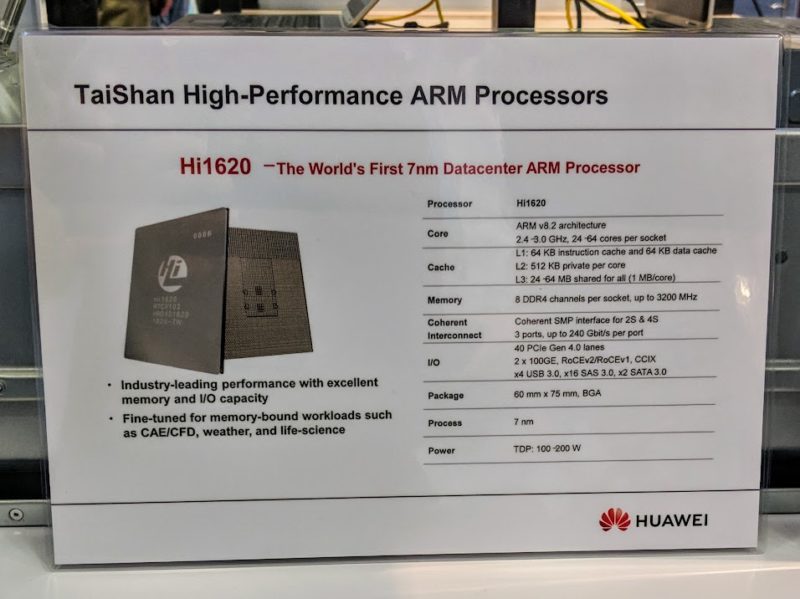 Huawei HiSilicon Hi1620 Placard At SC18
Huawei planned to use the new server CPUs in its TaiShan servers and has entire lines, like the TaiShan 200 (2280) that we just showed. The other main use case for this was in Huawei’s cloud.
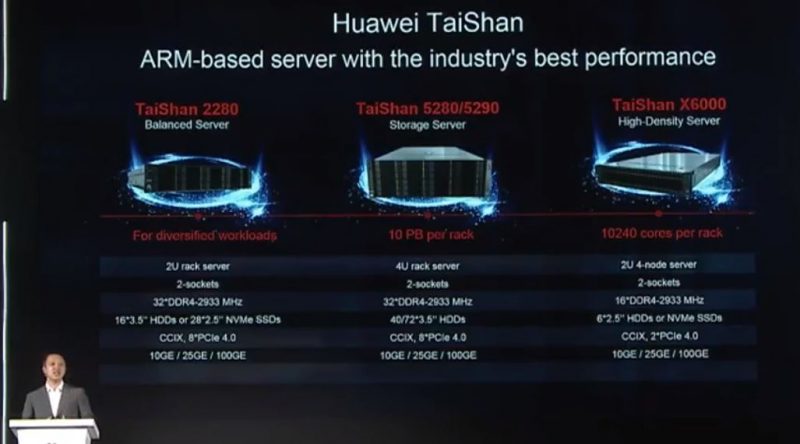 Huawei TaiShan Servers
We did not hear much else about the Kunpeng 920 until later in 2019 at Hot Chips when we saw that the Huawei Ascend 910 Provides a NVIDIA AI Training Alternative.
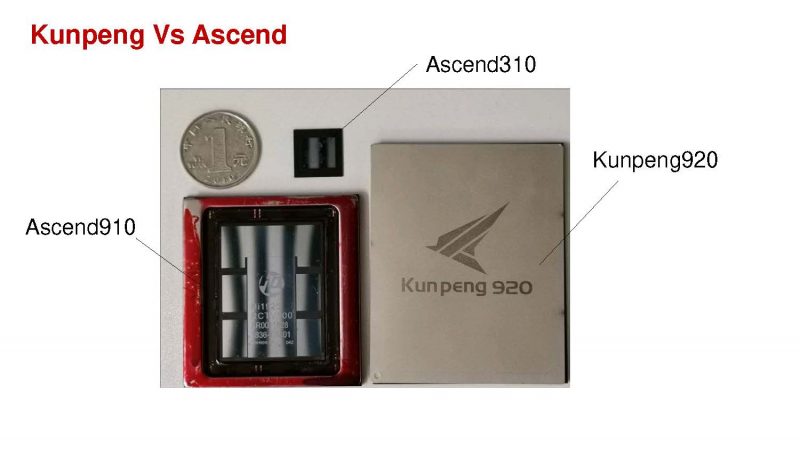 Huawei Ascend 910 310 And Kunpeng 920
Fast forward to our recent piece, and we now have a dual socket TaiShan 200 (2280) working. We can see the two sockets and 48 cores here. We did not have the 64 core models in our server.
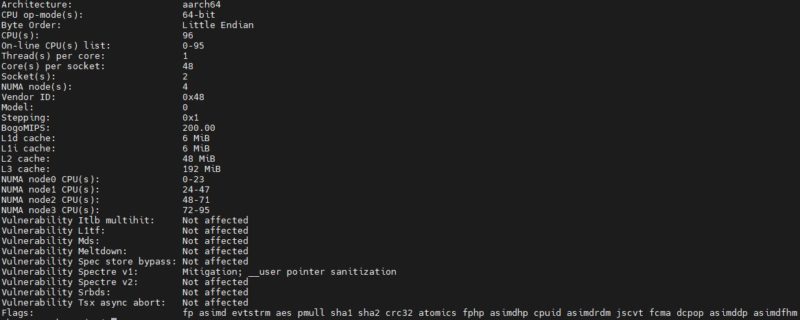 Huawei Kunpeng 920 2x 48c Lscpu Output
Here is the topology output.
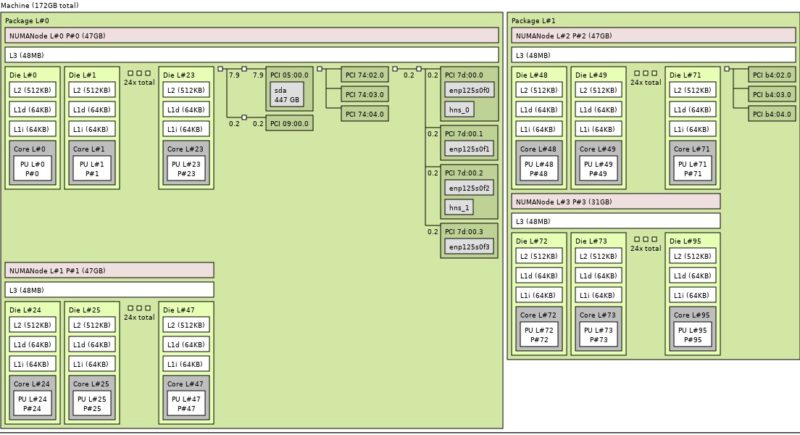 Huawei Kunpeng 920 2x 48c Topology
Just as a quick note here, this is a bigger deal for Huawei than for companies like Dell EMC, or HPE. Huawei both sells servers, and operates its own cloud. As a result, years ago it was granted access to both the Intel OEM as well as the Intel cloud provider’s price lists. For those that do not know, over a decade ago, Intel created two price lists, one for public clouds and one for server OEMs. The public cloud providers received enormous discounts on SKUs, and often special parts. Certain companies were effectively on the honor system to properly report if CPUs were being purchased and used in the cloud (at a steep discount.) One can imagine how that could be troublesome without a solid process behind it. Even with access to both price lists, Huawei building its own server CPUs was a big deal. We often discuss AWS as the pioneer of Arm instances and betraying Intel’s high discount/ lower margin structure. One could argue that Huawei was there was well, it is just something we hear less of in the US.
Still, let us get to the hardware.
A Quick Look at the Huawei HiSilicon Kunpeng 920 Arm Server CPU
A Quick Look at the Kunpeng 920 Arm Server CPU
Here is a photo of the Kunpeng 920 powered Huawei TaiShan 2280. One can see that there are two CPUs under the heatsinks. Each CPU has 16 DIMM slots for 8 channel DDR4-2933 and 2 DIMM per channel operation (2DPC.)
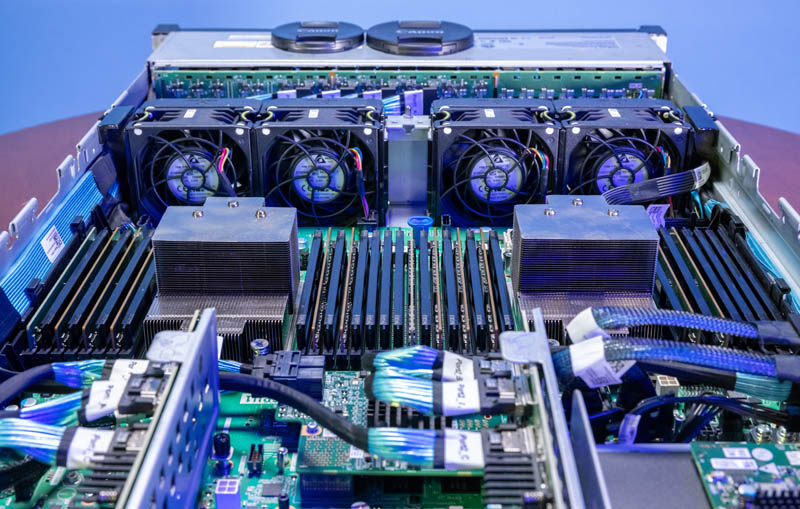 Huawei TaiShan 200 2280 CPU And Memory Area 1
Removing the heatsink, we can see a quite large CPU. In this section, we wanted to show a lot more around the actual chips, and some size comparisons, so this is going to be heavier on pictures than words.
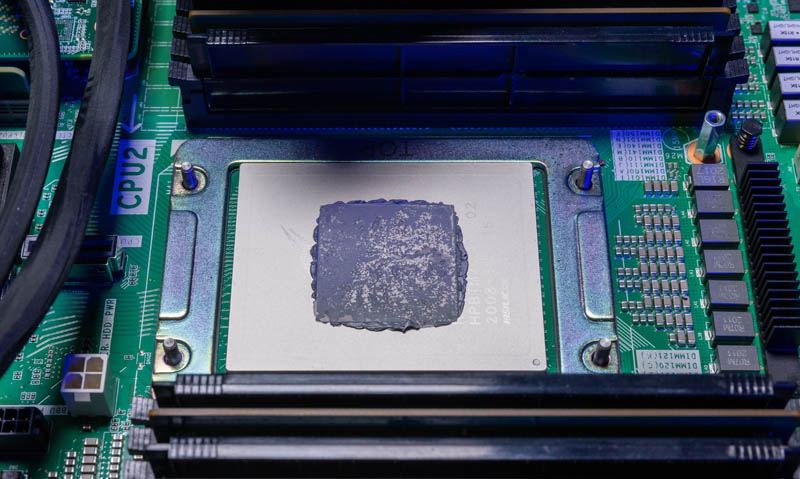 Huawei HiSilicon Kunpeng 920 Side With Thermal Paste Contact Area
Here is another angle. We can see that the chip is a BGA package. This was expected given the SC18 placard. It means that CPU is affixed to the motherboard and so this is not a socketed server.
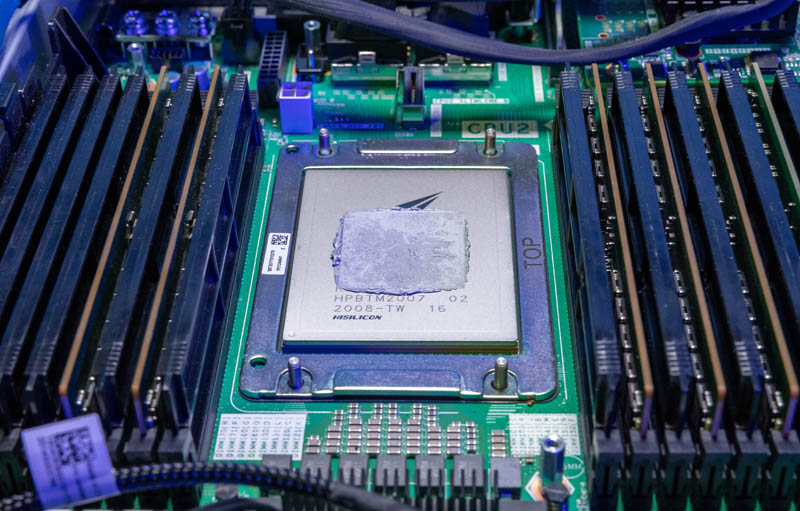 Huawei HiSilicon Kunpeng 920 Side With Thermal Paste Contact Area 3
Instead of a socket, around the CPU there is a brace structure. This is to provide a rigid mounting point for the heatsink assembly, but it is not holding the CPU in place.
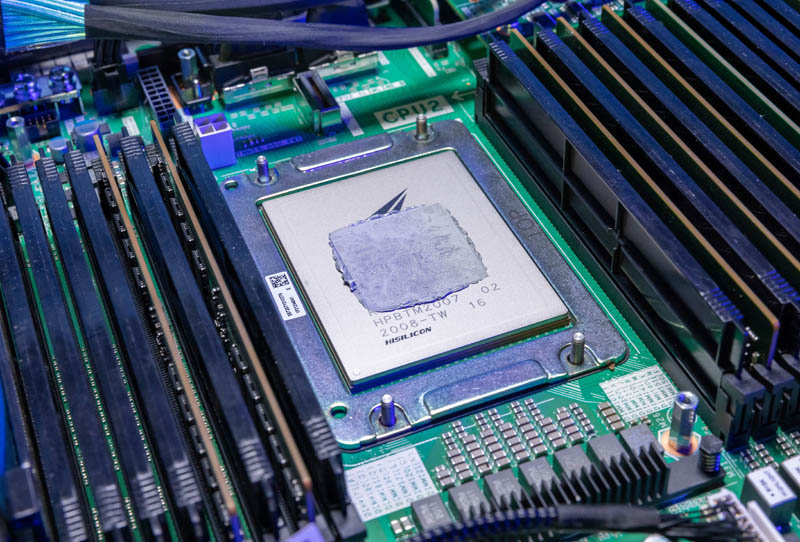 Huawei HiSilicon Kunpeng 920 Side With Thermal Paste Contact Area 2
At this point, and deliberately, we have left the thermal paste in place. Taking a look at the heatsink, we can see a matching contact patch.
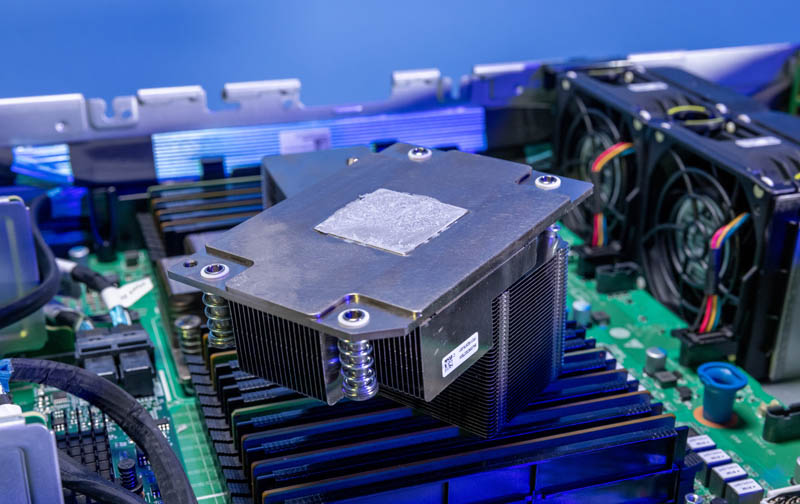 Huawei HiSilicon Kunpeng 920 TaiShan 200 Heatsink Contact Area
This smaller contact patch is raised. The entire heatsink is not designed to contact the CPU, just the middle section. This is different from what we see on AMD EPYC and Intel Xeon processors. For some frame of reference on the size of the contact patch, here is an Intel Xeon E5-2600 V4 chip next to the raised contact patch, both with thermal paste.
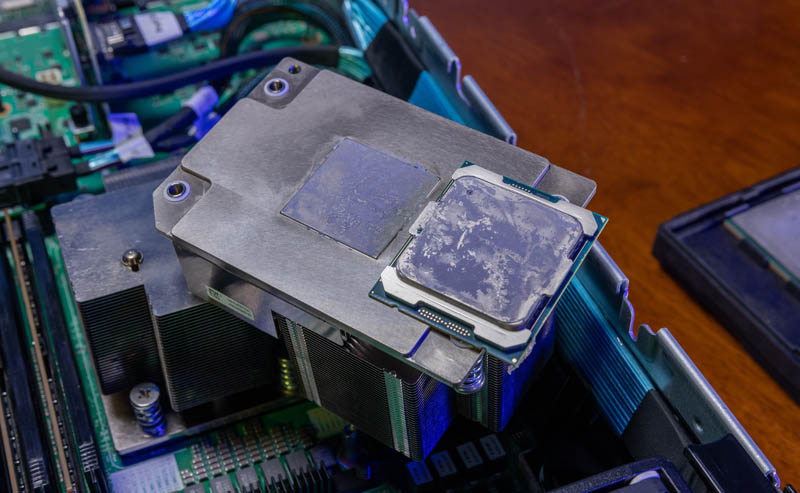 Huawei HiSilicon Kunpeng 920 Heatsink Contact Area Next To Intel Xeon E5 2600 V4 1
Here is the chip without the thermal paste, albeit with some residue. Apologies for that. The Kunpeng 920 has its HiSilicon marking and giant logo on it.
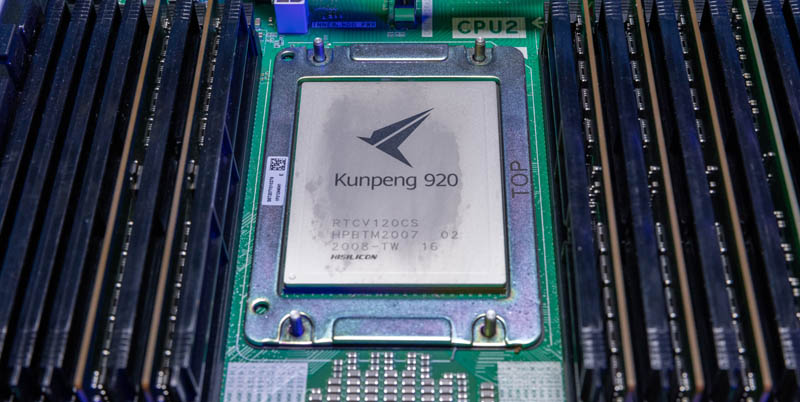 Huawei HiSilicon Kunpeng 920 2
Getting to some size comparisons, here is a 3rd Generation Intel Xeon Scalable “Ice Lake” CPU next to the Kunpeng 920, both with their thermal paste applied.
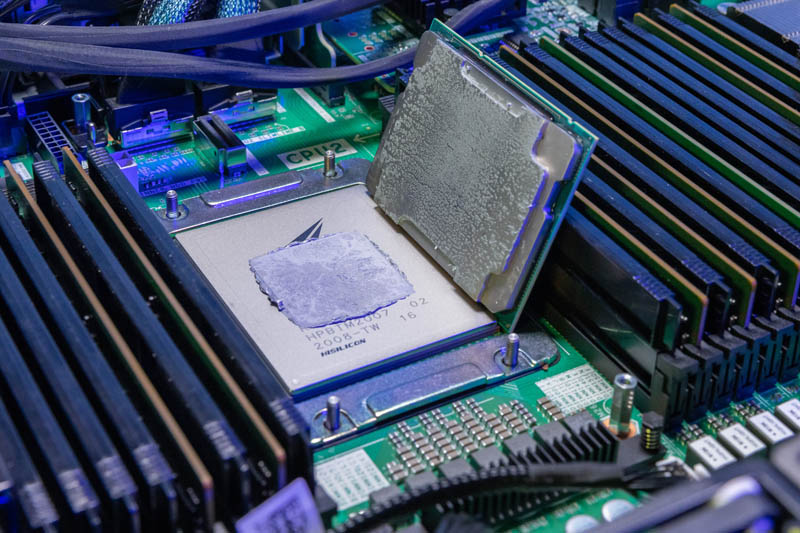 Huawei HiSilicon Kunpeng 920 Next To Intel Ice Lake Xeon
Here is an AMD EPYC 7003X processor next to the Kunpeng 920.
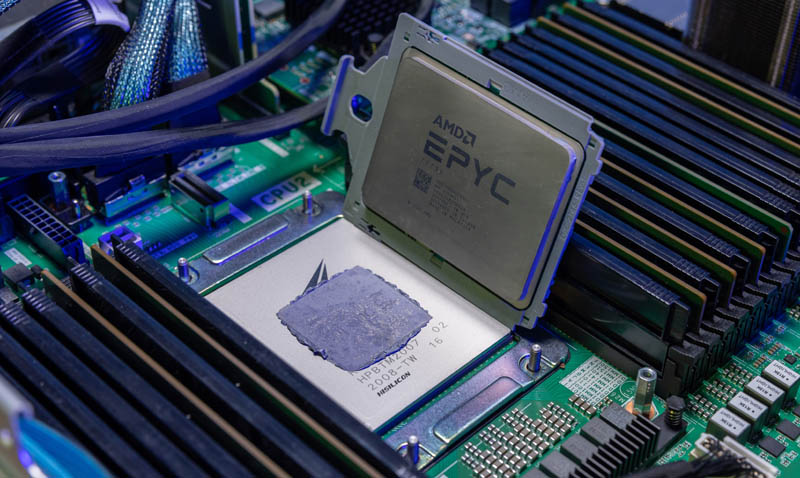 Huawei HiSilicon Kunpeng 920 Next To AMD EPYC Milan X
Here is another shot, but the EPYC is resting atop the DIMMs.
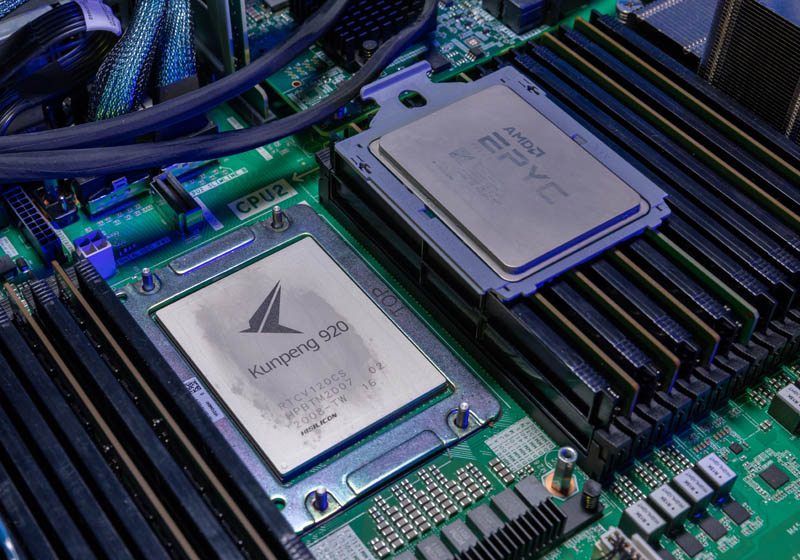 Huawei HiSilicon Kunpeng 920 Next To AMD EPYC Milan X 2
The Ampere Altra Max is much more similar in terms of scale. It is a large CPU package, just like the Kunpeng 920.
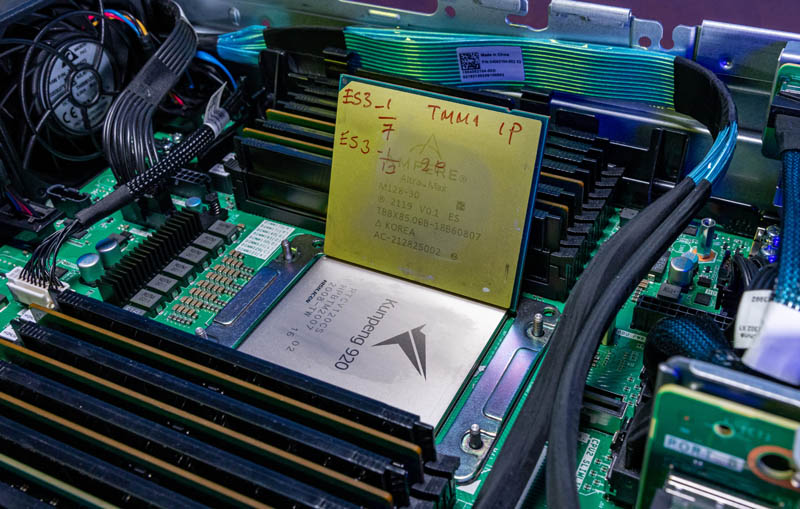 Huawei HiSilicon Kunpeng 920 Next To Ampere Altra Max M128 30 1
Some suggested that we photoshopped the yellow on that image. Actually, it was just lit like that. We had a blue light in the other direction but we used the yellow pictures more in our coverage.
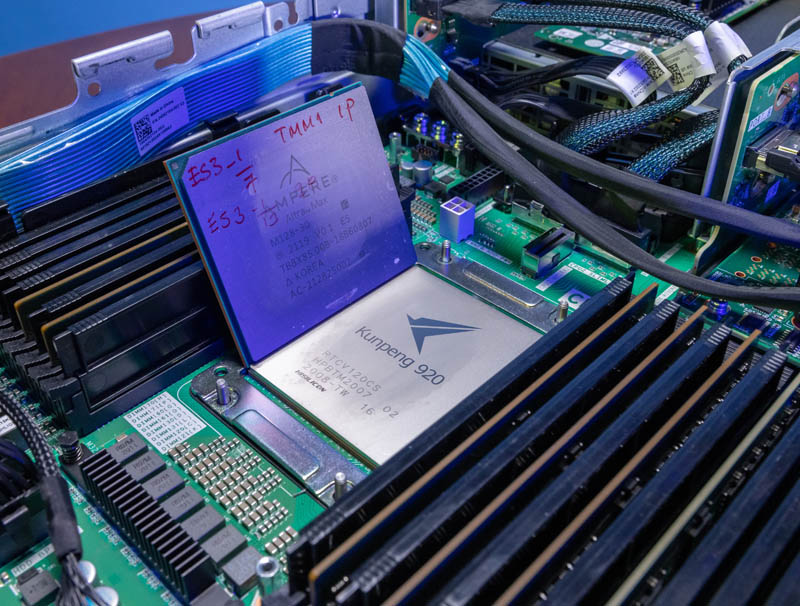 Huawei HiSilicon Kunpeng 920 Next To Ampere Altra Max M128 30 2
One can see that the Kunpeng 920 is maybe not as big as the Ampere Altra (Max) but it is noticeably bigger than the AMD EPYC 7003 (sans carrier) and the Intel Ice Lake Xeon.
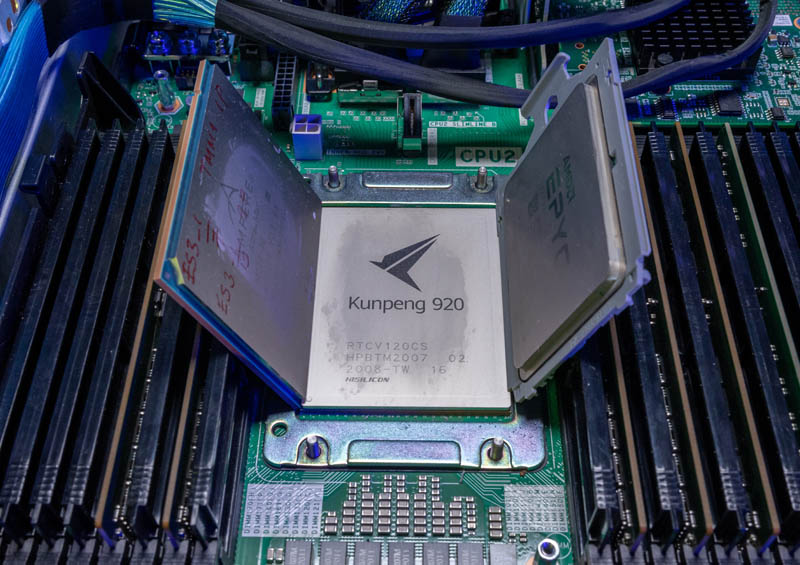 Huawei HiSilicon Kunpeng 920 Next To Ampere Altra Max M128 30 10
Of course, we were able to do this with the Ampere, AMD, and Intel chips because they are socketed while the Kunpeng 920 had to remain affixed to its motherboard because it is soldered.
Final Words
In 2019 when the Huawei HiSilicon Kunpeng 920 was first launched, it was a class-leading 7nm CPU. In Q3 2022, it is still a CPU being used in systems and clouds, but it is also showing its age. Not only has Ampere moved ahead, but AMD and Intel are also well beyond this generation of technology. Alibaba with the Arm-based Alibaba Cloud T-Head Yitian 710 has perhaps the fastest single-socket CPU, for integer workloads, not using accelerators, around. When we first saw this Kunpeng 920, it was a culmination of all kinds of new technology that made it really interesting. It just took us another 30 months to get them.
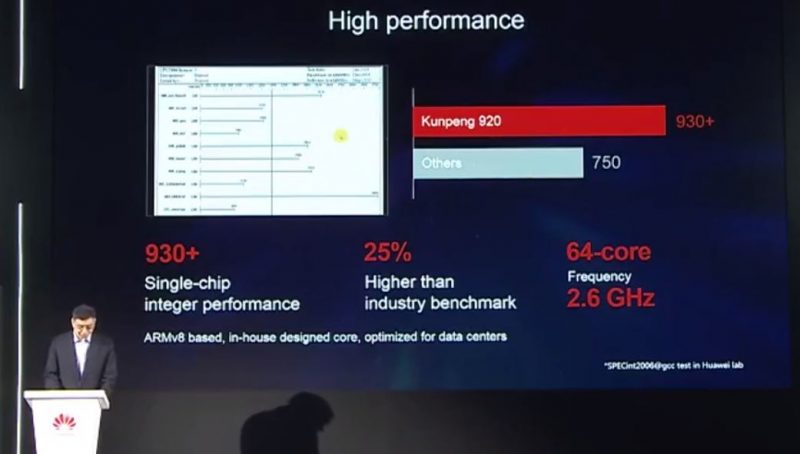 Huawei Kunpeng 920 2.6GHz Performance
With the new CPU, we have been working to get it ready for prime-time, but it is challenging. The firmware seems to be better suited to Huawei workloads than a lot of what we are trying to run. We have started to get results, as we showed in our recent Solidigm D7-P5520 7.68TB PCIe Gen4 NVMe SSD review but getting to this level took about a day of work just playing with the system and its settings.
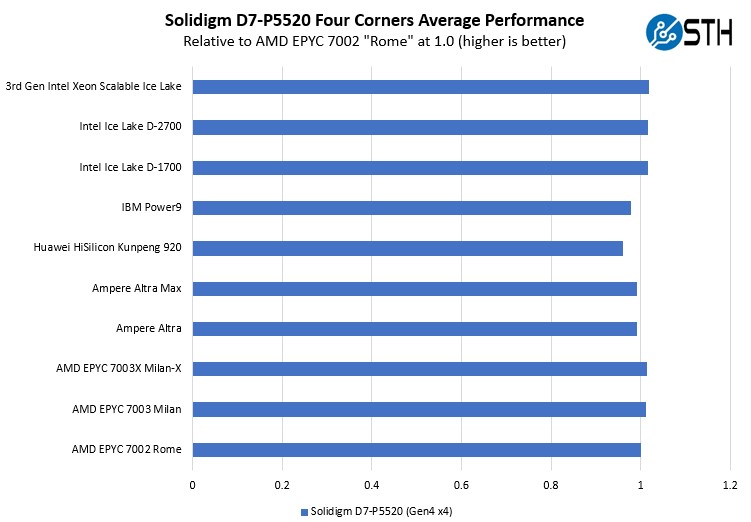 Solidigm SSD D7 P5520 Multiple CPU Architecture Performance Testing
This is one project that we will continue to work on, but expect to see figures from this server pop into more pieces as we get more confident in the results. So far, we are tracking that these CPUs on integer workloads, and not using accelerators, should be around that of a contemporary Cascade Lake 24-core processor.
Hopefully, this was a great look into a CPU that rarely gets seen. Since it is seen so infrequently in the US, many make assumptions about the chip that do not match reality. We hope our TaiShan 2280 piece as well as this one help to shed light on technology that is often referenced but rarely seen in the US and Canada.
[转帖]A Quick Look at the Huawei HiSilicon Kunpeng 920 Arm Server CPU的更多相关文章
- [转帖]VMware Vsphere 6.0安装部署 (三) vCenter Server安装
VMware Vsphere 6.0安装部署 (三) vCenter Server安装 2016年08月29日 14:59:14 dAng1r0Us 阅读数:72942 版权声明:本文为博主原创文 ...
- [转帖]SQLSERVER2008R2 将于2019.7.9 结束支持服务 Windows server 2008r2 将于 2020.1.14 结束支持
来源: https://cloudblogs.microsoft.com/sqlserver/2018/07/12/sql-server-2008-end-of-support-is-the-firs ...
- 【转帖】处理器史话 | 这张漫画告诉你,为什么双核CPU能打败四核CPU?
处理器史话 | 这张漫画告诉你,为什么双核CPU能打败四核CPU? https://www.eefocus.com/mcu-dsp/371324 2016-10-28 10:28 作者:付丽华预计 9 ...
- 【转帖】漏洞数量242:15,英特尔和AMD CPU谁更安全?
漏洞数量242:15,英特尔和AMD CPU谁更安全? http://www.eetop.cn/cpu_soc/6946340.html 越来越多的用户开始怀疑哪种处理器可以最好地保护他们的计算机,数 ...
- 自己家里搭建NAS服务器有什么好方案?
转自:https://www.zhihu.com/question/21359049 作者:陈二发链接:https://www.zhihu.com/question/21359049/answer/6 ...
- 编译FFmpeg成一个SO库<转>
转帖地址:http://www.ihubin.com/blog/android-ffmpeg-demo-3/ ============================================= ...
- FreeBSD 10 发布
发行注记:http://www.freebsd.org/releases/10.0R/relnotes.html 下文翻译中... 主要有安全问题修复.新的驱动与硬件支持.新的命名/选项.主要bug修 ...
- SharePoint 2013 内容部署功能简介
在之前的项目中,当客户有新的需求的时候,我们通常在测试环境上开发或者实施,然后手动在生产环境再弄一次.当发现内容部署这个东西,才知道这样是多么不合理的.我们可以创建两个网站集,一个用来修改,然后通过计 ...
- Darwin Streaming Server 6.0.3安装、订制、插件或模块
How to setup Darwin Streaming Server 6.0.3 on 32 or 64 bit Linux platforms, add custom functionality ...
- Some current MySQL Architecture writings
Posted on 19/09/2014 by Stewart Smith So, I’ve been looking around for a while (and a few times now) ...
随机推荐
- Salesforce LWC学习(四十六) record-picker组件浅谈
本篇参考: https://developer.salesforce.com/docs/platform/lwc/guide/reference-graphql.html https://develo ...
- CIDR技术划分和计算
CIDR:无类域间路由 由于早期的IP地址的划分会浪费太多的IP地址,所以,现在都是用CIDR表示法,为此引入了子网掩码的概念,即网络位的个数可以任意指定.该方法兼容早期的IP划分方法. CIDR表示 ...
- JVM学习-程序编译与优化
原文链接:https://gaoyubo.cn/blogs/89d6d9be.html 一.前端编译与优化 Java技术下讨论"编译期"需要结合具体上下文语境,因为它可能存在很多种 ...
- OPPO关停自研芯片公司哲库,这对行业将产生什么影响?
OPPO什么时候关停自研芯片公司哲库? 公元2023年5月12日,OPPO关停了自研芯片公司哲库.这也是汶川大地震的日子,而OPPO创始人是四川人,真是冥冥之中自有天意.OPPO公司在一份声明中表示, ...
- 2020-12-17:java和go,如何高效的拼接字符串?
福哥答案2020-12-17: java: stringbuilder 线程不安全. stringbuffer 线程安全. go:答案来自此链接: 1.在已有字符串数组的场合,使用 strings.J ...
- Asp .Net Core 系列:基于 Swashbuckle.AspNetCore 包 集成 Swagger
什么是 Swagger? Swagger 是一个规范和完整的框架,用于生成.描述.调用和可视化 RESTful 风格的 Web 服务.它提供了一种规范的方式来定义.构建和文档化 RESTful Web ...
- 神经网络入门篇:直观理解反向传播(Backpropagation intuition)
详细推导反向传播 下图是逻辑回归的推导: 回想一下逻辑回归的公式(参考公式1.2.公式1.5.公式1.6.公式1.15) 公式1.38: \[\left. \begin{array}{l} {x }\ ...
- 【技术控请进】华为云DevCloud深色模式开发解读
引言 近期,华为云DevCloud推出了开发者友好的深色模式,深受开发者们的喜爱和关注.大家都知道,深色模式(Dark Mode)在iOS13 引入该特性后各大应用和网站都开始支持了深色模式.在这之前 ...
- 对话 BitSail Contributor | 姚泽宇:新生火焰,未来亦可燎原
2022 年 10 月,字节跳动 BitSail 数据引擎正式开源.同期,社区推出 Contributor 激励计划第一期,目前已有 12 位开发者为 BitSail 社区做出贡献,成为了首批 Bit ...
- 标注BIO-精灵标注助手
目录 准备待标注数据 将待标数据生成文件 数据标注 下载标注软件 创建项目 标注数据 导出数据 ANN 转 BIO 推荐使用 Label Studio 准备待标注数据 创建 raw_data.txt ...