
【转载】 tensorflow中的batch_norm以及tf.control_dependencies和tf.GraphKeys.UPDATE_OPS的探究
版权声明:本文为博主原创文章,遵循 CC 4.0 BY-SA 版权协议,转载请附上原文出处链接和本声明。
本文链接:https://blog.csdn.net/huitailangyz/article/details/85015611
————————————————————————————————
笔者近来在tensorflow中使用batch_norm时,由于事先不熟悉其内部的原理,因此将其错误使用,从而出现了结果与预想不一致的结果。事后对其进行了一定的调查与研究,在此进行一些总结。
一、错误使用及结果
笔者最先使用时只是了解到了在tensorflow中tf.layers.batch_normalization这个函数,就在函数中直接将其使用,该函数中有一个参数为training,在训练阶段赋值True,在测试阶段赋值False。但是在训练完成后,出现了奇怪的现象时,在training赋值为True时,测试的正确率正常,但是training赋值为False时,测试正确率就很低。上述错误使用过程可以精简为下列代码段
is_traing = tf.placeholder(dtype=tf.bool)

input = tf.ones([1, 2, 2, 3])

output = tf.layers.batch_normalization(input, training=is_traing)

loss = ...

train_op = optimizer.minimize(loss)

with tf.Session() as sess:

    sess.run(tf.global_variables_initializer())

    sess.run(train_op)
二、batch_normalization
下面首先粗略的介绍一下batch_normalization,这种归一化方法的示意图和算法如下图,
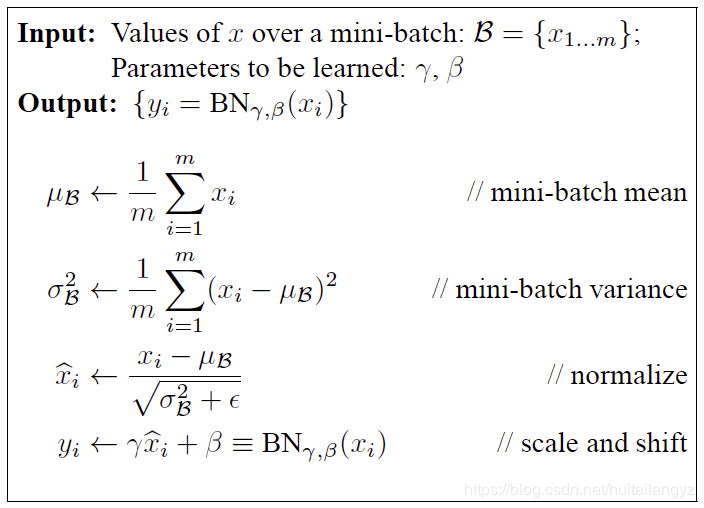
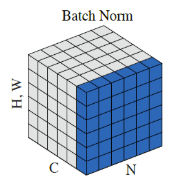
总的来说就是对于同一batch的input,假设输入大小为[batch_num, height, width, channel],逐channel地计算同一batch中所有数据的mean和variance,再对input使用mean和variance进行归一化,最后的输出再进行线性平移,得到batch_norm的最终结果。伪代码如下:
for i in range(channel):

    x = input[:,:,:,i]

    mean = mean(x)

    variance = variance(x)

    x = (x - mean) / sqrt(variance)

    x = scale * x + offset

    input[:,:,:,i] = x
在实现的时候,会在训练阶段记录下训练数据中平均mean和variance,记为moving_mean和moving_variance,并在测试阶段使用训练时的moving_mean和moving_variance进行计算,这也就是参数training的作用。另外,在实现时一般使用一个decay系数来逐步更新moving_mean和moving_variance,moving_mean = moving_mean * decay + new_batch_mean * (1 - decay)
三、tensorflow中的三种实现
tensorflow中关于batch_norm现在有三种实现方式。
1、tf.nn.batch_normalization(最底层的实现)
tf.nn.batch_normalization(

    x,

    mean,

    variance,

    offset,

    scale,

    variance_epsilon,

    name=None

)
该函数是一种最底层的实现方法,在使用时mean、variance、scale、offset等参数需要自己传递并更新,因此实际使用时还需自己对该函数进行封装,一般不建议使用,但是对了解batch_norm的原理很有帮助。
封装使用的实例如下:
import tensorflow as tf

def batch_norm(x, name_scope, training, epsilon=1e-3, decay=0.99):

    """ Assume nd [batch, N1, N2, ..., Nm, Channel] tensor"""

    with tf.variable_scope(name_scope):

        size = x.get_shape().as_list()[-1]

        scale = tf.get_variable('scale', [size], initializer=tf.constant_initializer(0.1))

        offset = tf.get_variable('offset', [size])

        pop_mean = tf.get_variable('pop_mean', [size], initializer=tf.zeros_initializer(), trainable=False)

        pop_var = tf.get_variable('pop_var', [size], initializer=tf.ones_initializer(), trainable=False)

        batch_mean, batch_var = tf.nn.moments(x, list(range(len(x.get_shape())-1)))

        train_mean_op = tf.assign(pop_mean, pop_mean * decay + batch_mean * (1 - decay))

        train_var_op = tf.assign(pop_var, pop_var * decay + batch_var * (1 - decay))

        def batch_statistics():

            with tf.control_dependencies([train_mean_op, train_var_op]):

                return tf.nn.batch_normalization(x, batch_mean, batch_var, offset, scale, epsilon)

        def population_statistics():

            return tf.nn.batch_normalization(x, pop_mean, pop_var, offset, scale, epsilon)

        return tf.cond(training, batch_statistics, population_statistics)

is_traing = tf.placeholder(dtype=tf.bool)

input = tf.ones([1, 2, 2, 3])

output = batch_norm(input, name_scope='batch_norm_nn', training=is_traing)

with tf.Session() as sess:

    sess.run(tf.global_variables_initializer())

    saver = tf.train.Saver()

    saver.save(sess, "batch_norm_nn/Model")
在batch_norm中,首先先计算了x的逐通道的mean和var,然后将pop_mean和pop_var进行更新,并根据是在训练阶段还是测试阶段选择将当批次计算的mean和var或者训练阶段保存的mean和var与新定义的变量scale和offset一起传递给tf.nn.batch_normalization
2、tf.layers.batch_normalization
tf.layers.batch_normalization(

    inputs,

    axis=-1,

    momentum=0.99,

    epsilon=0.001,

    center=True,

    scale=True,

    beta_initializer=tf.zeros_initializer(),

    gamma_initializer=tf.ones_initializer(),

    moving_mean_initializer=tf.zeros_initializer(),

    moving_variance_initializer=tf.ones_initializer(),

    beta_regularizer=None,

    gamma_regularizer=None,

    beta_constraint=None,

    gamma_constraint=None,

    training=False,

    trainable=True,

    name=None,

    reuse=None,

    renorm=False,

    renorm_clipping=None,

    renorm_momentum=0.99,

    fused=None,

    virtual_batch_size=None,

    adjustment=None

)
该函数也就是笔者之前使用的函数,在官方文档中写道
Note: when training, the moving_mean and moving_variance need to be updated.
By default the update ops are placed in tf.GraphKeys.UPDATE_OPS, so they need to be added as a dependency to the train_op.

Also, be sure to add any batch_normalization ops before getting the update_ops collection.
Otherwise, update_ops will be empty, and training/inference will not work properly. For example:
  x_norm = tf.layers.batch_normalization(x, training=training)

  # ...

  update_ops = tf.get_collection(tf.GraphKeys.UPDATE_OPS)

  with tf.control_dependencies(update_ops):

    train_op = optimizer.minimize(loss)
可以看到,与笔者之前的错误实现方法的差异主要在
update_ops = tf.get_collection(tf.GraphKeys.UPDATE_OPS)

  with tf.control_dependencies(update_ops):
这两句话,同时可以看到在第一种方法tf.nn.batch_normalization的封装过程中也用到了类似的处理方法,具体会在下一段进行说明。
3、tf.contrib.layers.batch_norm (slim)
tf.contrib.layers.batch_norm(

    inputs,

    decay=0.999,

    center=True,

    scale=False,

    epsilon=0.001,

    activation_fn=None,

    param_initializers=None,

    param_regularizers=None,

    updates_collections=tf.GraphKeys.UPDATE_OPS,

    is_training=True,

    reuse=None,

    variables_collections=None,

    outputs_collections=None,

    trainable=True,

    batch_weights=None,

    fused=None,

    data_format=DATA_FORMAT_NHWC,

    zero_debias_moving_mean=False,

    scope=None,

    renorm=False,

    renorm_clipping=None,

    renorm_decay=0.99,

    adjustment=None

)
这种方法与tf.layers.batch_normalization的使用方法差不多,两者最主要的差别在参数scale和centre的默认值上,这两个参数即是我们之前介绍原理时所说明的对input进行mean和variance的归一化之后采用的线性平移中的scale和offset,可以看到offset的默认值两者都是True,但是scale的默认值前者为True后者为False,也就是说明在tf.contrib.layers.batch_norm中,默认不对处理后的input进行线性缩放,只是加一个偏移。
四、关于tf.GraphKeys.UPDATA_OPS
介绍到这里,还有两个概念没有介绍,一个是tf.GraphKeys.UPDATE_OPS,另一个是tf.control_dependencies。
1、tf.control_dependencies
首先我们先介绍tf.control_dependencies,该函数保证其辖域中的操作必须要在该函数所传递的参数中的操作完成后再进行。请看下面一个例子。
import tensorflow as tf

a_1 = tf.Variable(1)

b_1 = tf.Variable(2)

update_op = tf.assign(a_1, 10)

add = tf.add(a_1, b_1)

a_2 = tf.Variable(1)

b_2 = tf.Variable(2)

update_op = tf.assign(a_2, 10)

with tf.control_dependencies([update_op]):

    add_with_dependencies = tf.add(a_2, b_2)

with tf.Session() as sess:

    sess.run(tf.global_variables_initializer())

    ans_1, ans_2 = sess.run([add, add_with_dependencies])

    print("Add: ", ans_1)

    print("Add_with_dependency: ", ans_2)


输出:

Add:  3

Add_with_dependency:  12
可以看到两组加法进行的对比,正常的计算图在计算add时是不会经过update_op操作的,因此在加法时a的值为1,但是采用tf.control_dependencies函数,可以控制在进行add前先完成update_op的操作,因此在加法时a的值为10,因此最后两种加法的结果不同。
2、tf.GraphKeys.UPDATE_OPS
关于tf.GraphKeys.UPDATE_OPS,这是一个tensorflow的计算图中内置的一个集合,其中会保存一些需要在训练操作之前完成的操作,并配合tf.control_dependencies函数使用。
关于在batch_norm中,即为更新mean和variance的操作。通过下面一个例子可以看到tf.layers.batch_normalization中是如何实现的。
import tensorflow as tf

is_traing = tf.placeholder(dtype=tf.bool)

input = tf.ones([1, 2, 2, 3])

output = tf.layers.batch_normalization(input, training=is_traing)

update_ops = tf.get_collection(tf.GraphKeys.UPDATE_OPS)

print(update_ops)

# with tf.control_dependencies(update_ops):

    # train_op = optimizer.minimize(loss)

with tf.Session() as sess:

    sess.run(tf.global_variables_initializer())

    saver = tf.train.Saver()

    saver.save(sess, "batch_norm_layer/Model")


输出:

 [<tf.Tensor 'batch_normalization/AssignMovingAvg:0' shape=(3,) dtype=float32_ref>,
  <tf.Tensor 'batch_normalization/AssignMovingAvg_1:0' shape=(3,) dtype=float32_ref>]
可以看到输出的即为两个batch_normalization中更新mean和variance的操作,需要保证它们在 train_op 前完成。
这两个操作是在tensorflow的内部实现中自动被加入tf.GraphKeys.UPDATE_OPS这个集合的,在tf.contrib.layers.batch_norm的参数中可以看到有一项updates_collections的默认值即为 tf.GraphKeys.UPDATE_OPS,
而在tf.layers.batch_normalization中则是直接将两个更新操作放入了上述集合。
五、关于最初的错误使用的思考
最后我对于一开始的使用方法为什么会导致错误进行了思考,tensorflow 中具体实现batch_normalization的代码在
tensorflow\python\layers\normalization.py中,下面展示一些关键代码。
( tf.layers.batch_normalization :)
if self.scale:

    self.gamma = self.add_variable(

          name='gamma',

          shape=param_shape,

          dtype=param_dtype,

          initializer=self.gamma_initializer,

          regularizer=self.gamma_regularizer,

          constraint=self.gamma_constraint,

          trainable=True)

else:

    self.gamma = None

if self.center:

    self.beta = self.add_variable(

          name='beta',

          shape=param_shape,

          dtype=param_dtype,

          initializer=self.beta_initializer,

          regularizer=self.beta_regularizer,

          constraint=self.beta_constraint,

          trainable=True)

else:

    self.beta = None

scale, offset = _broadcast(self.gamma), _broadcast(self.beta)

self.moving_mean = self._add_tower_local_variable(

          name='moving_mean',

          shape=param_shape,

          dtype=param_dtype,

          initializer=self.moving_mean_initializer,

          trainable=False)

self.moving_variance = self._add_tower_local_variable(

          name='moving_variance',

          shape=param_shape,

          dtype=param_dtype,

          initializer=self.moving_variance_initializer,

          trainable=False)

def _assign_moving_average(self, variable, value, momentum):

    with ops.name_scope(None, 'AssignMovingAvg', [variable, value, momentum]) as scope:

        decay = ops.convert_to_tensor(1.0 - momentum, name='decay')

        if decay.dtype != variable.dtype.base_dtype:

            decay = math_ops.cast(decay, variable.dtype.base_dtype)

        update_delta = (variable - value) * decay

        return state_ops.assign_sub(variable, update_delta, name=scope)

def _do_update(var, value):

    return self._assign_moving_average(var, value, self.momentum)

# Determine a boolean value for `training`: could be True, False, or None.

training_value = utils.constant_value(training)

if training_value is not False:

    mean, variance = nn.moments(inputs, reduction_axes, keep_dims=keep_dims)

    moving_mean = self.moving_mean

    moving_variance = self.moving_variance

    mean = utils.smart_cond(training,

                              lambda: mean,

                              lambda: moving_mean)

    variance = utils.smart_cond(training,

                                  lambda: variance,

                                  lambda: moving_variance)

else:

    new_mean, new_variance = mean, variance

mean_update = utils.smart_cond(

          training,

          lambda: _do_update(self.moving_mean, new_mean),

          lambda: self.moving_mean)

variance_update = utils.smart_cond(

          training,

          lambda: _do_update(self.moving_variance, new_variance),

          lambda: self.moving_variance)

if not context.executing_eagerly():

    self.add_update(mean_update, inputs=inputs)

    self.add_update(variance_update, inputs=inputs)

outputs = nn.batch_normalization(inputs,

                                     _broadcast(mean),

                                     _broadcast(variance),

                                     offset,

                                     scale,

                                     self.epsilon)
可以看到其内部逻辑和我在介绍tf.nn.batch_normalization一节中展示的封装时所使用的方法类似。
如果不在使用时添加tf.control_dependencies函数,即在训练时(training=True)每批次时只会计算当批次的mean和var,并传递给tf.nn.batch_normalization进行归一化,由于mean_update和variance_update在计算图中并不在上述操作的依赖路径上,因为并不会主动完成,也就是说,在训练时mean_update和variance_update并不会被使用到,其值一直是初始值。
因此在测试阶段(training=False)使用这两个作为mean和variance并进行归一化操作,这样就会出现错误。而如果使用tf.control_dependencies函数,会在训练阶段每次训练操作执行前被动地去执行mean_update和variance_update,因此moving_mean和moving_variance会被不断更新,在测试时使用该参数也就不会出现错误。
【转载】 tensorflow中的batch_norm以及tf.control_dependencies和tf.GraphKeys.UPDATE_OPS的探究的更多相关文章
- [转载]Tensorflow中reduction_indices 的用法
Tensorflow中reduction_indices 的用法 默认时None 压缩成一维
- tensorflow中的batch_norm以及tf.control_dependencies和tf.GraphKeys.UPDATE_OPS的探究
https://blog.csdn.net/huitailangyz/article/details/85015611#
- [转载]tensorflow中使用tf.ConfigProto()配置Session运行参数&&GPU设备指定
tf.ConfigProto()函数用在创建session的时候,用来对session进行参数配置: config = tf.ConfigProto(allow_soft_placement=True ...
- tensorflow笔记4:函数:tf.assign()、tf.assign_add()、tf.identity()、tf.control_dependencies()
函数原型: tf.assign(ref, value, validate_shape=None, use_locking=None, name=None) Defined in tensorflo ...
- 第二十二节,TensorFlow中RNN实现一些其它知识补充
一 初始化RNN 上一节中介绍了 通过cell类构建RNN的函数,其中有一个参数initial_state,即cell初始状态参数,TensorFlow中封装了对其初始化的方法. 1.初始化为0 对于 ...
- 第十四节,TensorFlow中的反卷积,反池化操作以及gradients的使用
反卷积是指,通过测量输出和已知输入重构未知输入的过程.在神经网络中,反卷积过程并不具备学习的能力,仅仅是用于可视化一个已经训练好的卷积神经网络,没有学习训练的过程.反卷积有着许多特别的应用,一般可以用 ...
- Tensorflow 中的优化器解析
Tensorflow:1.6.0 优化器(reference:https://blog.csdn.net/weixin_40170902/article/details/80092628) I: t ...
- [转]tensorflow中的gather
原文链接 tensorflow中取下标的函数包括:tf.gather , tf.gather_nd 和 tf.batch_gather. 1.tf.gather(params,indices,vali ...
- tensorflow中常量(constant)、变量(Variable)、占位符(placeholder)和张量类型转换reshape()
常量 constant tf.constant()函数定义: def constant(value, dtype=None, shape=None, name="Const", v ...
- tf.name_scope()和tf.variable_scope() (转)
网络层中变量存在两个问题: 随着层数的增多,导致变量名的增多: 在调用函数的时候,会重复生成变量,但他们存储的都是一样的变量. tf.variable不能解决这个问题. 变量作用域使用tf.var ...
随机推荐
- INFINI Labs 产品更新 | Easysearch 优化字段压缩提升写入速度,Console 优化数据迁移和校验等功能
INFINI Labs 产品又更新啦~.本次更新概要如下:Easysearch 增强 source_reuse 压缩功能,并大幅提升写入速度:Console 优化了数据迁移和校验功能,新增了通用的数据 ...
- MYSQL 连接数据库过程中发生错误,检查服务器是否正常连接字符串是否正确,错误信息:未将对象引用设置到对象的实例。
一: 中文提示 : 连接数据库过程中发生错误,检查服务器是否正常连接字符串是否正确,错误信息:未将对象引用设置到对象的实例.DbType="MySql";ConfigId=&quo ...
- vue3 父子组件间的传值通信
1.父转子 // 父组件 <template> <div> <div> <p>{{ count }}</p> <Son :countF ...
- gradle打包命令含离线模式
gradle打包命令gradlew clean 清理gradlew clean build -x test --refresh-dependencies 离线方式: gradlew --offline ...
- Big Exponential Addition
Big Exponential Addition 给定一非负整数n计算2^n的值,一般而言把 2 乘上 n 次,就能得到答案.然而,当n特别大时,2^n要一次次地乘2可能稍嫌太慢,面对此一巨大问题利用 ...
- UniRx-unirx中的对象池
UniRx-unirx中的对象池 对象池Unirxunity 对象池 一.对象池模式 <游戏设计模式-对象池模式> 1.概念 定义一个池对象,其包含了一组可重用对象. 其中每个可重用对象都 ...
- 洛谷 P5595 歌唱比赛
题目链接:歌唱比赛 思路 根据题目分析可得,假如小x的点赞数是123111,小y的点赞数是234111,则字符串的第4为到第6位结果都为Z,分别为对比(111,111),(11,11),(1,1),字 ...
- HTTP常见状态及其含义
HTTP常见状态及其含义 200: 请求成功 301: 被请求的资源已永久移动到新位置 302: 请求的资源现在临时从不同的URI响应请求 400: 1,语义有误当前请求无法被服务器理解2,请求参数有 ...
- python重拾第十一天-REDIS缓存数据库
缓存数据库介绍 NoSQL(NoSQL = Not Only SQL ),意即"不仅仅是SQL",泛指非关系型的数据库,随着互联网web2.0网站的兴起,传统的关系数据库在应付we ...
- AI Agent实战:智能检索在Kingbase数据库管理中的优势应用
前言 在信息技术飞速发展的今天,数据库管理已成为IT专业人员日常工作中不可或缺的一部分.然而,面对复杂的SQL问题,传统的web搜索往往难以提供精准的答案,尤其是在针对特定数据库系统,如金仓数据库时, ...