
性能优化-列表类型转换(ConvertList<TSource, TResult>)
之前,在项目中看到过一段通用列表类型转换的代码,直接的实现便是用反射。大概看了下,它用在领域模型转DTO和SOA接口中契约实体的转换等等。首先,它使用了反射,其次,还是在循环中使用,便有了优化的想法。
方法原型如:public static List<TResult> ConvertList<TSource, TResult>(List<TSource> source) where TResult : new(),下面贴出代码。说明一下,在此我没有任何的贬义,这段代码可能比较老,其次在项目中,首先是实现功能,如果当时没有更好的实现,就先实现功能,后面有时间可以在优化,毕竟项目有时间节点,个人自己平衡哈。
public class ObjectConvertHelperOld

    {

        /// <summary>

        /// 转换单个对象为另外一种类型对象

        /// </summary>

        /// <typeparam name="TSource">待转换的源对象类型</typeparam>

        /// <typeparam name="TResult">转换的目标对象类型</typeparam>

        /// <param name="source">待转换的源对象</param>

        /// <returns>转换的目标对象</returns>

        public static TResult ConvertObject<TSource, TResult>(TSource source) where TResult : new()

        {

            TResult result = new TResult();

            Type sourceType = source.GetType();

            Type resultType = result.GetType();

            PropertyInfo[] resultProperties = resultType.GetProperties(

                BindingFlags.Public | BindingFlags.Instance);

            if (resultProperties != null && resultProperties.Length > )

            {

                foreach (PropertyInfo resultProperty in resultProperties)

                {

                    if (resultProperty.PropertyType.IsGenericType)

                    {

                        continue;

                    }

                    PropertyInfo sourceProperty = sourceType.GetProperty(resultProperty.Name);

                    bool isMatched = sourceProperty != null &&

                            (!sourceProperty.PropertyType.IsGenericType) &&

                            (sourceProperty.PropertyType == resultProperty.PropertyType);

                    if (isMatched)

                    {

                        object currentValue = sourceProperty.GetValue(source, null);

                        resultProperty.SetValue(result, currentValue, null);

                    }

                }

            }

            return result;

        }

        /// <summary>

        /// 转换列表对象为另外一种列表对象

        /// </summary>

        /// <typeparam name="TSource">待转换的源对象类型</typeparam>

        /// <typeparam name="TResult">转换的目标对象类型</typeparam>

        /// <param name="source">待转换的源对象</param>

        /// <returns>转换的目标对象</returns>

        public static List<TResult> ConvertList<TSource, TResult>(List<TSource> source) where TResult : new()

        {

            return source.ConvertAll<TResult>(ConvertObject<TSource, TResult>);

        }

    }
从上面代码可以看出,它核心是从TSource类型到TResult类型转换,转换中,1、区分大小写,2、以TResult类型中的属性为准,如果源类型中有,就赋值过来(实际上是取两个实体属性的交集),3、还考虑字段是否是泛型等等。。。
如果熟悉Expression Tree的同学,可能就会想到,可以优化反射调用。老赵博客《表达式树与反射调用》系列中有详细实现,推荐大家去看看,绝对干货!我很多这方面的知识从这里学到的,非常感谢啊!
说一下优化思路,其实也不是什么思路了。利用类型字典和LambdaExpression的Compile方法为每组转换的类型缓存一个动态生成的委托。那么委托的调用和直接方法调用性能几乎是一样了。
有时候可能会涉及平台之间的契约转换,比如之前做的一个项目,在.net中调用第三方java的接口,java定义的契约,它的字段命名是camelCasing(小写开头,如:payAmount),我们之间约定是使用http post 数据传输格式采用json字符串,那么json字符串区分大小写,我们两边都使用序列化反序列化等。我这边就需要两份契约了,一份是第三方接口契约实体,采用小写开头命名,第二份是内部契约,采用.net 命名规则PascalCasing,来定义实体属性。这里将内部契约实体转换成第三方契约实体,PayAmount到payAmount的对应转换。
之前考虑的是属性映射区分大小写还是不区分,由调用者参数控制,对于这个需求,简化一下就是属性映射不区分大小写啦,2、以TResult类型中的字段为准(取交集),3、TResult对象的创建是在转换内部创建的,有没有可能这个TResult对象列表已经存在?对于为什么选择属性映射不区分大小写,考虑有二,1、.net中实体中属性的定义,一般不定义重名的(userId,UserId)2、对于TSource中字段和TResult字段完全相同,也不影响啊
优化代码如下:
public static class ObjectConvertHelper

    {

        private class InnerConversion<TSource, TResult>

        {

            private static readonly Func<TSource, TResult> s_convert;

            static InnerConversion()

            {

                s_convert = BuildConvert();

            }

            private static Func<TSource, TResult> BuildConvert()

            {//(x)=>new TResult{P1=x.p1,P2=x.p2,...};

                var paramExp = Expression.Parameter(typeof(TSource), "x");

                var sourcePropertyInfos = typeof(TSource).GetProperties(BindingFlags.Public | BindingFlags.Instance)

                                                                        .Where(p => p.CanRead && p.CanWrite);

                var resultPropertyInfos = typeof(TResult).GetProperties(BindingFlags.Public | BindingFlags.Instance)

                                                                        .Where(p => p.CanRead && p.CanWrite);

                var resultPropertyBindings = new List<MemberBinding>(resultPropertyInfos.Count());

                foreach (var item in resultPropertyInfos)

                {

                    //不区分大小写

                    PropertyInfo piIgnoreCase = sourcePropertyInfos.Where(x => string.Compare(x.Name, item.Name, true) == ).FirstOrDefault();

                    if (piIgnoreCase != null)

                    {

                        resultPropertyBindings.Add((MemberBinding)Expression.Bind(item, Expression.Property(paramExp, piIgnoreCase))

                                                   );

                    }

                }

                var body = Expression.MemberInit( // object initializer

                    Expression.New(typeof(TResult)), // ctor

                    resultPropertyBindings // property assignments

                );

                return Expression.Lambda<Func<TSource, TResult>>(body, paramExp).Compile();

            }

            /// <summary>

            /// 将TSource实体转换到TResult实体(属性匹配规则:1、不区分大小写,2、两个实体属性取交集,3、TResult实体内部创建)

            /// </summary>

            public static Func<TSource, TResult> Convert

            {

                get

                {

                    return s_convert;

                }

            }

        }

        /// <summary>

        /// 将一种类型列表转换为另一种类型列表

        /// </summary>

        /// <typeparam name="TSource"></typeparam>

        /// <typeparam name="TResult"></typeparam>

        /// <param name="sourceList"></param>

        /// <returns></returns>

        public static IList<TResult> ConvertList<TSource, TResult>(IList<TSource> sourceList)

            where TSource : class

            where TResult : class,new()

        {

            if (sourceList == null) { throw new ArgumentNullException("sourceList"); }

            if (sourceList.Count == )

            {

                return new List<TResult>();

            }

            return sourceList.Select(p => InnerConversion<TSource, TResult>.Convert(p)).ToList();

        }

        public static TResult Convert<TSource, TResult>(TSource source)

            where TSource : class

            where TResult : class,new()

        {

            if (source == null) { throw new ArgumentNullException("source"); }

            return InnerConversion<TSource, TResult>.Convert(source);

        }

        /// <summary>

        /// 浅拷贝实体

        /// </summary>

        /// <typeparam name="T"></typeparam>

        /// <param name="source"></param>

        /// <returns></returns>

        public static T ShallowClone<T>(T source) where T : class,new()

        {

            if (source == null) { throw new ArgumentNullException("source"); }

            return InnerConversion<T, T>.Convert(source);

        }

    }
类型字典(Type Dictionary):泛型类中的静态字段,会根据泛型的具体类型如InnerConversion<SourceEntity, ResultEntity>有一份对应的静态字段,具体可看装配脑袋文章等。由于系统中的类型个数有限,这样为每种类型缓存一份转换方法,可以说一劳永逸。动态生成委托Func<TSource, TResult>,很强大,可以做很多通用的功能,就像CLR帮我们写代码一样,可参考之前的《Expression Tree实践之通用Parse方法------"让CLR帮我写代码"》等。好了,下面来对比一下两者的性能吧,使用老赵的CodeTimer,测试代码如下:
class SourceEntity

        {

            public int UserId { get; set; }

            public string name { get; set; }

            public string p3 { get; set; }

            public string p4 { get; set; }

            public string p5 { get; set; }

            public string p6 { get; set; }

            public string p7 { get; set; }

            public string p8 { get; set; }

            public string p9 { get; set; }

            public string p10 { get; set; }

            public string p11 { get; set; }

            public string sourceOther { get; set; }

        }

        class ResultEntity

        {

            public int UserId { get; set; }

            public string Name { get; set; }

            public string P3 { get; set; }

            public string P4 { get; set; }

            public string P5 { get; set; }

            public string P6 { get; set; }

            public string P7 { get; set; }

            public string P8 { get; set; }

            public string P9 { get; set; }

            public string P10 { get; set; }

            public string P11 { get; set; }

            public string Comment { get; set; }

        }

        static List<SourceEntity> GenerateSources(int length)

        {

            List<SourceEntity> result = new List<SourceEntity>();

            for (int i = ; i < length; i++)

            {

                result.Add(new SourceEntity {

                    UserId=i,

                    name="stevey"+i,

                    p3=i.ToString(),

                    p4 = i.ToString(),

                    p5 = i.ToString(),

                    p6 = i.ToString(),

                    p7 = i.ToString(),

                    p8 = i.ToString(),

                    p9 = i.ToString(),

                    p10 = i.ToString(),

                    p11 = i.ToString(),

                    sourceOther="sourceOther"

                });

            }

            return result;

        }

        public static void Main(string[] args)

        {

            List<SourceEntity> sourceList = GenerateSources();//生成测试数据

            CodeTimer.Initialize();

            //对于10W个元素集合执行10次转换,如下

            CodeTimer.Time("常规反射实现的类型转换", , () => {

                var resultList = ObjectConvertHelperOld.ConvertList<SourceEntity, ResultEntity>(sourceList);

            });

            CodeTimer.Time("优化过的类型转换",, () => {

                var resultList = ObjectConvertHelper.ConvertList<SourceEntity, ResultEntity>(sourceList);

            });

            Console.ReadKey();

        }
在Release模式下编译后,对于10W个元素的列表执行10次结果如下:
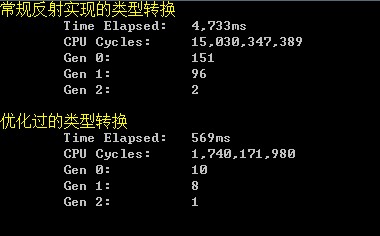
如果执行次数增加,还会有更大的差距,因为已经为类型缓存了委托,就几乎相当于直接方法调用了,而老的实现每次都需要反射SetValue。但是动态编译生成委托,这个过程比较耗时,可以作为初始化,只执行一次,后面就一劳永逸了。
执行100次的结果如下:
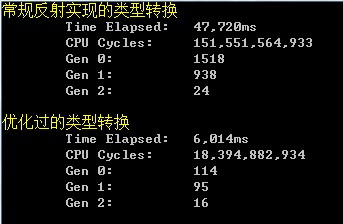
好了,就写到这里吧,如有不正之处还请指正,相互交流,共同进步~~
性能优化-列表类型转换(ConvertList<TSource, TResult>)的更多相关文章
- 列表类型转换(ConvertList<TSource, TResult>)
性能优化-列表类型转换(ConvertList<TSource, TResult>) 2013-12-16 16:55 by stevey, 426 阅读, 7 评论, 收藏, 编辑 之前 ...
- Web前端性能优化总结——如何提高网页加载速度
一.提高网页加载速度的必要性 国际知名的一组来自Jupiter Research的数据显示:购物者在访问网站过程中的不满会导致销售损失和品牌受损,其中 77%的人将不再访问网站 ,62%的人不再从该网 ...
- [daily][optimize] 一个小python程序的性能优化 (python类型转换函数引申的性能优化)
前天,20161012,到望京面试.第四个职位,终于进了二面.好么,结果人力安排完了面试时间竟然没有通知我,也没有收到短信邀请.如果没有短信邀请门口的保安大哥是不让我进去大厦的.然后,我在11号接到了 ...
- Vue2.5开发去哪儿网App 城市列表开发之 兄弟组件间联动及列表性能优化
一, 兄弟组件间联动 1. 点击城市字母,左侧对应显示 给遍历的 字母 添加一个点击事件: Alphabet.vue @click="handleLetterClick" ha ...
- h5列表页的性能优化
//0.还原状态 caoke.loading=false $(".loadbtn").text("点击加载更多") //1 还没有任何数据的情况 if(data ...
- 摘:JavaScript性能优化小知识总结
原文地址:http://www.codeceo.com/article/javascript-performance-tips.html JavaScript的性能问题不容小觑,这就需要我们开发人员在 ...
- 《Android开发艺术探索》读书笔记 (13) 第13章 综合技术、第14章 JNI和NDK编程、第15章 Android性能优化
第13章 综合技术 13.1 使用CrashHandler来获取应用的Crash信息 (1)应用发生Crash在所难免,但是如何采集crash信息以供后续开发处理这类问题呢?利用Thread类的set ...
- s性能优化方面的小知识
总结的js性能优化方面的小知识 前言 一直在学习javascript,也有看过<犀利开发Jquery内核详解与实践>,对这本书的评价只有两个字犀利,可能是对javascript理解的还不够 ...
- [转]C#程序性能优化
C#程序性能优化 1.显式注册的EvenHandler要显式注销以避免内存泄漏 将一个成员方法注册到某个对象的事件会造成后者持有前者的引用.在事件注销之前,前者不会被垃圾回收. private v ...
随机推荐
- C# - Delegate Simple Demo
- poj 1631 Bridging signals (二分||DP||最长递增子序列)
Bridging signals Time Limit: 1000MS Memory Limit: 10000K Total Submissions: 9234 Accepted: 5037 ...
- simplest_dll 最简dll的创建与隐式调用(显式调用太麻烦,个人不建议使用)
首先需要有个头文件,名字随便写 假设test.h //test.h #ifndef _TEST_H #define _TEST_H #ifdef TEST_EXPORTS //通过宏定义控制是输入还 ...
- csdn搜索技巧
由于CSDN下载资源高级搜索,只能显示10页分页,所以我们换种方法去搜索csdn的资源. 第10页以后没了. 在百度框里面输入如下: jquery site:download.csdn.net 图:
- Ubuntu之网络配置
一.配置大概分三类:通过配置文件配置.通过命令配置.通过图形化的网络连接菜单配置. 拨号无线等的没条件实验,不涉及. 主要文件:/etc/network/interfaces,这里是IP.网关.掩码等 ...
- Linux下OpenSSL 安装图文详解
安装环境: 操作系统:CentOs6.3 OpenSSL Version:openssl-1.0.0e.tar.gz 目前版本最新的SSL地址为http://www.openssl.or ...
- Altium快捷键
M快捷键 PCB快捷键 编辑 视图
- Understanding Network Class Loaders
By Qusay H. Mahmoud, October 2004 When Java was first released to the public in 1995 it came wit ...
- 将win7电脑变身WiFi热点
转自:http://bbs.feng.com/read-htm-tid-2167498.html 开启windows 7的隐藏功能:虚拟WiFi和SoftAP(即虚拟无线AP),就可以让电脑变成无线路 ...
- FAQ_浏览器_ChromeDriver报错
Started ChromeDriverport=2437version=23.0.1240.0log=D:\workspace\WebdriverTest\chromedriver.log[0704 ...