
转:locality sensitive hashing

Motivation
The task of finding nearest neighbours is very common. You can think of applications like finding duplicate or similar documents, audio/video search. Although using brute force to check for all possible combinations will give you the exact nearest neighbour but it’s not scalable at all. Approximate algorithms to accomplish this task has been an area of active research. Although these algorithms don’t guarantee to give you the exact answer, more often than not they’ll be provide a good approximation. These algorithms are faster and scalable.
Locality sensitive hashing (LSH) is one such algorithm. LSH has many applications, including:

- Near-duplicate detection: LSH is commonly used to deduplicate large quantities of documents, webpages, and other files.
- Genome-wide association study: Biologists often use LSH to identify similar gene expressions in genome databases.
- Large-scale image search: Google used LSH along with PageRank to build their image search technology VisualRank.
- Audio/video fingerprinting: In multimedia technologies, LSH is widely used as a fingerprinting technique A/V data.
In this blog, we’ll try to understand the workings of this algorithm.
General Idea
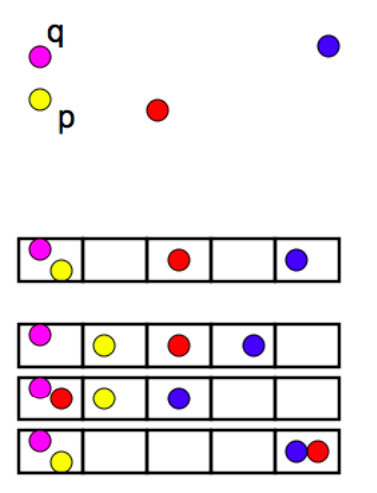
LSH refers to a family of functions (known as LSH families) to hash data points into buckets so that data points near each other are located in the same buckets with high probability, while data points far from each other are likely to be in different buckets. This makes it easier to identify observations with various degrees of similarity.
Finding similar documents
Let’s try to understand how we can leverage LSH in solving an actual problem. The problem that we’re trying to solve:
Goal: You have been given a large collections of documents. You want to find “near duplicate” pairs.
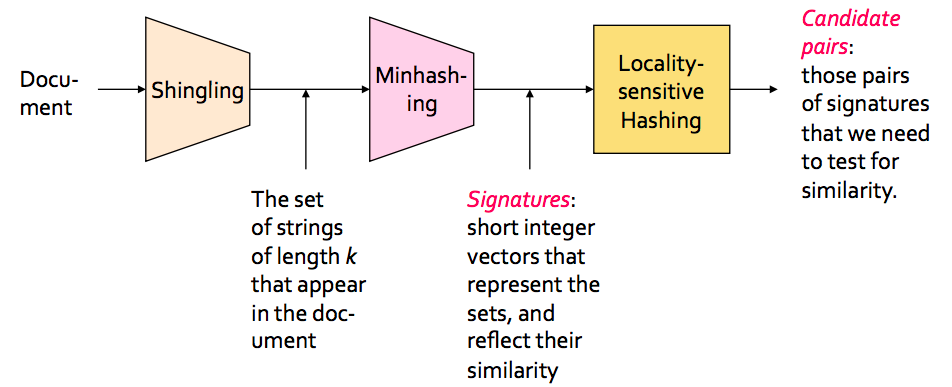
In the context of this problem//////再次问题的背景下, we can break down the LSH algorithm into 3 broad steps:
- Shingling
- Min hashing
- Locality-sensitive hashing
Shingling
In this step, we convert each document into a set of characters of length k (also known as k-shingles or k-grams). The key idea is to represent each document in our collection as a set of k-shingles.
For ex: One of your document (D): “Nadal”. Now if we’re interested in 2-shingles, then our set: {Na, ad, da, al}. Similarly set of 3-shingles: {Nad, ada, dal}.
- Similar documents are more likely to share more shingles
- Reordering paragraphs in a document of changing words doesn’t have much affect on shingles
- k value of 8–10 is generally used in practice. A small value will result in many shingles which are present in most of the documents (bad for differentiating documents)
Jaccard Index
We’ve a representation of each document in the form of shingles. Now, we need a metric to measure similarity between documents. Jaccard Index is a good choice for this. Jaccard Index between document A & B can be defined as:
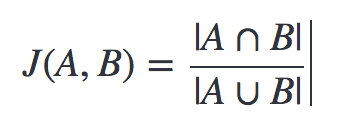
It’s also known as intersection over union (IOU).
A: {Na, ad, da, al} and B: {Na, ad, di, ia}.
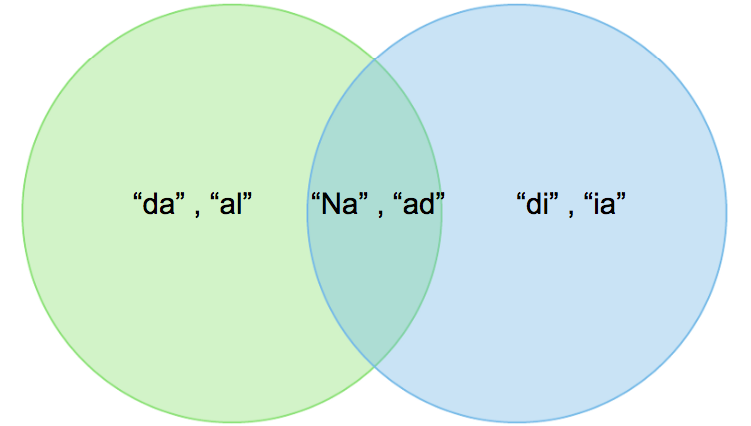
Jaccard Index = 2/6
Let’s discuss 2 big issues that we need to tackle:
Time complexity
Now you may be thinking that we can stop here. But if you think about the scalability, doing just this won’t work. For a collection of n documents, you need to do n*(n-1)/2 comparison, basically O(n²). Imagine you have 1 million documents, then the number of comparison will be 5*10¹¹ (not scalable at all!).
Space complexity
The document matrix is a sparse matrix and storing it as it is will be a big memory overhead. One way to solve this is hashing.
Hashing
The idea of hashing is to convert each document to a small signature using a hashing function H*.* Suppose a document in our corpus is denoted by d. Then:
- H(d) is the signature and it’s small enough to fit in memory
- If similarity(d1,d2) is high then *Probability(H(d1)==H(d2))* is high
- If similarity(d1,d2) is low then *Probability(H(d1)==H(d2))* is low
Choice of hashing function is tightly linked to the similarity metric we’re using. For Jaccard similarity the appropriate hashing function is min-hashing.
Min hashing
This is the critical and the most magical aspect of this algorithm so pay attention:
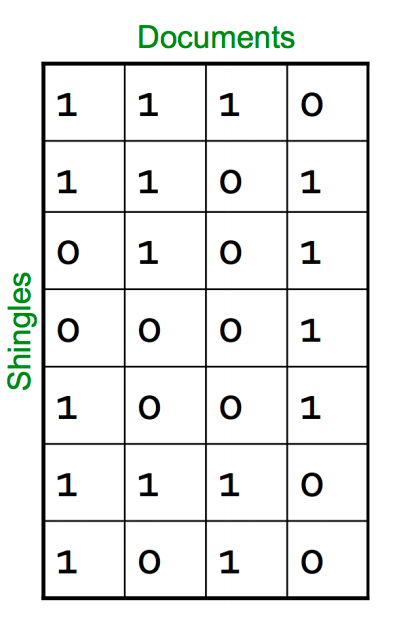
Step 1: Random permutation (π) of row index of document shingle matrix.
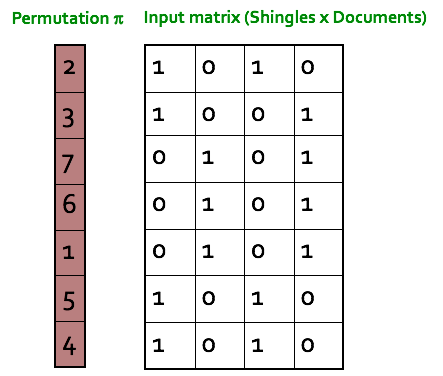
////////对行进行随机排列
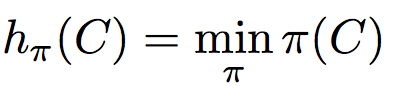
Step 2: Hash function is the index of the first (in the permuted order) row in which column C has value 1. Do this several time (use different permutations) to create signature of a column.
第2步:哈希函数是列C值为1的第一行(按顺序排列)的索引。这样做几次(使用不同的排列)来创建一个列的签名。
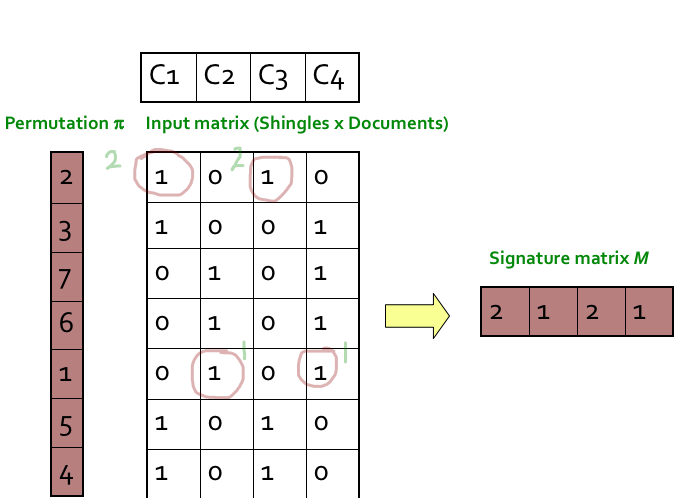
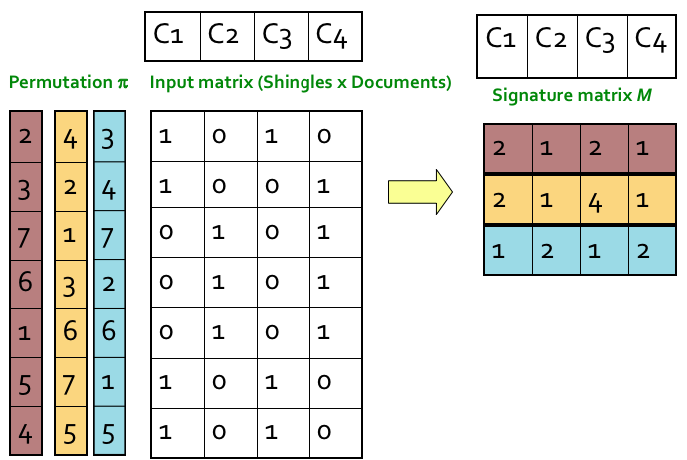
////这个图根本看不懂
转:locality sensitive hashing的更多相关文章
- [Algorithm] 局部敏感哈希算法(Locality Sensitive Hashing)
局部敏感哈希(Locality Sensitive Hashing,LSH)算法是我在前一段时间找工作时接触到的一种衡量文本相似度的算法.局部敏感哈希是近似最近邻搜索算法中最流行的一种,它有坚实的理论 ...
- 局部敏感哈希-Locality Sensitive Hashing
局部敏感哈希 转载请注明http://blog.csdn.net/stdcoutzyx/article/details/44456679 在检索技术中,索引一直须要研究的核心技术.当下,索引技术主要分 ...
- LSH(Locality Sensitive Hashing)原理与实现
原文地址:https://blog.csdn.net/guoziqing506/article/details/53019049 LSH(Locality Sensitive Hashing)翻译成中 ...
- Locality Sensitive Hashing,LSH
1. 基本思想 局部敏感(Locality Senstitive):即空间中距离较近的点映射后发生冲突的概率高,空间中距离较远的点映射后发生冲突的概率低. 局部敏感哈希的基本思想类似于一种空间域转换思 ...
- 局部敏感哈希算法(Locality Sensitive Hashing)
from:https://www.cnblogs.com/maybe2030/p/4953039.html 阅读目录 1. 基本思想 2. 局部敏感哈希LSH 3. 文档相似度计算 局部敏感哈希(Lo ...
- 局部敏感哈希Locality Sensitive Hashing(LSH)之随机投影法
1. 概述 LSH是由文献[1]提出的一种用于高效求解最近邻搜索问题的Hash算法.LSH算法的基本思想是利用一个hash函数把集合中的元素映射成hash值,使得相似度越高的元素hash值相等的概率也 ...
- 局部敏感哈希-Locality Sensitivity Hashing
一. 近邻搜索 从这里开始我将会对LSH进行一番长篇大论.因为这只是一篇博文,并不是论文.我觉得一篇好的博文是尽可能让人看懂,它对语言的要求并没有像论文那么严格,因此它可以有更强的表现力. 局部敏感哈 ...
- 从NLP任务中文本向量的降维问题,引出LSH(Locality Sensitive Hash 局部敏感哈希)算法及其思想的讨论
1. 引言 - 近似近邻搜索被提出所在的时代背景和挑战 0x1:从NN(Neighbor Search)说起 ANN的前身技术是NN(Neighbor Search),简单地说,最近邻检索就是根据数据 ...
- Locality Sensitive Hash 局部敏感哈希
Locality Sensitive Hash是一种常见的用于处理高维向量的索引办法.与其它基于Tree的数据结构,诸如KD-Tree.SR-Tree相比,它较好地克服了Curse of Dimens ...
随机推荐
- 剑指offer刷题(算法类_2)
排序 035-数组中的逆序对(归并排序) 题目描述 题解 代码 复杂度 029-最小的K个数(堆排序) 题目描述 题解 代码 复杂度 029-最小的K个数(快速排序) 题目描述 题解 代码 复杂度 位 ...
- ceph使用memdisk做journal
记得在很久很久以前,ceph当时的版本是有提供使用内存做journal的配置的,当时是使用的tmpfs,但是现在的版本在搜资料的时候,发现关于这个的没怎么找到资料,邮件列表里面有人有提到怎么做,看了下 ...
- 自动化测试_移动端测试(二)—— Appium原理
一.什么是Appium Appium是一个开源.跨平台的测试框架,可以用来测试原生及混合的移动端应用.Appium支持IOS.Android及FirefoxOS平台.Appium使用WebDriver ...
- 微信公众号获取openid(php实例)
微信公众号获取openid 公众号获取openid的方法跟小程序获取openid其实是一样的,只是code获取的方式不一样 小程序获取code: 用户授权登录时调用wx.login即可获取到code ...
- python菜鸟教程学习5: python运算符
算术运算符: 整除符号//:向下取接近商的整数 加+ 减- 乘* 除/ 取余% 幂** 比较运算符: 等于== 不等于!= 大于> 小于< 大于等于>= 小于等于<= 赋值运算 ...
- How to realize one's ambition
Work Overtime Can it work? To some extent, it parhaps works very well. What if you do little job and ...
- word查找与替换
------------恢复内容开始------------ 如何快速删除大量空格键:查找和替换-更多-特殊格式-查找内容[特殊格式(段落标记)]设置为(^p^p,即点击两次段落标记),替换设置为(^ ...
- css3系列之transform 详解skew
skew skewx skewy skewX() 倾斜该元素,里面填的是角度,下面↓ 你会看到,随着元素被倾斜,高度居然不变.聪明的你,一定会知道,高度不变,代表了,Y轴被拉伸了. 跟scale 同 ...
- 【???】今天上午的考试题——区间dp和字符串/线性筛的综合应用
T3还没有打出来,就先放两道. ---------------------------------------------------------- T1:密码破译 温温手下的情报部门截获了一封加密信 ...
- LeetCode 041 First Missing Positive
题目要求:First Missing Positive Given an unsorted integer array, find the first missing positive integer ...