
muduo网络库学习笔记(三)TimerQueue定时器队列
muduo网络库学习笔记(三)TimerQueue定时器队列
TimerQueue是EventLoop的组件之一,可以提供定时任务,和周期任务。
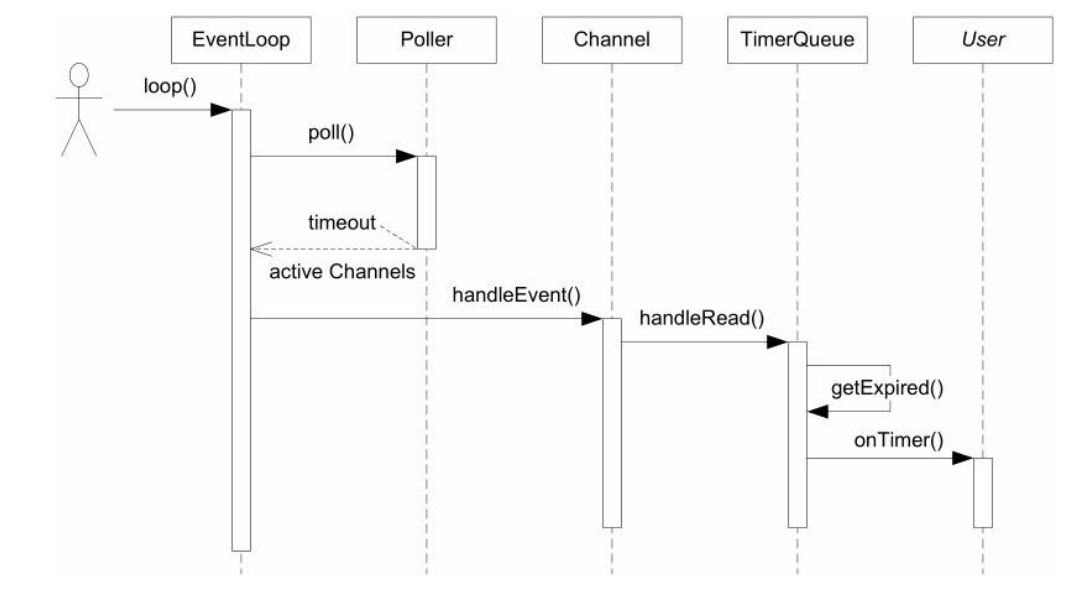
本章首先会简述关于timerfd系统定时函数的基本使用,和TimerQueue类的封装结构,最后给出TimerQueue::addTimer()接口的时序图与使用例子.
Linux中的时间函数
·time(2) / time_t(秒)
·ftime(3) / struct timeb(毫秒)
·gettimeofday(2) / struct timeval(微秒)
·clock_gettime(2) / struct timespec(纳秒)
还有gmtime / localtime / timegm / mktime / strftime / struct tm等与当
前时间无关的时间格式转换函数。
定时函数, 用于让程序等待一段时间或安排计划任务:·sleep(3)
·alarm(2)
·usleep(3)
·nanosleep(2)
·clock_nanosleep(2)
·getitimer(2) / setitimer(2)
·timer_create(2) / timer_settime(2) / timer_gettime(2) / timer_delete(2)
·timerfd_create(2) / timerfd_gettime(2) / timerfd_settime(2)
muduo中做的取舍如下
·(计时) 只使用gettimeofday(2)来获取当前时间。
·(定时) 只使用timerfd_*系列函数来处理定时任务。
gettimeofday(2)入选原因(这也是muduo::Timestamp class的主要设计考虑) :
1. time(2)的精度太低, ftime(3)已被废弃; clock_gettime(2)精度最高, 但是其系统调用的开销比gettimeofday(2)大。
2. 在x86-64平台上, gettimeofday(2)不是系统调用, 而是在用户态实现的, 没有上下文切换和陷入内核的开销32。
3. gettimeofday(2)的分辨率(resolution) 是1微秒, 现在的实现确实能达到这个计时精度, 足以满足日常计时的需要。 muduo::Timestamp用一个int64_t来表示从Unix Epoch到现在的微秒数, 其范围可达上下30万年。
timerfd_*入选的原因:
1. sleep(3) / alarm(2) / usleep(3)在实现时有可能用了SIGALRM信号, 在多线程程序中处理信号是个相当麻烦的事情, 应当尽量避免, 再说, 如果主程序和程序库都使用SIGALRM, 就糟糕了。
2. nanosleep(2)和clock_nanosleep(2)是线程安全的, 但是在非阻塞网络编程中, 绝对不能用让线程挂起的方式来等待一段时间, 这样一来程序会失去响应。 正确的做法是注册一个时间回调函数。
3. getitimer(2)和timer_create(2)也是用信号来deliver超时,在多线程程序中也会有麻烦。timer_create(2)可以指定信号的接收方是进程还是线程, 算是一个进步, 不过信号处理函数(signal handler) 能做的事情实在很受限。
4.timerfd_create(2)把时间变成了一个文件描述符, 该“文件”在定时器超时的那一刻变得可读, 这样就能很方便地融入select(2)/poll(2)框架中, 用统一的方式来处理IO事件和超时事件, 这也正是Reactor模式的长处。
5. 传统的Reactor利用select(2)/poll(2)/epoll(4)的timeout来实现定时功能, 但poll(2)和epoll_wait(2)的定时精度只有毫秒,远低于timerfd_settime(2)的定时精度。
timerfd简单使用介绍
本章使用到的两个系统函数:
#include <sys/timerfd.h>

int timerfd_create(int clockid, int flags);

int timerfd_settime(int fd, int flags, const struct itimerspec *new_value,struct itimerspec *old_value);
1、timerfd_create函数生成一个定时器,返回与之关联的文件描述,其中的clockid可以设成CLOCK_REALTIME和CLOCK_MONOTONIC
CLOCK_REALTIME:系统实时时间,随系统实时时间改变而改变,即从UTC1970-1-1 0:0:0开始计时,中间时刻如果系统时间被用户改成其他,则对应的时间相应改变
CLOCK_MONOTONIC:从系统启动这一刻起开始计时,不受系统时间被用户改变的影响
2、timerfd_settime用于启停定时器,new_value为超时时间,old_value为周期性定时时间,为0表示不进行周期性定时.
 struct timespec {

      time_t tv_sec;                /* Seconds */

      long   tv_nsec;               /* Nanoseconds */

  };

  struct itimerspec {

     struct timespec it_interval;  /* Interval for periodic timer */

     struct timespec it_value;     /* Initial expiration */

  };
timerfd示例
通过select 监听timerfd,可读时表明到达定时时间.
#include <sys/timerfd.h>

#include <sys/select.h>

/* According to earlier standards */

#include <sys/time.h>

#include <sys/types.h>

#include <unistd.h>

int main()

{

  int timerfd = ::timerfd_create(CLOCK_MONOTONIC, TFD_NONBLOCK |TFD_CLOEXEC);

  struct itimerspec howlong;

  bzero(&howlong, sizeof howlong);

  howlong.it_value.tv_sec = 3;

  timerfd_settime(timerfd, 0, &howlong, NULL);

  fd_set rdset;

  FD_ZERO(&rdset);

  FD_SET(timerfd, &rdset);

  struct timeval timeout;

  timeout.tv_sec = 1;

  timeout.tv_usec = 0;

  while(1)

  {

    if(select(timerfd + 1, &rdset, NULL, NULL, &timeout) == 0)

    {

      std::cout << "timeout\n";

      timeout.tv_sec = 1;

      timeout.tv_usec = 0;

      FD_SET(timerfd, &rdset);

        continue;

    }

    std::cout << " timer happend\n";

    break;

  }

  close(timerfd);

  return 0;

}

/* print

timeout

timeout

timer happend

*/
muduo中对timerfd的封装
int createTimerfd()

{

  int timerfd = ::timerfd_create(CLOCK_MONOTONIC,

                                 TFD_NONBLOCK | TFD_CLOEXEC);

  if (timerfd < 0)

  {

    std::cout << "Failed in timerfd_create" << std::endl;

    abort();

  }

  return timerfd;

}

struct timespec howMuchTimeFromNow(TimeStamp when)

{

  int64_t microseconds = when.microSecondsSinceEpoch()

                         - TimeStamp::now().microSecondsSinceEpoch();

  if (microseconds < 100)

  {

    microseconds = 100;

  }

  struct timespec ts;

  ts.tv_sec = static_cast<time_t>(

      microseconds / TimeStamp::kMicroSecondsPerSecond);

  ts.tv_nsec = static_cast<long>(

      (microseconds % TimeStamp::kMicroSecondsPerSecond) * 1000);

  return ts;

}

void readTimerfd(int timerfd, TimeStamp now)

{

  uint64_t howmany;

  ssize_t n = ::read(timerfd, &howmany, sizeof howmany);

  std::cout << "TimerQueue::handleRead() " << howmany << " at " << now.toString() << std::endl;

  if (n != sizeof howmany)

  {

    std::cout << "TimerQueue::handleRead() reads " << n << " bytes instead of 8" << std::endl;

  }

}

void resetTimerfd(int timerfd, TimeStamp expiration)

{

  // wake up loop by timerfd_settime()

  struct itimerspec newValue;

  struct itimerspec oldValue;

  bzero(&newValue, sizeof newValue);

  bzero(&oldValue, sizeof oldValue);

  newValue.it_value = howMuchTimeFromNow(expiration);

  int ret = ::timerfd_settime(timerfd, 0, &newValue, &oldValue);

  if (ret)

  {

    std::cout << "timerfd_settime()" << std::endl;

  }

}
TimerQueue的结构.
TimerQueue只提供了两个对外的接口
addTimer()添加一个定时器超时执行回调函数cb. interval是周期性定时时间,本章不讲,置零不打开.
cancel() 取消一个定时器,本章也不细述,本章只介绍addTimer()接口.后面如果需要会补充本章.
TimerQueue定义如下
class TimerQueue

{

public:

  TimerQueue(EventLoop* loop);

  ~TimerQueue();

  // Schedules the callback to be run at given time,

  TimerId addTimer(const NetCallBacks::TimerCallBack& cb, TimeStamp when, double interval = 0.0);

  void cancel(TimerId timerId);

private:

  /*

    .....

  */

  EventLoop* p_loop;

  const int m_timerfd;

  Channel m_timerfdChannel;

  //Timer List sorted by expiration

  TimerList m_timers;

  ActiveTimerSet m_activeTimers;

};
虽然只提供了两个对外接口,但是私有成比较复杂,首先简介成员Timer.
Timer
Timer类作为TimerQueue的内部成员使用,封装一个定时器,addTimer()接口调用后生成一个Timer(),外头的回调函数和定时反应时间会封装再此Timer中.
Tiemr主要接口都是获取这些构造时配置的成员值
run() 调用回调函数.
expiration 定时器过期时间.
interval 周期性定时时间.
repeat 是否是周期性定时.
sequence 一个静态成员,用于记录Timer创建的个数. 为了保证它的线程安全性,使用AtomicInt64封装了一层原子操作.
TimerId 用于Cancel Timer的标志Id, 这两个类都不复杂,可自行参看muduo源码,也可翻我github上的SimpleMuduo单独类文件夹下的测试代码.
  Timer(const NetCallBacks::TimerCallBack& cb, TimeStamp when, double interval)

  :m_callBack(cb),

  m_expiration(when),

  m_interval(interval),

  m_repeat(interval > 0.0),

  m_sequence(s_numCreated.incrementAndGet())
TimerId TimerQueue::addTimer(const NetCallBacks::TimerCallBack& cb, TimeStamp when, double interval)

{

  Timer* timer = new Timer(cb, when, interval);

  //p_loop->runInLoop(std::bind(&TimerQueue::addTimerInLoop, this, timer));

  return TimerId(timer, timer->sequence());

}
Timer的容器.
  typedef std::pair<TimeStamp, Timer*> Entry;

  typedef std::set<Entry> TimerList;

  typedef std::pair<Timer*, int64_t> ActiveTimer;

  typedef std::set<ActiveTimer> ActiveTimerSet;
为了解决无法处理两个Timer到期时间相同的情况。使用了pair将时间戳和Timer的地址组成了一对.然后使用Set存储.
ActiveTimer 将Timer和sequence组成一对主要作用来索引迭代的.
TimerQueue私有接口介绍.
  void addTimerInLoop(Timer* timer);

  void cancelInLoop(TimerId timerId);

  //called when timerfd alarms

  void handleRead();

  //move out all expired timers and return they.

  std::vector<Entry> getExpired(TimeStamp now);

  bool insert(Timer* timer);

  void reset(const std::vector<Entry>& expired, TimeStamp now);
添加定时器
bool insert(Timer* timer); //插入一个定时器.
EventLoop添加了一个runInLoop接口: 在它的IO线程内执行某个用户
任务回调, 即EventLoop::runInLoop(const Functor& cb), 其中Functor是
std::function<void()>。 如果用户在当前IO线程调用这个函数, 回调会
同步进行; 如果用户在其他线程调用runInLoop(), cb会被加入队列, IO
线程会被唤醒来调用这个Functor。
addTimer()使用了EventLoop的runInLoop接口(这个接口主要来保证线程安全性的,暂不讲),来执行addTimerInLoop().addTimerInLoop()调用insert()插入定时器.
如果此定时器是最早触发的那一个则会调用resetTimerfd()->timerfd_settime()启动定时器.
addTimer()->addTimerInLoop()->insert()->resetTimerfd()->timerfd_settime()
更新定时器
添加逻辑就在上面了,下面给出处理逻辑.
三个接口.
void handleRead(); //定时器触发回调.获取已过期的事件并处理随后更新列表.
std::vector getExpired(TimeStamp now);//获取一组已过期的定时器,并从TimerList中删除.
void reset(const std::vector& expired, TimeStamp now);//如果是周期性任务则重新配置时间插入,随后调用resetTimerfd()更新下一定时任务.
handleRead()->getExpired()->Timer->run(cb)->reset()->resetTimerfd()->timerfd_settime()
时序图
TimerQueue源码
#ifndef _NET_TIMERQUEUE_HH

#define _NET_TIMERQUEUE_HH

#include "TimerId.hh"

#include "CallBacks.hh"

#include "TimeStamp.hh"

#include "Channel.hh"

#include <set>

#include <vector>

class EventLoop;

class TimerQueue

{

public:

  TimerQueue(EventLoop* loop);

  ~TimerQueue();

  // Schedules the callback to be run at given time,

  TimerId addTimer(const NetCallBacks::TimerCallBack& cb, TimeStamp when, double interval = 0.0);

  void cancel(TimerId timerId);

private:

  typedef std::pair<TimeStamp, Timer*> Entry;

  typedef std::set<Entry> TimerList;

  typedef std::pair<Timer*, int64_t> ActiveTimer;

  typedef std::set<ActiveTimer> ActiveTimerSet;

  void addTimerInLoop(Timer* timer);

  void cancelInLoop(TimerId timerId);

  //called when timerfd alarms

  void handleRead();

  //move out all expired timers and return they.

  std::vector<Entry> getExpired(TimeStamp now);

  bool insert(Timer* timer);

  void reset(const std::vector<Entry>& expired, TimeStamp now);

  EventLoop* p_loop;

  const int m_timerfd;

  Channel m_timerfdChannel;

  //Timer List sorted by expiration

  TimerList m_timers;

  ActiveTimerSet m_activeTimers;

  bool m_callingExpiredTimers; /*atomic*/

  ActiveTimerSet m_cancelingTimers;

};

#endif

//TimerQueeu.cpp

#include <stdint.h>

#include <assert.h>

#include <sys/timerfd.h>

#include <unistd.h>

#include "Logger.hh"

#include "EventLoop.hh"

#include "Timer.hh"

#include "TimerQueue.hh"

namespace TimerFd

{

int createTimerfd()

{

  int timerfd = ::timerfd_create(CLOCK_MONOTONIC,

                                 TFD_NONBLOCK | TFD_CLOEXEC);

  if (timerfd < 0)

  {

    LOG_SYSFATAL << "Failed in timerfd_create";

  }

  return timerfd;

}

struct timespec howMuchTimeFromNow(TimeStamp when)

{

  int64_t microseconds = when.microSecondsSinceEpoch()

                         - TimeStamp::now().microSecondsSinceEpoch();

  if (microseconds < 100)

  {

    microseconds = 100;

  }

  struct timespec ts;

  ts.tv_sec = static_cast<time_t>(

      microseconds / TimeStamp::kMicroSecondsPerSecond);

  ts.tv_nsec = static_cast<long>(

      (microseconds % TimeStamp::kMicroSecondsPerSecond) * 1000);

  return ts;

}

void readTimerfd(int timerfd, TimeStamp now)

{

  uint64_t howmany;

  ssize_t n = ::read(timerfd, &howmany, sizeof howmany);

  LOG_TRACE << "TimerQueue::handleRead() " << howmany << " at " << now.toString();

  if (n != sizeof howmany)

  {

    LOG_ERROR << "TimerQueue::handleRead() reads " << n << " bytes instead of 8";

  }

}

void resetTimerfd(int timerfd, TimeStamp expiration)

{

  // wake up loop by timerfd_settime()

  LOG_TRACE << "resetTimerfd()";

  struct itimerspec newValue;

  struct itimerspec oldValue;

  bzero(&newValue, sizeof newValue);

  bzero(&oldValue, sizeof oldValue);

  newValue.it_value = howMuchTimeFromNow(expiration);

  int ret = ::timerfd_settime(timerfd, 0, &newValue, &oldValue);

  if (ret)

  {

    LOG_SYSERR << "timerfd_settime()";

  }

}

};

using namespace TimerFd;

TimerQueue::TimerQueue(EventLoop* loop)

  :p_loop(loop),

   m_timerfd(createTimerfd()),

   m_timerfdChannel(p_loop, m_timerfd),

   m_timers(),

   m_callingExpiredTimers(false)

{

  m_timerfdChannel.setReadCallBack(std::bind(&TimerQueue::handleRead, this));

  m_timerfdChannel.enableReading();

}

TimerQueue::~TimerQueue()

{

  m_timerfdChannel.disableAll();

  m_timerfdChannel.remove();

  ::close(m_timerfd);

  for (TimerList::iterator it = m_timers.begin();

      it != m_timers.end(); ++it)

  {

    delete it->second;

  }

}

std::vector<TimerQueue::Entry> TimerQueue::getExpired(TimeStamp now)

{

  std::vector<Entry> expired;

  Entry sentry = std::make_pair(now, reinterpret_cast<Timer*>UINTPTR_MAX);

  TimerList::iterator it = m_timers.lower_bound(sentry);

  assert(it == m_timers.end() || now < it->first);

  std::copy(m_timers.begin(), it, back_inserter(expired));

  m_timers.erase(m_timers.begin(), it);

  for(std::vector<Entry>::iterator it = expired.begin();

      it != expired.end(); ++it)

  {

    ActiveTimer timer(it->second, it->second->sequence());

    size_t n = m_activeTimers.erase(timer);

    assert(n == 1); (void)n;

  }

  assert(m_timers.size() == m_activeTimers.size());

  return expired;

}

TimerId TimerQueue::addTimer(const NetCallBacks::TimerCallBack& cb, TimeStamp when, double interval)

{

  Timer* timer = new Timer(cb, when, interval);

  p_loop->runInLoop(std::bind(&TimerQueue::addTimerInLoop, this, timer));

  return TimerId(timer, timer->sequence());

}

void TimerQueue::addTimerInLoop(Timer* timer)

{

  p_loop->assertInLoopThread();

  bool earliestChanged = insert(timer);

  if (earliestChanged)

  {

    resetTimerfd(m_timerfd, timer->expiration());

  }

}

void TimerQueue::cancel(TimerId timerId)

{

  p_loop->runInLoop(std::bind(&TimerQueue::cancelInLoop, this, timerId));

}

void TimerQueue::cancelInLoop(TimerId timerId)

{

  p_loop->assertInLoopThread();

  assert(m_timers.size() ==  m_activeTimers.size());

  ActiveTimer timer(timerId.m_timer, timerId.m_sequence);

  ActiveTimerSet::iterator it = m_activeTimers.find(timer);

  if(it != m_activeTimers.end())

  {

    size_t n = m_timers.erase(Entry(it->first->expiration(), it->first));

    assert(n == 1);

    delete it->first;

  }

  else if (m_callingExpiredTimers)

  {

    m_cancelingTimers.insert(timer);

  }

  assert(m_timers.size() == m_activeTimers.size());

}

bool TimerQueue::insert(Timer* timer)

{

  p_loop->assertInLoopThread();

  assert(m_timers.size() == m_activeTimers.size());

  bool earliestChanged = false;

  TimeStamp when = timer->expiration();

  TimerList::iterator it = m_timers.begin();

  if (it == m_timers.end() || when < it->first)

  {

    earliestChanged = true;

  }

  {

    std::pair<TimerList::iterator, bool> result

      = m_timers.insert(Entry(when, timer));

    assert(result.second); (void)result;

  }

  {

    std::pair<ActiveTimerSet::iterator, bool> result

      = m_activeTimers.insert(ActiveTimer(timer, timer->sequence()));

    assert(result.second); (void)result;

  }

  LOG_TRACE << "TimerQueue::insert() " << "m_timers.size() : "

  << m_timers.size() << " m_activeTimers.size() : " << m_activeTimers.size();

  assert(m_timers.size() == m_activeTimers.size());

  return earliestChanged;

}

void TimerQueue::handleRead()

{

  p_loop->assertInLoopThread();

  TimeStamp now(TimeStamp::now());

  readTimerfd(m_timerfd, now);

  std::vector<Entry> expired = getExpired(now);

  LOG_TRACE << "Expired Timer size " << expired.size() << "  ";

  m_callingExpiredTimers = true;

  m_cancelingTimers.clear();

  for(std::vector<Entry>::iterator it = expired.begin();

      it != expired.end(); ++it )

  {

    it->second->run();

  }

  m_callingExpiredTimers = false;

  reset(expired, now);

}

void TimerQueue::reset(const std::vector<Entry>& expired, TimeStamp now)

{

  TimeStamp nextExpire;

  for(std::vector<Entry>::const_iterator it = expired.begin();

      it != expired.end(); ++it)

  {

    ActiveTimer timer(it->second, it->second->sequence());

    if(it->second->repeat()

      && m_cancelingTimers.find(timer) == m_cancelingTimers.end())

    {//如果是周期定时器则重新设定时间插入. 否则delete.

      it->second->restart(now);

      insert(it->second);

    }

    else

    {// FIXME move to a free list no delete please

      delete it->second;

    }

  }

  if (!m_timers.empty())

  {

    nextExpire = m_timers.begin()->second->expiration();

  }

  if (nextExpire.valid())

  {

    resetTimerfd(m_timerfd, nextExpire);

  }

}
TimerQueue使用示例
测试TimerQueue的addTimer接口.
#include <errno.h>

#include <thread>

#include <strings.h>

#include <poll.h>

#include <functional>

#include "EventLoop.hh"

#include "Channel.hh"

#include "Poller.hh"

#include "Logger.hh"

#include "Timer.hh"

#include "TimeStamp.hh"

#include "TimerQueue.hh"

EventLoop* g_loop;

void print() { LOG_DEBUG << "test print()";  }

void test()

{

  LOG_DEBUG << "[test] : test timerQue";

}

int main()

{

  EventLoop loop;

  g_loop = &loop;

  TimerQueue timerQue(&loop);

  timerQue.addTimer(test, times::addTime(TimeStamp::now(), 3.0));

  timerQue.addTimer(test, times::addTime(TimeStamp::now(), 3.0));

  timerQue.addTimer(test, times::addTime(TimeStamp::now(), 5.0));

  loop.loop();

  return 0;

}
./test.out

2018-11-11 15:49:22.493990 [TRACE] [Poller.cpp:64] [updateChannel] fd= 3 events3

2018-11-11 15:49:22.494042 [TRACE] [EventLoop.cpp:34] [EventLoop] EventLoop Create 0x7FFFBD3C39B0 in thread 3262

2018-11-11 15:49:22.494047 [TRACE] [Poller.cpp:64] [updateChannel] fd= 5 events3

2018-11-11 15:49:22.494055 [TRACE] [TimerQueue.cpp:172] [insert] TimerQueue::insert() m_timers.size() : 1 m_activeTimers.size() : 1

2018-11-11 15:49:22.494058 [TRACE] [TimerQueue.cpp:55] [resetTimerfd] resetTimerfd()

2018-11-11 15:49:22.494066 [TRACE] [TimerQueue.cpp:172] [insert] TimerQueue::insert() m_timers.size() : 2 m_activeTimers.size() : 2

2018-11-11 15:49:22.494070 [TRACE] [TimerQueue.cpp:172] [insert] TimerQueue::insert() m_timers.size() : 3 m_activeTimers.size() : 3

2018-11-11 15:49:22.494073 [TRACE] [EventLoop.cpp:59] [loop] EventLoop 0x7FFFBD3C39B0 start loopig

2018-11-11 15:49:22.494075 [TRACE] [Poller.cpp:20] [poll] Poller::poll()

2018-11-11 15:49:23.495462 [TRACE] [Poller.cpp:28] [poll]  nothing happended

2018-11-11 15:49:23.495488 [TRACE] [Poller.cpp:20] [poll] Poller::poll()

2018-11-11 15:49:24.496618 [TRACE] [Poller.cpp:28] [poll]  nothing happended

2018-11-11 15:49:24.496640 [TRACE] [Poller.cpp:20] [poll] Poller::poll()

2018-11-11 15:49:25.494222 [TRACE] [Poller.cpp:24] [poll] 1 events happended

2018-11-11 15:49:25.494253 [TRACE] [TimerQueue.cpp:45] [readTimerfd] TimerQueue::handleRead() 1 at 1541922565.494251

2018-11-11 15:49:25.494316 [TRACE] [TimerQueue.cpp:188] [handleRead] Expired Timer size 2

2018-11-11 15:49:25.494320 [DEBUG] [main.cpp:50] [test] [test] : test timerQue

2018-11-11 15:49:25.494322 [DEBUG] [main.cpp:50] [test] [test] : test timerQue

2018-11-11 15:49:25.494325 [TRACE] [TimerQueue.cpp:55] [resetTimerfd] resetTimerfd()

2018-11-11 15:49:25.494332 [TRACE] [Poller.cpp:20] [poll] Poller::poll()

2018-11-11 15:49:26.496293 [TRACE] [Poller.cpp:28] [poll]  nothing happended

2018-11-11 15:49:26.496318 [TRACE] [Poller.cpp:20] [poll] Poller::poll()

2018-11-11 15:49:27.494291 [TRACE] [Poller.cpp:24] [poll] 1 events happended

2018-11-11 15:49:27.494319 [TRACE] [TimerQueue.cpp:45] [readTimerfd] TimerQueue::handleRead() 1 at 1541922567.494317

2018-11-11 15:49:27.494328 [TRACE] [TimerQueue.cpp:188] [handleRead] Expired Timer size 1

2018-11-11 15:49:27.494331 [DEBUG] [main.cpp:50] [test] [test] : test timerQue

2018-11-11 15:49:27.494334 [TRACE] [Poller.cpp:20] [poll] Poller::poll()

2018-11-11 15:49:28.495665 [TRACE] [Poller.cpp:28] [poll]  nothing happended
muduo网络库学习笔记(三)TimerQueue定时器队列的更多相关文章
- muduo网络库学习笔记(10):定时器的实现
传统的Reactor通过控制select和poll的等待时间来实现定时,而现在在Linux中有了timerfd,我们可以用和处理IO事件相同的方式来处理定时,代码的一致性更好. 一.为什么选择time ...
- muduo网络库学习笔记(四) 通过eventfd实现的事件通知机制
目录 muduo网络库学习笔记(四) 通过eventfd实现的事件通知机制 eventfd的使用 eventfd系统函数 使用示例 EventLoop对eventfd的封装 工作时序 runInLoo ...
- muduo网络库学习笔记(五) 链接器Connector与监听器Acceptor
目录 muduo网络库学习笔记(五) 链接器Connector与监听器Acceptor Connector 系统函数connect 处理非阻塞connect的步骤: Connetor时序图 Accep ...
- muduo 网络库学习之路(一)
前提介绍: 本人是一名大三学生,主要使用C++开发,兴趣是高性能的服务器方面. 网络开发离不开网络库,所以今天开始学一个新的网络库,陈老师的muduo库 我参考的书籍就是陈老师自己关于muduo而编著 ...
- muduo网络库学习之MutexLock类、MutexLockGuard类、Condition类、CountDownLatch类封装中的知识点
一.MutexLock 类 class MutexLock : boost::noncopyable 二.MutexLockGuard类 class MutexLockGuard : bo ...
- Linux多线程服务端编程 使用muduo C++网络库 学习笔记 日志log
代码来自陈硕开源代码库 muduo中 地址是https://github.com/chenshuo/muduo #pragma once #include <string> #define ...
- python网络编程学习笔记(三):socket网络服务器(转载)
1.TCP连接的建立方法 客户端在建立一个TCP连接时一般需要两步,而服务器的这个过程需要四步,具体见下面的比较. 步骤 TCP客户端 TCP服务器 第一步 建立socket对象 建立socket对 ...
- muduo网络库架构总结
目录 muduo网络库简介 muduo网络库模块组成 Recator反应器 EventLoop的两个组件 TimerQueue定时器 Eventfd Connector和Acceptor连接器和监听器 ...
- muduo网络库源码学习————Timestamp.cc
今天开始学习陈硕先生的muduo网络库,moduo网络库得到很多好评,陈硕先生自己也说核心代码不超过5000行,所以我觉得有必要拿过来好好学习下,学习的时候在源码上面添加一些自己的注释,方便日后理解, ...
随机推荐
- 【转】Java学习---垃圾回收算法与 JVM 垃圾回收器综述
[原文]https://www.toutiao.com/i6593931841462338062/ 垃圾回收算法与 JVM 垃圾回收器综述 我们常说的垃圾回收算法可以分为两部分:对象的查找算法与真正的 ...
- python解析式
一.列表解析式 列表解析是外面一对中括号,它返回的是列表. 一般形式为:[expr for item in itratoble] print([i+1 for i in range(10)]) #结果 ...
- October 12th 2017 Week 41st Thursday
Be happy for this moment. This moment is your life. 为这一刻感到高兴,这一刻是你的人生. Yesterday Tencent became Asia ...
- Python shutil.md
shutil shutil模块包括高级文件操作,例如复制和归档. Copying Files shutil.copyfileobj(fsrc, fdst[, length]):将类似文件的对象fsrc ...
- php可逆加密解密
函数: function encrypt($data, $key) { $prep_code = serialize($data); $block = mcrypt_get_block_size('d ...
- 使用mysql乐观锁解决并发问题思路
本文摘自网络,仅供个人学习之用 案例说明: 银行两操作员同时操作同一账户.比如A.B操作员同时读取一余额为1000元的账户,A操作员为该账户增加100元,B操作员同时为该账户扣除50元,A先提交,B后 ...
- 【转】浅谈React、Flux 与 Redux
本文转自<浅谈React.Flux 与 Redux>,转载请注明出处. React React 是一个 View 层的框架,用来渲染视图,它主要做几件事情: 组件化 利用 props 形成 ...
- 测试udp服务的端口是否可用
测试tcp服务的端口是否可用,可以使用: telnet ip port 但是如果这个用在upd服务上,就会报错, 因为telnet走的是tcp协议, 比如说192.168.80.131在8888端 ...
- shiro实战系列(九)之Web
一.Configuration(配置) 将 Shiro 集成到任何 Web 应用程序的最简单的方法是在 web.xml 中配置 ContextListener 和 Filter,理解如何读取 Shir ...
- WorldWind源码剖析系列:二维点类Point2d和三维点类Point3d
PluginSDK中的点主要有二维和三维两种类型,分别用来描述平面和立体点.其类图如下. 这两个类比较简单.其字段成员主要用来描述点对象在各坐标轴上的分量. 属性Length用来返回二维和三维点的距离 ...