
TF之BN:BN算法对多层中的每层神经网络加快学习QuadraticFunction_InputData+Histogram+BN的Error_curve
# 23 Batch Normalization

import numpy as np

import tensorflow as tf

import matplotlib.pyplot as plt

ACTIVATION = tf.nn.tanh

N_LAYERS = 7

N_HIDDEN_UNITS = 30

def fix_seed(seed=1):

    # reproducible

    np.random.seed(seed)

    tf.set_random_seed(seed)

def plot_his(inputs, inputs_norm):

    # plot histogram for the inputs of every layer

    for j, all_inputs in enumerate([inputs, inputs_norm]):

        for i, input in enumerate(all_inputs):

            plt.subplot(2, len(all_inputs), j*len(all_inputs)+(i+1))

            plt.cla()

            if i == 0:

                the_range = (-7, 10)

            else:

                the_range = (-1, 1)

            plt.hist(input.ravel(), bins=15, range=the_range, color='#0000FF')

            plt.yticks(())

            if j == 1:

                plt.xticks(the_range)

            else:

                plt.xticks(())

            ax = plt.gca()

            ax.spines['right'].set_color('none')

            ax.spines['top'].set_color('none')

        plt.title("%s normalizing" % ("Without" if j == 0 else "With"))

    plt.title('Matplotlib,BN,histogram--Jason Niu')

    plt.draw()

    plt.pause(0.001)

def built_net(xs, ys, norm):

    def add_layer(inputs, in_size, out_size, activation_function=None, norm=False):

        # weights and biases (bad initialization for this case)

        Weights = tf.Variable(tf.random_normal([in_size, out_size], mean=0., stddev=1.))

        biases = tf.Variable(tf.zeros([1, out_size]) + 0.1)

        # fully connected product

        Wx_plus_b = tf.matmul(inputs, Weights) + biases

        # normalize fully connected product

        if norm:

            # Batch Normalize

            fc_mean, fc_var = tf.nn.moments(

                Wx_plus_b,

                axes=[0],

            )

            scale = tf.Variable(tf.ones([out_size]))

            shift = tf.Variable(tf.zeros([out_size]))

            epsilon = 0.001

            # apply moving average for mean and var when train on batch

            ema = tf.train.ExponentialMovingAverage(decay=0.5)

            def mean_var_with_update():

                ema_apply_op = ema.apply([fc_mean, fc_var])

                with tf.control_dependencies([ema_apply_op]):

                    return tf.identity(fc_mean), tf.identity(fc_var)

            mean, var = mean_var_with_update()

            Wx_plus_b = tf.nn.batch_normalization(Wx_plus_b, mean, var, shift, scale, epsilon)

            # Wx_plus_b = (Wx_plus_b - fc_mean) / tf.sqrt(fc_var + 0.001)  #进行BN一下

            # Wx_plus_b = Wx_plus_b * scale + shift

        # activation

        if activation_function is None:

            outputs = Wx_plus_b

        else:

            outputs = activation_function(Wx_plus_b)

        return outputs  #输出激活结果

    fix_seed(1)

    if norm:

        # BN for the first input

        fc_mean, fc_var = tf.nn.moments(

            xs,

            axes=[0],

        )

        scale = tf.Variable(tf.ones([1]))

        shift = tf.Variable(tf.zeros([1]))

        epsilon = 0.001

        # apply moving average for mean and var when train on batch

        ema = tf.train.ExponentialMovingAverage(decay=0.5)

        def mean_var_with_update():

            ema_apply_op = ema.apply([fc_mean, fc_var])

            with tf.control_dependencies([ema_apply_op]):

                return tf.identity(fc_mean), tf.identity(fc_var)

        mean, var = mean_var_with_update()

        xs = tf.nn.batch_normalization(xs, mean, var, shift, scale, epsilon)

    # record inputs for every layer

    layers_inputs = [xs]

    # build hidden layers

    for l_n in range(N_LAYERS):

        layer_input = layers_inputs[l_n]

        in_size = layers_inputs[l_n].get_shape()[1].value

        output = add_layer(

            layer_input,    # input

            in_size,        # input size

            N_HIDDEN_UNITS, # output size

            ACTIVATION,     # activation function

            norm,           # normalize before activation

        )

        layers_inputs.append(output)

    # build output layer

    prediction = add_layer(layers_inputs[-1], 30, 1, activation_function=None)

    cost = tf.reduce_mean(tf.reduce_sum(tf.square(ys - prediction), reduction_indices=[1]))

    train_op = tf.train.GradientDescentOptimizer(0.001).minimize(cost)

    return [train_op, cost, layers_inputs]

fix_seed(1)

x_data = np.linspace(-7, 10, 2500)[:, np.newaxis]  #水平轴-7~10

np.random.shuffle(x_data)

noise = np.random.normal(0, 8, x_data.shape)

y_data = np.square(x_data) - 5 + noise

xs = tf.placeholder(tf.float32, [None, 1])  # [num_samples, num_features]

ys = tf.placeholder(tf.float32, [None, 1])

#建立两个神经网络作对比

train_op, cost, layers_inputs = built_net(xs, ys, norm=False)

train_op_norm, cost_norm, layers_inputs_norm = built_net(xs, ys, norm=True)

sess = tf.Session()

if int((tf.__version__).split('.')[1]) < 12 and int((tf.__version__).split('.')[0]) < 1:

    init = tf.initialize_all_variables()

else:

    init = tf.global_variables_initializer()

sess.run(init)

# record cost

cost_his = []

cost_his_norm = []

record_step = 5

plt.ion()

plt.figure(figsize=(7, 3))

for i in range(250):

    if i % 50 == 0:

        # plot histogram

        all_inputs, all_inputs_norm = sess.run([layers_inputs, layers_inputs_norm], feed_dict={xs: x_data, ys: y_data})

        plot_his(all_inputs, all_inputs_norm)

    # train on batch每一步都run一下

    sess.run([train_op, train_op_norm], feed_dict={xs: x_data[i*10:i*10+10], ys: y_data[i*10:i*10+10]})

    if i % record_step == 0:

        # record cost

        cost_his.append(sess.run(cost, feed_dict={xs: x_data, ys: y_data}))

        cost_his_norm.append(sess.run(cost_norm, feed_dict={xs: x_data, ys: y_data}))

#以下是绘制误差值Cost误差曲线的方法

plt.ioff()

plt.figure()

plt.title('Matplotlib,BN,Error_curve--Jason Niu')

plt.plot(np.arange(len(cost_his))*record_step, np.array(cost_his), label='no BN')     # no norm

plt.plot(np.arange(len(cost_his))*record_step, np.array(cost_his_norm), label='BN')   # norm

plt.legend()

plt.show()
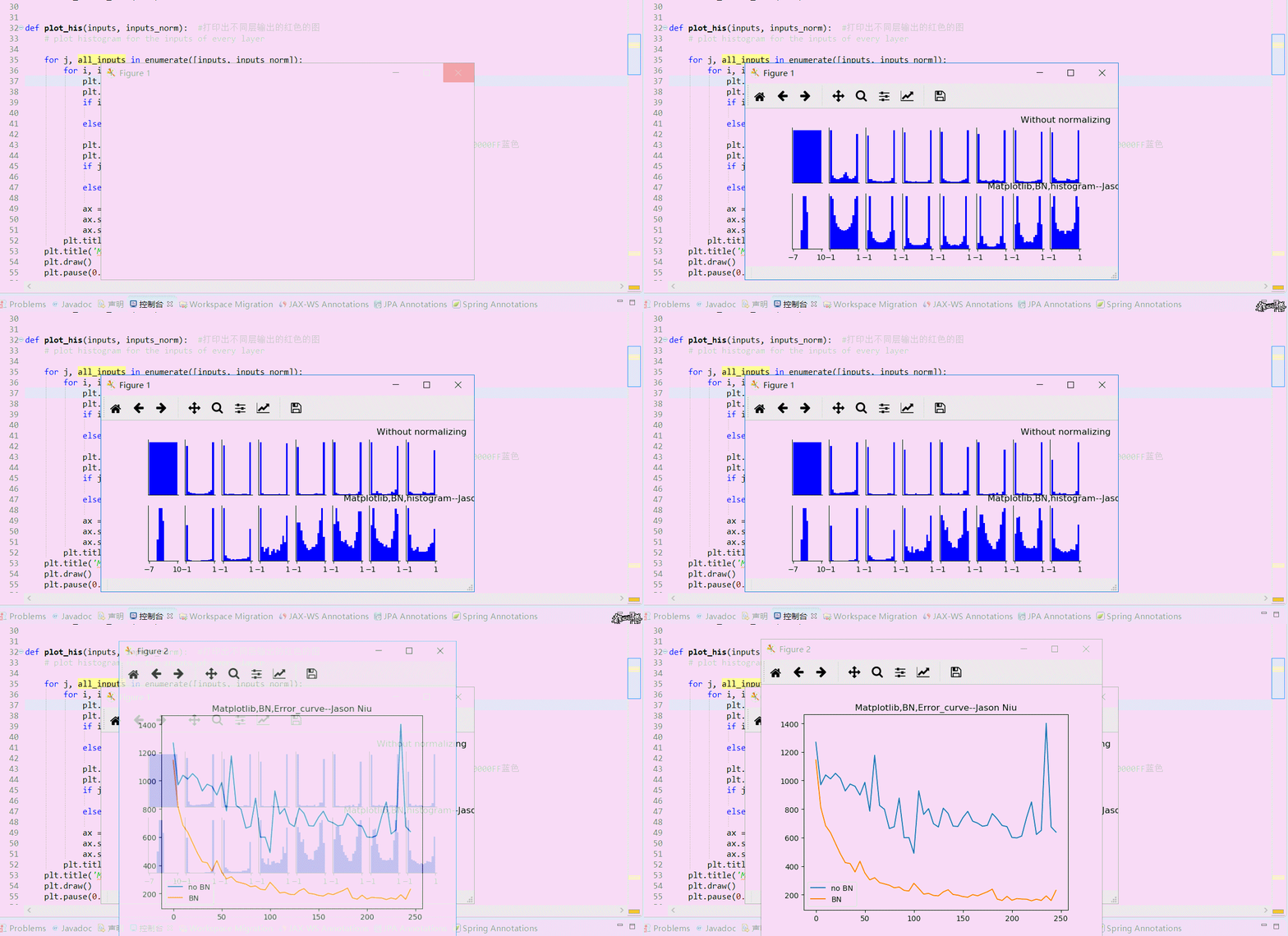
TF之BN:BN算法对多层中的每层神经网络加快学习QuadraticFunction_InputData+Histogram+BN的Error_curve的更多相关文章
- Batch Normalization的算法本质是在网络每一层的输入前增加一层BN层(也即归一化层),对数据进行归一化处理,然后再进入网络下一层,但是BN并不是简单的对数据进行求归一化,而是引入了两个参数λ和β去进行数据重构
Batch Normalization Batch Normalization是深度学习领域在2015年非常热门的一个算法,许多网络应用该方法进行训练,并且取得了非常好的效果. 众所周知,深度学习是应 ...
- 信息检索中的TF/IDF概念与算法的解释
https://blog.csdn.net/class_brick/article/details/79135909 概念 TF-IDF(term frequency–inverse document ...
- 深度学习归一化:BN、GN与FRN
在深度学习中,使用归一化层成为了很多网络的标配.最近,研究了不同的归一化层,如BN,GN和FRN.接下来,介绍一下这三种归一化算法. BN层 BN层是由谷歌提出的,其相关论文为<Batch No ...
- 任意半径局部直方图类算法在PC中快速实现的框架。
在图像处理中,局部算法一般来说,在很大程度上会获得比全局算法更为好的效果,因为他考虑到了图像领域像素的信息,而很多局部算法可以借助于直方图获得加速.同时,一些常规的算法,比如中值滤波.最大值滤波.最小 ...
- 06 - 从Algorithm 算法派生类中删除ExecuteInformation() 和ExecuteData() VTK 6.0 迁移
在先前的vtk中,如vtkPointSetAlgorithm 等算法派生类中定义了虚方法:ExecuteInformation() 和 ExecuteData().这些方法的定义是为了平稳的从VTK4 ...
- 1145: 零起点学算法52——数组中删数II
1145: 零起点学算法52--数组中删数II Time Limit: 1 Sec Memory Limit: 64 MB 64bit IO Format: %lldSubmitted: 293 ...
- KMP算法 --- 在文本中寻找目标字符串
KMP算法 --- 在文本中寻找目标字符串 很多时候,为了在大文本中寻找到自己需要的内容,往往需要搜索关键字.这其中就牵涉到字符串匹配的算法,通过接受文本和关键词参数来返回关键词在文本出现的位置.一般 ...
- 剑指Offer——算法复杂度中的O(logN)底数是多少
剑指Offer--算法复杂度中的O(logN)底数是多少 前言 无论是计算机算法概论.还是数据结构书中,关于算法的时间复杂度很多都用包含O(logN)这样的描述,但是却没有明确说logN的底数究竟是多 ...
- 机器学习算法中如何选取超参数:学习速率、正则项系数、minibatch size
机器学习算法中如何选取超参数:学习速率.正则项系数.minibatch size 本文是<Neural networks and deep learning>概览 中第三章的一部分,讲机器 ...
随机推荐
- js学习——函数
函数声明 function funName(parameter){} 函数表达式,并把函数存储在变量x中 //不用给函数名,后续并不能直接用给定的函数名调用 var x = function(a){r ...
- 软件测试作业 - fault error failure
给出的题目如下: 我的解答如下: For program 1:1. where i > 0 is the fault , it should be changed to i>= 0 to ...
- <<人月神话>>阅读体会(一)
第一次听说人月神话还是在大一上学期的导论课那会儿,那会儿好像就已经确定了自己要学软件,于是就去问王建民老师能不能给我推荐几本软件工程方面的书,我想要提前自己学学,以为老师会给我推荐一些某种语言类的学习 ...
- Socket网络编程(二)
udp协议发送消息案例 1.创建UdpServer(udp服务器端) package com.cppdy.udp; import java.net.DatagramPacket; import jav ...
- uva11916 bsgs算法逆元模板,求逆元,组合计数
其实思维难度不是很大,但是各种处理很麻烦,公式推导到最后就是一个bsgs算法解方程 /* 要给M行N列的网格染色,其中有B个不用染色,其他每个格子涂一种颜色,同一列上下两个格子不能染相同的颜色 涂色方 ...
- 刚发了两个关于极光推送的网上Demo,再次自己结合官网总结一下,以便加深印象
简单源码如下: //Map<String, String> parm是我自己传过来的参数,同学们可以自定义参数public static void jpushAndroid(Map< ...
- java设置字符串编码、转码
Unicode(统一码.万国码.单一码)是计算机科学领域里的一项业界标准,包括字符集.编码方案等.Unicode 是为了解决传统的字符编码方案的局限而产生的,它为每种语言中的每个字符设定了统一并且唯一 ...
- java读取pdf和MS Office文档
有时候PDF中的文字无法复制,这可能是因为PDF文件加密了,不过使用PDFBox开源软件就可以把它读出来. 还有一个用于创建PDF文件的项目----iText. PDFBox下面有两个子项目:Font ...
- 利用sqoop对mysql执行DML操作
业务背景 利用Sqoop对MySQL进行查询.添加.删除等操作. 业务实现 select操作: sqoop eval \ --connect jdbc:mysql://127.0.0.1:3306/m ...
- dubbo负载均衡策略和集群容错策略都有哪些
dubbo负载均衡策略 random loadbalance 默认情况下,dubbo是random load balance随机调用实现负载均衡,可以对provider不同实例设置不同的权重,会按照权 ...