
7. Function Decorators and Closures
- A decorator is a callable that takes another function as argument (the decorated function). The decorator may perform some processing with the decorated function, and returns it or replaces it with another function or callable object.
1. Variable Scope Rules
b = 6

def f1(a):

	print(a)  # 3

	print(b)  # 6

f1(3)
b = 6

def f2(a):

	print(a)  # 3

	print(b)  # UnboundLocalError: local variable 'b' referenced before assignment

	b = 9

f2(3)

# 1. When Python compiles the body of the function, it decides that b is a local

# variable because it's assigned within the function.

# 2. Python does not require you to declare variables, but assumes that a variable

# assigned in the body of a function is local
b = 6

def f3(a):

	global b  # declare

	print(a)  # 3

	print(b)  # 6

	b = 9

f3(3)
2. Closures
- Actually, a closure is a function with an extended scope that encompasses nonglobal variables referenced in the body of the function but not defined there. It does not matter whether the function is anonymous or not; what matters is that it can access nonglobal variables that are defined outside of its body.
- A closure is a function that retains the bindings of the free variables that exist when the function is defined, so that they can be used later when the function is invoked and the defining scope is no longer available.
- The only situation in which a function may need to deal with external variables that are nonglobal is when it is nested in another function.
def make_averager():

	series = []

	def averager(new_value):

		series.append(new_value)

		total = sum(series)

		return total / len(series)

	return averager

avg = make_averager()

print avg(10)  # 10

print avg(12)  # 11

print avg(14)  # 12

print avg.__code__.co_varnames  # ('new_value', 'total')

print avg.__code__.co_freevars  # ('series',)

print avg.__closure__  # (<cell at 0x1030d1280: list object at 0x1030a97e8>,)

print avg.__closure__[0].cell_contents  # [10, 12, 14]
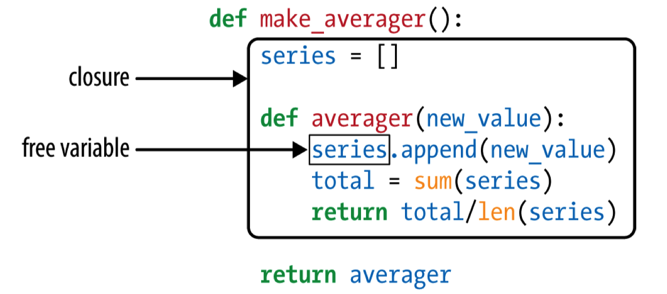
- free variable: a variable that is not bound in the local scope.
3. The nonlocal Declaration
def make_averager():

	count = 0

	total = 0

	def averager(new_value):

		count += 1

		total += new_value

		return total / count

	return averager

avg = make_averager()

print avg(10)  # UnboundLocalError: local variable 'count' referenced before assignment

# 1. We actually assign count in the body of averager, and that makes it a local variable.

# 2. We didn't have this problem before, because we never assigned to the series name,

# we only called series.append and invoked sum and len on it.

# 3. With immutable types, if you try to rebind them, then you are implicitly creating a

# local variable, it's no longer a free variable, therefore it is not saved in the closure.
def make_averager():

	count = 0

	total = 0

	def averager(new_value):

		nonlocal count, total  #  **********

		count += 1

		total += new_value

		return total / count

	return averager

avg = make_averager()

print(avg(10))  # 10.0

# 1. The nonlocal declaration was introduced in Python 3. It lets you flag a variable as a

# free variable even when it is assigned a new value within the function.
4. Implementing a Simple Decorator
- Typical behavior of a decorator: It replaces the decorated function with a new function that accepts the same arguments and (usually) returns whatever the decorated function was supposed to return, while also doing some extra processing.
def deco(func):

	print('running deco()')

	print('func -> %s' % str(func))

	def inner():

		print('running inner()')

	return inner

@deco  # target = deco(target)

def target():

	print('running target()')

target()

# running deco()  # executed immediately when the module is loaded

# func -> <function target at 0x106c460c8>

# running inner()

print(target.__name__)  # inner (function is replaced)
import time

FMT = '[{elapsed:0.8f}s] {name}({arg_str}) -> {result}'

def clock(func):

	def clocked(*args, **kwargs):

		t0 = time.time()

		result = func(*args, **kwargs)

		elapsed = time.time() - t0  # 用时

		name = func.__name__

		arg_lst = []

		if args:

			arg_lst.append(', '.join(repr(arg) for arg in args))

		if kwargs:

			pairs = ['%s=%r' % (k, w) for k, w in sorted(kwargs.items())]

			arg_lst.append(', '.join(pairs))

		arg_str = ', '.join(arg_lst)

		print(FMT.format(**locals()))  # any local variable of clocked

		return result

	return clocked

@clock

def snooze(seconds):

	time.sleep(seconds)

@clock

def factorial(n):

	return 1 if n < 2 else n*factorial(n-1)

print('*' * 40, 'Calling snooze(.123)')

snooze(.123)

print('*' * 40, 'Calling factorial(6)')

print('6! =', factorial(6))

# ('****************************************', 'Calling snooze(.123)')

# [0.12694907s] snooze(0.123) -> None

# ('****************************************', 'Calling factorial(6)')

# [0.00000286s] factorial(1) -> 1

# [0.00004411s] factorial(2) -> 2

# [0.00005984s] factorial(3) -> 6

# [0.00007296s] factorial(4) -> 24

# [0.00014281s] factorial(5) -> 120

# [0.00015783s] factorial(6) -> 720

# ('6! =', 720)
5. Decorators in the Standard Library
5.1 functools.wraps
import functools

def deco(func):

	@functools.wraps(func)  # copy the relevant attributes from func to inner

	def inner():

		print('running inner()')

	return inner

@deco

def target():

	"""i'm target"""

	print('running target()')

target()  # running inner()

print(target.__name__)  # target

print(target.__doc__)  # i'm target
5.2 functools.lru_cache
- An optimization technique that works by saving the results of previous invocations of an expensive function, avoiding repeat computations on previously used arguments.
- The cache is limited by discarding the entries that have not been read for a while.
import functools

@functools.lru_cache()  # Python 3

@clock

def fibonacci(n):

	if n < 2:

		return n

	return fibonacci(n-2) + fibonacci(n-1)

print(fibonacci(6))

# [0.00000095s] fibonacci(0) -> 0

# [0.00000215s] fibonacci(1) -> 1

# [0.00036097s] fibonacci(2) -> 1

# [0.00000167s] fibonacci(3) -> 2

# [0.00039101s] fibonacci(4) -> 3

# [0.00000095s] fibonacci(5) -> 5

# [0.00041699s] fibonacci(6) -> 8

# 8

# @functools.lru_cache(maxsize=128, typed=False)

# maxsize: how many call results are stored. (should be a power of 2)

# typed: True -> store results of different argument types separately (1 / 1.0)

#        False -> don't store

# [notes]: lru_cache uses a dict to store the results, all the arguments

#          taken by the decorated function must be hashable.
5.3 functools.singledispatch
- The new functools.singledispatch decorator in Python 3.4 allows each module to contribute to the overall solution, and lets you easily provide a specialized function even for classes that you can’t edit.
- If you decorate a plain function with @singledispatch, it becomes a generic function: a group of functions to perform the same operation in different ways, depending on the type of the first argument.
from functools import singledispatch

from collections import abc

import numbers

import html

@singledispatch  # mark the base function handles the obj type.

def htmlize(obj):

	content = html.escape(repr(obj))

	return '<pre>{}</pre>'.format(content)

@htmlize.register(str)  # @«base_function».register(«type»).

def _(text):  # name of the specialized functions is irrelevant

	return '<p>{0}</p>'.format(html.escape(text))

@htmlize.register(numbers.Integral)

def _(n):

	return '<pre>{0} (0x{0:x})</pre>'.format(n)

@htmlize.register(tuple)

@htmlize.register(abc.MutableSequence)

def _(seq):

	inner = '</li>\n<li>'.join(htmlize(item) for item in seq)

	return '<ul>\n<li>' + inner + '</li>\n</ul>'

print(htmlize(str))  # <pre><class 'str'></pre>

print(htmlize('<hello>'))  # <p><hello></p>

print(htmlize(10))  # <pre>10 (0xa)</pre>

print(htmlize(['alpha', {3, 2, 1}]))

# <ul>

# <li><p>alpha</p></li>

# <li><pre>{1, 2, 3}</pre></li>

# </ul>

# 1. Register the specialized functions to handle ABCs (abstract classes)

# instead of concrete implementations like int and list. (support more)

# 2. A notable quality of the singledispatch mechanism is that you can

# register specialized functions anywhere in the system, in any module.
6. Stacked Decorators
@d1

@d2

def f():

	print('f')

# f = d1(d2(f))
7. Parameterized Decorators
- Make a decorator factory that takes those arguments and returns a decorator, which is then applied to the function to be decorated.
def outter(a=1):

	def deco(func):

		def inner():

			if a == 1:

				print(1)

			else:

				print(a)

		return inner

	return deco

@outter()

def target1():

	pass

@outter(9)

def target2():

	pass

target1()  # 1

target2()  # 9
7. Function Decorators and Closures的更多相关文章
- 《流畅的Python》Data Structures--第7章 colsure and decorator
Function Decorators and Closures 装饰器是用于增强函数的行为,理解它,就必须先理解闭包. Python3引入关键字nonlocal,如果要理解闭包,就必须了解它的所有方 ...
- 浅入浅出Typescript Decorators
临时起的兴趣,想写一篇关于ts decorator的文章,就花小半天整理了一下... 这东西,在ES2017里好像也有... 文档的话看这里. 因为临时,就没想写太多文字介绍,带少许文字说明直接开撸 ...
- JavaScript Decorators 的简单理解
Decorators,装饰器的意思, 所谓装饰就是对一个物件进行美化,让它变得更漂亮.最直观的例子就是房屋装修.你买了一套房子,但是毛坯房,你肯定不想住,那就对它装饰一下,床,桌子,电视,冰箱等一通买 ...
- TypeScript学习笔记(九):装饰器(Decorators)
装饰器简介 装饰器(Decorators)为我们在类的声明及成员上通过元编程语法添加标注提供了一种方式. 需要注意的是:装饰器是一项实验性特性,在未来的版本中可能会发生改变. 若要启用实验性的装饰器特 ...
- 《dive into python3》 笔记摘录
1.list can hold arbitrary objects and can expand dynamically as new items are added. A list is an ...
- JAVASCRIPT的一些知识点梳理
春节闲点,可以安心的梳理一下以前不是很清楚的东东.. 看的是以下几个URL: http://web.jobbole.com/82520/ http://blog.csdn.net/luoweifu/a ...
- [TypeScript] Reflection and Decorator Metadata
TypeScript allows you to emit decorator metadata which enables more powerful features through reflec ...
- python函数与方法装饰器
之前用python简单写了一下斐波那契数列的递归实现(如下),发现运行速度很慢. def fib_direct(n): assert n > 0, 'invalid n' if n < 3 ...
- 是什么让javascript变得如此奇妙
What Makes Javascript Weird...and AWESOME -> First Class Functions -> Event-Driven Evironment ...
随机推荐
- Spark源码资料汇总
近几月,想要了解Spark的内部实现原理,因此想要查阅Spark的源码信息,现将所了解的资料汇总如下: 1. 博客文字类 (1) 官网 1) github 2) Spark官网 (2) gitbook ...
- Django:(06)Django模版
一.模版的使用 配置 如果是命令行创建的项目需要手动配置模版文件目录(如果是Pycharm创建的项目则无需配置) 在项目根目录下创建目录templates, 用来存放模版文件 在项目的配置文件夹set ...
- RMQ问题--ST
#include<iostream> #include<cstdio> #include<cmath> using namespace std; ; ]; int ...
- 自助机dmv?鸡肋
今天终于扛着懒癌去了一趟所谓的dmv自动机(dmv now kiosk),发现此机器只处理有关vehicle的三种事项,比如vehicle的new registration之类的,如果是其它事情还是得 ...
- C#7:什么是丢弃物以及如何使用它们
转载 http://www.devsanon.com/c/using-discards-feature-of-c-7 假设您希望调用一个具有返回值并且也接受out变量的方法,但是您不希望使用将要返回的 ...
- 在Linux上显示某个进程的线程的几种方式
方法一:PS 在ps命令中,"-T"选项可以开启线程查看.下面的命令列出了由进程号为的进程创建的所有线程. 1.$ ps -T -p 方法二: Top top命令可以实时显示各个线 ...
- 测试sigaction重启动标识
#include <stdio.h>#include <unistd.h>#include <signal.h>#include <string.h># ...
- loback的介绍与配置-(通俗易通)
一.logback的配置介绍 Logback的配置分为三个内容:Logger.appender及layout Logger:作为日志的记录器,主要用于存放日志对象,也可以定义日志类型.级别. appe ...
- oracle学习笔记day2
第三章:单值函数 函数分为: 1.单值函数 1.字符函数 2.日期函数 3.转换函数 4.数字函数 2.分组函数(后面的章节再做学习) 哑表dual dual是一个虚拟表,用来构成select的语法规 ...
- oracle常用命令(1)
oracle常用命令 一.登录 1.管理员身份登录:sqlplus/nolog--->conn/as sysdba 2.普通用户登录:sqlplus/nolog---->conn 用户名/ ...