
Biquads
From : http://www.earlevel.com/main/2003/02/28/biquads/
One of the most-used filter forms is the biquad. A biquad is a second order (two poles and two zeros) IIR filter. It is high enough order to be useful on its own, and—because of coefficient sensitivities in higher order filters—the biquad is often used as the basic building block for more complex filters. For instance, a biquad lowpass filter has a cutoff slope of 12 dB/octave, useful for tone controls; if you need a 24 dB/octave slope, you can cascade two biquads, and it will have less coefficient-sensitivity problems than a single fourth-order design.
Biquads come in several forms. The most obvious, a direct implementation of the second order difference equation (y[n] = a0*x[n] + a1*x[n-1] + a2*x[n-2] – b1*y[n-1] – b2*y[n-2]), called direct form I:
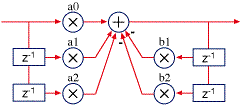 Direct form I
Direct form I is the best choice for implementation in a fixed point processor because it has a single summation point (fixed point DSPs usually have an extended accumulator that allows for intermediate overflows).
We can take direct form I and split it at the summation point like this:
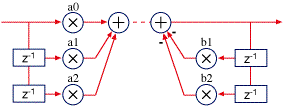
We then take the two halves and swap them, so that the feedback half (the poles) comes first:
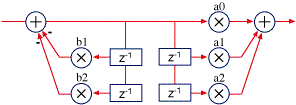
Now, notice that one pair of the z delays is redundant, storing the same information as the other. So, we can merge the two pairs, yielding the direct form II configuration:
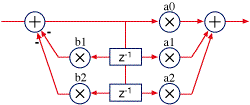 Direct form II
In floating point, direct form II is better because it saves two memory locations, and floating point is not sensitive to overflow in the way fixed point math is. We can improve this a little by transposing the filter. To transpose a filter, reverse the signal flow direction—output becomes input, distribution nodes become summers, and summers become nodes. The characteristics of the filter are unchanged, but in this case it happens that the floating point characteristics are a little better. Floating point has better accuracy when intermediate sums are with closer values (adding small numbers to large number in floating point is less precise than with similar values). Here is the transposed direct form II:
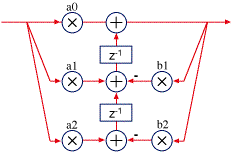 Transposed direct form II
Notes and recommendations
Again, direct form I is usually the best choice for fixed point, and transposed direct form II for floating point.
At low frequency settings, biquads are more susceptible to quantization error, mainly from the feedback coefficients (b1 and b2) and the delay memory. Lack of resolution in the coefficients makes precise positioning of the poles difficult, which is particularly a problem when the poles are positioned near the unit circle. The second problem, delay memory, is because multiplication generates more bits, and the bits are truncated when stored to memory. This quantization error is fed back in the filter, causing instability. 32-bit floating point is usually good enough for audio filters, but you may need to use double precision, especially at very low frequencies (for control filtering) and at high sample rates.
For fixed point filters, 24-bit coefficients and memory work well for most filters, but start to become unstable below about 300 Hz at 48 kHz sample rate (or twice that at 96 kHz). Double precision is always costly on a fixed point processor, but fortunately there is a simple technique for improving stability. Looking at the direct form I drawing, the quantization occurs when the higher precision accumulator is stored in the lower precision delay memory on the right side. By taking the quantization error (the difference between the full accumulated value and its value after storing it to memory) and adding it back in for the next sample calculation, the filter performs nearly as well as using full double precision calculations, but at a much lower computational cost. This technique is called first order noise shaping. There are higher order noise shapers, but this one works well enough to handle almost all audio needs, even at high sample rates.
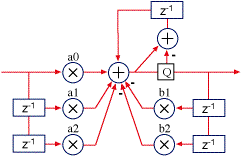 Direct form I with first-order noise shaping
In general, 16-bit fixed point processing is not suitable for audio without double precision coefficients and computation.
Finally, biquads are just one of a DSP programmers tools—they aren’t always the best filter form. There are other filters that don’t share the biquad’s low-frequency sensitivities (in general, biquad coefficient precision is very good at high frequencies, and poor at low ones; there are other filter forms that spread the precision out more evenly, or trade off reduced high frequency performance for better low frequency performance). However, biquads are well known and design tools are plentiful, so they are usually the first choice for an IIR filter unless you find a reason to use another.
There are too many filter forms to cover, but one other filter form that is popular for synthesizers is the state variable filter. It has very excellent low frequency performance, and limitations in the high frequencies that have to be worked around, but most importantly frequency and Q coefficients are separate and easy to change for dynamic filtering. It also make a great low frequency sine wave generator.
Biquads的更多相关文章
- Libfilth(一个滤波器C库)使用
Libfilth使用说明 winshton 2009年2月 (*本文大部分翻译自libfilth,还有一部分是个人使用实践 *时间水平均有限,翻译的不完整,尤其第二章可以忽略) 版本历史修改记录 版本 ...
- Digital biquad filter
Direct Form 1 The most straightforward implementation is the Direct Form 1, which has the following ...
随机推荐
- [C++]求解三元一次方程组
/** * author:johnny zen * date:2017-09-20 11:19 * function:Calculate Ternary system of equations * n ...
- SSM框架中将时间写入数据库的格式定义
//声明Date类接收的数据格式 @DateTimeFormat(pattern="yyyy-MM-dd HH:mm:ss") private Date addtime;
- 【vim】把当前文件转化为网页
这会生成一个 HTML 文件来显示文本,并在分开的窗口显示源代码: :%TOhtml (译者注:原文是 :%Tohtml,但在我的电脑上是 :%TOhtml) 转载自:https://linux.cn ...
- 内核IS_ERR宏解析 【转】
转自:http://blog.chinaunix.net/uid-20196318-id-28769.html 最近在使用filp_open打开文件时遇到到一个问题,当打开一个并不存在的文件时,fil ...
- BootStrap学习从现在开始
前言 原文链接 http://aehyok.com/Blog/Detail/6.html 当下最流行的前端开发框架Bootstrap,可大大简化网站开发过程,从而深受广大开发者的喜欢.本文总结了Boo ...
- shiro设置session超时时间
系统默认超时时间是180000毫秒(30分钟) long timeout = SecurityUtils.getSubject().getSession().getTimeout(); System. ...
- Android:Camera
Android Camera开发 Android手机关于Camera的使用,一是拍照,二是摄像,由于Android提供了强大的组件功能,为此对于在Android手机系统上进行Camera的开发,我们可 ...
- js实现星级评分效果(非常规5个li代码)
1. 前言 此方案受到JS单行写一个评级组件启发,自己写了一个简单Demo. 功能有正常滑动,动态显示实心星星个数:当点击确认,则保持当前的实心星星个数:再移动时未点击,则离开后还是保持之前的状态. ...
- OneNET麒麟座应用开发之四:数据上传测试
已经测试过OneNET麒麟座开发板了,这次来尝试与OneNET的连接和数据上传.这也是我们测试这块开发办的主要原因,因为在十几种我们有这种将分散的采集点数据上传到后台的需求. 先看看麒麟座这块开发板, ...
- Neural style transfer
网络风格迁移 作者:无用 本文通过学习吴恩达视频所做笔记 目录 简介 可视化卷积层 构建风格迁移网络 一.网络风格迁移简介 二.可视化卷积层 可视化深层卷积网络???这个问题我看过一篇文章,我会在后补 ...