
WPF中模板选择和DataContext的一些使用
如图样:
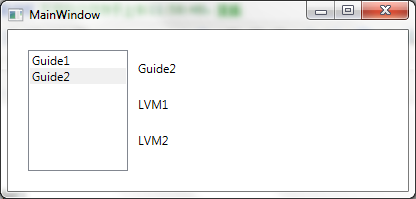
View结构
MainView(MainViewModel)
|---Guide1View(Guide1ViewModel)
|---Guide2View(Guide2ViewModel)
|---Guide2_1View1(Guide2_1ViewModel)
|---Guide2_1View2(Guide2_1ViewModel)
ViewModel实例结构
Main(ViewModelViewModel)
|---CurrentViewModel(GuidePageViewModelBase)
|---PageViewModelList(ObservableCollection<GuidePageViewModelBase>)
|---Guide1(Guide1ViewModel)
|---Guide2(Guide2ViewModel)
|---LVM1(LViewModel)
|---LVM2(LViewModel)
1、通过ContentControl显示选中的视图模型对应的视图:
<ContentControl Content="{Binding CurrentViewModel}">

    <ContentControl.Resources>

        <DataTemplate DataType="{x:Type viewmodel:Guide1ViewModel}">

            <view:Guide1View/>

        </DataTemplate>

        <DataTemplate DataType="{x:Type viewmodel:Guide2ViewModel}">

            <view:Guide2View/>

        </DataTemplate>

    </ContentControl.Resources>

</ContentControl>
2、Guide2_1View作为一个多次使用的控件,对应一个LViewModel,设置自己的DataContext(这里的背景是该视图的使用个数确定的。当然也可以用ListBox代替):
<view:Guide2_1View DataContext="{Binding Path=DataContext.LVM1,RelativeSource={RelativeSource AncestorType={x:Type UserControl}}}" />

<view:Guide2_1View DataContext="{Binding Path=DataContext.LVM2,RelativeSource={RelativeSource AncestorType={x:Type UserControl}}}" />
完整代码:
ViewModel:
using GalaSoft.MvvmLight;

namespace WPF_NestedVMAndView.ViewModel

{

    public class MainViewModel : ViewModelBase

    {

        public MainViewModel()

        {

            PageViewModelList = new ObservableCollection<GuidePageViewModelBase>()

            {

                new Guide1ViewModel(),

                new Guide2ViewModel(),

            };

            CurrentViewModel = PageViewModelList[];

        }

        public const string CurrentViewModelPropertyName = "CurrentViewModel";

        private GuidePageViewModelBase _currentViewModel;

        public GuidePageViewModelBase CurrentViewModel

        {

            get

            {

                return _currentViewModel;

            }

            set

            {

                if (_currentViewModel == value)

                    return;

                _currentViewModel = value;

                RaisePropertyChanged(CurrentViewModelPropertyName);

            }

        }

        public const string PageViewModelListPropertyName = "PageViewModelList";

        private ObservableCollection<GuidePageViewModelBase> _pageViewModelList;

        public ObservableCollection<GuidePageViewModelBase> PageViewModelList

        {

            get

            {

                return _pageViewModelList;

            }

            set

            {

                if (_pageViewModelList == value)

                    return;

                _pageViewModelList = value;

                RaisePropertyChanged(PageViewModelListPropertyName);

            }

        }

    }

    public class GuidePageViewModelBase : ViewModelBase

    {

        public GuidePageViewModelBase(string name)

        {

            Name = name;

        }

        public const string NamePropertyName = "Name";

        private string _name;

        public string Name

        {

            get

            {

                return _name;

            }

            set

            {

                if (_name == value)

                    return;

                _name = value;

                RaisePropertyChanged(NamePropertyName);

            }

        }

    }

    public class Guide1ViewModel : GuidePageViewModelBase

    {

        public Guide1ViewModel()

            : base("Guide1")

        {

        }

    }

    public class Guide2ViewModel : GuidePageViewModelBase

    {

        public Guide2ViewModel() : base("Guide2")

        {

            LVM1 = new LViewModel()

            {

                Text = "LVM1",

            };

            LVM2 = new LViewModel()

            {

                Text = "LVM2",

            };

        }

        public const string LVM1PropertyName = "LVM1";

        private LViewModel _lvm1;

        public LViewModel LVM1

        {

            get

            {

                return _lvm1;

            }

            set

            {

                if (_lvm1 == value)

                    return;

                _lvm1 = value;

                RaisePropertyChanged(LVM1PropertyName);

            }

        }

        public const string LVM2PropertyName = "LVM2";

        private LViewModel _lvm2;

        public LViewModel LVM2

        {

            get

            {

                return _lvm2;

            }

            set

            {

                if (_lvm2 == value)

                    return;

                _lvm2 = value;

                RaisePropertyChanged(LVM2PropertyName);

            }

        }

    }

    public class LViewModel : ViewModelBase

    {

        public const string TextPropertyName = "Text";

        private string _text;

        public string Text

        {

            get

            {

                return _text;

            }

            set

            {

                if (_text == value)

                    return;

                _text = value;

                RaisePropertyChanged(TextPropertyName);

            }

        }

    }

}
MainView:
<Window x:Class="WPF_NestedVMAndView.MainWindow"

        xmlns="http://schemas.microsoft.com/winfx/2006/xaml/presentation"

        xmlns:x="http://schemas.microsoft.com/winfx/2006/xaml"

        xmlns:view="clr-namespace:WPF_NestedVMAndView.View"

        xmlns:viewmodel="clr-namespace:WPF_NestedVMAndView.ViewModel"

        Title="MainWindow" Height="350" Width="525"

        DataContext="{Binding Main,Source={StaticResource Locator}}">

    <DockPanel Margin="20">

        <ListBox ItemsSource="{Binding PageViewModelList}" DisplayMemberPath="Name" SelectedItem="{Binding CurrentViewModel}" DockPanel.Dock="Left" Width="100"/>

        <ContentControl Content="{Binding CurrentViewModel}">

            <ContentControl.Resources>

                <DataTemplate DataType="{x:Type viewmodel:Guide1ViewModel}">

                    <view:Guide1View/>

                </DataTemplate>

                <DataTemplate DataType="{x:Type viewmodel:Guide2ViewModel}">

                    <view:Guide2View/>

                </DataTemplate>

            </ContentControl.Resources>

        </ContentControl>

    </DockPanel>

</Window>
Guide1View:
<UserControl x:Class="WPF_NestedVMAndView.View.Guide1View"

             xmlns="http://schemas.microsoft.com/winfx/2006/xaml/presentation"

             xmlns:x="http://schemas.microsoft.com/winfx/2006/xaml"

             xmlns:mc="http://schemas.openxmlformats.org/markup-compatibility/2006"

             xmlns:d="http://schemas.microsoft.com/expression/blend/2008"

             mc:Ignorable="d"

             Background="White"

             >

    <Grid>

        <TextBlock Text="{Binding Name}" Margin="10"/>

    </Grid>

</UserControl>
Guide2View:
<UserControl x:Class="WPF_NestedVMAndView.View.Guide2View"

             xmlns="http://schemas.microsoft.com/winfx/2006/xaml/presentation"

             xmlns:x="http://schemas.microsoft.com/winfx/2006/xaml"

             xmlns:mc="http://schemas.openxmlformats.org/markup-compatibility/2006"

             xmlns:d="http://schemas.microsoft.com/expression/blend/2008"

             xmlns:view="clr-namespace:WPF_NestedVMAndView.View"

             mc:Ignorable="d"

             Background="White">

    <DockPanel>

        <TextBlock Text="{Binding Name}" Margin="10" DockPanel.Dock="Top"/>

        <view:Guide2_1View DataContext="{Binding Path=DataContext.LVM1,RelativeSource={RelativeSource AncestorType={x:Type UserControl}}}" DockPanel.Dock="Top"/>

        <view:Guide2_1View DataContext="{Binding Path=DataContext.LVM2,RelativeSource={RelativeSource AncestorType={x:Type UserControl}}}" DockPanel.Dock="Top"/>

    </DockPanel>

</UserControl>
Guide2_1View:
<UserControl x:Class="WPF_NestedVMAndView.View.Guide2_1View"

             xmlns="http://schemas.microsoft.com/winfx/2006/xaml/presentation"

             xmlns:x="http://schemas.microsoft.com/winfx/2006/xaml"

             xmlns:mc="http://schemas.openxmlformats.org/markup-compatibility/2006"

             xmlns:d="http://schemas.microsoft.com/expression/blend/2008"

             mc:Ignorable="d"

             Background="White">

    <Grid>

        <TextBlock Text="{Binding Text}" Margin="10"/>

    </Grid>

</UserControl>
。
WPF中模板选择和DataContext的一些使用的更多相关文章
- WPF中如何选择合适的元数据标记?(英文)
原文:WPF中如何选择合适的元数据标记?(英文) FrameworkPropertyMetadataOptions Enumeration:Specifies the types of framewo ...
- 总结:WPF中模板需要绑定父级别的ViewModel该如何处理
原文:总结:WPF中模板需要绑定父级别的ViewModel该如何处理 <ListBox ItemsSource="{Binding ClassCollection}"> ...
- WPF动态模板选择的两种实现
前言 .net开发工作了六年,看了大量的博客,现在想开始自己写博客,这是我的第一篇博客,试试水,就从自己最常使用的WPF开始. 今天我来给大家分享可用户动态选择控件模板的两种实现方式:DataTrig ...
- WPF中 ItemsSource 和DataContext不同点
此段为原文翻译而来,原文地址 WPF 中 数据绑定 ItemSource和 DataContext的不同点: 1.DataContext 一般是一个非集合性质的对象,而ItemSource 更期望数据 ...
- WPF中的数据模板使用方式之一:ContentControl、ContentTemplate和TemplateSelector的使用
在WPF中,数据模板是非常强大的工具,他是一块定义如何显示绑定的对象的XAML标记.有两种类型的控件支持数据模板:(1)内容控件通过ContentTemplate属性支持数据模板:(2)列表控件通过I ...
- wpf 获取datagrid中模板中控件
//获取name为datagrid中第三列第一行模板的控件 FrameworkElement item = dataGrid.Columns[].GetCellContent(dataGrid.Ite ...
- 关于WPF中ItemsControl系列控件中Item不能继承父级的DataContext的解决办法
WPF中所有的集合类控件,子项都不能继承父级的DataContext,需要手动将绑定的数据源指向到父级控件才可以. <DataGridTemplateColumn Header="操作 ...
- WPF 中获取DataGrid 模板列中控件的对像
WPF 中获取DataGrid 模板列中控件的对像 #region 当前选定行的TextBox获得焦点 /// <summary> /// 当前选定行的TextBox获得焦点 /// &l ...
- 在WPF中使用文件夹选择对话框
开发中有时会想实现"选择某个文件夹"的效果: 在WPF中,使用Microsoft.Win32.OpenFileDialog只能选择文件,FolderBrowserDialog只能用 ...
随机推荐
- Cento OS 6.5 YUM 安装 R 的方法
(1)配置yum (2)安装EPEL YUM源 yum install epel-release 修改源配置文件/etc/yum.repos.d/epel.repo ,把基础的恢复,镜像的地址注释掉 ...
- Leetcode 299 Bulls and Cows 字符串处理 统计
A就是统计猜对的同位同字符的个数 B就是统计统计猜对的不同位同字符的个数 非常简单的题 class Solution { public: string getHint(string secret, s ...
- Linux中如何产生core文件?
在程序不寻常退出时,内核会在当前工作目录下生成一个core文件(是一个内存映像,同时加上调试信息).使用gdb来查看core文件,可以指示出导致程序出错的代码所在文件和行数. 1.core文件 ...
- 巧用在线html编辑器,保存文章到数据库(带html标签)
1.对于读取数据库的文章字段刷新到web页面,如何使文章格式很好的显示出来,那么数据库应存text格式,并记录文章的个数(转换为html): 2.如何转换html格式,可以使文章从word直接粘贴到在 ...
- Java Socket网络编程常见异常(转)
1.java.net.SocketTimeoutException 这个异常比较常见,socket超时.一般有2个地方会抛出这个,一个是connect的时候,这个超时参数由connect(Socket ...
- InstallShield 2012 Spring优惠升级到最新版本(2015.4.30之前)
InstallShield 2012 Spring即将EOF,所以仍在使用InstallShield 2012 Spring的用户请注意下面内容: InstallShield 2012 Spring升 ...
- [salesforce] URLFOR function finally
While developing your Visualforce pages you may need to be able to obtain the URL of certain actions ...
- 【实用技巧】取消Win7开机账户的手动选择
因为前面碰到的一些事情,稍有感慨. 关于win7的一些小技巧都不是什么很有技术含量东西,或者说很浅显.我说一个技巧,也许很多人都知道,也许也早有人说过.但我想说的是我不是在炫耀什么,我只是想分享一些我 ...
- Codeforces Round #384 (Div. 2) A. Vladik and flights 水题
A. Vladik and flights 题目链接 http://codeforces.com/contest/743/problem/A 题面 Vladik is a competitive pr ...
- 使用nginx-http-concat优化网站响应
前言: 我们在访问淘宝的时候,会看到代码中的js和css文件是通过一次请求或得的,我们知道浏览器一次请求只能并发访问数个资源,这样的处理错输在网络传输层面可以大大节省时间,这里使用的技术就是把css. ...