
ActiveMQ笔记——技术点汇总
Table of contents
· What's the Java Message Service?
· How are messages stored by ActiveMQ?
· Caching messages in the broker for consumers
· Embedding ActiveMQ using Spring
Introduction to ActiveMQ
1. ActiveMQ is an open source, Java Message Service (JMS) 1.1–compliant, message-oriented middleware (MOM) from the Apache Software Foundation that provides high availability, performance, scalability, reliability, and security for enterprise messaging.
2. ActiveMQ features:
a) JMS compliance.
b) Connectivity - ActiveMQ supports for protocols such as HTTP/S, IPmulticast, SSL, STOMP, TCP, UDP, XMPP, and more.
c) Pluggable persistence and security - ActiveMQ provides multiple flavors of persistence. Security can be completely customized for the type of authentication and authorization.
d) Integration with application servers - It’s common to integrate ActiveMQ with a Java application server, including Apache Tomcat, Jetty, Apache Geronimo, JBoss and etc.
e) Client APIs - ActiveMQ provides client APIs for many languages besides just Java, including C/C++, .NET, Perl, PHP, Python, Ruby, and more.
f) Broker clustering - Many ActiveMQ brokers can work together as a federated network of brokers for scalability purposes.
g) Dramatically simplified administration - ActiveMQ is designed with developers in mind.
3. When to use ActiveMQ.
a) Heterogeneous application integration - When integrating applications written in different languages on different platforms, the various client APIs make it possible to send and receive messages via ActiveMQ no matter what language is used.
b) As a replacement for RPC - Systems that rely upon synchronous requests typically have a limited ability to scale because eventually requests will begin to back up, thereby slowing the whole system. Instead of experiencing this type of a slowdown, using asynchronous messaging, additional message receivers can be easily added so that messages are consumed concurrently and therefore handled faster.
c) To loosen the coupling between applications - A loosely coupled design is considered to be asynchronous, where the calls from either application have no bearing on one another; there’s no interdependence or timing requirements. It’s often said that applications sending messages just fire-and-forget - they send the message to ActiveMQand aren’t concerned with how or when the message is delivered. In the same manner, the consuming applications have no concern with where the messages originated or how they were sent to ActiveMQ. With a tightly coupled system design, moving a application to a new location is difficult because all segments of the application must experience an outage. With an application designed using loose coupling, different segments of the system can be moved independent of one another.
d) As the backbone of an event-driven architecture - Asynchronous processes are what afford massive scalability and high availability. When a user makes a purchase on Amazon, there are quite a few separate stages through which that order must travel including order placement, invoice creation, payment processing, order fulfillment, shipping, and more. When the user places the order, there’s a synchronous call to submit the order, but the entire order process doesn’t take place behind a synchronous call via the web browser. Instead, the order is accepted and acknowledged immediately. The rest of the steps in the process are handled asynchronously. If a problem occurs that prevents the process from proceeding, the user is notified via email.
e) To improve application scalability - The ability to design an application using a service for a specific task is the backbone of service-oriented architecture (SOA). Each service fulfills a discrete function and only that function. Then applications are built through the composition of these services, and the communication among services is achieved using asynchronous messaging and eventual consistency.
Installing ActiveMQ
1. Install JDK (version >= 1.7) and set JAVA_HOME and PATH environment variable.
2. Extract the files from the zipped tarball into a directory of your choice.
tar zxvf apache-activemq-5.13.-bin.tar.gz

cd apache-activemq-5.13.
3. Run ActiveMQ as a daemon process.
bin/activemq start
4. Testing the Installation
a) Open the administrative interface.
i. URL: http://127.0.0.1:8161/admin/
ii. Login: admin
iii. Passwort: admin
b) Navigate to "Queues".
c) Add a queue name and click "Create".
d) Send test message by klicking on "Send to".
5. Shutdown ActiveMQ.
bin/activemq stop
Message-oriented middleware
1. Message-oriented middleware (MOM) is best described as a category of software for communication in an asynchronous, loosely-coupled, reliable, scalable, and secure manner among distributed applications or systems.
2. MOMs are important concept in the distributed computing world. They allow application-to-application communication using APIs provided by each vendor, and begin to deal with many issues in the distributed system space. A MOM acts as a message mediator between message senders and message receivers.
JMS specification
What's the Java Message Service?
1. The Java Message Service (JMS) aims to provide a standardized API to send and receive messages using the Java programming language in a vendor-neutral manner.
2. JMSisn’t itself a MOM. It’s an APIthat abstracts the interaction between messaging clients and MOMs in the same manner that JDBCabstracts communication with relational databases.
JMS client
JMS clients utilize the JMS APIfor interacting with the JMSprovider.
Non-JMS client
A non-JMS client uses a JMS provider’s native client APIinstead of the JMS API.
JMS producer
1. JMS clients use the JMS MessageProducer class for sending messages to a destination.
2. The default destination for a given producer is set when the producer is created using the Session.createProducer() method. But this can be overridden for individual messages by using the MessageProducer.send() method.
 public interface MessageProducer {

     void setDisableMessageID(boolean value) throws JMSException;

     boolean getDisableMessageID() throws JMSException;

     void setDisableMessageTimestamp(boolean value) throws JMSException;

     boolean getDisableMessageTimestamp() throws JMSException;

     void setDeliveryMode(int deliveryMode) throws JMSException;

     int getDeliveryMode() throws JMSException;

     void setPriority(int defaultPriority) throws JMSException;

     int getPriority() throws JMSException;

     void setTimeToLive(long timeToLive) throws JMSException;

     long getTimeToLive() throws JMSException;

     Destination getDestination() throws JMSException;

     void close() throws JMSException;

     void send(Message message) throws JMSException;

     void send(Message message, int deliveryMode, int priority,

     long timeToLive)

     throws JMSException;

     void send(Destination destination, Message message)

     throws JMSException;

     void send(

         Destination destination,

         Message message,

         int deliveryMode,

         int priority,

         long timeToLive) throws JMSException;

 }
JSM consumer
1. JMS clients use the JMS MessageConsumer class for consuming messages from a destination.
2. The MessageConsumer can consume messages either synchronously by using one of the receive() methods or asynchronously by providing a MessageListener implementation to the consumer.
 public interface MessageConsumer {

     String getMessageSelector() throws JMSException;

     MessageListener getMessageListener() throws JMSException;

     void setMessageListener(MessageListener listener) throws JMSException;

     Message receive() throws JMSException;

     Message receive(long timeout) throws JMSException;

     Message receiveNoWait() throws JMSException;

     void close() throws JMSException;

 }
JSM provider
The JMS provider is the vendor-specific MOM that implements the JMS API.
JMS message
1. A JMS message allows anything to be sent as part of the message, including text and binary data as well as information in the headers.
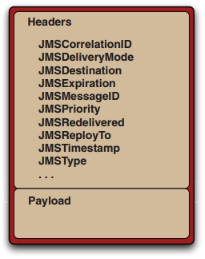
2. Headers set automatically by the client’s send() method:
a) JMSDestination.
b) JMSDeliveryMode - JMS supports two types of delivery modes for messages: persistent and nonpersistent. The default delivery mode is persistent.
i. Persistent - Advises the JMS provider to persist the message so it’s not lost if the provider fails. A JMS provider must deliver a persistent message once and only once.
ii. Nonpersistent - Instructs the JMS provider not to persist the message. A JMS provider must deliver a nonpersistent message at most once. Nonpersistent messages are typically usedfor sending notifications or real-time data.
c) JMSExpiration - The time that a message will expire. The JMSExpiration message header is calculated by adding the time-to-live to the current time in GMT. By default the time-to-live is zero, meaning that the message won’t expire.
d) JMSMessageID - A string that uniquely identifies a message that’s assigned by the JMS provider and must begin with ID.
e) JMSPriority.
f) JMSTimestamp - This header denotes the time the message was sent by the producer to the JMS provider.
3. Header set optionally by the client:
a) JMSCorrelationID - Used to associate the current message with a previous message.
b) JMSReplyTo - Used to specify a destination where a reply should be sent.
c) JMSType - Used to semantically identify the message type.
4. Headers set optionally by the JMS provider:
a) JMSRedelivered - Used to indicate the liklihood that a message was previously delivered but not acknowledged.
 public interface Message {

     ...

     boolean getBooleanProperty(String name) throws JMSException;

     byte getByteProperty(String name) throws JMSException;

     short getShortProperty(String name) throws JMSException;

     int getIntProperty(String name) throws JMSException;

     long getLongProperty(String name) throws JMSException;

     float getFloatProperty(String name) throws JMSException;

     double getDoubleProperty(String name) throws JMSException;

     String getStringProperty(String name) throws JMSException;

     Object getObjectProperty(String name) throws JMSException;

     ...

     Enumeration getPropertyNames() throws JMSException;

     boolean propertyExists(String name) throws JMSException;

     ...

     void setBooleanProperty(String name, boolean value) throws JMSException;

     void setByteProperty(String name, byte value) throws JMSException;

     void setShortProperty(String name, short value) throws JMSException;

     void setIntProperty(String name, int value) throws JMSException;

     void setLongProperty(String name, long value) throws JMSException;

     void setFloatProperty(String name, float value) throws JMSException;

     void setDoubleProperty(String name, double value) throws JMSException;

     void setStringProperty(String name, String value) throws JMSException;

     void setObjectProperty(String name, Object value) throws JMSException;

     ....

 }
5. Message selectors.
a) Message selectors allow a JMSclient to specify which messages it wants to receive from a destination based on values in message headers.
b) Selectors are conditional expressions defined using a subset of SQL92.
6. Message body - JMS defines six Java types for the message body, also known as the payload.
a) Message - The base message type. Used to send a message with no payload, only headers and properties. Typically used for simple event notification.
b) TextMessage.
c) MapMessage - Uses a set of name/value pairs as its payload. The names are of type String and the values are a Java primitive type.
d) BytesMessage.
e) StreamMessage.
f) ObjectMessage - Used to hold a serializable Java object as its payload.
JMS domains
1. The point-to-point domain.
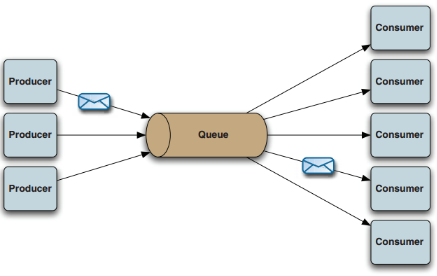
a) The point-to-point (PTP) messaging domain uses destinations known as queues.
b) Each message received on the queue is delivered once and only once to a single consumer.
c) Through the use of queues, messages are sent and received either synchronously or asynchronously.
2. The publish/subscribe domain.
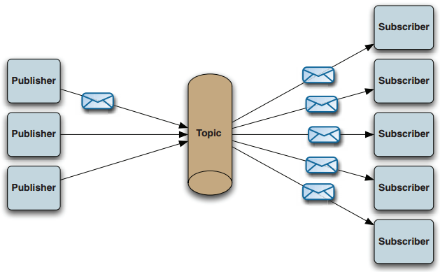
a) The publish/subscribe (pub/sub) messaging domain uses destinations known as topics. Publishers send messages to the topic and subscribers register to receive messages from the topic.
b) Any messages sent to the topic are automatically delivered to all subscribers.
c) Much the same as PTP messaging, subscribers register to receive messages from the topic either synchronously or asynchronously.
3. Request/reply messaging.
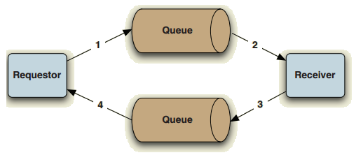
a) Although the JMS spec doesn’t define request/reply messaging as a formal messaging domain, it does provide some message headers and a couple of convenience classes for handling basic request/reply messaging.
b) Request/reply messaging is an asynchronous back-and-forth conversational pattern utilizing either the PTP domain or the pub/sub domain through a combination of the JMSReplyTo and JMSCorrelationID message headers and temporary destinations. The JMSReplyTo specifies the destination where a reply should be sent, and the JMSCorrelationID in the reply message specifies the JMSMessageID of the request message.
c) The convenience classes for handling basic request/reply are the QueueRequestor and the TopicRequestor. These classes provide a request() method that sends a request message and waits for a reply message through the creation of a temporary destination where only one reply per requestis expected.
Administered objects
1. Administered objects contain provider-specific JMSconfiguration information and are supposed to be created by a JMSadministrator.
2. The JMS spec defines two types of administered objects: ConnectionFactoryand Destination.
Connection factory
1. JMS clients use the ConnectionFactory object to create connections to a JMS provider.
2. JMS connections are used by JMS clients to create javax.jms.Session objects that represent an interaction with the JMS provider.
Destination
The Destination object encapsulates the provider-specific address to which messages are sent and from which messages are consumed.
ActiveMQ message storage
How are messages stored by ActiveMQ?
1. Messages sent to queues and topics are stored differently.
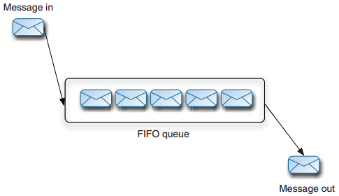
2. Queue - Storage for queues is straightforward-messages are basically stored in first in, first out order (FIFO). Only when that message has been consumed and acknowledged can it be deleted from the broker’s message store.
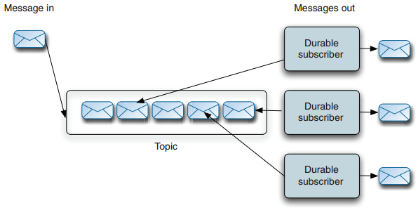
3. Topic - In order to save storage space, only one copy of a message is stored by the broker. A durable subscriber object in the store maintains a pointer to its next stored message and dispatches a copy of it to its consumer. The message store is implemented in this manner because each durable subscriber could be consuming messages at different rates or they may not all be running at the same time. Also, because every message can potentially have many consumers, a message can’t be deleted from the store until it’s been successfully delivered to every interested durable subscriber.
The KahaDB message store
1. The recommended message store for general-purpose messages since ActiveMQ version 5.3 is KahaDB.
2. This is a file-based message store that combines a transactional journal, for reliable message storage and recovery, with good performance and scalability.
3. Enable the KahaDB store for ActiveMQ.
<broker brokerName="broker" persistent="true" useShutdownHook="false">

    ...

    <persistenceAdapter>

    <kahaDB directory="activemq-data" journalMaxFileLength="16mb"/>

    </persistenceAdapter>

    ...

</broker>
The AMQ message store
1. The AMQ message store, like KahaDB, is a combination of a transactional journal for reliable persistence (to survive system crashes) and high-performance indexes, which makes this store the best option when message throughput is the main requirement for an application.
2. But because it uses two separate files for every index, and there’s an index per destination, the AMQ message store shouldn’t beused if you intend to use thousands of queues per broker. Also, recovery can be slow if the ActiveMQ broker isn’t shut down cleanly, because all the indexes need to be rebuilt.
The JDBC message store
1. The most common reason why so many organizations choose the JDBC message store is because they already have expertise administering relational databases.
2. JDBC persistence is definitely not superior in performance to the aforementioned message store implementations.
3. Databases supported by the JDBC message store:
a) Apache Derby
b) MySQL
c) PostgreSQL
d) Oracle
e) SQL Server
f) Sybase
g) Informix
h) MaxDB
The memory message store
1. The memory message store holds all persistent messages in memory.
2. No active caching is involved, so you have to be careful that both the JVM and the memory limits you set for the broker are large enough to accommodate all the messages that may exist in this message store at one time.
Caching messages in the broker for consumers
1. The ActiveMQ message broker caches messages in memory for every topic that’s used. The only types of topics that aren’t supported are temporary topics and ActiveMQ advisory topics. Caching of messages in thisway isn’t handled for queues, as the normal operation of a queue is to hold every message sent to it.
2. Messages that are cached by the broker are only dispatched to a topic consumer if the consumer is retroactive, and never to durable topic subscribers.
Code examples
Publish/subscribe messaging
1. The first use case revolves around a stock portfolio use case for demonstrating publish/subscribe messaging.
2. This example is simple and utilizes a Publisher class for sending stock price messages to a topic, as well as a Consumer class for registering a Listener class to consume messages from topics in an asynchronous manner.
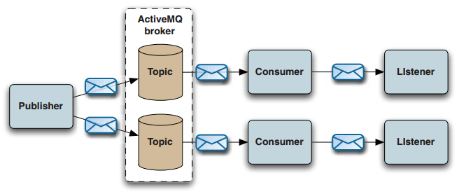
3. Publisher.java
 import java.util.Hashtable;

 import java.util.Map;

 import javax.jms.Connection;

 import javax.jms.ConnectionFactory;

 import javax.jms.Destination;

 import javax.jms.JMSException;

 import javax.jms.MapMessage;

 import javax.jms.Message;

 import javax.jms.MessageProducer;

 import javax.jms.Session;

 import org.apache.activemq.ActiveMQConnectionFactory;

 import org.apache.activemq.command.ActiveMQMapMessage;

 public class Publisher {

     protected int MAX_DELTA_PERCENT = 1;

     protected Map<String, Double> LAST_PRICES = new Hashtable<String, Double>();

     protected static int count = 10;

     protected static int total;

     protected static String brokerURL = "tcp://centos1:61616";

     protected static transient ConnectionFactory factory;

     protected transient Connection connection;

     protected transient Session session;

     protected transient MessageProducer producer;

     public Publisher() throws JMSException {

         factory = new ActiveMQConnectionFactory(brokerURL);

         connection = factory.createConnection();

         try {

         connection.start();

         } catch (JMSException jmse) {

             connection.close();

             throw jmse;

         }

         session = connection.createSession(false, Session.AUTO_ACKNOWLEDGE);

         producer = session.createProducer(null);

     }

     public void close() throws JMSException {

         if (connection != null) {

             connection.close();

         }

     }

     public static void main(String[] args) throws JMSException {

         String[] stocks = { "IONA", "JAVA" };

         Publisher publisher = new Publisher();

         while (total < 1000) {

             for (int i = 0; i < count; i++) {

                 publisher.sendMessage(stocks);

             }

             total += count;

             System.out.println("Published '" + count + "' of '" + total + "' price messages");

             try {

               Thread.sleep(1000);

             } catch (InterruptedException x) {

             }

         }

         publisher.close();

     }

     protected void sendMessage(String[] stocks) throws JMSException {

         int idx = 0;

         while (true) {

             idx = (int)Math.round(stocks.length * Math.random());

             if (idx < stocks.length) {

                 break;

             }

         }

         String stock = stocks[idx];

         Destination destination = session.createTopic("STOCKS." + stock);

         Message message = createStockMessage(stock, session);

         System.out.println("Sending: " + ((ActiveMQMapMessage)message).getContentMap() + " on destination: " + destination);

         producer.send(destination, message);

     }

     protected Message createStockMessage(String stock, Session session) throws JMSException {

         Double value = LAST_PRICES.get(stock);

         if (value == null) {

             value = new Double(Math.random() * 100);

         }

         // lets mutate the value by some percentage

         double oldPrice = value.doubleValue();

         value = new Double(mutatePrice(oldPrice));

         LAST_PRICES.put(stock, value);

         double price = value.doubleValue();

         double offer = price * 1.001;

         boolean up = (price > oldPrice);

         MapMessage message = session.createMapMessage();

         message.setString("stock", stock);

         message.setDouble("price", price);

         message.setDouble("offer", offer);

         message.setBoolean("up", up);

         return message;

     }

     protected double mutatePrice(double price) {

         double percentChange = (2 * Math.random() * MAX_DELTA_PERCENT) - MAX_DELTA_PERCENT;

         return price * (100 + percentChange) / 100;

     }

 }
4. Consumer.java
 import javax.jms.Connection;

 import javax.jms.ConnectionFactory;

 import javax.jms.Destination;

 import javax.jms.JMSException;

 import javax.jms.MessageConsumer;

 import javax.jms.Session;

 import org.apache.activemq.ActiveMQConnectionFactory;

 public class Consumer {

     private static String brokerURL = "tcp://centos1:61616";

     private static transient ConnectionFactory factory;

     private transient Connection connection;

     private transient Session session;

     public Consumer() throws JMSException {

         factory = new ActiveMQConnectionFactory(brokerURL);

         connection = factory.createConnection();

         connection.start();

         session = connection.createSession(false, Session.AUTO_ACKNOWLEDGE);

     }

     public void close() throws JMSException {

         if (connection != null) {

             connection.close();

         }

     }

     public static void main(String[] args) throws JMSException {

         String[] stocks = { "IONA", "JAVA" };

         Consumer consumer = new Consumer();

         for (String stock : stocks) {

             Destination destination = consumer.getSession().createTopic("STOCKS." + stock);

             MessageConsumer messageConsumer = consumer.getSession().createConsumer(destination);

             messageConsumer.setMessageListener(new Listener());

         }

     }

     public Session getSession() {

         return session;

     }

 }
5. Listener.java
 import java.text.DecimalFormat;

 import javax.jms.MapMessage;

 import javax.jms.Message;

 import javax.jms.MessageListener;

 public class Listener implements MessageListener {

     public void onMessage(Message message) {

         try {

             MapMessage map = (MapMessage)message;

             String stock = map.getString("stock");

             double price = map.getDouble("price");

             double offer = map.getDouble("offer");

             boolean up = map.getBoolean("up");

             DecimalFormat df = new DecimalFormat( "#,###,###,##0.00" );

             System.out.println(stock + "\t" + df.format(price) + "\t" + df.format(offer) + "\t" + (up?"up":"down"));

         } catch (Exception e) {

             e.printStackTrace();

         }

     }

 }
Point-to-point messaging
1. The second use case focuses on job queues to illustrate point-to-point messaging.
2. This example uses a Producer class to send job messages to a job queue and a Consumer class for registering a Listener class to consume messages from queues in an asynchronous manner.
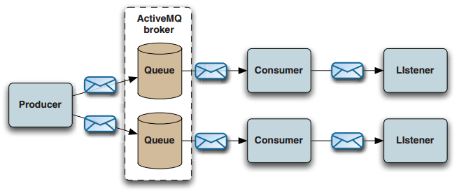
3. Publisher.java
 import javax.jms.Connection;

 import javax.jms.ConnectionFactory;

 import javax.jms.Destination;

 import javax.jms.JMSException;

 import javax.jms.Message;

 import javax.jms.MessageProducer;

 import javax.jms.ObjectMessage;

 import javax.jms.Session;

 import org.apache.activemq.ActiveMQConnectionFactory;

 public class Publisher {

     private static String brokerURL = "tcp://centos1:61616";

     private static transient ConnectionFactory factory;

     private transient Connection connection;

     private transient Session session;

     private transient MessageProducer producer;

     private static int count = 10;

     private static int total;

     private static int id = 1000000;

     private String jobs[] = new String[]{"suspend", "delete"};

     public Publisher() throws JMSException {

         factory = new ActiveMQConnectionFactory(brokerURL);

         connection = factory.createConnection();

         connection.start();

         session = connection.createSession(false, Session.AUTO_ACKNOWLEDGE);

         producer = session.createProducer(null);

     }

     public void close() throws JMSException {

         if (connection != null) {

             connection.close();

         }

     }

     public static void main(String[] args) throws JMSException {

         Publisher publisher = new Publisher();

         while (total < 1000) {

             for (int i = 0; i < count; i++) {

                 publisher.sendMessage();

             }

             total += count;

             System.out.println("Published '" + count + "' of '" + total + "' job messages");

             try {

               Thread.sleep(1000);

             } catch (InterruptedException x) {

             }

           }

         publisher.close();

     }

     public void sendMessage() throws JMSException {

         int idx = 0;

         while (true) {

             idx = (int)Math.round(jobs.length * Math.random());

             if (idx < jobs.length) {

                 break;

             }

         }

         String job = jobs[idx];

         Destination destination = session.createQueue("JOBS." + job);

         Message message = session.createObjectMessage(id++);

         System.out.println("Sending: id: " + ((ObjectMessage)message).getObject() + " on queue: " + destination);

         producer.send(destination, message);

     }

 }
4. Consumer.java
 import javax.jms.Connection;

 import javax.jms.ConnectionFactory;

 import javax.jms.Destination;

 import javax.jms.JMSException;

 import javax.jms.MessageConsumer;

 import javax.jms.Session;

 import org.apache.activemq.ActiveMQConnectionFactory;

 public class Consumer {

     private static String brokerURL = "tcp://centos1:61616";

     private static transient ConnectionFactory factory;

     private transient Connection connection;

     private transient Session session;

     private String jobs[] = new String[]{"suspend", "delete"};

     public Consumer() throws JMSException {

         factory = new ActiveMQConnectionFactory(brokerURL);

         connection = factory.createConnection();

         connection.start();

         session = connection.createSession(false, Session.AUTO_ACKNOWLEDGE);

     }

     public void close() throws JMSException {

         if (connection != null) {

             connection.close();

         }

     }

     public static void main(String[] args) throws JMSException {

         Consumer consumer = new Consumer();

         for (String job : consumer.jobs) {

             Destination destination = consumer.getSession().createQueue("JOBS." + job);

             MessageConsumer messageConsumer = consumer.getSession().createConsumer(destination);

             messageConsumer.setMessageListener(new Listener(job));

         }

     }

     public Session getSession() {

         return session;

     }

 }
5. Listener.java
 import javax.jms.Message;

 import javax.jms.MessageListener;

 import javax.jms.ObjectMessage;

 public class Listener implements MessageListener {

     private String job;

     public Listener(String job) {

         this.job = job;

     }

     public void onMessage(Message message) {

         try {

             //do something here

             System.out.println(job + " id:" + ((ObjectMessage)message).getObject());

         } catch (Exception e) {

             e.printStackTrace();

         }

     }

 }
Embedding ActiveMQ using Spring
ActiveMQ与Spring集成待补充。
作者:netoxi
出处:http://www.cnblogs.com/netoxi
本文版权归作者和博客园共有,欢迎转载,未经同意须保留此段声明,且在文章页面明显位置给出原文连接。欢迎指正与交流。
ActiveMQ笔记——技术点汇总的更多相关文章
- Hadoop笔记——技术点汇总
目录 · 概况 · Hadoop · 云计算 · 大数据 · 数据挖掘 · 手工搭建集群 · 引言 · 配置机器名 · 调整时间 · 创建用户 · 安装JDK · 配置文件 · 启动与测试 · Clo ...
- Kafka笔记——技术点汇总
Table of contents Table of contents Overview Introduction Use cases Manual setup Assumption Configur ...
- Spark SQL笔记——技术点汇总
目录 概述 原理 组成 执行流程 性能 API 应用程序模板 通用读写方法 RDD转为DataFrame Parquet文件数据源 JSON文件数据源 Hive数据源 数据库JDBC数据源 DataF ...
- JVM笔记——技术点汇总
目录 · 初步认识 · Java里程碑(关键部分) · 理解虚拟机 · Java虚拟机种类 · Java语言规范 · Java虚拟机规范 · 基本结构 · Java堆(Heap) · Java栈(St ...
- Netty笔记——技术点汇总
目录 · Linux网络IO模型 · 文件描述符 · 阻塞IO模型 · 非阻塞IO模型 · IO复用模型 · 信号驱动IO模型 · 异步IO模型 · BIO编程 · 伪异步IO编程 · NIO编程 · ...
- Java并发编程笔记——技术点汇总
目录 · 线程安全 · 线程安全的实现方法 · 互斥同步 · 非阻塞同步 · 无同步 · volatile关键字 · 线程间通信 · Object.wait()方法 · Object.notify() ...
- Storm笔记——技术点汇总
目录 概况 手工搭建集群 引言 安装Python 配置文件 启动与测试 应用部署 参数配置 Storm命令 原理 Storm架构 Storm组件 Stream Grouping 守护进程容错性(Dae ...
- Spark Streaming笔记——技术点汇总
目录 目录 概况 原理 API DStream WordCount示例 Input DStream Transformation Operation Output Operation 缓存与持久化 C ...
- Spark笔记——技术点汇总
目录 概况 手工搭建集群 引言 安装Scala 配置文件 启动与测试 应用部署 部署架构 应用程序部署 核心原理 RDD概念 RDD核心组成 RDD依赖关系 DAG图 RDD故障恢复机制 Standa ...
随机推荐
- 微信客户端+微信公众平台+新浪云SAE+Arduino+WS100(控制LED)
第一步:准备 1.智能手机微信客户端或微信电脑版 2.注册微信公众平台 https://mp.weixin.qq.com 3.注册新浪账号 http://www.sinacloud.com 4.拥有一 ...
- metasploit快速入门
今天没上班,在小黑屋里看了一个一百多页的书<metasploit新手指南>,在此将笔记分享给大家.欢迎大家批评指正,共同学习进步. metasploit新手指南 笔记 kali 0 ...
- solr6.5 的安装与配置
运行环境: JDK: 1.8.0_131 Tomcat: 9.0.0.M21 Solr: 6.5.1 注:1.建议打开两个连接linux的窗口,一个负责 solr压缩目录,另外一个负责 ...
- 纯Css绘制三角形箭头三种方法
在制作网页的过程中少不了绘制类似图片的三角形箭头效果,虽然工程量不大,但是确实麻烦.在学习的过程中,总结了以下三种方法,以及相关的例子. 一.三种绘制三角形箭头方法 1.方法一:利用overflow: ...
- 资金平台交易明细扩展开发-DEP
前言 支持农垦项目中,需要增加抓取银行接口传输数据,需求有两点:一是银企平台前置机需要增加扩展中行.农行数据字段.(代理账号.代理账户名称.代理银行) 二是EAS资金模块中的交易明细查询列表界面能够显 ...
- java多线程系列(七)---Callable、Future和FutureTask
Callable.Future和FutureTask 前言:如有不正确的地方,还望指正. 目录 认识cpu.核心与线程 java多线程系列(一)之java多线程技能 java多线程系列(二)之对象变量 ...
- 【NO.9】jmeter - 一个完整的接口测试的脚本
使用Jmeter对一个接口地址或者一个页面地址执行N次请求,下面来说说怎么建立一个测试脚本(也称为”测试计划”). 1. 运行Jmeter.bat 双击"Jmeter.bat"文件,稍等片刻后J ...
- Celery 使用(一)
Celery 使用(一) 架构 Producer:任务发布者: Celery Beat:任务调度器,Beat进程会读取配置文件中的内容,周期性的将配置中到期需要执行的任务发送给任务队列: Broker ...
- RMAN备份介质的移动与再恢复测试 [ catalog start with ‘dir’ ]
--RMAN备份介质的移动与再恢复测试 ---------------------------------------------------------2013/09/21 由于目前生产环境中没 ...
- JS之this
作为JS中比较容易让人迷糊,同时又很重要的难点. 关于this指向问题,我们始终要记住一句话,这句话对于理解this指向很重要.这句话是:this要在执行时才能确认它的值,定义时无法确认. this的 ...