
Multi-Dimensional Recurrent Neural Networks
Multi-Dimensional Recurrent Neural Networks
The basic idea of MDRNNs is to replace the single recurrent connection found in standard RNNs with as many recurrent connections as there are dimensions in the data. During the forward pass, at each point in the data sequence, the hidden layer of the network receives both an external input and its own activations from one step back along all dimensions.
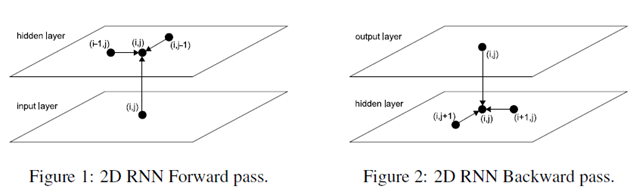
Clearly, the data must be processed in such a way that when the network reaches a poin in an n-dimensional sequence, it has already passed through all the points from which it will rechive its previous activations.
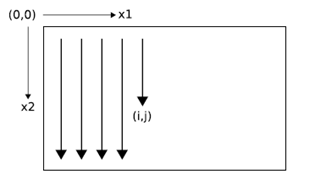
2D sequence ordering. The MDRNN forword pass starts at the origin and follows the direction of the arrows. The point(I,j) is never reached before both (i-1,j) and (i,j-1)
The forward pass of an MDRNN can then be carried out by feeding forward the input and the n previous hidden layer activations at each point in the ordered input sequence, and storing the resulting hidden layer activations at each point in the ordered input sequence, and storing the resulting hidden layer activations. Care must be taken at the sequence boundaries not to feed forward activations from points outside the sequence.
Note that each 'point' in the input sequence will in general be a multivalued vector. For example, in a two dimensional color image, the inputs could be single pixels represented by RGB triples, or blocks of pixels, or the outputs of a preprocessing method such as a discrete cosine transform.
The error gradient of an MDRNN(that is, the derivative of some objective function with respect to the network weights) can be calculated with an n-dimensional extension of the backpropagation through time(BPTT) algorithm. As with one dimensional BPTT, the sequence is processed in the reverse order of the forward pass. At each timestep, the hidden layer receives both the output error derivatives and its own n 'future' derivatives. Figure 2 illustrates the BPTT backword pass for two dimensions. Again, care must be taken at the sequence boundaries.
At a point in an n-dimensional sequence, define and respectively as the activations of the input unit and the hidden unit. Define as the weight of the connection going from unit j to unit k. Then for an n-dimensional MDRNN whose hidden layer consists of summation units with the tanh activation function, the forward pass for a sequence with dimensions can be sumarised as follows:

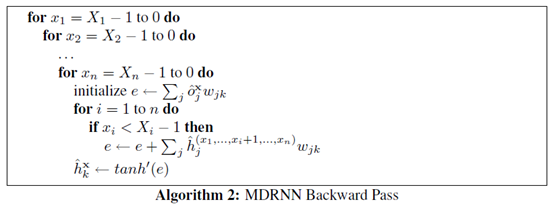
Defining and respectively as the derivatives of the objective function with respect to the activations of the output unit and the hidden unit at point x, the backward pass is:
Since the forward and backward pass require one pass each through the data sequence, the overall complexity of MDRNN training is linear in the number of data points and the unmber of network weights.
Multi-directional MDRNNs
For one dimensional RNNs, the problem of multi-directional context was solved in 1997 by the introduction of bidirectional recurrent neural networks (BRNNs). BRNNs contain two separate hidden layers that process the input sequence in the forward and reverse directions. The two hidden layers are connected to a single output layer, thereby providing the network with access to both past and future context.
BRNNs can be extended to n-dimensional data by using separate hidden layers, each of which processes the sequence using the ordering defined above, but with a different choice of axes.
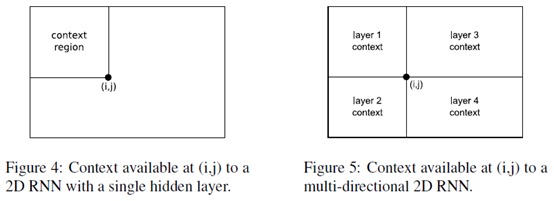
More specifically, the axes are chosen so that their origins lie on the the vertices of the sequence. The 2 dimensional case is illustrated in Figure 6.

As before, the hidden layers are connected to a single output layer, which now has access to all surrounding context.
If the size of the hidden layers is held constan, multi-direcitonal MDRNNs scales as O() for n-dimensional data. In practive however, we have found that using small layers gives better results than 1 large layer with the same overall number of weights, presumably because the data processing is shared between the hidden layers. This also holds in one dimension, as previous experiments have demonstrated. In any case the complexity of the algorithm remains linear in the number of data points and the number of parameters, and the number of parameters is independent of the data dimensionality.
For a multi-directional MDRNN, the forward and backward passes through an n-dimensional sequence can be summarized as follows:


MCGSM
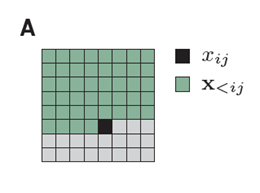
We factorize the distribution of images such that the prediction of a pixel(black) may depend on any pixel in the upper-left green region.
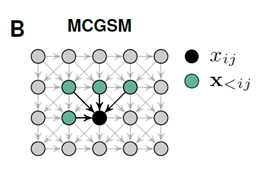
A graphical model representation of an MCGSM with a causal neighborhood limited to a small region.
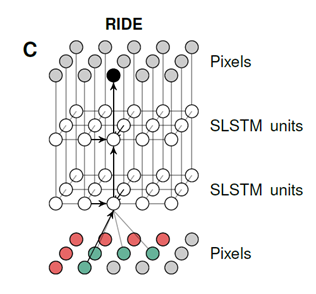
A visualization of our recurrent iamge model with two layers of spatial LSTMs. The pixels of the image are represented twice and some arrows are omitted for clarity. Through feedforward connections, the prediction of a pixel depends directly on its neighborhood(gre-e),but through recurrent connections it hs access to the information in a much larger region(r-ed).

Multi-Dimensional Recurrent Neural Networks的更多相关文章
- The Unreasonable Effectiveness of Recurrent Neural Networks (RNN)
http://karpathy.github.io/2015/05/21/rnn-effectiveness/ There’s something magical about Recurrent Ne ...
- 循环神经网络(RNN, Recurrent Neural Networks)介绍(转载)
循环神经网络(RNN, Recurrent Neural Networks)介绍 这篇文章很多内容是参考:http://www.wildml.com/2015/09/recurrent-neur ...
- Attention and Augmented Recurrent Neural Networks
Attention and Augmented Recurrent Neural Networks CHRIS OLAHGoogle Brain SHAN CARTERGoogle Brain Sep ...
- cs231n spring 2017 lecture10 Recurrent Neural Networks 听课笔记
(没太听明白,下次重新听一遍) 1. Recurrent Neural Networks
- 第十四章——循环神经网络(Recurrent Neural Networks)(第一部分)
由于本章过长,分为两个部分,这是第一部分. 这几年提到RNN,一般指Recurrent Neural Networks,至于翻译成循环神经网络还是递归神经网络都可以.wiki上面把Recurrent ...
- 第十四章——循环神经网络(Recurrent Neural Networks)(第二部分)
本章共两部分,这是第二部分: 第十四章--循环神经网络(Recurrent Neural Networks)(第一部分) 第十四章--循环神经网络(Recurrent Neural Networks) ...
- Pixel Recurrent Neural Networks翻译
Pixel Recurrent Neural Networks 目前主要在用的文档存放: https://www.yuque.com/lart/papers/prnn github存档: https: ...
- 循环神经网络(Recurrent Neural Networks, RNN)介绍
目录 1 什么是RNNs 2 RNNs能干什么 2.1 语言模型与文本生成Language Modeling and Generating Text 2.2 机器翻译Machine Translati ...
- 《转》循环神经网络(RNN, Recurrent Neural Networks)学习笔记:基础理论
转自 http://blog.csdn.net/xingzhedai/article/details/53144126 更多参考:http://blog.csdn.net/mafeiyu80/arti ...
随机推荐
- android图片缩放平移
<?xml version="1.0" encoding="utf-8"?> <FrameLayout xmlns:android=" ...
- eclipse、idea安装lombok插件
今天新项目中,用到了lombok知识,很方便. 但是使用之前,需要在eclipse.idea中安装插件才可以使用,配置如下. 一:在开发工具中安装插件: Eclipse: 下载地址:https:// ...
- LINQ 组合查询 和分页查询的使用
前端代码 <%@ Page Language="C#" AutoEventWireup="true" Debug="true" Cod ...
- xampp默认配置拿shell
xampp默认配置拿shell 首先我们先来科普一下xampp(Apache+MySQL+PHP+PERL)是一个功能强大的建 XAMPP 软件站集成软件包 是一个易于安装且包含 MySQL.PHP ...
- COGS 1619. [HEOI2012]采花
★★☆ 输入文件:1flower.in 输出文件:1flower.out 简单对比时间限制:5 s 内存限制:128 MB [题目描述] 萧薰儿是古国的公主,平时的一大爱好是采花. 今 ...
- 使 windows 无需输入开机密码自动进入系统
步骤 运行netplwiz: 勾去图中所示复选框,确定后输入密码.
- 程序员的智囊库系列之2----网站框架(framework)
程序员的智囊库系列之2--网站框架(framework) 这是程序员的智囊库系列的第二篇文章.上一篇文章讲了服务器与运维相关的工具,这篇文章我们将介绍几个搭建网站的框架: django express ...
- SpringMVC-常用的注解
1. RequestParam注解 把请求中的指定名称的参数传递给控制器中的形参赋值 value:请求参数中的名称 require:请求参数中是否必须提供此参数,默认值是true,必须提供 2. Re ...
- Beta冲刺(周五)
这个作业属于哪个课程 https://edu.cnblogs.com/campus/xnsy/SoftwareEngineeringClass1 这个作业要求在哪里 https://edu.cnblo ...
- shell的切换
从zsh切换到bash:在命令行输入bash即可 从bash切换到zsh:在命令行输入zsh即可