C++ Code 
1
2
3
4
5
6
7
8
9
10
11
12
13
14
15
16
17
18
19
20
21
22
23
24
25
26
27
28
29
30
31
32
33
34
35
36
37
38
39
40
41
42
43
44
45
46
47
48
49
50
51
52
53
54
55
56
57
58
59
60
61
62
63
64
65
66
67
68
69
70
71
72
73
74
75
76
77
78
79
80
81
82
83
84
85
86
87
88
89
90
91
92
93
94
95
96
97
98
99
100
101
102
103
104
105
106
107
108
109
110
111
112
113
114
115
116
117
118
119
120
121
122
123
124
125
126
127
128
129
130
131
132
133
134
135
136
137
138
139
140
141
142
143
144
145
146
147
148
149
150
151
152
153
154
155
156
157
158
159
160
161
162
163
164
165
166
167
168
169
170
171
172
173
174
175
176
177
178
179
180
181
182
183
184
185
186
187
188
189
190
191
192
193
194
195
196
197
198
199
200
201
202
203
204
205
206
207
208
209
210
211
212
213
214
215
216
217
218
219
220
221
222
223
224
225
226
227
228
229
230
231
232
233
234
235
236
237
238
239
240
241
242
243
244
245
246
247
248
249
250
251
252
253
254
255
256
257
258
259
260
261
262
263
264
265
266
267
268
269
270
271
272
273
274
275
 
#include <stdio.h>
#include <stdlib.h>
#include <string.h>
#include <sys/types.h>
#include <sys/socket.h>
#include <netdb.h>
#include <unistd.h>
#include <fcntl.h>
#include <sys/epoll.h>
#include <errno.h>

static int
make_socket_non_blocking (int sfd)
{
    int flags, s;

flags = fcntl (sfd, F_GETFL, );
    )
    {
        perror ("fcntl");
        ;
    }

flags |= O_NONBLOCK;
    s = fcntl (sfd, F_SETFL, flags);
    )
    {
        perror ("fcntl");
        ;
    }

;
}

static int
create_and_bind (char *port)
{
    struct addrinfo hints;
    struct addrinfo *result, *rp;
    int s, sfd;

memset (&hints, , sizeof (struct addrinfo));
    hints.ai_family = AF_UNSPEC;     /* Return IPv4 and IPv6 choices */
    hints.ai_socktype = SOCK_STREAM; /* We want a TCP socket */
    hints.ai_flags = AI_PASSIVE;     /* All interfaces */

s = getaddrinfo (NULL, port, &hints, &result);
    )
    {
        fprintf (stderr, "getaddrinfo: %s\n", gai_strerror (s));
        ;
    }

for (rp = result; rp != NULL; rp = rp->ai_next)
    {
        sfd = socket (rp->ai_family, rp->ai_socktype, rp->ai_protocol);
        )
        {
            continue;
        }

s = bind (sfd, rp->ai_addr, rp->ai_addrlen);
        )
        {
            /* We managed to bind successfully! */
            break;
        }

close (sfd);
    }

if (rp == NULL)
    {
        fprintf (stderr, "Could not bind\n");
        ;
    }

freeaddrinfo (result);

return sfd;
}

int
main (int argc, char *argv[])
{
    int sfd, s;
    int efd;
    struct epoll_event event;
    struct epoll_event *events;

)
    {
        fprintf (stderr, ]);
        exit (EXIT_FAILURE);
    }

sfd = create_and_bind (argv[]);
    )
    {
        abort ();
    }

s = make_socket_non_blocking (sfd);
    )
    {
        abort ();
    }

s = listen (sfd, SOMAXCONN);
    )
    {
        perror ("listen");
        abort ();
    }

efd = epoll_create1 ();
    )
    {
        perror ("epoll_create");
        abort ();
    }

event.data.fd = sfd;
    event.events = EPOLLIN | EPOLLET;
    s = epoll_ctl (efd, EPOLL_CTL_ADD, sfd, &event);
    )
    {
        perror ("epoll_ctl");
        abort ();
    }

/* Buffer where events are returned */
    events = calloc (MAXEVENTS, sizeof event);

/* The event loop */
    )
    {
        int n, i;

n = epoll_wait (efd, events, MAXEVENTS, -);
        ; i < n; i++)
        {
            if ((events[i].events & EPOLLERR) ||
                    (events[i].events & EPOLLHUP) ||
                    (!(events[i].events & EPOLLIN)))
            {
                /* An error has occured on this fd, or the socket is not
                   ready for reading (why were we notified then?) */
                fprintf (stderr, "epoll error\n");
                close (events[i].data.fd);
                continue;
            }

else if (sfd == events[i].data.fd)
            {
                /* We have a notification on the listening socket, which
                   means one or more incoming connections. */
                )
                {
                    struct sockaddr in_addr;
                    socklen_t in_len;
                    int infd;
                    char hbuf[NI_MAXHOST], sbuf[NI_MAXSERV];

in_len = sizeof in_addr;
                    infd = accept (sfd, &in_addr, &in_len);
                    )
                    {
                        if ((errno == EAGAIN) ||
                                (errno == EWOULDBLOCK))
                        {
                            /* We have processed all incoming
                               connections. */
                            break;
                        }
                        else
                        {
                            perror ("accept");
                            break;
                        }
                    }

s = getnameinfo (&in_addr, in_len,
                                     hbuf, sizeof hbuf,
                                     sbuf, sizeof sbuf,
                                     NI_NUMERICHOST | NI_NUMERICSERV);
                    )
                    {
                        printf("Accepted connection on descriptor %d "
                               "(host=%s, port=%s)\n", infd, hbuf, sbuf);
                    }

/* Make the incoming socket non-blocking and add it to the
                       list of fds to monitor. */
                    s = make_socket_non_blocking (infd);
                    )
                    {
                        abort ();
                    }

event.data.fd = infd;
                    event.events = EPOLLIN | EPOLLET;
                    s = epoll_ctl (efd, EPOLL_CTL_ADD, infd, &event);
                    )
                    {
                        perror ("epoll_ctl");
                        abort ();
                    }
                }
                continue;
            }
            else
            {
                /* We have data on the fd waiting to be read. Read and
                   display it. We must read whatever data is available
                   completely, as we are running in edge-triggered mode
                   and won't get a notification again for the same
                   data. */
                ;

)
                {
                    ssize_t count;
                    ];

count = read (events[i].data.fd, buf, sizeof buf);
                    )
                    {
                        /* If errno == EAGAIN, that means we have read all
                           data. So go back to the main loop. */
                        if (errno != EAGAIN)
                        {
                            perror ("read");
                            done = ;
                        }
                        break;
                    }
                    )
                    {
                        /* End of file. The remote has closed the
                           connection. */
                        done = ;
                        break;
                    }

/* Write the buffer to standard output */
                    s = write (, buf, count);
                    )
                    {
                        perror ("write");
                        abort ();
                    }
                }

if (done)
                {
                    printf ("Closed connection on descriptor %d\n",
                            events[i].data.fd);

/* Closing the descriptor will make epoll remove it
                       from the set of descriptors which are monitored. */
                    close (events[i].data.fd);
                }
            }
        }
    }

free (events);

close (sfd);

return EXIT_SUCCESS;
}

具体函数介绍请参考:https://banu.com/blog/2/how-to-use-epoll-a-complete-example-in-c/

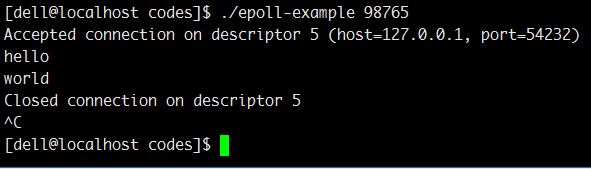
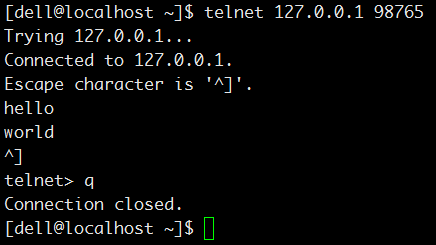
运行结果:

服务器端:
客户端:
epoll测试实例的更多相关文章

  1. JMeter学习-026-JMeter 分布式(远程)参数化测试实例

    以前文所述对文章详情的HTTP请求进行性能测试为例.日常实际场景中,不可能所有的人都在同时访问一篇文章,而是多人访问不同的文章,因而需要对文章编号进行参数化,以更好的模拟日常的性能测试场景.同时,因文 ...

  2. webservice测试实例

    webservice测试实例(LR8.1) 接口声明:这个接口是sina的短信服务接口,我只是用来做脚本学习使用,不会对其产生压力:希望读者也只是用来进行录制学习,而不是产生压力. 接口文档:http ...

  3. [原]在Fedora中编译Libevent测试实例

    在我的昨天的博文<[原]我在Windows环境下的首个Libevent测试实例>中介绍了在Windows环境下如何编译一个echo server例子.今天我又试了一下在Linux环境中编译 ...

  4. C++动态链接库测试实例

    前话 上一章节我导出了一个动态链接库 要使用该链接库,我们还需要该链接库对外公开的函数,即头文件 下面开始实例 测试实例 第一步--将动态链接库的dll.lib.和头文件导入项目中 文件目录如下: 项 ...

  5. Linux下简易蜂鸣器驱动代码及测试实例

    驱动代码: #include <linux/module.h> #include <linux/kernel.h> #include <linux/init.h> ...

  6. 微服务架构 - 离线部署k8s平台并部署测试实例

    一般在公司部署或者真实环境部署k8s平台,很有可能是内网环境,也即意味着是无法连接互联网的环境,这时就需要离线部署k8s平台.在此整理离线部署k8s的步骤,分享给大家,有什么不足之处,欢迎指正. 1. ...

  7. WinForm中 Asp.Net Signalr消息推送测试实例

    p{ text-align:center; } blockquote > p > span{ text-align:center; font-size: 18px; color: #ff0 ...

  8. Confluence 6 从生产环境中恢复一个测试实例

    请参考 Restoring a Test Instance from Production 页面中的内容获得更多完整的说明. 很多 Confluence 的管理员将会使用生产实例运行完整数据和服务的 ...

  9. Rabbit简单测试实例

    Rabbit简单测试实例 安装环境: Yum -y install python-pip Pip install pika 生产者 1 2 3 4 5 6 7 8 9 10 11 import pik ...

随机推荐

  1. 【DSU on tree】【CF741D】Arpa’s letter-marked tree and Mehrdad’s Dokhtar-kosh paths

    Description 给定一棵 \(n\) 个节点的树,每条边上有一个字符,字符集大小 \(22\),求每个节点的子树内最长的简单路径使得路径上的字符经过重排后构成回文串. Limitation \ ...

  2. 一些程序OEP入口特征

    声明: 1.本文中使用的例子来源于吾爱破解的官方教程第一课中的无壳例子,本人利用空闲时间挨个进行查看并截图纪录下来 2.欢迎补充讨论 一些程序OEP入口特征 一.       AMS程序 1.载入PE ...

  3. gitlab的备份与恢复与迁移

    一.gitlab的备份1.1 创建备份目录,并授权 1 2 3 4 [root@linux-node1 ~]# mkdir /data/backups/gitlab -p [root@linux-no ...

  4. Linux基础实验

    过滤,管道与重定向 过滤 管道 重定向 运维常用 给某目录设置权限 sudo chmod -R /var/www/html/

  5. Spring Boot后台启动不打印nohup.out

    #!/bin/bashnohup java -jar websocket-server-0.0.1-SNAPSHOT.jar --spring.profiles.active=prod --serve ...

  6. Scala2.10.4在CentOS7中的安装与配置

    随着基于内存的大数据计算框架——spark的火爆流行,用于编写spark内核的Scala语言也随之流行开来.由于其编写代码的简洁性,受到了越来越多程序员的喜爱.我今天给大家展示的时Scala2.10. ...

  7. c++刷题(27/100)反转单项链表,链表的倒数第k个

    题目1:调整数组顺序使奇数位于偶数前面 输入一个整数数组,实现一个函数来调整该数组中数字的顺序,使得所有的奇数位于数组的前半部分,所有的偶数位于数组的后半部分,并保证奇数和奇数,偶数和偶数之间的相对位 ...

  8. 【leetcode 简单】 第六十六题 用栈实现队列

    使用栈实现队列的下列操作: push(x) -- 将一个元素放入队列的尾部. pop() -- 从队列首部移除元素. peek() -- 返回队列首部的元素. empty() -- 返回队列是否为空. ...

  9. 逆序对 inversion

      评测传送门 [问题描述] 有一个1 − n的排列,你会依次进行m次操作,第i次操作表示为(x i , y i ),交换以这两个 值为下标的元素,每次操作有一半的概率成功,你需要求出最后序列的逆序对 ...

  10. Python中的and和or

    引子: 出现以上情况的原因是什么呢? print(bool('')) # False print(bool(0)) # False 所有变量的位操作都是通过强制转换成bool实现的,并且表达式的值是从 ...