
斯坦福大学卷积神经网络教程UFLDL Tutorial - Convolutional Neural Network
Convolutional Neural Network
Overview
A Convolutional Neural Network (CNN) is comprised of one or more convolutional layers (often with a subsampling step) and then followed by one or more fully connected layers as in a standard multilayer neural network. The architecture of a CNN is designed to take advantage of the 2D structure of an input image (or other 2D input such as a speech signal). This is achieved with local connections and tied weights followed by some form of pooling which results in translation invariant features. Another benefit of CNNs is that they are easier to train and have many fewer parameters than fully connected networks with the same number of hidden units. In this article we will discuss the architecture of a CNN and the back propagation algorithm to compute the gradient with respect to the parameters of the model in order to use gradient based optimization. See the respective tutorials on convolution andpooling for more details on those specific operations.
Architecture
A CNN consists of a number of convolutional and subsampling layers optionally followed by fully connected layers. The input to a convolutional layer is a m x m x rm x m x r image where mm is the height and width of the image and rr is the number of channels, e.g. an RGB image has r=3r=3. The convolutional layer will have kk filters (or kernels) of size n x n x qn x n x q where nn is smaller than the dimension of the image and qq can either be the same as the number of channels rr or smaller and may vary for each kernel. The size of the filters gives rise to the locally connected structure which are each convolved with the image to produce kk feature maps of size m−n+1m−n+1. Each map is then subsampled typically with mean or max pooling over p x pp x p contiguous regions where p ranges between 2 for small images (e.g. MNIST) and is usually not more than 5 for larger inputs. Either before or after the subsampling layer an additive bias and sigmoidal nonlinearity is applied to each feature map. The figure below illustrates a full layer in a CNN consisting of convolutional and subsampling sublayers. Units of the same color have tied weights.
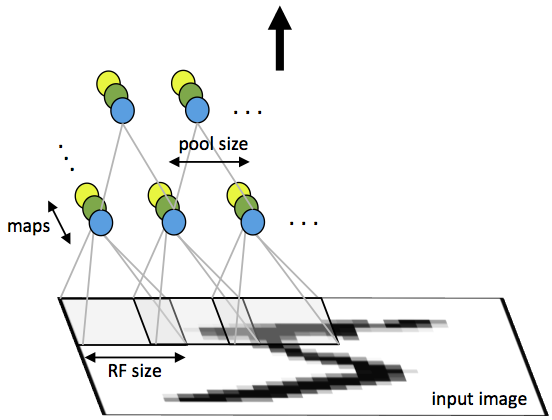
Fig 1: First layer of a convolutional neural network with pooling. Units of the same color have tied weights and units of different color represent different filter maps.
After the convolutional layers there may be any number of fully connected layers. The densely connected layers are identical to the layers in a standard multilayer neural network.
Back Propagation
Let δ(l+1)δ(l+1) be the error term for the (l+1)(l+1)-st layer in the network with a cost function J(W,b;x,y)J(W,b;x,y)where (W,b)(W,b) are the parameters and (x,y)(x,y) are the training data and label pairs. If the ll-th layer is densely connected to the (l+1)(l+1)-st layer, then the error for the ll-th layer is computed as
and the gradients are
If the ll-th layer is a convolutional and subsampling layer then the error is propagated through as
Where kk indexes the filter number and f′(z(l)k)f′(zk(l)) is the derivative of the activation function. The upsampleoperation has to propagate the error through the pooling layer by calculating the error w.r.t to each unit incoming to the pooling layer. For example, if we have mean pooling then upsample simply uniformly distributes the error for a single pooling unit among the units which feed into it in the previous layer. In max pooling the unit which was chosen as the max receives all the error since very small changes in input would perturb the result only through that unit.
Finally, to calculate the gradient w.r.t to the filter maps, we rely on the border handling convolution operation again and flip the error matrix δ(l)kδk(l) the same way we flip the filters in the convolutional layer.
Where a(l)a(l) is the input to the ll-th layer, and a(1)a(1) is the input image. The operation (a(l)i)∗δ(l+1)k(ai(l))∗δk(l+1) is the “valid” convolution between ii-th input in the ll-th layer and the error w.r.t. the kk-th filter.
from: http://ufldl.stanford.edu/tutorial/supervised/ConvolutionalNeuralNetwork/
斯坦福大学卷积神经网络教程UFLDL Tutorial - Convolutional Neural Network的更多相关文章
- 树卷积神经网络Tree-CNN: A Deep Convolutional Neural Network for Lifelong Learning
树卷积神经网络Tree-CNN: A Deep Convolutional Neural Network for Lifelong Learning 2018-04-17 08:32:39 看_这是一 ...
- 深度学习笔记 (一) 卷积神经网络基础 (Foundation of Convolutional Neural Networks)
一.卷积 卷积神经网络(Convolutional Neural Networks)是一种在空间上共享参数的神经网络.使用数层卷积,而不是数层的矩阵相乘.在图像的处理过程中,每一张图片都可以看成一张“ ...
- 卷积神经网络用语句子分类---Convolutional Neural Networks for Sentence Classification 学习笔记
读了一篇文章,用到卷积神经网络的方法来进行文本分类,故写下一点自己的学习笔记: 本文在事先进行单词向量的学习的基础上,利用卷积神经网络(CNN)进行句子分类,然后通过微调学习任务特定的向量,提高性能. ...
- Deep Learning 19_深度学习UFLDL教程:Convolutional Neural Network_Exercise(斯坦福大学深度学习教程)
理论知识:Optimization: Stochastic Gradient Descent和Convolutional Neural Network CNN卷积神经网络推导和实现.Deep lear ...
- Deep Learning 8_深度学习UFLDL教程:Stacked Autocoders and Implement deep networks for digit classification_Exercise(斯坦福大学深度学习教程)
前言 1.理论知识:UFLDL教程.Deep learning:十六(deep networks) 2.实验环境:win7, matlab2015b,16G内存,2T硬盘 3.实验内容:Exercis ...
- Deep Learning 1_深度学习UFLDL教程:Sparse Autoencoder练习(斯坦福大学深度学习教程)
1前言 本人写技术博客的目的,其实是感觉好多东西,很长一段时间不动就会忘记了,为了加深学习记忆以及方便以后可能忘记后能很快回忆起自己曾经学过的东西. 首先,在网上找了一些资料,看见介绍说UFLDL很不 ...
- Deep Learning 10_深度学习UFLDL教程:Convolution and Pooling_exercise(斯坦福大学深度学习教程)
前言 理论知识:UFLDL教程和http://www.cnblogs.com/tornadomeet/archive/2013/04/09/3009830.html 实验环境:win7, matlab ...
- Deep Learning 13_深度学习UFLDL教程:Independent Component Analysis_Exercise(斯坦福大学深度学习教程)
前言 理论知识:UFLDL教程.Deep learning:三十三(ICA模型).Deep learning:三十九(ICA模型练习) 实验环境:win7, matlab2015b,16G内存,2T机 ...
- Deep Learning 12_深度学习UFLDL教程:Sparse Coding_exercise(斯坦福大学深度学习教程)
前言 理论知识:UFLDL教程.Deep learning:二十六(Sparse coding简单理解).Deep learning:二十七(Sparse coding中关于矩阵的范数求导).Deep ...
随机推荐
- apache2.2控制目录文件访问设置
1.apache2.2控制目录文件访问需求 红框可以访问,其他不能访问 2.apache2.2具体正则配置 <locationMatch ^/f/user/Panorama/81/581/(gr ...
- 如何设计一个基于Node.js和Express的网站架构?
前言 今年七月份,我和几个小伙伴们合伙建立了一个开发团队.业务开展如火如荼的同时,团队宣传就提上了日程,所以迫切需要搭建公司网站出来.确定目标后我们就开始考虑如果构建一个企业网站.先是进行业内调查,看 ...
- java EE : http 协议之请求报文、响应报文
1 HTTP协议特点 1)客户端->服务端(请求request)有三部份 a)请求行 b)请求头 c)请求的内容,如果没有,就是空白字符 2)服务端->客户端(响应response)有三部 ...
- Java学习笔记之:Java Servlet环境配置
一.介绍 Java Servlet 是运行在 Web 服务器或应用服务器上的程序,它是作为来自 Web 浏览器或其他 HTTP 客户端的请求和 HTTP 服务器上的数据库或应用程序之间的中间层. 使用 ...
- Jenkins hello world
1. 点击[新建项目],选择如下: (2)点击[流水线],并键入以下图示代码. (3) 点击保存,并[立即构建].
- 很好的开源UI框架Chico UI
介绍一个很好的开源的UI框架,依赖于jquery 官网:http://www.chico-ui.com.ar/ 以下是相关截图: 消息提示 自动完成 分页,列表 Chico UI是什么? Chico ...
- CentOS下Redis安装与配置
本文详细介绍redis单机单实例安装与配置,服务及开机自启动.如有不对的地方,欢迎大家拍砖o(∩_∩)o (以下配置基于CentOS release 6.5 Final, redis版本3.0.2 [ ...
- 湖南大学ACM程序设计新生杯大赛(同步赛)L - Liao Han
题目描述 Small koala special love LiaoHan (of course is very handsome boys), one day she saw N (N<1e1 ...
- WebApi使用JWT认证(二)
这是第二部:实现NetCore上的WebApi使用JWT认证 1.NetCore新建一个WebApi的项目 2.打开AppSettings.json,添加Jwt的信息,这里为了演示而已 { " ...
- Linux-数据库1
数据库介绍 数据库(database,DB)是指长期存储在计算机内的,有组织,可共享的数据的集合.数据库中的数据按一定的数学模型组织.描述和存储,具有较小的冗余,较高的数据独立性和易扩展性,并可为各种 ...