
windows内核提权
Windows by default are vulnerable to several vulnerabilities that could allow an attacker to execute malicious code in order to abuse a system. From the other side patching systems sufficiently is one of the main problems in security. Even if an organization has a patching policy in place if important patches are not implemented immediately this can still give short window to an attacker to exploit a vulnerability and escalate his privileges inside a system and therefore inside the network.
This article will discuss how to identify missing patches related to privilege escalation and the necessary code to exploit the issue.
Discovery of Missing Patches
The discovery of missing patches can be identified easily either through manual methods or automatic. Manually this can be done easily be executing the following command which will enumerate all the installed patches.
wmic qfe get Caption,Description,HotFixID,InstalledOn
The output will be similar to this:
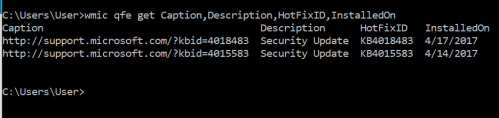
Enumeration of Installed Patches
The HotFixID can be used in correlation with the table below in order to discover any missing patches related to privilege escalation. As the focus is on privilege escalation the command can be modified slightly to discover patches based on the KB number.
wmic qfe get Caption,Description,HotFixID,InstalledOn | findstr /C:"KB3136041" /C:"KB4018483"
Alternatively this can be done automatically via Metasploit, Credential Nessus Scan or via a custom script that will look for missing patches related to privilege escalation.
Metasploit
There is a Metasploit module which can quickly identify any missing patches based on the Knowledge Base number and specifically patches for which there is a Metasploit module.
post/windows/gather/enum_patches

Metasploit – Patches Enumeration
Windows Exploit Suggester
Gotham Digital Security released a tool with the name Windows Exploit Suggester which compares the patch level of a system against the Microsoft vulnerability database and can be used to identify those exploits that could lead to privilege escalation. The only requirement is that requires the system information from the target.
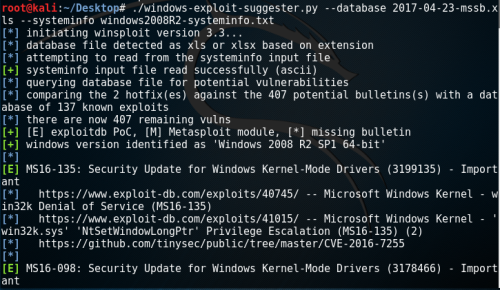
Windows Exploit Suggester
PowerShell
There is also a PowerShell script which target to identify patches that can lead to privilege escalation. This script is called Sherlock and it will check a system for the following:
- MS10-015 : User Mode to Ring (KiTrap0D)
- MS10-092 : Task Scheduler
- MS13-053 : NTUserMessageCall Win32k Kernel Pool Overflow
- MS13-081 : TrackPopupMenuEx Win32k NULL Page
- MS14-058 : TrackPopupMenu Win32k Null Pointer Dereference
- MS15-051 : ClientCopyImage Win32k
- MS15-078 : Font Driver Buffer Overflow
- MS16-016 : ‘mrxdav.sys’ WebDAV
- MS16-032 : Secondary Logon Handle
- CVE-2017-7199 : Nessus Agent 6.6.2 – 6.10.3 Priv Esc
The output of this tool can be seen below:
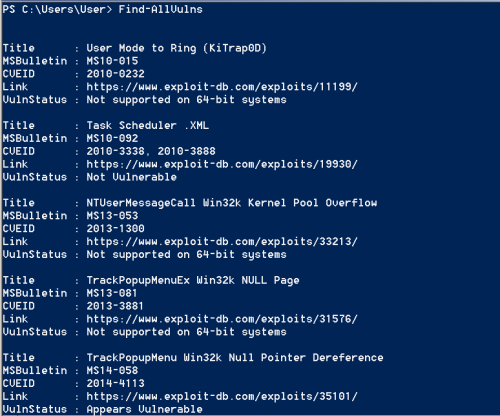
Sherlock – Missing Patches
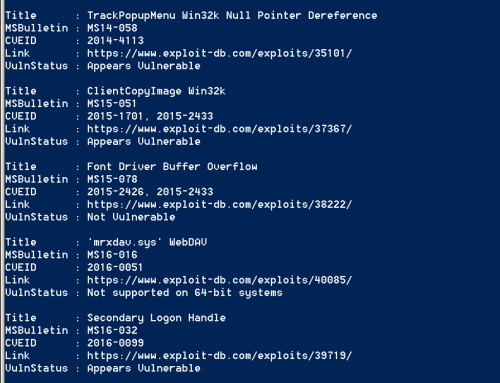
Sherlock – Identification of Privilege Escalation Patches
Privilege Escalation Table
The following table has been compiled to assist in the process of privilege escalation due to lack of sufficient patching.
| Operating System | Description | Security Bulletin | KB | Exploit |
|---|---|---|---|---|
| Windows Server 2016 | Windows Kernel Mode Drivers | MS16-135 | 3199135 | Exploit |
| Windows Server 2008 ,7,8,10 Windows Server 2012 | Secondary Logon Handle | MS16-032 | 3143141 | GitHub |
| Windows Server 2008, Vista, 7 | WebDAV | MS16-016 | 3136041 | Github |
| Windows Server 2003, Windows Server 2008, Windows 7, Windows 8, Windows 2012 | Windows Kernel Mode Drivers | MS15-051 | 3057191 | GitHub |
| Windows Server 2003, Windows Server 2008, Windows Server 2012, 7, 8 | Win32k.sys | MS14-058 | 3000061 | GitHub |
| Windows Server 2003, Windows Server 2008, 7, 8, Windows Server 2012 | AFD Driver | MS14-040 | 2975684 | Python |
| Windows XP, Windows Server 2003 | Windows Kernel | MS14-002 | 2914368 | Metasploit |
| Windows Server 2003, Windows Server 2008, 7, 8, Windows Server 2012 | Kernel Mode Driver | MS13-005 | 2778930 | Metasploit |
| Windows Server 2008, 7 | Task Scheduler | MS10-092 | 2305420 | Metasploit |
| Windows Server 2003, Windows Server 2008, 7, XP | KiTrap0D | MS10-015 | 977165 | Exploit |
| Windows Server 2003, XP | NDProxy | MS14-002 | 2914368 | Exploit |
| Windows Server 2003, Windows Server 2008, 7, 8, Windows Server 2012 | Kernel Driver | MS15-061 | 3057839 | Github |
| Windows Server 2003, XP | AFD.sys | MS11-080 | 2592799 | EXE |
| Windows Server 2003, XP | NDISTAPI | MS11-062 | 2566454 | ExploitDB |
| Windows Server 2003, Windows Server 2008, 7, 8, Windows Server 2012 | RPC | MS15-076 | 3067505 | Github |
| Windows Server 2003, Windows Server 2008, 7, 8, Windows Server 2012 | Hot Potato | MS16-075 | 3164038 | GitHub |
| Windows Server 2003, Windows Server 2008, 7, XP | Kernel Driver | MS15-010 | 3036220 | GitHub |
| Windows Server 2003, Windows Server 2008, 7, XP | AFD.sys | MS11-046 | 2503665 | EXE |
windows内核提权的更多相关文章
- msf利用- windows内核提权漏洞
windows内核提权漏洞 环境: Kali Linux(攻击机) 192.168.190.141 Windows2003SP2(靶机) 192.168.190.147 0x01寻找可利用的exp 实 ...
- Windows原理深入学习系列-Windows内核提权
这是[信安成长计划]的第 22 篇文章 0x00 目录 0x01 介绍 0x02 替换 Token 0x03 编辑 ACL 0x04 修改 Privileges 0x05 参考文章 继续纠正网上文章中 ...
- 2018-2019-2 20165215《网络对抗技术》Exp10 Final Windows本地内核提权+Exploit-Exercises Nebula学习与实践
目录 PART ONE :Windows本地内核提权 漏洞概述 漏洞原理 漏洞复现 windbg调试本地内核 查看SSDT表和SSDTShadow表 查看窗口站结构体信息 利用Poc验证漏洞 漏洞利用 ...
- 9.CVE-2016-5195(脏牛)内核提权漏洞分析
漏洞描述: 漏洞编号:CVE-2016-5195 漏洞名称:脏牛(Dirty COW) 漏洞危害:低权限用户利用该漏洞技术可以在全版本Linux系统上实现本地提权 影响范围:Linux内核>=2 ...
- Linux本地内核提权漏洞复现(CVE-2019-13272)
Linux本地内核提权漏洞复现(CVE-2019-13272) 一.漏洞描述 当调用PTRACE_TRACEME时,ptrace_link函数将获得对父进程凭据的RCU引用,然后将该指针指向get_c ...
- CVE-2019-13272:Linux本地内核提权漏洞复现
0x00 简介 2019年07月20日,Linux正式修复了一个本地内核提权漏洞.通过此漏洞,攻击者可将普通权限用户提升为Root权限. 0x01 漏洞概述 当调用PTRACE_TRACEME时,pt ...
- ssh远程端口转发&&windows系统提权之信息收集&&网安工具分享(部分)
一.ssh远程端口转发 背景:当我们在渗透过程中,获取到内网的一台仅有内网IP的服务器后,我们可以通过ssh隧道,将内网某个主机的端口进行远程转发 1.网络拓扑图 假设获取的服务器为web服务器,we ...
- windows下提权基础
拿到webshell很多时候代表渗透的开始,下面带来windows提权基础 环境:虚拟机 win7系统 首先:查看权限whoami 我们知道windows的高权限应该是administrator和sy ...
- 新Windows本地提权漏洞学习(CVE-2019-0841)
1.这是一个啥漏洞? 睁眼一看,妈呀本地提权,快加入本地提权漏洞利用包里,速度加入.github连接我就不发了.担心被认为是传播黑客工具,咱们在这里单纯学习一下漏洞的原理和部分源代码. 2.文件读写权 ...
随机推荐
- SQL基本的45题
-- 查询Student表中的所有记录的Sname.Ssex和Class列.SELECT Sname,Ssex,Class from student -- 查询教师所有的单位即不重复的Depart列. ...
- 小计Tomcat的调优思路
描述 最近在补充自己的短板,刚好整理到Tomcat调优这块,基本上面试必问,于是就花了点时间去搜集一下tomcat调优 都调了些什么,先记录一下调优手段,更多详细的原理和实现以后用到时候再来补充记录, ...
- Python环境搭建和pycharm安装
Python环境搭建和pycharm安装 本人安装环境为Windows10系统,下载的Python版本为3.4社区版本,可参考 1.下载Python3.4版本 官网:https://www.pytho ...
- python-将爬取到的m3u8合并为mp4
当你看到这个博客的时候恭喜你,你以后不用开vip就可以观看和下载vip视频了 最简单的观看vip视频步骤:进入全民解析网将vip视频地址进行解析 以下代码是通过python将vip视频进行下载为mp4 ...
- 深圳第XX天
今天早晨,面了一家小公司.先说结果吧,面过了.但是,总感觉太假了.面试中很多问题都没有回答上来.然后老板看了一下简历,问:期薪资多少?我想了想,说7000.啊,要不留下来看看?我答应了.不到十分钟,就 ...
- Alpha发布用户使用报告【欢迎来怼】
目录 用户统计表 部分用户评论截图 用户统计图 总结 一.用户统计表 目前,博客园安卓版的用户已达到11位.为了采集到更加客观公正的用户评价,并没有将团队内部人员的评价统计进来.同时,为了更好地保护用 ...
- RIGHT-BICEP测试第二次
1.Right-结果是否正确? 正确 2.B-是否所有的边界条件都是正确的? 正确 3.P-是否满足性能要求? 部分满足 4.是否满足有无括号? 无 5.数字个数是否不超过十? 只是双目运算 6.能否 ...
- 利用p4实现ipv6转发实验
写在前面 只是作为一个入门p4的实验尝试,借用了一些即成的运行代码. p4代码 /**p4_16,v1_model**/ #include<core.p4> #include<v1m ...
- 细节--服务器mysql空密码
在部署致服务器的时候 发现mysql密码为空的情况 如果采用 root账户的话 试过很多 比如不写下面这行 <property name="password" value=& ...
- lintcode-208-赋值运算符重载
208-赋值运算符重载 实现赋值运算符重载函数,确保: 新的数据可准确地被复制 旧的数据可准确地删除/释放 可进行 A = B = C 赋值 说明 本题只适用于C++,因为 Java 和 Python ...