
ICEE-PCIe-PCI-SIG + What + Generations + PCIe6.0@x16@256GB/s
- PCI-SIG:
https://pcisig.com - PCIe Available Specification:
http://pcisig.com/specifications - Download the PCIe6.0 Specification
- Intel PCIe:
- What is PCIe(Peripheral Component Interconnect express)?
What is PCIe?
Last Updated : 06 Jul, 2022
- PCIe stands for Peripheral Component Interconnect express. It is an interface standard that is used to connect high-speed components. it is a high-bandwidth expansion bus.
- Newer PCIe standards mean a higher-bandwidth connection to GPUs, SSDs, and other peripherals.
All generations of PCIe are backwards compatible, so there's no reason not to upgrade. - PCIe is available in a different physical configuration(PCIe lanes) which includes x1, x2, x4, x8, x16, x32.
Higer Configuration(More lanes) mean more bandwidth, as well as a longer slot.- The motherboard has a number of PCIe slots to connect different components such as GPU(or video cards or graphics cards ), WI-FI cards, SSD (Solid-state drive).
Different motherboards have different types of PCIe slots. - commonly used to connect graphics cards and SSDs, as well as peripherals like capture cards and wireless cards.
- GPUs are usually installed in the top slot, as it has the most bandwidth and,
traditionally, the most direct connection to the CPU. - Modern PCIe m.2 SSDs use x4 or higer lanes.
- The motherboard has a number of PCIe slots to connect different components such as GPU(or video cards or graphics cards ), WI-FI cards, SSD (Solid-state drive).
PCIe Generation Comparison:
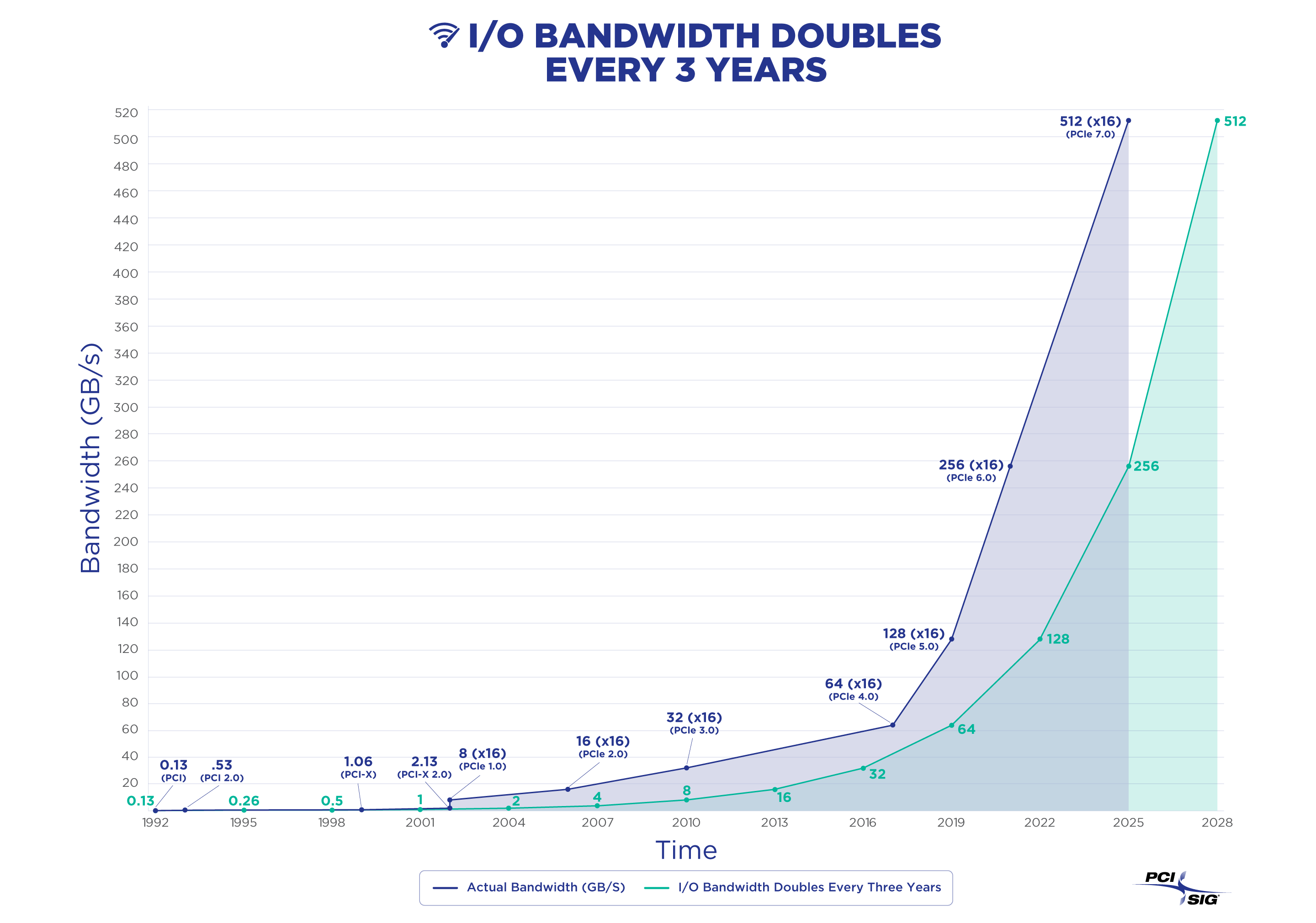
| Bandwidth | Gigatransfer | Frequency | Encoding |
|---|---|---|---|
| PCIe 1.0 | 8 GB/s | 2.5 GT/s | 2.5 GHz |
| PCIe 2.0 | 16 GB/s | 5 GT/s | 5.0 GHz |
| PCIe 3.0 | 32 GB/s | 8 GT/s | 8.0 GHz |
| PCIe 4.0 | 64 GB/s | 16 GT/s | 16.0 GHz |
| PCIe 5.0 | 128 GB/s | 32 GT/s | 32.0 GHz |
| PCIe 6.0 | 256 GB/s | 64 GT/s | 64.0 GHz |
| PCIe 7.0 | 512 GB/s | 128 GT/s | 128.0 GHz |
Generation of PCIe
Till now six generations of PCIe have been introduced in the market i.e PCIe 1.0, PCIe 2.0, PCIe 3.0, PCIe 4.0, PCIe 5.0, PCIe 6.0 out of these only first four have been debuted in the market.
PCIe 4.0 was first introduced in 2019 by AMD Ryzen 3000-series CPUs.
History
AWG(Arapaho Work Group), initially consisted of Intel engineers, later expanded to include industry partners, draw this standard.
First PCIe was named as High-Speed Interconnect (HSI), then renamed to 3GIO (3rd generation I/O) and finally renamed to PCIe.
- PCIe 1.0a: It was introduced by PCI-SIG in year 2003. It has a per-lane data rate of 250 MB/s and a transfer rate of 2.5 Giga transfers per second (GT/s).
- PCIe 1.1: It was introduced by PCI-SIG in year 2005. It has more clarification and improvement over PCIe 1.0a but * per-lane data rate and transfer rate was unchanged.
- PCIe 2.0: It was introduced by PCI-SIG in year 2007. It doubled the per-lane data rate and transfer rate compared to PCIe 1.0. It has a per-lane data rate of 500MB/s instead of 250 MB/s and a transfer rate of 5GT/s instead of 2.5 Giga transfers per second (GT/s). PCIe 2.0 slots provides backward compatibility with PCIe 1.x cards.
- PCIe 3.0: It was introduced by PCI-SIG in November 2010, after multiple delays. In August 2007, PCI-SIG announced backward compatible with existing PCI Express implementations and a bit rate of 8 Giga transfers per second (GT/s) for PCI Express 3.0. PCI-SIG also announced, a delay in release until Q2 2010 for the final specification for PCI Express 3.0. A number of optimizations for enhanced signaling and data integrity, including transmitter and receiver equalization, PLL improvements, clock data recovery, and channel enhancements for currently supported topologies were added in PCI Express 3.0 specification It has a per-lane data rate of 984.6MB/s instead of 500MB/s (as in PCIe 2.0) and a transfer rate of 8GT/s instead of 5 GT/s (as in PCIe 2.0).
- PCIe 4.0: It was introduced by PCI-SIG on November 29, 2011. It doubled the per-lane data rate and transfer rate compared to PCIe 3.0. It has a per-lane data rate of 1969MB/s instead of 984.6MB/s (as in PCIe 3.0) and a transfer rate of 16GT/s instead of 8 GT/s (as in PCIe 3.0). PCIe 4.0 provides full backward and forward compatibility.
- PCIe 5.0: PCI Express 5.0 preliminary specification was introduces by PCI-SIG in JUNE, 2017. In a 16-lane configuration Bandwidth was expected to increase to 32 GT/s, yielding 63 GB/s in each direction. The draft was expected to be standardized in 2019. Final PCI-Express 5.0 specification was introduced by PCI-SIG On 29 May 2019. The mass production for PCIe 5.0 is planned to start in 2020.
PCIe 6.0: PCI-SIG announced the development of PCI Express 6.0 specification On June 18, 2019.
It has a target release date of 2021.- In a 16-lane configuration bandwidth is expected to increase to 64 GT/s, yielding 128 GB/s in each direction.
- PAM-4(4-level pulse-amplitude modulation) with low-latency FEC(forward error correction) in place of non-return-to-zero (NRZ) modulation is used in this new standard.
Forward error correction is used to increase data integrity,
PAM-4 is used as line code so that two bits are transferred per transfer which was not provided in the earlier version.
It has 64 GT/s data transfer rate (raw bit rate) and up to 256 GB/s via x16 configuration.
PCIe 7.0 Specification
PCI Express (PCIe) specification has served as the de facto interconnect of choice for nearly two decades and will continue to evolve to meet the needs of the compute continuum.
As was announced at the PCI-SIG Developers Conference 2022, the forthcoming PCIe 7.0 specification is targeted for member release in 2025.
- PCIe 7.0 specification is intended to provide a data rate of 128 GT/s, providing a doubling of the data rate of the PCIe 6.0 specification.
- PCIe 7.0 technology is targeted to be a scalable interconnect solution for data-intensive markets like Artificial Intelligence/Machine Learning, Data Center, HPC, Automotive, IoT, and Military/Aerospace.
PCIe 7.0 Specification Feature Goals
- Delivering 128 GT/s raw bit rate and up to 512 GB/s bi-directionally via x16 configuration Utilizing PAM4(Pulse Amplitude Modulation with 4 levels) signaling
- Focusing on maintaining the channel parameters and reach
Continuing to deliver the low-latency and high-reliability targets - Improving power efficiency
- Maintaining backwards compatibility with all previous generations of PCIe technology
PCIe 7.0 Specification Resources
- Press Release
- FAQ
- Blogs:
- Infographics:
ICEE-PCIe-PCI-SIG + What + Generations + PCIe6.0@x16@256GB/s的更多相关文章
- 用qemu搭建aarch64学习环境
作者信息 作者: 彭东林 邮箱: pengdonglin137@163.com QQ: 405728433 软件平台 主机: Ubuntu14.04 64位版本 模拟器:Qemu-2.8.0 Linu ...
- 交叉编译Python-2.7.13到ARM(aarch64)平台
方法跟交叉编译Python-2.7.13到ARM(aarch32)平台基本一样, 不同的地方只是把工具链换成编译aarch64的工具链,这里可以参考用qemu搭建aarch64学习环境. 创建目录: ...
- [知乎]老狼:深入PCI与PCIe之二:软件篇
深入PCI与PCIe之二:软件篇 https://zhuanlan.zhihu.com/p/26244141 我们前一篇文章(深入PCI与PCIe之一:硬件篇 - 知乎专栏)介绍了PCI和PCIe的硬 ...
- [中英对照]How PCI Express Works | PCIe工作原理
How PCI Express Works | PCIe工作原理 PCI Express is a high-speed serial connection that operates more li ...
- Q35+uefi or bios+legacy // PCI | PCIE
1:首先统一可扩展固件接口(UEFI)是一种规范定义操作系统和平台固件之间的软件接口. UEFI旨在替代基本输入/输出系统(BIOS)固件接口.(legacy) 硬件平台厂商越来越多地采用UEFI管理 ...
- PCI PCI-X PCI-E介绍
1.PCI 外设互联标准(或称个人电脑接口,Personal Computer Interface),实际应用中简称PCI(Peripheral Component Interconnect),是一种 ...
- PCI、PCI-x,PCI-E兼容以及他们之间的区别详细图解
一.PCI PCI接口分为32bit和64bit两种,32bit就是一般台式机使用的普通的pci接口(图一.图三),64bit接口比32bit接口长一些一般只出现在服务器上(图四.图五).32bit和 ...
- [转帖]PCIe 6.0 v0.3版本草案已完稿:2021年转正、x16带宽飙至128GB/s
PCIe 6.0 v0.3版本草案已完稿:2021年转正.x16带宽飙至128GB/s https://www.cnbeta.com/articles/tech/899389.htm 硬件发展突飞猛进 ...
- 【VS开发】【电子电路技术】PCI与PCIE主板插卡与插槽识别
一.PCI PCI接口分为32bit和64bit两种,32bit就是一般台式机使用的普通的pci接口(图一.图三),64bit接口比32bit接口长一些一般只出现在服务器上(图四.图五).32bit和 ...
- 2.3 PCI桥与PCI设备的配置空间
PCI设备都有独立的配置空间,HOST主桥通过配置读写总线事务访问这段空间.PCI总线规定了三种类型的PCI配置空间,分别是PCI Agent设备使用的配置空间,PCI桥使用的配置空间和Cardbus ...
随机推荐
- AutoFac(三)——装配扫描(批量注册之扫描模块)
RegisterAssemblyModules() 模块扫描使用RegisterAssemblyModules()注册方法执行,该方法完全按照其名称执行.它扫描提供的Autofac模块的程序集,创建模 ...
- 【BERT】详解BERT
一.为什么要提出BERT? 传统的RNN类模型,包括LSTM,GRU以及其他各种变体,最大的问题在于提取能力不足.在<Why Self-Attention? A Targeted Evaluat ...
- Queue接口分析
一.Queue是什么 该接口时Java集合框架成员 Queue: 通常(但不一定)队列就是一个先入先出(FIFO)的数据结构,和堆一样(但可以进行转换,比如优先级列队排序,又或者改为栈形式的后进先出数 ...
- 中国版 Cursor:CodeBuddy
我正在参加CodeBuddy「首席试玩官」内容创作大赛,本文所使用的 CodeBuddy 免费下载链接:腾讯云代码助手 CodeBuddy - AI 时代的智能编程伙伴 一句话即可让 AI 助手生成网 ...
- c++并发编程实战-第3章 在线程间共享数据
线程间共享数据的问题 多线程之间共享数据,最大的问题便是数据竞争导致的异常问题.多个线程操作同一块资源,如果不做任何限制,那么一定会发生错误.例如: 1 int g_nResource = 0; 2 ...
- 网络编程:C10K问题
C10K问题 C10K问题就是如何一台物理机上同时服务10000个用户?C代表并发,10K就是10000 C10K 问题是由一个叫 Dan Kegel 的工程师提出并总结归纳的,你可以通过访问http ...
- C/C++双叹号!!运算符
1.问题引入 在阅读https://github.com/amhndu/SimpleNES源代码中ppu.cpp中发现如下代码 m_bgPage = static_cast<CharacterP ...
- Seata源码—9.Seata XA模式的事务处理
大纲 1.Seata XA分布式事务案例及AT与XA的区别 2.Seata XA分布式事务案例的各模块运行流程 3.Seata使用Spring Boot自动装配简化复杂配置 4.全局事务注解扫描组件的 ...
- GStreamer开发笔记(四):ubuntu搭建GStreamer基础开发环境以及基础Demo
前言 本篇开始gstreamer的编程学习,先搭建基础的环境,跑通一个基础的Demo对GStreamer编程有个初步的了解. Demo GStreamer GStreame ...
- 五分钟扫盲:25个工作中常用的Linux命令
目录 §基础篇 cd 命令 ls / ll 和 clear 命令 grep 命令 : 查找关键字 find命令 kill tail cp命令 mv命令 rm命令 mkdir命令 rmdir 命令 ca ...