
3.字符设备驱动------Poll机制
1.poll情景描述
以之前的按键驱动为例进行说明,用阻塞的方式打开按键驱动文件/dev/buttons,应用程序使用read()函数来读取按键的键值。
 while ()

 {

 read(fd, &key_val, );

 printf("key_val = 0x%x\n", key_val);

 }
这样做的效果是:如果有按键按下了,调用该read()函数的进程,就成功读取到数据,应用程序得到继续执行;倘若没有按键按下,则要一直处于休眠状态,等待这有按键按下这样的事件发生。
这种功能在一些场合是适用的,但是并不能满足我们所有的需要,有时我们需要一个时间节点。倘若没有按键按下,那么超过多少时间之后,也要返回超时错误信息,进程能够继续得到执行,而不是没有按键按下,就永远休眠。这种例子其实还有很多,比方说两人相亲,男方等待女方给个确定相处的信,男方不可能因为女方不给信,就永远等待下去,双方需要一个时间节点。这个时间节点,就是说超过这个时间之后,不能再等了,程序还要继续运行,需要采取其他的行动来解决问题。
poll机制作用:相当于定时器,设置一定时间使进程等待资源,如果时间到了中断还处于睡眠状态(等待队列),poll机制就会唤醒中断,获取一次资源
2.poll机制内核框架
在用户层上,使用poll或select函数时,和open、read那些函数一样,也要进入内核sys_poll函数里,接下来我们分析sys_poll函数来了解poll机制(位于/fs/select.c)

2.1 sys_poll:
sys_poll函数会对超时参数timeout_msecs作简单处理后调用do_sys_poll
 asmlinkage long sys_poll(struct pollfd __user *ufds, unsigned int nfds,long timeout_msecs)

 {

         if (timeout_msecs > )    //参数timeout>0

     {

          timeout_jiffies = msecs_to_jiffies(timeout_msecs);  //通过频率来计算timeout时间需要多少计数值

     }

     else

     {

           timeout_jiffies = timeout_msecs;    //如果timeout时间为0,直接赋值

        }

   return do_sys_poll(ufds, nfds, &timeout_jiffies);   //调用do_sys_poll。

 }
2.2 do_sys_poll
函数do_sys_poll会调用poll_initwait来初始化一个struct poll_wqueues table,也就是table->pt->qproc = __pollwait,__pollwait将在驱动的poll函数里用到,接着调用do_poll
 int do_sys_poll(struct pollfd __user *ufds, unsigned int nfds, s64 *timeout)

 {

     struct poll_wqueues table;

      int fdcount, err;

      unsigned int i;

     struct poll_list *head;

      struct poll_list *walk;

     /* Allocate small arguments on the stack to save memory and be

        faster - use long to make sure the buffer is aligned properly

        on 64 bit archs to avoid unaligned access */

     long stack_pps[POLL_STACK_ALLOC/sizeof(long)];

     struct poll_list *stack_pp = NULL;

     /* Do a sanity check on nfds ... */

     if (nfds > current->signal->rlim[RLIMIT_NOFILE].rlim_cur)

         return -EINVAL;

     poll_initwait(&table);

     head = NULL;

     walk = NULL;

     i = nfds;

     err = -ENOMEM;

     while(i!=) {

         struct poll_list *pp;

         int num, size;

         if (stack_pp == NULL)

             num = N_STACK_PPS;

         else

             num = POLLFD_PER_PAGE;

         if (num > i)

             num = i;

         size = sizeof(struct poll_list) + sizeof(struct pollfd)*num;

         if (!stack_pp)

             stack_pp = pp = (struct poll_list *)stack_pps;

         else {

             pp = kmalloc(size, GFP_KERNEL);

             if (!pp)

                 goto out_fds;

         }

         pp->next=NULL;

         pp->len = num;

         if (head == NULL)

             head = pp;

         else

             walk->next = pp;

         walk = pp;

         if (copy_from_user(pp->entries, ufds + nfds-i,

                 sizeof(struct pollfd)*num)) {

             err = -EFAULT;

             goto out_fds;

         }

         i -= pp->len;

     }

     fdcount = do_poll(nfds, head, &table, timeout);

     /* OK, now copy the revents fields back to user space. */

     walk = head;

     err = -EFAULT;

     while(walk != NULL) {

         struct pollfd *fds = walk->entries;

         int j;

         for (j=; j < walk->len; j++, ufds++) {

             if(__put_user(fds[j].revents, &ufds->revents))

                 goto out_fds;

         }

         walk = walk->next;

       }

     err = fdcount;

     if (!fdcount && signal_pending(current))

         err = -EINTR;

 out_fds:

     walk = head;

     while(walk!=NULL) {

         struct poll_list *pp = walk->next;

         if (walk != stack_pp)

             kfree(walk);

         walk = pp;

     }

     poll_freewait(&table);

     return err;

 }
do_sys_poll
 int do_sys_poll(struct pollfd __user *ufds, unsigned int nfds, s64 *timeout)

 {

   ... ...

   /*初始化一个poll_wqueues变量table*/

   poll_initwait(&table);

   ... ...

   fdcount = do_poll(nfds, head, &table, timeout);

   ... ...

 }
2.2.1 进入poll_initwait
table ->pt-> qproc=__pollwait; //__pollwait将在驱动的poll函数里的poll_wait函数用到
 poll_initwait(&table);

 void poll_initwait(struct poll_wqueues *pwq)

 {

     init_poll_funcptr(&pwq->pt, __pollwait);

     pwq->error = ;

     pwq->table = NULL;

     pwq->inline_index = ;

 }

 static inline void init_poll_funcptr(poll_table *pt, poll_queue_proc qproc)

 {

     pt->qproc = qproc;

 }

 也就是最终是

 table->pt->qproc=__pollwait
那么_pollwait做了什么
 /* Add a new entry */

 static void __pollwait(struct file *filp, wait_queue_head_t *wait_address,

                 poll_table *p)

 {

     struct poll_table_entry *entry = poll_get_entry(p);

     if (!entry)

         return;

     get_file(filp);

     entry->filp = filp;

     entry->wait_address = wait_address;

     init_waitqueue_entry(&entry->wait, current);

     add_wait_queue(wait_address, &entry->wait);  /*将当前进程current挂到队列里面去*/

 }
2.2.2 进入 do_poll
 static int do_poll(unsigned int nfds,  struct poll_list *list,

            struct poll_wqueues *wait, s64 *timeout)

 {

     int count = ;

     poll_table* pt = &wait->pt;

     /* Optimise the no-wait case */

     if (!(*timeout))

         pt = NULL;

     for (;;) {

         struct poll_list *walk;

         long __timeout;

         set_current_state(TASK_INTERRUPTIBLE);

         for (walk = list; walk != NULL; walk = walk->next) {

             struct pollfd * pfd, * pfd_end;

             pfd = walk->entries;

             pfd_end = pfd + walk->len;

             for (; pfd != pfd_end; pfd++) {

                 /*

                  * Fish for events. If we found one, record it

                  * and kill the poll_table, so we don't

                  * needlessly register any other waiters after

                  * this. They'll get immediately deregistered

                  * when we break out and return.

                  */

                 if (do_pollfd(pfd, pt)) {

                     count++;

                     pt = NULL;

                 }

             }

         }

         /*

          * All waiters have already been registered, so don't provide

          * a poll_table to them on the next loop iteration.

          */

         pt = NULL;

         if (count || !*timeout || signal_pending(current))

             break;

         count = wait->error;

         if (count)

             break;

         if (*timeout < ) {

             /* Wait indefinitely */

             __timeout = MAX_SCHEDULE_TIMEOUT;

         } else if (unlikely(*timeout >= (s64)MAX_SCHEDULE_TIMEOUT-)) {

             /*

              * Wait for longer than MAX_SCHEDULE_TIMEOUT. Do it in

              * a loop

              */

             __timeout = MAX_SCHEDULE_TIMEOUT - ;

             *timeout -= __timeout;

         } else {

             __timeout = *timeout;

             *timeout = ;

         }

         __timeout = schedule_timeout(__timeout);

         if (*timeout >= )

             *timeout += __timeout;

     }

     __set_current_state(TASK_RUNNING);

     return count;

 }
do_poll
 static int do_poll(unsigned int nfds,  struct poll_list *list, struct poll_wqueues *wait,  s64 *timeout)

 {

   ……

        for (;;)

    {

     ……

     set_current_state(TASK_INTERRUPTIBLE);       //设置为等待队列状态

     ......

        for (; pfd != pfd_end; pfd++) {             //for循环运行多个poll机制

                    /*将pfd和pt参数代入我们驱动程序里注册的poll函数*/

                         if (do_pollfd(pfd, pt))     //若返回非0,count++,后面并退出

               {  count++;

                            pt = NULL; } }

     ……

     /*count非0(.poll函数返回非0),timeout超时计数到0,有信号在等待*/

        if (count || !*timeout || signal_pending(current))

                             break;

     ……


     /*进入休眠状态,只有当timeout超时计数到0,或者被中断唤醒才退出,*/

          __timeout = schedule_timeout(__timeout);

     ……

    }

 __set_current_state(TASK_RUNNING);  //开始运行

 return count;

 }
2.2.2.1 do_poll中的do_pollfd函数到底是怎么将pfd和pt参数代入的?
if (do_pollfd(pfd, pt)) -->>>mask = file->f_op->poll(file, pwait); return mask;
 static inline unsigned int do_pollfd(struct pollfd *pollfd, poll_table *pwait)

 {

       ……

          if (file->f_op && file->f_op->poll)

          mask = file->f_op->poll(file, pwait);  //f_op 即 file_operation结构体

       ……

 return mask;

 }
当poll进入休眠状态后,又是谁来唤醒它?这就要分析我们的驱动程序.poll函数
3.写驱动程序.poll函数,并分析.poll函数
在上一节驱动程序里添加以下代码:
 static unsigned int forth_drv_poll(struct file *file, poll_table *wait)

 {

     unsigned int mask = ;

     poll_wait(file, &button_waitq, wait);    //将进程挂到队列里,不会立即休眠

     if (ev_press)    //中断事件标志, 1:退出休眠状态     0:进入休眠状态

         mask |= POLLIN | POLLRDNORM;    //普通数据可读|优先级带数据可读

     return mask;    //当超时,就返给应用层为0 ,被唤醒了就返回POLLIN | POLLRDNORM

 }

 static struct file_operations forth_drv_fops = {

     .owner   = THIS_MODULE,

     .open    = forth_drv_open,

     .read    = forth_drv_read,

     .release = forth_drv_close,

     .poll    = forth_drv_poll,    //创建.poll函数

 };
4.测试·应用程序
 #include <sys/types.h>

 #include <sys/stat.h>

 #include <fcntl.h>

 #include <stdio.h>

 #include <poll.h>

 /* forthdrvtest

   */

 int main(int argc, char **argv)

 {

     int fd;

     unsigned char key_val;

     int ret;

     struct pollfd fds[];

     fd = open("/dev/buttons", O_RDWR);

     if (fd < )

     {

         printf("can't open!\n");

     }

     fds[].fd     = fd;

     fds[].events = POLLIN;

     while ()

     {

         ret = poll(fds, , );

         if (ret == )

         {

             printf("time out\n");

         }

         else

         {

             read(fd, &key_val, );

             printf("key_val = 0x%x\n", key_val);

         }

     }

     return ;

 }
forthdrv_test.c
驱动程序
 #include <linux/module.h>

 #include <linux/kernel.h>

 #include <linux/fs.h>

 #include <linux/init.h>

 #include <linux/delay.h>

 #include <linux/irq.h>

 #include <asm/uaccess.h>

 #include <asm/irq.h>

 #include <asm/io.h>

 #include <asm/arch/regs-gpio.h>

 #include <asm/hardware.h>

 #include <linux/poll.h>

 static struct class *forthdrv_class;

 static struct class_device    *forthdrv_class_dev;

 volatile unsigned long *gpfcon;

 volatile unsigned long *gpfdat;

 volatile unsigned long *gpgcon;

 volatile unsigned long *gpgdat;

 static DECLARE_WAIT_QUEUE_HEAD(button_waitq);

 /* 中断事件标志, 中断服务程序将它置1,forth_drv_read将它清0 */

 static volatile int ev_press = ;

 struct pin_desc{

     unsigned int pin;

     unsigned int key_val;

 };

 /* 键值: 按下时, 0x01, 0x02, 0x03, 0x04 */

 /* 键值: 松开时, 0x81, 0x82, 0x83, 0x84 */

 static unsigned char key_val;

 struct pin_desc pins_desc[] = {

     {S3C2410_GPF0, 0x01},

     {S3C2410_GPF2, 0x02},

     {S3C2410_GPG3, 0x03},

     {S3C2410_GPG11, 0x04},

 };

 /*

   * 确定按键值

   */

 static irqreturn_t buttons_irq(int irq, void *dev_id)

 {

     struct pin_desc * pindesc = (struct pin_desc *)dev_id;

     unsigned int pinval;

     pinval = s3c2410_gpio_getpin(pindesc->pin);

     if (pinval)

     {

         /* 松开 */

         key_val = 0x80 | pindesc->key_val;

     }

     else

     {

         /* 按下 */

         key_val = pindesc->key_val;

     }

     ev_press = ;                  /* 表示中断发生了 */

     wake_up_interruptible(&button_waitq);   /* 唤醒休眠的进程 */

     return IRQ_RETVAL(IRQ_HANDLED);

 }

 static int forth_drv_open(struct inode *inode, struct file *file)

 {

     /* 配置GPF0,2为输入引脚 */

     /* 配置GPG3,11为输入引脚 */

     request_irq(IRQ_EINT0,  buttons_irq, IRQT_BOTHEDGE, "S2", &pins_desc[]);

     request_irq(IRQ_EINT2,  buttons_irq, IRQT_BOTHEDGE, "S3", &pins_desc[]);

     request_irq(IRQ_EINT11, buttons_irq, IRQT_BOTHEDGE, "S4", &pins_desc[]);

     request_irq(IRQ_EINT19, buttons_irq, IRQT_BOTHEDGE, "S5", &pins_desc[]);

     return ;

 }

 ssize_t forth_drv_read(struct file *file, char __user *buf, size_t size, loff_t *ppos)

 {

     if (size != )

         return -EINVAL;

     /* 如果没有按键动作, 休眠 */

     wait_event_interruptible(button_waitq, ev_press);

     /* 如果有按键动作, 返回键值 */

     copy_to_user(buf, &key_val, );

     ev_press = ;

     return ;

 }

 int forth_drv_close(struct inode *inode, struct file *file)

 {

     free_irq(IRQ_EINT0, &pins_desc[]);

     free_irq(IRQ_EINT2, &pins_desc[]);

     free_irq(IRQ_EINT11, &pins_desc[]);

     free_irq(IRQ_EINT19, &pins_desc[]);

     return ;

 }

 static unsigned forth_drv_poll(struct file *file, poll_table *wait)

 {

     unsigned int mask = ;

     poll_wait(file, &button_waitq, wait); // 不会立即休眠

     if (ev_press)

         mask |= POLLIN | POLLRDNORM;

     return mask;

 }

 static struct file_operations sencod_drv_fops = {

     .owner   =  THIS_MODULE,    /* 这是一个宏,推向编译模块时自动创建的__this_module变量 */

     .open    =  forth_drv_open,

     .read     =    forth_drv_read,

     .release =  forth_drv_close,

     .poll    =  forth_drv_poll,

 };

 int major;

 static int forth_drv_init(void)

 {

     major = register_chrdev(, "forth_drv", &sencod_drv_fops);

     forthdrv_class = class_create(THIS_MODULE, "forth_drv");

     forthdrv_class_dev = class_device_create(forthdrv_class, NULL, MKDEV(major, ), NULL, "buttons"); /* /dev/buttons */

     gpfcon = (volatile unsigned long *)ioremap(0x56000050, );

     gpfdat = gpfcon + ;

     gpgcon = (volatile unsigned long *)ioremap(0x56000060, );

     gpgdat = gpgcon + ;

     return ;

 }

 static void forth_drv_exit(void)

 {

     unregister_chrdev(major, "forth_drv");

     class_device_unregister(forthdrv_class_dev);

     class_destroy(forthdrv_class);

     iounmap(gpfcon);

     iounmap(gpgcon);

     return ;

 }

 module_init(forth_drv_init);

 module_exit(forth_drv_exit);

 MODULE_LICENSE("GPL");
forth_drv.c
5.相关参数:
POLLIN相关:
 常量                说明

 POLLIN            普通或优先级带数据可读

 POLLRDNORM    normal普通数据可读

 POLLRDBAND    优先级带数据可读

 POLLPRI            Priority高优先级数据可读

 POLLOUT            普通数据可写

 POLLWRNORM    normal普通数据可写

 POLLWRBAND     band优先级带数据可写

 POLLERR            发生错误

 POLLHUP            发生挂起

 POLLNVAL            描述字不是一个打开的文件
POLLxxx
poll函数相关
int poll(struct pollfd *fds, nfds_t nfds, int timeout)
1) *fds:是一个poll描述符结构体数组(可以处理多个poll),结构体pollfd如下:
   struct pollfd {

                int   fd;         /* file descriptor 文件描述符*/

                short events;     /* requested events 请求的事件 --其中events=POLLIN表示期待有数据读取.*/

                short revents;    /* returned events 返回的事件(函数返回值)*/

            };
2) nfds:表示多少个poll,如果1个,就填入1
3) timeout:定时多少ms
6.调用流程
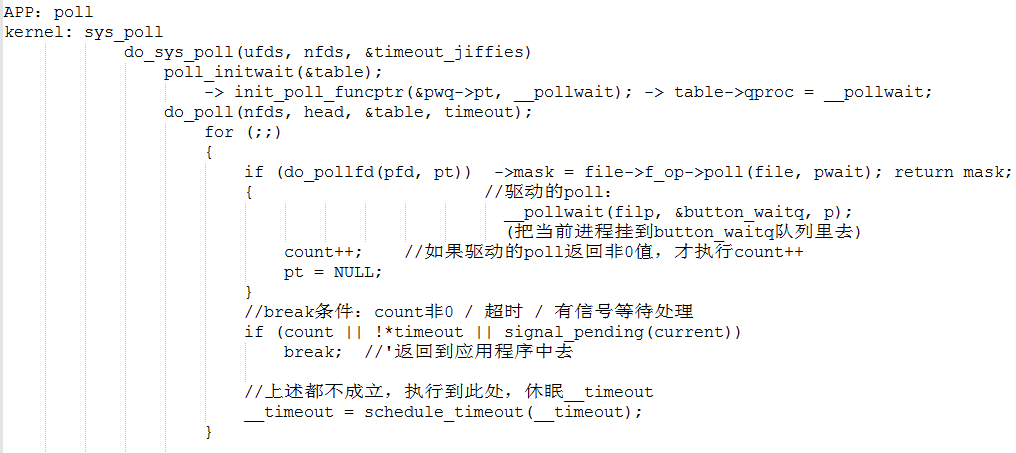
(1)当应用程序调用poll函数的时候,会调用到系统调用sys_poll函数,该函数最终调用do_poll函数
(2)do_poll函数中有一个死循环,在里面又会利用do_pollfd函数去调用驱动中的poll函数(fds中每个成员的字符驱动程序都会被扫描到),
(3)驱动程序中的Poll函数的工作 有两个
①调用poll_wait 函数,把进程挂到等待队列中去(这个是必须的,你要睡眠,必须要在一个等待队列上面,否则到哪里去唤醒你呢??),
②另一个是确定相关的fd是否有内容可读,如果可读,就返回1,否则返回0,如果返回1 ,do_poll函数中的count++
(4) do_poll函数中判断三个条件(if (count ||!timeout || signal_pending(current)))
①如果成立就直接跳出,
②如果不成立,就睡眠timeout个jiffes这么长的时间(调用schedule_timeout实现睡眠),
如果在这段时间内没有其他进程去唤醒它,那么第二次执行判断的时候就会跳出死循环。(????????不懂)
如果在这段时间内有其他进程唤醒它,那么也可以跳出死循环返回
(例如我们可以利用中断处理函数去唤醒它,这样的话一有数据可读,就可以让它立即返回)。
7.测试
加载驱动后可以发现超时后会打印超时,按键有输出
# insmod dri.ko

# ./test /dev/xyz0

time out

irq55

key_val = 0x3

irq55

key_val = 0x83
ps查询是休眠状态,top查询cpu也比较低
#ps

  PID  Uid        VSZ Stat Command

            S   ./test /dev/xyz0

#top

  PID  PPID USER     STAT   VSZ %MEM %CPU COMMAND

              S        %   % ./test /dev/xyz0
参考文章:
linux字符驱动之poll机制按键驱动
8.中断按键驱动程序之poll机制(详解)
字符设备驱动(六)按键poll机制
3.字符设备驱动------Poll机制的更多相关文章
- Linux高级字符设备驱动 poll方法(select多路监控原理与实现)
1.什么是Poll方法,功能是什么? 2.Select系统调用(功能) Select系统调用用于多路监控,当没有一个文件满足要求时,select将阻塞调用进程. int selec ...
- 字符设备之poll机制
poll机制作用:相当于一个定时器.时间到了还没有资源就唤醒进程. 主要用途就是:进程设置一段时间用来等待资源,假设时间到了资源还没有到来,进程就立马从睡眠状态唤醒不再等待.当然这仅仅是使用于这段时间 ...
- 字符设备驱动(六)按键poll机制
title: 字符设备驱动(六)按键poll机制 tags: linux date: 2018-11-23 18:57:40 toc: true --- 字符设备驱动(六)按键poll机制 引入 在字 ...
- Linux字符设备驱动框架
字符设备是Linux三大设备之一(另外两种是块设备,网络设备),字符设备就是字节流形式通讯的I/O设备,绝大部分设备都是字符设备,常见的字符设备包括鼠标.键盘.显示器.串口等等,当我们执行ls -l ...
- Linux驱动设计——字符设备驱动(一)
Linux字符设别驱动结构 cdev结构体 struct cdev { struct kobject kobj; struct module *owner; const struct file_ope ...
- Linux字符设备驱动
一.字符设备基础 字符设备 二.字符设备驱动与用户空间访问该设备的程序三者之间的关系 三.字符设备模型 1.Linux内核中,使用 struct cdev 来描述一个字符设备 动态申请(构造)cdev ...
- 《linux设备驱动开发详解》笔记——6字符设备驱动
6.1 字符设备驱动结构 先看看字符设备驱动的架构: 6.1.1 cdev cdev结构体是字符设备的核心数据结构,用于描述一个字符设备,cdev定义如下: #include <linux/cd ...
- 浅析Linux字符设备驱动程序内核机制
前段时间在学习linux设备驱动的时候,看了陈学松著的<深入Linux设备驱动程序内核机制>一书. 说实话.这是一本非常好的书,作者不但给出了在设备驱动程序开发过程中的所须要的知识点(如对 ...
- (57)Linux驱动开发之三Linux字符设备驱动
1.一般情况下,对每一种设备驱动都会定义一个软件模块,这个工程模块包含.h和.c文件,前者定义该设备驱动的数据结构并声明外部函数,后者进行设备驱动的具体实现. 2.典型的无操作系统下的逻辑开发程序是: ...
随机推荐
- POJ 1895 分层图网络流+输出路径
题意: 题目描述:在公元3141年人类的足迹已经遍布银河系.为了穿越那巨大的距离,人类发明了一种名为超时空轨道的技术.超时空轨道是双向的,连接两个星系,穿越轨道需要一天的时间.然而这个轨道只能同时给一 ...
- main函数argc,argv操作
使用main(int argc, char *argv[])==main(int argc, char **argv)的基本操作是linux编程的最基本的一步,在windows下也是exe脱离IDE运 ...
- SFML学习纪要
工作需要,近段粗浅看了一下SFML,记录一下! 一.浅见概述 SFML,simple and Fast mulitmedia Library官方网站:http://www.sfml-dev.org/i ...
- 【Uva 1626】Brackets sequence
[Link]: [Description] 括号序列由这样的规则生成: 1.空字符是一个括号序列; 2.在括号序列两端加上一对括号也是括号序列; 如(s),[s]; 3.两个括号序列A和B,连在一起, ...
- ethercat主站控制软件TwinCAT的安装
TwinCAT软件系统是基于PC兼容机的自己主动化系统,全称是"The Windows Control and Automation Technology".它把不论什么PC兼容机 ...
- [51Nod]NOIP2018提高组省一冲奖班模测训练(三) 题解
链接 A.Anan的派对 题意:Anan想举办一个派对.Anan的朋友总共有 n 人.第i个人如果参加派对会得到 \(c_i\) 的快乐值,除他自己外每多一个人参加他会减少 \(d_i\) 的快乐值. ...
- amaze ui响应式辅助
amaze ui响应式辅助 响应式辅助 就是不同的显示屏幕,或者手机的横竖屏,你可以控制栏目的显影,还是挺有帮助的 视口大小 .am-[show|hide]-[sm|md|lg][-up|-down| ...
- ubuntu 分屏工具
本文提到的分屏工具,均可通过sudo apt-get install的方式进行安装: 基本:terminator 高级:tmux,screen 还可进一步使用:ctrl + superkey + 方向 ...
- Scott Hanselman的问题-2
.Net程序员面试 每个人都应知道篇 (回答Scott Hanselman的问题) 昨天回答了Scott Hanselman在他清单上关于C#那部分的题目,.Net 程序员面试 C# 语言篇 (回 ...
- Can't access RabbitMQ web management interface after fresh install
http://stackoverflow.com/questions/22850546/cant-access-rabbitmq-web-management-interface-after-fres ...